
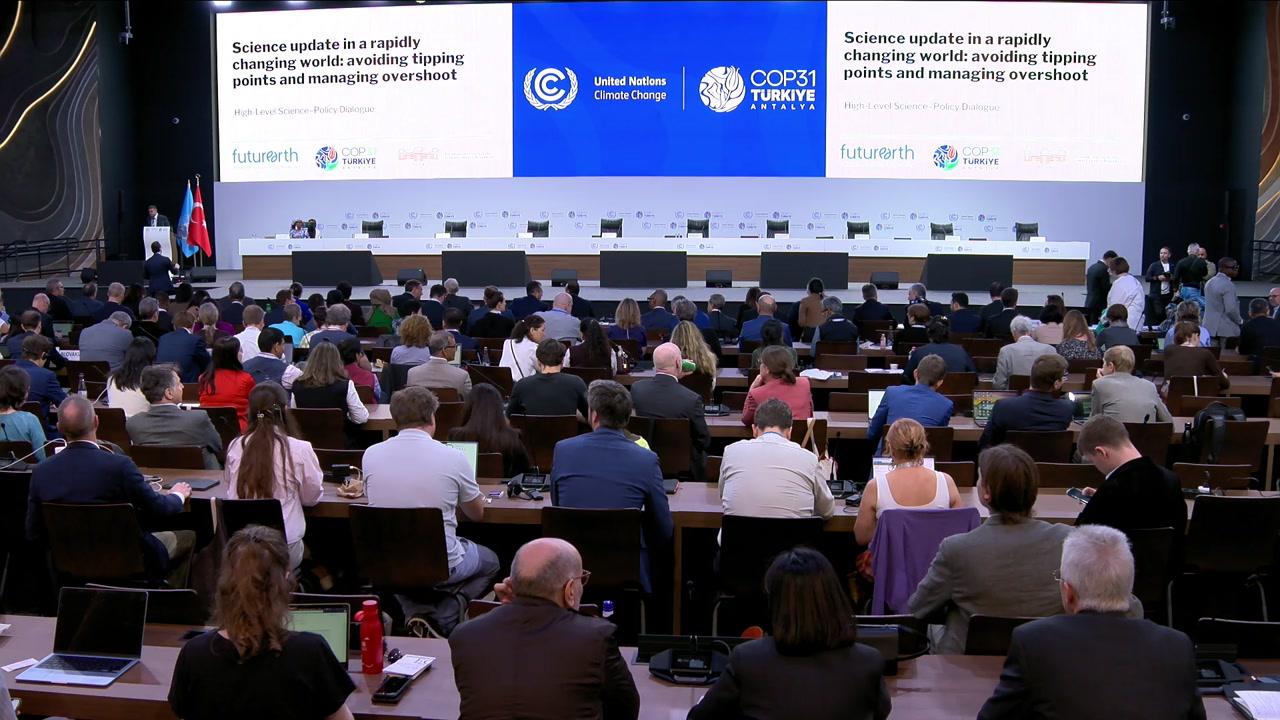
COP31 Science Session Rallies to Defend IPCC as 1.5C Window Narrows
COP 31 Presidency Events • United NationsNovember 16, 2026
Locunity is an independent informational service and is not an official government page for this commission. All information is sourced from public footage and an analysis of official agendas with the aid of responsible, fact-checked AI. to report an error or omission.
Scientists and ministers used a COP31 science session on Nov. 16, 2026, to warn that political pressure on the Intergovernmental Panel on Climate Change (IPCC) is rising just as the evidence grows more urgent. The session was informational. It produced no votes or decisions, but it laid out the scientific case negotiators will be pressed to act on, from 710,000 heat deaths in 2023 to a 1.5C limit that scientists say will be exceeded.
- Defend the IPCC: Nepal, Mary Robinson and the Australian negotiation lead urge protecting the IPCC's next assessment
- Heat killed 710,000 in 2023, and panelists say the social cost of carbon is understated
- Johan Rockström: 1.5C will be exceeded, and the next decade decides whether warming can be bent back
- Türkiye sets a 35% electrification goal for 2035, and Brazil says its implementation accelerator is now running
Science Under Pressure: Calls to Protect the IPCC
Why it matters: The IPCC's Seventh Assessment Report, known as AR7, is contested in the negotiations. Speakers warned that weakening it threatens the evidence base for the Global Stocktake, the Paris Agreement's periodic review of collective progress.
Where things stand: The policy-response segment ran longest of the session, stretching across roughly 40 minutes of the program. Speakers urged governments to keep science at the center of policy.
- Geeta Chaudhary, Minister of Agriculture, Forests and Environment of Nepal, called for "living assessments," meaning continuously updated science, and for applying CARE principles.
- Ingrid Lundberg, Head of Office, COP31 Presidency Negotiation Team Australia, pointed to the contestability of science and to information integrity as live concerns.
- Laurence Tubiana of the European Climate Foundation called on governments to defend scientists.
- The President of the Turkish Academy of Sciences (TÜBA) joined the call to embed science in policy.
Mary Robinson, a member of Planetary Guardians, delivered the sharpest line:
"The world cannot afford to undermine or lose the IPCC," said Robinson.
Decisions and stakeholder impacts: No formal action was taken. Still, the Australian negotiation lead's attention to information integrity is notable, because it came from inside the presidency. Countries that rely on IPCC findings to press for faster action have the most to lose if AR7 stalls. That includes Nepal and other climate-vulnerable nations.
What's next: AR7's completion remains an open question in the COP31 negotiations.
The Bill Comes Due: Deaths, Lost Wages, Hidden Costs
Why it matters: The panel put numbers on climate damage, and those costs fall hardest on low-income countries.
Where things stand: Five researchers presented the evidence:
- Sonia Seneviratne of ETH Zurich
- Marina Romanello of the Lancet Countdown on Health and Climate Change
- Rina Cui, an IPCC AR7 Working Group III lead author at the University of Maryland Center for Global Sustainability
- Chukwumerije Okereke, Professor of Public Policy at the University of Bristol
- A fifth panel scientist who presented on the social cost of carbon
Their key findings:
- Heat deaths: Lancet Countdown data put heat-related deaths at 710,000 in 2023.
- Lost wages: Panelists reported more than $1 trillion in lost labor income.
- Responsibility: The panel presented research attributing climate damage to "carbon majors," the largest fossil fuel producers.
- Carbon pricing: The social cost of carbon, the dollar estimate of damage from each added ton of emissions, is underestimated and due for revision.
The other side of the ledger: The panel did not stop at damage. It presented faster transition pathways from the Science Panel for the Global Energy Transition. It also addressed just transition and finance gaps, with discussion touching on the EU's Carbon Border Adjustment Mechanism (CBAM) and the UNEP Adaptation Gap Report.
Decisions and stakeholder impacts: No action was taken. The data matter most for:
- Workers in heat-exposed jobs, whose lost income the labor figures capture
- Health systems, which absorb the cost of heat illness and death
- Finance ministries that use social-cost-of-carbon figures to weigh regulations
If those carbon-cost estimates are revised upward, the case for stricter policy strengthens.
Rockström: The Window Is Narrowing
Why it matters: Scientists say a delay of even five to 10 years forecloses pathways that bring warming back down to 1.5C after an overshoot.
Where things stand: Johan Rockström said warming is accelerating and that 1.5C will be exceeded. He also reported:
- Seven of nine planetary boundaries, the safe limits for Earth's critical systems, have been breached.
- The Amazon faces risk at 1.5C to 1.9C of warming.
- Land carbon sinks, the forests and soils that absorb emissions, are weakening.
His scenarios show emissions must fall 6% a year to keep a path back open. Delaying by 10 years prevents bending the curve back. A 10-year window remains to avoid exceeding 2C.
"The window is still open, but it's narrowing very fast," said Rockström.
What's next: The presentation was meant to set the urgency framing for COP31 negotiators. Nothing was decided.
Hosts Frame COP31 Around Science and Electrification
Why it matters: The opening remarks signal which implementation priorities the presidency will push in negotiations.
Where things stand: The Minister of Industry and Technology of Türkiye described a COP31 goal of raising electricity to 35% of final energy use by 2035. The minister cited national programs, including TÜBİTAK and REACH 2030.
João Paulo Capobianco, Minister of Environment and Climate Change of Brazil, pointed back to commitments made at COP30:
- Limiting the magnitude and duration of overshoot
- Harnessing "positive tipping points," the changes that can accelerate clean technology adoption
He said the Global Implementation Accelerator became operational in Antalya.
Decisions and stakeholder impacts: These were framing remarks, not commitments adopted in the session. Industry and grid operators are the stakeholders to watch on the electrification goal.
Looking Ahead
The session was moderated by Hindou Oumarou Ibrahim. It closed without formal action. The live question for negotiators is whether the IPCC's AR7 survives a contested process intact.