
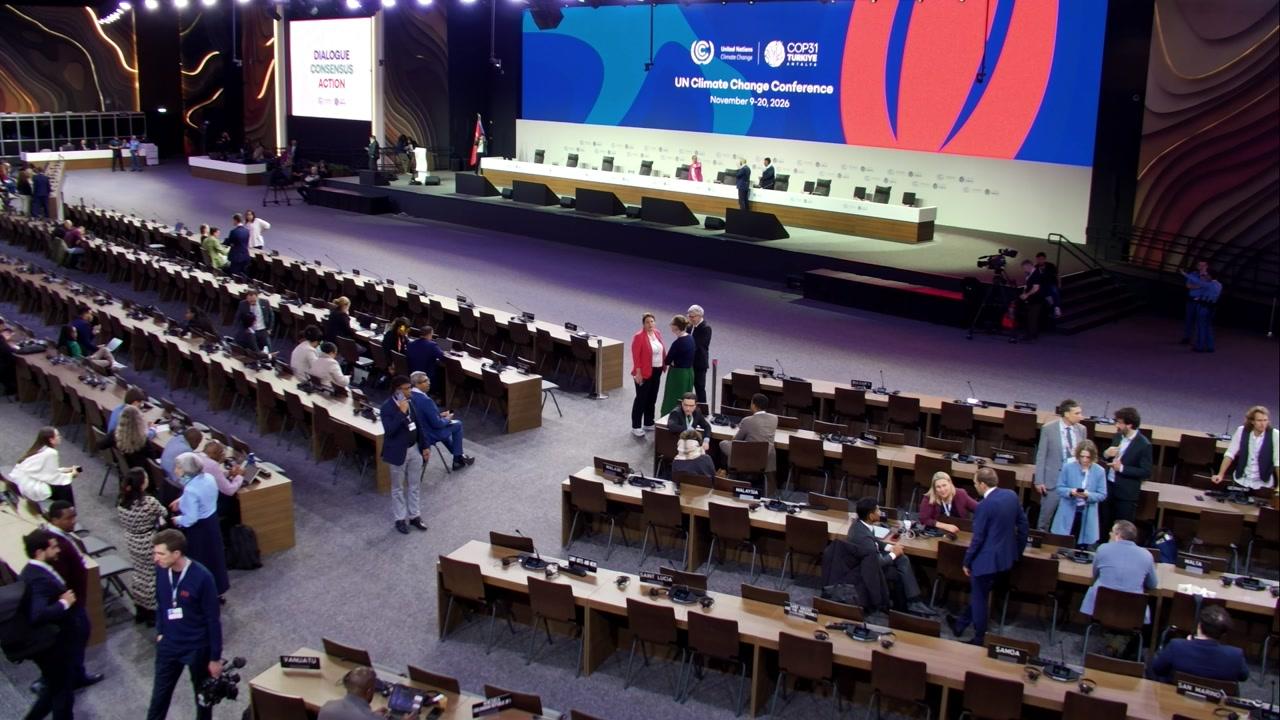
Russia Blocks Climate Empowerment Plan as COP31 Talks Run Overnight
COP 31 Negotiations • United NationsNovember 21, 2026
Locunity is an independent informational service and is not an official government page for this commission. All information is sourced from public footage and an analysis of official agendas with the aid of responsible, fact-checked AI. to report an error or omission.
A single objection from the Russian Federation sank the 2027–2031 Action for Climate Empowerment plan at the resumed COP31 closing plenary on Nov. 21, 2026. Several blocs had believed the text had consensus, and it now goes back to technical negotiators. The presidency did secure decisions on climate finance oversight and technology support, but it deferred a disputed long-term finance text and suspended all three governing bodies with a 6 a.m. deadline on the final cover decision.
- Russia blocks the ACE action plan, and the chair proposes sending it to SBI 66
- Long-term finance stalls as the African Group and EU clash over the $100 billion assessment
- UNEP confirmed as Climate Technology Centre host, with a budget nearly doubled
- Standing Committee on Finance decisions adopted, while Argentina and Paraguay narrow "gender"
- 6 a.m. deadline set for the cover decision, with plenaries resuming at 9 a.m.
One Objection Sends Climate Empowerment Plan Back
The basics: Action for Climate Empowerment (ACE) is the U.N. climate track on education, public participation and access to information, organized under the Glasgow Work Programme. Draft decision CP/2026/L.8 would have set its action plan for 2027–2031. The SBI is the Subsidiary Body for Implementation, a technical negotiating body.
Why it matters: This was the longest fight of the session. The plan is now delayed at least another session, and the debate exposed divides over science, gender language and how the presidency runs the room.
Where things stand: The chair asked the COP to adopt L.8, and Russia shut it down.
"The Russian Federation objects to this decision, is against the adoption of this decision under the relevant agenda items 2C and 2F in this Conference of the Parties," said the delegate of the Russian Federation.
Russia gave three reasons:
- The text contained new terms that lacked multilateral negotiation.
- It raised concerns about censorship of science.
- The presidency had refused its request for a procedural decision.
The other side: The European Union, the United Kingdom for the Umbrella Group, Panama for AILAC and Mexico each said they were surprised and disappointed, because they believed consensus had been reached. Panama directly rejected the premise of the science dispute.
"Access to accurate science-based information is not a contested idea," said the delegate of Panama, speaking for AILAC.
The African Group opened a second front. Ghana did not object to the decision. It did protest that the text ignored the group's red lines, and it said the presidency must facilitate consensus rather than impose outcomes.
"The process must remain party-driven and the position of parties must be meaningfully considered," said the delegate of Ghana, speaking for the African Group. Tanzania aligned itself with Ghana.
Decisions and stakeholder impacts: No vote was taken. The chair proposed that the SBI continue consideration at SBI 66, but no formal acceptance of that referral was recorded.
The presidency took criticism from opposite directions. Russia said its procedural request was refused, while the African Group said outcomes were being imposed. Groups that rely on ACE's work on education, participation and information access must wait for a new plan.
What's next: The plan returns to the SBI at its 66th session.
Long-Term Finance Stalls Over $100 Billion Math
Why it matters: How negotiators measure progress on the $100 billion climate finance goal shapes developing countries' trust in the finance system. On closing day, that question remained unresolved.
Where things stand: The chair invited adoption of CP/2026/L.2, and Ghana, speaking for the African Group, refused.
"We'll not be willing to adopt the decision as it is now," said the delegate of Ghana.
Ghana raised two objections:
- Process: It said negotiations lacked space for parties to engage.
- Substance: It said the assessment relied mainly on the OECD and Oxfam, while Biennial Transparency Reports (BTRs) submitted by all parties did not get equal attention.
Ghana asked for changes to paragraph 3 and said the group could then join consensus.
The other side: The EU would not reopen the text.
"The EU cannot accept changes to the text as we have already shown significant flexibility," said the delegate of the European Union.
Ghana countered by citing the presidency's earlier assurance that parties could comment on L documents, the near-final drafts brought to plenary.
Decisions and stakeholder impacts: The chair agreed to return to the item later in the meeting, but no return occurred before suspension. The standoff pits the African Group's push to center party-reported data against the EU's position that its concessions are already made.
What's next: L.2 remains pending. Its fate is not part of the record of this session.
Finance Committee Decisions Pass With Gender Caveats
Where things stand: The COP adopted CP/2026/L.1 on the Standing Committee on Finance (SCF) when the chair declared, "Hearing no objection, it's so decided." The CMA, the Paris Agreement's governing body, then adopted CMA/2026/L.7 without objection. No tally was taken on either.
The second review of the SCF's functions was deferred to SBI 66.
Why it matters: The adoptions themselves were routine. The interpretive statements that followed could color how gender language is read across COP31's decisions.
The other side: Argentina, taking the floor for the first time, said it understands gender as defined in Article 7.3 of the Rome Statute of the International Criminal Court. It also said co-chair selection should be based on merit.
Paraguay went further. It said its reading applies to current and future decisions.
"The Republic of Paraguay understands the term gender as framed exclusively within the provision of Article 48 of its national constitution and interprets it as referring to the female and male sex," said the delegate of Paraguay.
The EU pushed back.
"The EU cannot accept any backsliding on previously agreed language and commitments, including those adopted as recently as COP30," said the delegate of the European Union.
Decisions and stakeholder impacts: The chair said the statements would be noted in the meeting report. They do not change the adopted text, but they put formal reservations on the record. Gender language also surfaced in the ACE dispute, which suggests the issue is a live fault line across negotiating tracks.
UNEP Confirmed as Climate Technology Centre Host
Where things stand: The COP adopted CP/2026/L.3, and the CMA adopted CMA/2026/L.9, confirming the U.N. Environment Programme (UNEP) as host of the Climate Technology Centre and Network (CTCN). Both passed without objection, and no tally was taken.
Why it matters: The decision funds new CTCN functions and support for national designated entities, the country-level contacts for technology assistance. That support still depends on backing from developed countries.
Chile welcomed UNEP's selection and the proposed budget, which it said is almost double the current one.
"In our view, this will be one of the most positive outcomes of this COP," said the delegate of Chile.
The other side: Chile's praise came with caveats:
- It criticized reluctance to retain "best available science" in assessing developing countries' technology needs.
- It flagged uncertainty over Green Climate Fund support for the Belém Technology Implementation Programme.
Decisions and stakeholder impacts: UNEP thanked the parties and committed to a more responsive CTCN. Developing countries seeking technology support stand to gain the most, provided the funding materializes.
Everything Rides on an Overnight Cover Decision
Where things stand: The presiding officer said the third and final cover decision, the umbrella political text for COP31, was with the Secretariat for legal review and would be shared that night. The officer added that the gaps were narrowing.
"Parties have until 6:00 a.m. to come to us with agreement on the text, and we will reconvene tomorrow morning at 9:00 a.m.," said the presiding officer.
The other side: Ghana pressed for a full package.
"I just want to be sure whether all the other papers will also be ready by 6 o'clock so that all of them are taken as a package," said the delegate of Ghana.
A presidency spokesperson answered only partly. The reply said the cover decision and the negotiation items should both be finalized by 6 a.m. and that the matter was now with the parties. It did not directly address whether every paper would move together.
What's next: The COP, CMP and CMA were suspended, not closed, and are set to reconvene at 9 a.m.
Looking ahead: Three threads remain open: the overnight cover decision, the deferred long-term finance text (L.2), and the ACE plan and SCF review, both headed to SBI 66.