
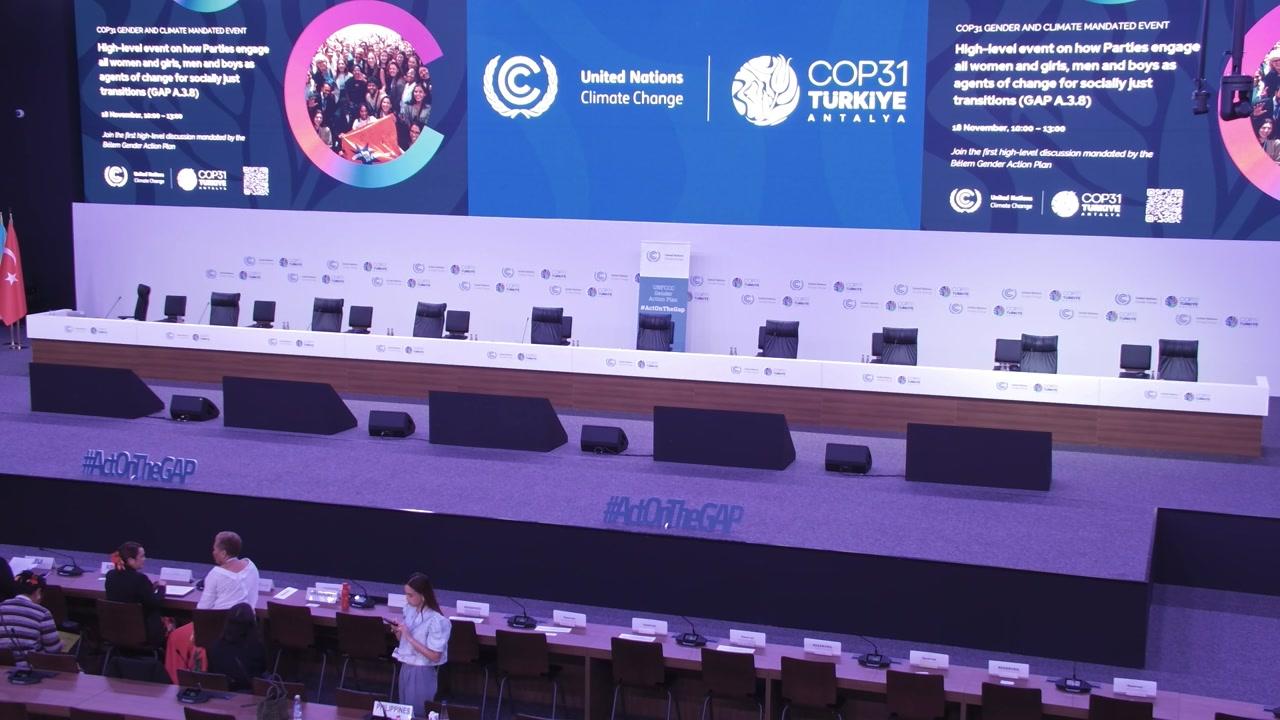
Island States Warn Against Reopening Agreed Gender Language at COP31
COP 31 Mandated Events • United NationsNovember 18, 2026
Locunity is an independent informational service and is not an official government page for this commission. All information is sourced from public footage and an analysis of official agendas with the aid of responsible, fact-checked AI. to report an error or omission.
One year into the Belém Gender Action Plan, Pacific island states used COP31's first high-level gender event on Nov. 18, 2026, to accuse several countries of trying to reopen language everyone had already agreed to. No decisions were taken, but ministers, a prime minister and grassroots leaders spent more than three hours making a shared case: gender equality is a condition of effective climate action, and finance is the bottleneck.
- Pacific SIDS "deeply disappointed" that several countries are seeking to reopen agreed Belém language
- EU calls gender equality language "non-negotiables" as ministers from five countries detail national plans
- Tuvalu Prime Minister Feleti Teo pledges not to "negotiate backwards" on women's and girls' rights
- Economist Mariana Mazzucato urges a shift from "market fixing" to market shaping to fund just transitions
- Fisherwoman reports women receive 30% of the support paid to male fishers
Defending the Deal: Islands Push Back on Rollback
Why it matters: The open floor exposed a negotiating fault line over the Belém Gender Action Plan as COP31 enters its final stretch. Advocates tracking the final outcome now have a clear marker for whether agreed language holds.
Where things stand: A delegate from Fiji, speaking for the Pacific SIDS (small island developing states), delivered the session's sharpest warning.
“Pacific SIDS are deeply disappointed that one year into implementation, several countries are seeking to reopen language we all agreed on,” said the Delegate of Fiji, speaking for Pacific SIDS.
The bloc also called for keeping warming to 1.5 degrees Celsius, mainstreaming ocean issues into climate work and improving access to finance and disaggregated data. The speakers did not name the countries seeking to reopen the text.
The other side: Support came from Europe. Secretary General Una Buckley of Ireland's Department of Climate, Energy and Environment said gender equality language is a firm EU position: “these are non-negotiables for the European Union.”
Delegates from Samoa and Kenya shifted the focus from text to implementation, pressing for finance that reaches the ground. Kiribati and the Dominican Republic offered examples of what implementation looks like (detailed below).
Decisions and stakeholder impacts: No vote was taken; the session was informational. The stakes fall heaviest on Pacific women and island communities, whose governments tied gender commitments directly to 1.5C and ocean protection. Negotiators defending the plan now have public, on-the-record statements from the EU and Pacific bloc to cite.
What's next: Watch whether the Belém language survives intact in COP31's final outcomes.
National Plans Put Care and Energy at the Center
Why it matters: Ministers showed what implementing the Belém plan looks like in practice. They also said the main obstacle is getting money to flow.
Where things stand: Four countries offered concrete models.
- Uruguay: María Fernanda Sosa Rodrigues, National Director of Climate Change and head of delegation, presented a 2026–2030 gender and climate plan with care at its center.
- Philippines: Assistant Secretary Mandy Romero of the Department of Energy cited a requirement to dedicate 5% of budgets to gender and household electrification of 95.8%.
- Democratic Republic of the Congo: Minister Marie Nyange Ndambo, Minister of Environment, Sustainable Development and New Climate Economy, said energy access is rising and called for simplified financing.
- Kiribati: Minister Ruth Kewanzi, Minister of Women, Youth, Sports and Social Affairs, described seats reserved for women on disaster committees.
The Dominican Republic's delegate described a consultation on the country's NDC (nationally determined contribution, its climate pledge under the Paris Agreement) and a gender roundtable.
Sosa Rodrigues framed the stakes plainly: “gender equality in no way is an ancillary component to climate action or climate justice.”
Decisions and stakeholder impacts: The common thread was finance. The DRC's call for simpler access echoed Samoa, Kenya and the Pacific bloc. For finance ministries and multilateral funders, the message was that national plans exist but complex funding channels slow delivery. Women in care work stand to gain most where plans like Uruguay's treat care as infrastructure.
Tuvalu's Prime Minister: 'Not Negotiate Backwards'
Why it matters: As the only head of government with a closing role, Prime Minister Feleti Teo of Tuvalu set specific asks for negotiators, funders and governments heading into COP31's final days.
Where things stand: Teo urged parties to keep 1.5C within reach, transition away from fossil fuels, protect the ocean and fund local organizations. He described the contributions of women and men in Tuvalu that go unrecorded.
“Tuvalu will not negotiate backwards on the rights of women and girls,” said Prime Minister Teo.
He was blunt on gender-based violence, placing responsibility on perpetrators: “violence is a choice, and the men who choose it are responsible for it.”
Decisions and stakeholder impacts: Teo made two structural asks. He invited every region to build its own gender action plan, and he urged governments to take the plan out of the gender ministry so it is owned across government. That second ask matters for finance, energy and environment agencies that have often treated gender as another ministry's job.
What's next: Teo's commitments give advocates concrete benchmarks to track in COP31's final outcomes.
Rethinking Economics to Fund Just Transitions
Why it matters: The keynote argued that funding gaps for women persist because economic policy reacts to problems instead of setting goals. That framing bears on how climate and gender finance is designed.
Where things stand: Mariana Mazzucato, Professor of Economics of Innovation and Public Value at University College London, called for a goal-oriented "common good economy" built on five principles, including missions, co-creation, shared knowledge and rewards, and conditions attached to public lending. She criticized how GDP measures care work and pointed to public development banks that attach conditions to their financing.
“We need to rethink Econ 101 from market fixing to shaping our economic system,” said Mazzucato.
The other side: Kirsten Dunlop, Lead at Climate KIC, focused on the barriers women face in practice. She said access to capital is the persistent obstacle and that relational networks function as economic infrastructure.
“Gender inequality is systemic. It is not a deficit of capabilities,” said Dunlop.
Decisions and stakeholder impacts: For public lenders and procurement officials, the argument is that conditionality should be a policy tool, not an afterthought. For women entrepreneurs, the diagnosis shifts responsibility from individual "capacity building" toward capital access and how institutions are designed.
Local Leaders Show Results and Gaps
Why it matters: Grassroots examples showed women's centers and cooperatives delivering income and care. They also documented a hard pay gap.
Where things stand: Sally Higgins, COP31 Youth Climate Champion, described visiting Trabzon's Women's Life and Employment Center. Şengül Serdar Kibar, the center's head at Trabzon Metropolitan Municipality, said it offers sport, childcare and zero-waste production, and that its sports services have reached 34,416 women.
Necla Yassisi, a fisherwoman and community leader who has fished for 55 years, said women fishers receive 30% of the support paid to men. “We were paid only thirty percent,” she said.
Civil society speakers pushed for durable funding and real authority. Anisa Abibuloeba, project coordinator with Little Earth, described solar-powered sewing centers in remote Tajikistan. She said the work succeeds by engaging local leaders and men as allies, and she called for long-term climate finance for grassroots groups. Ashato Manu, Vice Co-Chair of the Local Communities and Indigenous Peoples Platform's Facilitative Working Group, said Indigenous peoples and local communities must be decision-makers and rights holders, not only consulted. He cited carbon sink and mangrove restoration work as examples.
Decisions and stakeholder impacts: Women fishers and remote communities gain little from participation that comes without resources or decision power. Funders face a clear ask: multiyear money routed to local groups.
- Opening framing: Simon Stiell, Executive Secretary of UN Climate Change, said “ILO modeling estimates men will hold 5 of the 7 million jobs lost in carbon-intensive sectors by 2030.”
- Renewables plateau: Stiell added that “IRENA finds women's share of renewable energy employment has stalled since 2019.”
- Brazil's handoff: Ambassador Lilian Chagas, Brazil's COP30 lead negotiator, called the Belém Gender Action Plan a major COP30 outcome. She said gender equality “is a condition for making climate action effective and should engage each and every person.”
- Türkiye's priorities: Deputy Director Orhan Solak of Türkiye's Directorate of Climate Change stressed sex-disaggregated data and women as innovators.
- Australia closes: Ingrid Lundberg closed for Australia, citing the country's Equal by 30 campaign.
Looking ahead: With no decisions taken at this session, the test comes in COP31's final negotiating days. The question is whether parties hold the agreed Belém gender language that Pacific states, the EU and Tuvalu publicly pledged to defend.