
Contra Costa Water District Eyes 6% Rate Hikes, Backs Water-Transfer Pilot
Board of Directors • Contra Costa Water DistrictOctober 21, 2026
Locunity is an independent informational service and is not an official government page for this commission. All information is sourced from public footage and an analysis of official agendas with the aid of responsible, fact-checked AI. to report an error or omission.
Contra Costa Water District customers got their first look Oct. 21 at the bills they will likely pay in 2027 and 2028: draft rates with 6% annual treated water revenue increases, adding roughly $11 every two months for a typical household. The Board of Directors took no vote on the rates, which head to a Jan. 6, 2027 public hearing. Directors did unanimously approve a one-year pilot to buy conserved water from a neighboring irrigation district.
- Draft rates propose 6% treated, 4% untreated increases in both 2027 and 2028
- Median household bill would rise about $11 every two months starting Feb. 1, 2027, if approved
- Board approves $350,000 pilot to buy 5,000 acre-feet of conserved water from ECCID
- Governor vetoes water rate-assistance bills, while district's golden mussel bill is signed
- Randall Bold plant offline as State Water Board schedules Bay-Delta Plan hearing for Oct. 28–30
Rate Hikes Driven by Costs the District Can't Control
Why it matters: Treated-water households would pay roughly 19 to 20 cents more per day. Staff and directors said most of the pressure comes from outside forces: purchased water, invasive golden mussels and state mandates.
Where things stand: Rates and Financial Analyst Celia Cheung walked the board through the draft numbers. "We are recommending in 2027 and '28 a 6% treated water revenue increase and 4% increase for untreated water," said Cheung.
Residential bills, which arrive every two months, would rise about $7 to $8 for low users, $11 for median users and $16 to $17 for high users.
The plan rests on these assumptions:
- Treated water demand up 3.6% in fiscal 2027 and 2% in fiscal 2028
- Untreated demand up 10.5% and 0.8%
- Budgets of $147.5M and $152.1M
- Revenue-funded capital spending of $57.3M and $58.5M
The cost drivers: Directors pointed to three cost pressures.
- Purchased water: Staff assumed a 7% increase in purchased water costs after a 23% jump this year.
- Golden mussels: Managing them now costs about $1M a year on a recurring basis.
- Clean fleet rules: Directors flagged unfunded mandates such as the California Air Resources Board's Advanced Clean Fleet rule.
Directors stressed that much of the rate pressure stems from costs the district has little ability to influence.
The balance-sheet play: Debt service is projected to fall about 40% after the district's Series T bonds are repaid. Staff want to use that breathing room to build operating reserves to 12 months by 2031, a target they tied to protecting the district's credit rating and borrowing capacity.
The other side: Board Vice President Antonio Martinez pressed staff to make the numbers more relatable to customers. "Is there a way that we can incorporate the number of people per household who are in that category?" asked Martinez, who also requested regional bill comparisons. Martinez also called for earlier customer education about the coming costs of the district's canal replacement program.
General Manager Rachel Murphy said canal costs are not baked into this cycle. Any canal-related rate impact is still years away, and "the earliest that would be going into effect is 2029," said Murphy. She said the issue will be reviewed at a board study session the following week.
Decisions and stakeholder impacts: No vote was taken; the board gave direction only. High-use households absorb the largest dollar increases. Untreated-water customers face smaller 4% revenue increases. The reserve strategy favors long-term borrowing costs over short-term bill relief.
What's next: The district will mail notices under Proposition 218, the state constitutional requirement for notice before property-related fee increases. "We are scheduled for the public hearing on January 6th, 2027, for board's consideration of approval," said Cheung. If adopted, new rates take effect Feb. 1, 2027.
Board Bets on Conserved Water From ECCID
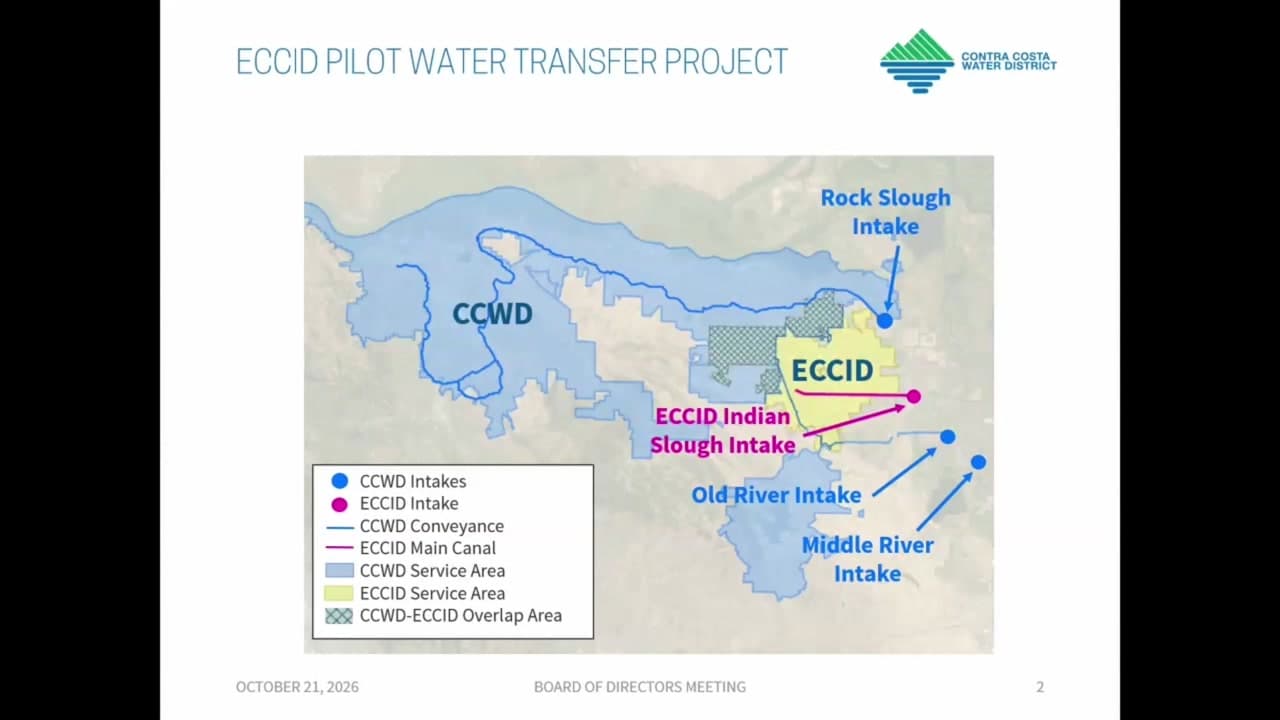
The basics: East Contra Costa Irrigation District (ECCID) holds a pre-1914 water right, a senior right that predates California's modern permitting system, for up to 50,000 acre-feet a year. Contra Costa Water District already has an agreement with ECCID for up to 8,200 acre-feet, plus a 4,000-acre-foot dry-year program.
Why it matters: Staff said water transfers could close a projected supply gap late in multiyear droughts. The pilot is designed to show that water conserved when farmland converts to urban use is real and transferable.
Where things stand: Water Resources Manager Lucinda Sheehy outlined a 5,000-acre-foot transfer of documented conserved water for calendar year 2027. Of that total, 1,500 acre-feet come from Brentwood's use of recycled water and 3,500 from agriculture-to-urban conversion.
The price is $70 per acre-foot, rising to $100 in a Central Valley Project shortage year. "Multiplying $70 by 5,000 acre-feet is $350,000 to purchase that water," said Sheehy. The cost replaces purchases from the U.S. Bureau of Reclamation and is already in the approved budget.
Directors praised both the price and the partnership. "I just want to commend you and staff for thinking outside the box here," said Director Dan Fitzpatrick, Division 2. "The actual price per acre-foot is a very reasonable price," said Martinez.
Open questions: One director asked about the environmental review timeline; staff cited a 35-day public period. Board President Ernesto Avila asked whether the model could work for agencies without a pre-1914 right.
Decisions and stakeholder impacts: Martinez moved and Director Patricia Young, Division 1, seconded. The motion passed by voice vote, announced as unanimous; no individual tally was recorded.
ECCID gains a buyer for water saved as farmland urbanizes. Ratepayers get a budgeted test of a drought supply source. Brentwood's recycled water use now carries measurable value beyond city limits.
What's next: Staff will file a California Environmental Quality Act notice of exemption, a declaration that the project does not require full environmental review. Staff will also notify the State Water Resources Control Board and reach out to parties including the Department of Water Resources.
Capitol Scorecard: A Mussel Win, Affordability Vetoes
Why it matters: State help for struggling water customers remains unresolved heading into 2027, even as the district pushes for canal replacement funding.
Where things stand: Director of Public Affairs Jennifer Allen reported that more than 5,000 bills were introduced across the two-year session.
- Signed bills: Bills the district supported that were signed include AB 2032 on golden mussels, AB 2180, SB 1085 and SB 1153.
- Vetoed bills: AB 2739 and SB 1125, both on water rate assistance, were vetoed. "The governor's veto message noted that there was no funding source," said Allen. SB 872, on which the district took no position, was also vetoed.
What's next: The district will seek another state budget request for canal replacement in 2027. Allen expects golden mussels, water rights, drinking water affordability, Delta operations, data centers and recreation to be live issues.
At the federal level, the district supports HR 3717 on golden mussels, and a continuing resolution funds the government through Dec. 11. Martinez praised staff's technical work.
Plant Outage and a Bay-Delta Decision Point
Where things stand: The Randall Bold Water Treatment Plant is offline for about $4M in work. Bowman Water Treatment Plant is now running around the clock and also serving East County by running the multipurpose pipeline in reverse. Randall Bold is expected to be able to return to service within 24 hours if needed. Bowman will be taken down later, typically between December and February.
Why it matters: The State Water Board released updated final changes to the Bay-Delta Plan with no additional written comment period. The district is reviewing the changes with legal counsel.
What's next: "The dates for that hearing are October 28th and 29th, with the possibility to extend to Friday, October 30th," said Murphy.
Minor Items
- Consent calendar: Items 1 through 5 passed by voice vote, announced as unanimous, without discussion.
- Committee reports: Finance (Sept. 11) and Operations and Engineering (Sept. 17) reports drew no comment.
- Director reports: Directors attended East Bay Leadership Council, Antioch State of Business, FutureBuild and ACWA regional events. They also met with Assemblymember Lori Wilson.
- Closed session: The board evaluated the general manager's performance; no reportable action.
Looking ahead: The board's next regular meeting is Nov. 4, 2026. The draft rates return for a public hearing Jan. 6, 2027.