Federal Grant Threats and AI-Powered Delta Models Dominate Water Board Briefing
Board of Directors • Contra Costa Water DistrictAugust 5, 2026
Locunity is an independent informational service and is not an official government page for this commission. All information is sourced from public footage and an analysis of official agendas with the aid of responsible, fact-checked AI. to report an error or omission.
The Contra Costa Water District board received a sweeping policy briefing that put the district at the crossroads of some of California's most pressing water challenges — from proposed federal rules that could upend infrastructure grant financing to new machine learning tools that question decades of fish-protection science. The Aug. 5 meeting also brought a warning: cyber attacks are hitting water utilities across the country, though CCWD says its systems are protected.
Proposed federal rules would let agencies change or cancel infrastructure grants after award, threatening CCWD's multi-year project pipeline
New AI entrainment model challenges the scientific basis of fish-protection restrictions on Delta pumping since 2007
Bay Delta Plan Phase 2 expected to be issued this month, with adoption targeted for late 2026
Fall salinity protections permanently removed federally, raising costs when CCWD shifts water intakes
Cyber attacks hit water utilities in seven states; CCWD confirms its systems are not publicly exposed
Board awards $4M in on-call construction contracts, extending a decade-old expedited-repair model
ACWA to develop formal policy for advocating on projects of statewide significance
The Rules Could Change Mid-Game: Federal Grant Threat
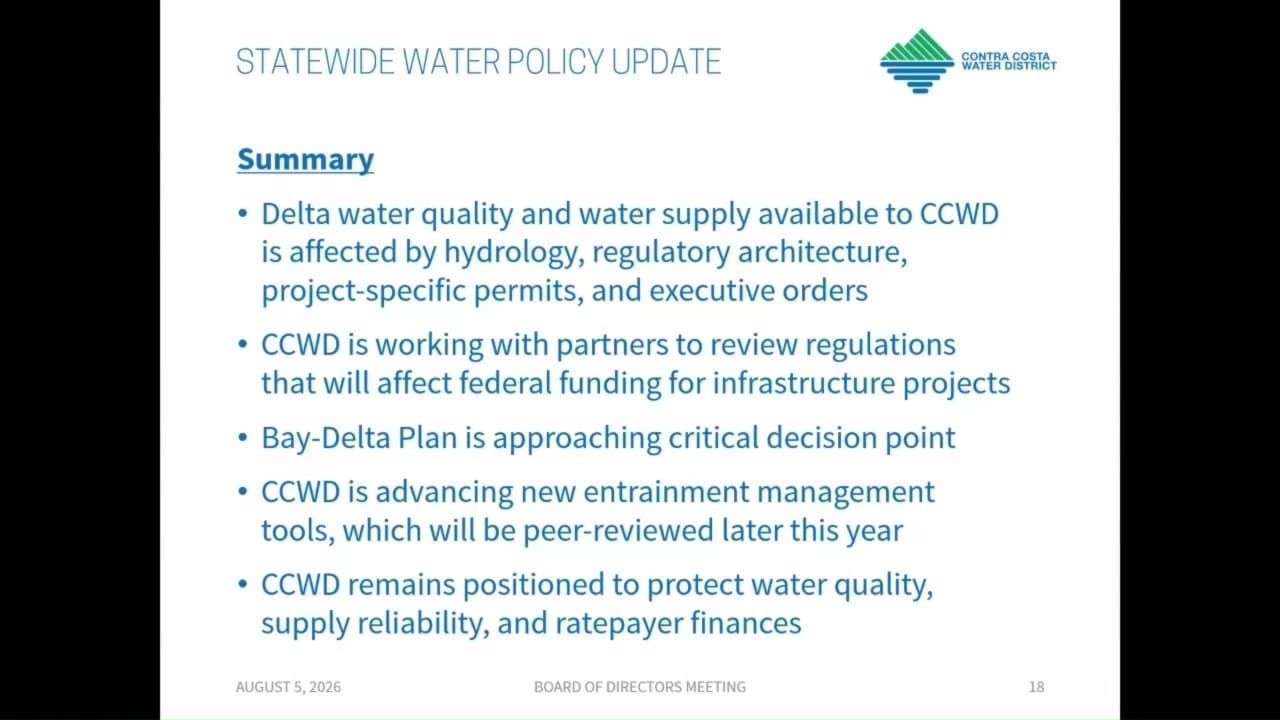
Why it matters: The federal government published proposed regulations in May that would give agencies broad new authority to modify or terminate the terms of grants after they've already been awarded — a direct threat to water districts like CCWD that rely on multi-year federal funding to plan and execute infrastructure projects.
Where things stand: Science and Policy Manager Deanna Sereno told the board the proposed rule has far-reaching implications for how water agencies finance long-term capital work. "The proposal, even though it might be targeting good intentions of aligning grants with federal administration policy, it really broadens agency authority so that they can change terms and conditions after a grant has already been awarded," she said. "It's kind of like changing the rules of the game once you're already playing the game."
CCWD coordinated with the Association of California Water Agencies on a comment letter submitted in mid-July. For a district that has built a successful grant program around predictable federal commitments, the stakes are clear: if agencies can rewrite deal terms after award, multi-year infrastructure investments become much riskier to plan and finance.
AI Model Questions Decades of Delta Fish Protections
The basics: Since 2007, the state and federal governments have managed Delta pumping largely through a metric called Old and Middle River (OMR) flow to limit fish entrainment — the risk that endangered species like delta smelt are pulled into export pumps. CCWD developed a new machine learning tool that suggests this approach may be fundamentally flawed.
Where things stand: Sereno presented a particle tracking model emulator built with AI tools that replicates hundreds of thousands of Bureau of Reclamation simulations with roughly 1% error. The key finding: identical OMR conditions can produce wildly different entrainment outcomes depending on other variables.
"These two time periods with the same OMR have very different particle transport," Sereno explained. "What that tells us is that OMR itself has a lot of uncertainty into whether or not it's being protective."
The tool, she said, was built off the bureau's own simulation data. "They took hundreds of thousands of particle tracking simulations and we found a way to be able to simulate that with great accuracy. The error is on the order of 1%." The model will undergo peer review — and could reshape how California balances fish protections against water exports across the entire Delta system.
Why it matters: If OMR-based restrictions are shown to be an unreliable proxy for actual entrainment risk, it opens the door to alternative management approaches that could either increase or decrease water available for export, depending on how regulators respond. That has direct implications for every agency drawing water from the Delta.
Bay Delta Plan, Salinity, and Southern California Pressure
Where things stand: The State Water Resources Control Board is expected to release Bay Delta Water Quality Control Plan Phase 2 — covering the Sacramento River watershed — this month, with adoption targeted for late 2026. CCWD submitted comments in February on the December 2025 draft. Phase 1 amendments covering the lower San Joaquin River have been mired in litigation since 2018.
Sereno noted the Central Valley Project and State Water Project operating permits have been stuck in a perpetual legal cycle. "The permits for operation of the Central Valley Project and the State Water Project have pretty much been in this cycle of develop new permits, litigate those permits, develop new permits, litigate those permits," she said.
On fall salinity, protections that once benefited CCWD's Rock Slough and Old River intakes were relaxed under the Biden administration in 2024 and permanently removed federally in 2025. "It was removed entirely in 2025, and then it has been removed again for 2026," Sereno said. "On the federal side, it's a permanent removal. On the state side, so far, it's been a year by year evaluation." While the protections were originally designed for fish, not drinking water quality, CCWD benefited from them. "It was never intended to protect us, but we did benefit from it and it's gotten rolled back," she noted.
CCWD can shift diversions to its Middle River intake to maintain water quality for customers, but that increases operational energy costs. Vice President Antonio Martinez pressed on quantifying those costs, asking whether the district has enough data to calculate what the salinity shifts have cost in additional pumping.
The other side: Board President Ernesto Avila raised broader concerns about the interaction between the Bay Delta Plan and SB 72, the state's push for 9 million acre-feet of long-term supply. "My concern has been the Bay Delta Plan," President Avila said. "There's been a lot of discussion about SB 72 and about the desire of the state to get its 9 million acre feet as part of its long-term goal. But they don't really talk a lot about water quality."
General Manager Rachel Murphy confirmed CCWD staff are participating in an SB 72 working group through the California Municipal Utilities Association.
Meanwhile, Colorado River cuts add another layer of pressure. Vice President Martinez asked what federal action on the Colorado means for Delta exports. President Avila connected the dots: "Obviously if they are constrained in terms of the amount of water that they get from Colorado River, they are going to try to draw more water from the Delta one way or another." Sereno confirmed: "That does mean cuts to Colorado supply and possibly additional stress on SWP exports."
Vice President Martinez also asked about the tipping point for subsidence on State Water Project canals, a growing risk to the state's conveyance infrastructure. Sereno offered a practical perspective: "I think you can do a pump around a lot cheaper than you can fix subsidence problems."
What's next: The Bay Delta Plan Phase 2 release is expected this month. CCWD's entrainment model will undergo peer review. Board Member Connstance Holdaway praised the team's work: "Every time you come in here I learn so much and I know the public gets so much out of your presentations and I'm looking forward to these new management tools."
New Deputy Science and Policy Manager Ashley was introduced to the board, describing her background in water law with a J.D. from UC Law San Francisco and a master's in law from the University of London specializing in water law and policy. "This has been truly a privilege to work for a leader in the water space," she told the board.
Cyber Attacks Hit Water Utilities in Seven States
Why it matters: Water and wastewater utilities in at least seven states have been hit by cyber attacks since late July 2026, targeting programmable logic controllers (PLCs) exposed to the public internet. Attackers changed device addresses and passwords to lock out operators, causing loss of pressure and flooding — conditions that could allow untreated groundwater to seep into pipelines.
Where things stand: General Manager Rachel Murphy reported that CCWD's operational technology infrastructure is not exposed to or discoverable on the public internet, which is the primary recommended defense. "Fortunately, our operational technology infrastructure is not exposed to or discoverable on the public facing internet, which is one of the primary mitigation measures that have been suggested in these communications," she said. As an additional precaution, the district created current backups of all PLCs and maintains individual credentials with an approved access list.
Decisions: The board also held a closed session on threats to public services under Government Code Section 54957 A1, with no reportable actions taken.
ACWA Charts New Course on Statewide Advocacy
Where things stand: Board President Ernesto Avila delivered an extensive report on activities at the Association of California Water Agencies, where a major strategic shift is underway. ACWA has decided to develop a formal policy framework for taking positions on projects of statewide significance — a move that could shape how aggressively the association advocates for major infrastructure like Sites Reservoir.
"The big decision there was should ACWA have a policy for taking positions of statewide projects of statewide significance? The answer is yes. Now we get to the devils in the details," President Avila said. The framework will use graduated advocacy levels modeled on the state legislative committee's watch/favor/support structure.
Incoming ACWA Executive Director Carla Namath, who previously led the Department of Water Resources and starts Sept. 1, held a two-and-a-half-hour meeting with Becerra on water policy. President Avila reported that Becerra asked about the state's role relative to local water agencies and the linkage between water affordability and housing.
ACWA's labor outreach also surfaced a telling observation about permitting culture. "The interesting comment that was made is they get more kudos by taking their time on deliberating a longer period of time on issuing the permit than on the content of the permit," President Avila said, summarizing feedback that reform needs to go beyond commissioner appointments to address the regulatory culture itself. ACWA is also pursuing outreach to the Hilton gubernatorial campaign, with former Congressman John Duarte focused on CVP issues.
What's next: ACWA's website will be overhauled to become issue-driven, and Namath will formally begin her role on Sept. 1.
$4M in On-Call Construction Contracts Approved
The board unanimously authorized two on-call construction and repair service agreements: one with Conquest Contractors Inc. (partnered with Harrison Associates for design-build) and one with GSE Construction Inc. (partnered with G3 Water Engineers). Each agreement is valued at up to $1M in fiscal year 2027 with an option for $1M in fiscal year 2028, totaling $4M combined.
GM Murphy explained the model's track record: "We have been successfully utilizing this contracting approach since 2014, and we've implemented approximately $15 million in various task orders throughout the years. Safety projects, storm damage repair projects, smaller maintenance projects." Seven firms responded to the request for proposals, scored equally on pricing and qualifications. (For: 5, Against: 0; motion by Director Patricia Young, second by Director Connstance Holdaway)
Minor Items
Consent calendar items 1-4 approved unanimously; Vice President Martinez abstained from item 2 (meeting minutes from a session he did not attend). Motion by Director Holdaway, second by Director Young. (For: 5, Against: 0, Abstain: 1 on item 2)
Vice President Martinez reported completing mandatory SBA 27 fiscal and financial training for board members.
CCWD announced fall public engagement opportunities: a Bolman Water Treatment Plant tour in Concord this Saturday with 26 participants registered, plus two full-day Value of Water tours on Sept. 28 and Oct. 19, available at no cost via Eventbrite.
President Avila reported attending an ACWA Region 9 event highlighting Rancho Water's crop swap program funded by federal and state grants, and an innovation day concept for evaluating new equipment.