
Board of Directors - Jun 03, 2026 - Regular Meeting
Board of Directors • Contra Costa Water DistrictJune 3, 2026
Locunity is a independent informational service and is not an official government page for this commission.We use AI-assisted analysis and human editorial review to publish information.
CCWD Previews $285M Budget as Canal Replacement, Golden Mussels Drive Costs Higher
The Contra Costa Water District Board of Directors used its June 3 meeting to take the first deep look at a two-year spending plan that would raise treated water rates 6% annually, add nearly eight full-time positions, and pour roughly $140 million into capital projects — all while grappling with invasive golden mussels, surging chemical prices, and a decades-old canal that needs replacing. The board also held a public hearing on a water management plan that projects supply shortfalls in extended droughts sooner than previously expected, and approved more than $2 million in contracts and budget transfers.
$285M biennial budget projects 6% treated water rate increases and nearly eight new staff positions, driven largely by the Canal Replacement Program and external mandates
Water management plan warns supply deficits could hit by 2030 in multi-year droughts; demand projections fall 16% below 2020 estimates
$850,000 mid-year chemical budget transfer approved as Randall Bold conversion and golden mussel treatment push costs higher
Final $1.34M storm damage repair contract from 2022-23 winters awarded, with 94% federal/state reimbursement expected
GM announces meeting with Department of Interior official to pitch federal funding for canal replacement
A $285M Blueprint: Canal Replacement, Mussels and Mandates Shape Two-Year Budget
Eight department heads walked the board through the proposed FY27-28 biennial budget in a presentation that consumed the bulk of the meeting — more than 100 minutes of detailed fiscal review ahead of a scheduled June 17 adoption vote.
The basics: The total FY27 budget rises 4%, with a 6% increase in operating costs; FY28 dips 3% as Series T bonds retire. Treated water rates would climb 6% in each year, untreated water 4%. The budget requests 4.75 permanent full-time positions and three project positions in FY27, with three more project positions added in FY28, growing total staffing from 329.75 to 340.5 FTEs.
Why it matters: The spending plan funds the ramp-up of the Canal Replacement Program — the district's effort to replace the oldest Central Valley Project canal with a pipeline — while simultaneously responding to golden mussel mitigation, a 47% spike in aluminum sulfate costs, new state zero-emission vehicle mandates, and a $4 million habitat mitigation credit purchase required by the 2024 incidental take permit. These externally driven cost pressures flow directly to the rates paid by 550,000 customers.
Where things stand: Capital spending totals approximately $140 million over both years against a $161 million capital improvement plan, with $20 million in deferrals. Among the deferred projects: $8 million for automated meter infrastructure, pending a federal grant decision.
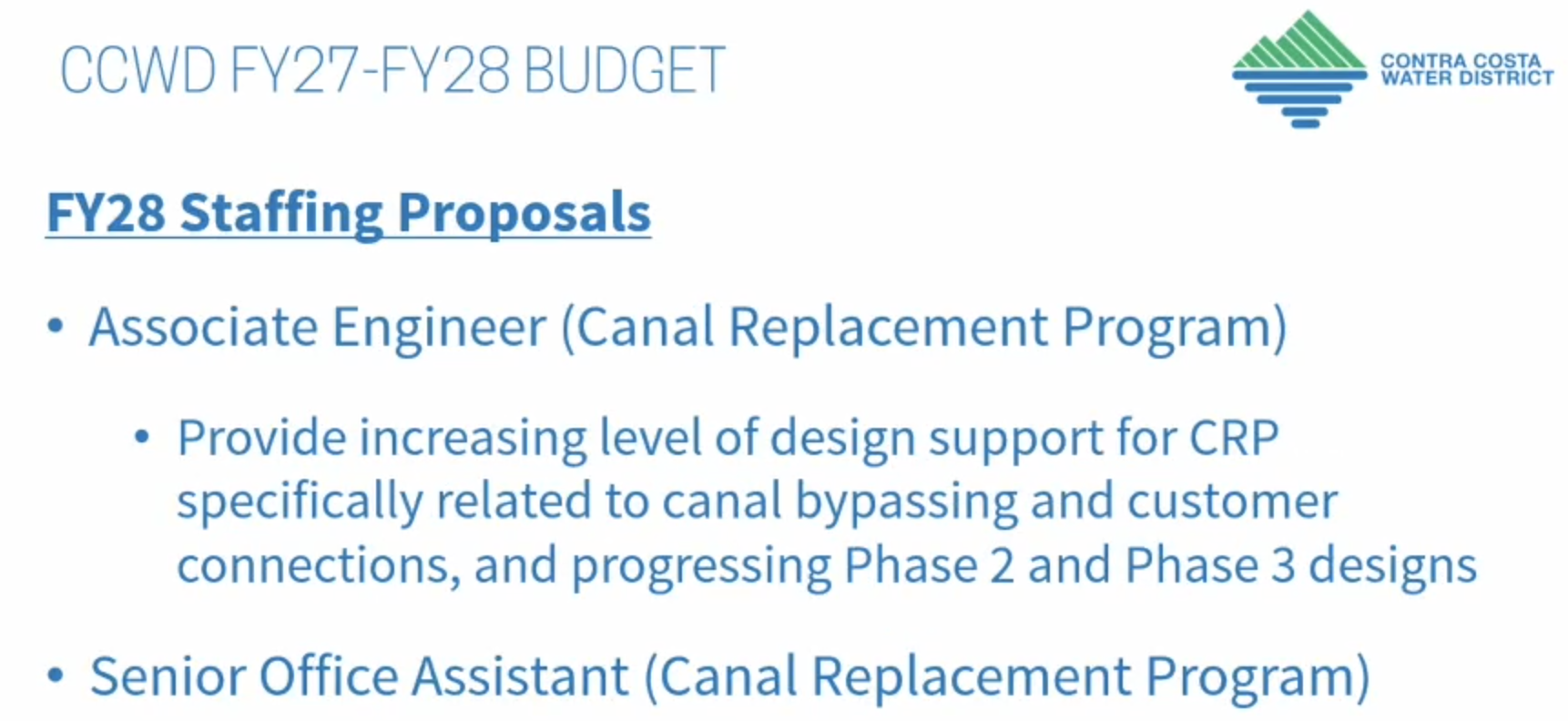
The Canal Replacement Program is the primary driver of new positions and capital growth. Engineering staffing would jump from two to five new project positions, and the district would add a dedicated public information specialist and senior office assistant in planning to handle the communications load.
Director of Finance Herman Williams presented the overall fiscal framework, while Director of Operations Matt Hobbs detailed the Operations & Maintenance budget — the largest at $90.9 million in FY27 — which adds a fleet supervisor, senior chemist/microbiologist, and fourth water quality inspector.
Hobbs also introduced new American Water Works Association benchmarking metrics. "First one, we're going to calculate and track our cost to produce treated water. Our target will be set at $625 per million gallons produced," said Matt Hobbs, Director of Operations. The metrics also include a preventive-to-corrective maintenance ratio and hydrant out-of-service rate.
Chemical costs drew particular attention. Hobbs outlined the damage: "Most notably aluminum sulfates increased 47% or $650,000 per year, sulfuric acid 22% or $120,000, and fluoride just shy of 16% at $90,000."
Vice President Antonio Martinez cautioned that benchmarking should not inadvertently reward cost-cutting at the expense of water quality. "As long as we don't sacrifice our water quality — when you set a goal of doing something and then you don't have control over what comes in, that's problematic for me," he said. Board President Ernesto Avila offered a solution: "The other option is to integrate built-in suspenders, and that is link this benchmark with a water quality benchmark to make sure that there's no degradation in water quality."
Avila also flagged accounting treatment for the canal program, urging staff to capitalize operations and maintenance costs directly tied to the replacement project. "Those are costs that can be capitalized and should be capitalized versus applicable to operating costs in my book," he said. "It'll be important to track that for the future as that program really kicks in."
Water Resources Manager Lucinda Shih explained the $4 million capital expenditure for habitat mitigation credits, calling it an externally driven mandate. "This was approved by the board back in March 2025, is included in the CIP. And once we buy that land, then in FY28 you can see that water resources capital budget goes back down to what I like to call more normal," she said.
Martinez also alerted staff that the California Air Resources Board is changing how leased vehicles count toward zero-emission fleet requirements, with a 15-day public comment period underway.
Insurance premiums rise 10-11% across both years. An organizational assessment prompted by the unsuccessful assistant general manager recruitment will inform FY28 budgeting for that position. General Manager Rachel Murphy noted the challenge: "In debriefing with the external recruiter, part of our discussion was the extremely competitive market for executive-level top talent. And I expect that that's going to persist for some time."
What's next: Murphy acknowledged the recurring theme of externally driven unfunded mandates and committed to consolidating that information for the adoption meeting. "When we bring this back for presentation and ultimate board consideration at the next meeting, as part of the Director of Finance's presentation, we'll have a slide that pulls all of that into one place to further illustrate that point and what's been folded into this budget," she said. Budget adoption is scheduled for June 17.
Water Plan Warns of Drought Supply Gaps Starting as Early as 2030
Why it matters: California law requires the district to update its Urban Water Management Plan every five years, with a July 1 submission deadline. The plan guides drought contingency planning, desalination exploration, and water transfer strategies through 2050.
Where things stand: Senior Engineer Maggie Dutton presented the draft 2025 plan, delivering a mixed picture. On the demand side, projections are significantly better than expected: "The demand projections in the plan are about 16% lower than the 2020 Urban Water Management Plan projected for the same years, and that's due primarily to reduced industrial use as well as lasting changes in water use following recent droughts."
The supply side is more troubling. The plan's portfolio can meet the district's goal of 100% demand in normal years and 85% in dry years, but deficits could emerge in the fifth year of a multi-year drought as early as 2030. Dutton explained the shift in assumptions: "Historically, we've assumed that we would have access to at least 50% of our CVP allocations in drought years. But we've had three instances in the past 10 years when we've been allocated public health and safety, which is less than 50%."
That reality means the district will need water transfers and long-term alternative supply projects — including recycled water and desalination — sooner than previously projected.
Vice President Martinez pushed on the desalination question, suggesting the district explore a partnership with the city of Antioch. "If there's an opportunity for a partnership with Antioch because that proves to be a better or more cost-effective deal, then we should be exploring that as well," he said. He also raised the impact of golden mussels on the district's Freeport facility agreement with East Bay MUD. GM Murphy confirmed no water has been proposed through Freeport since the golden mussel discovery.
President Avila highlighted the importance of keeping a flexible demand envelope, especially with data center development potentially returning to the region. "There's a big issue right now as to whether or not data centers may come back or may become more viable within our respective area," he said. "So it makes a lot of sense to be prudent about what that demand envelope might be to make sure we never find ourselves in a situation we don't have sufficient capacity to meet the demands."
No public comments were received during the hearing. What's next: The plan returns to the board for adoption on June 17, with a July 1 submission to the state Department of Water Resources.
Chemical Costs Surge: Board Approves $850K Mid-Year Transfer
The board unanimously approved an $850,000 mid-year budget transfer to cover rising water treatment chemical costs, bringing total chemical authority to $5.95 million for FY26.
Why it matters: Two factors are driving the increase. The December chemical conversion at the Randall Bold Water Treatment Plant to sodium hypochlorite and liquid ammonium sulfate — safer for workers but more expensive — added significant ongoing costs. Simultaneously, the district expanded use of Earthtec, a copper-based treatment for taste and odor issues.
GM Murphy explained the dual value of the investment: "Earthtec is a chemical we use to help with taste and odor issues. We are going through a pilot effort to bring it to the third treatment plant at the city of Brentwood. So we are using more of that product. It also is a product that is appearing to be effective against golden mussels."
The budget transfer was funded by an energy underrun from lower-than-projected Los Vaqueros Reservoir filling — a one-time offset for what will likely become a recurring cost increase.
Decisions: Passed unanimously (For: 5, Against: 0, Absent: 0). Motion by Vice President Martinez, second by President Avila.
Final Storm Damage Contract Closes Out 2022-23 Repairs
The board awarded a $1.34 million contract to GradeTech Inc. to repair three landslide areas along Buckeye Canyon Road and restore two mitigation ponds at Los Vaqueros Reservoir — the last remaining storm damage project from the winter 2022-23 emergency declaration.
Nine bids were received; GradeTech was the lowest responsive bidder at $1,239,002, plus 8% change order authority. Kleinfelder, the designer of record, received a $125,000 amendment for field testing during construction. Approximately 94% of costs are eligible for federal and state disaster reimbursement.
President Avila recused himself due to a professional conflict of interest; Vice President Martinez presided over the item.
Decisions: Passed unanimously among participating directors (For: 4, Against: 0, Recused: 1 — Avila). Motion by Board Member Patricia Young, second by Board Member Connstance Holdaway.
GM Eyes Federal Support for Canal Replacement
GM Murphy reported that summer operations are more constrained than usual, with salinity at Mallard Slough and taste-and-odor compounds at Rock Slough taking both intakes offline and shifting diversions to Old and Middle rivers. Rock Slough will remain out of service through the summer for the city of Oakley's road widening project. Los Vaqueros Reservoir filling is complete, and intake gate inspections begin later in June.
Murphy said staff attended a MOTCO military briefing where they presented the Canal Replacement Program, and that she will meet with Department of Interior Assistant Secretary Dr. Andrea Travnicek on Thursday. "My plan is to provide a background on the Contra Costa Canal, which is the oldest of the canals built by the federal government for the Central Valley Project," Murphy said. "Highlight our program which will be replacing that canal with a pipeline, and focus on our continuing need for partnership and support for our federal funding pursuits."
Vice President Martinez reported his own legislative outreach, including an introduction to Congressman Josh Harder. "During my introduction to Mr. Harder, I mentioned our interest in engaging with him on delta issues, such as the invasive mussel issues that we have," Martinez said. He also met with Assemblymember Avila Farias about Prop 4 canal replacement funding.
Board Member Young reported on an EBLC meeting with Pablo Garza, flagging AB 2739, a water infrastructure trust proposal, and discussions about federal funding impacts.
Minor Items
Consent calendar (Items 1-5) approved unanimously (5-0), including Resolution 26-010 calling for the Nov. 3, 2026, consolidated election for Board Divisions 1 and 2; Resolution 26-011 authorizing sole-source procurement of valve actuator and control system equipment for the Brentwood Water Treatment Plant; directors' business activities and expenses; minutes from four prior meetings; and the June 4 warrant register.
No meeting schedule changes were requested by board members.