Board of Directors - Jul 15, 2026 - Regular Meeting

Board of Directors - Jul 15, 2026 - Regular Meeting

Board of DirectorsContra Costa Water DistrictJuly 15, 2026

Sources:

Locunity is a independent informational service and is not an official government page for this commission.We use AI-assisted analysis and human editorial review to publish information.

Board Approves Nearly $4M in Water Infrastructure Contracts

The Contra Costa Water District Board of Directors moved swiftly through a packed agenda July 15, approving a slate of capital contracts that will reshape the district's treatment plants and pump stations for years to come. Between the engineering dollars, a deep legislative briefing on Sacramento's $351 billion budget and a clean bill of health on drinking water compliance, the meeting offered a clear picture of a utility investing heavily to stay ahead of aging infrastructure and tightening federal mandates.

  • Board greenlights nearly $4 million in design and construction contracts for water treatment plant upgrades and pump station power system improvements
  • CCWD earns national recognition as pipe-tapping and Top Ops competition teams place second and third at the 2026 Water Conference of the West
  • District achieves 100% drinking water compliance in 2025 and confirms zero lead service lines — but faces unfunded EPA mandate to double annual reporting starting in 2027
  • Legislative update flags failed water rights bill, active golden mussel and wildfire liability legislation, and federal engagement on canal replacement funding
  • PG&E power shutoff hits Kirker Pass facilities; advance coordination prevents any service disruptions

$3.9M in Contracts for Treatment Plants and Pump Stations

The board approved four related infrastructure items that together commit roughly $3.9 million to keeping the district's water treatment and untreated water systems operational and compliant.

The basics: The Water Treatment Plant Improvements Program covers ongoing upgrades at the Bowman, Randall Bold, and City of Brentwood treatment plants. The Old River Pump Station is a critical untreated water facility.

Where things stand: The board authorized two-year design services agreements — $1,308,000 with Carollo Engineers and $1,181,000 with Water Works Engineers — covering ozone generator replacements, filter media replacement, and safety improvements. General Manager Rachel Murphy described the competitive process: "Ten firms provided a response to the request for qualifications, four firms were invited to submit proposals, and two firms were selected to provide services over the next two-year cycle."

For construction, the board awarded a $1,413,720 contract to Blocka Construction — the lowest of just two bidders — for electrical system upgrades at Old River Pump Station, plus a $123,091 amendment to Mead & Hunt for construction-phase design support. GM Murphy noted the thin bidding pool was expected: "The lower than we typically see competition on this construction contract bid is likely due to the specialized nature of the substation equipment and the expertise needed to work on the substation equipment."

On the consent calendar, the board also adopted Resolution 26-019, authorizing $478,280 for sole-source water quality instrumentation at Rock Slough Intake, Old River and Middle River Pump Stations.

Conflict of interest: Board President Ernesto Avila recused himself from the Carollo Engineers vote, disclosing a personal family relationship with the firm. "To avoid any appearance of a conflict of interest due to a personal family relationship with Carollo Engineers, I'll recuse myself from this item and turn the meeting over to Director Holdaway," he said. Director Connstance Holdaway presided for that item.

Decisions: The Carollo agreement passed 3-0 (For: Holdaway, Young, Fitzpatrick; Avila recused; Vice President Antonio Martinez absent). The Water Works Engineers agreement passed 4-0 (For: Avila, Holdaway, Young, Fitzpatrick; Martinez absent). The Blocka Construction contract passed 4-0 (For: Avila, Holdaway, Young, Fitzpatrick; Martinez absent). The consent calendar covering items 2–5 also passed 4-0 with Martinez absent.

Why it matters: These multi-year capital investments ensure the district can continue meeting state and federal water quality regulations while maintaining reliable service to its 550,000 customers. The ozone generator replacements and filter upgrades are central to the treatment process, and the pump station power system overhaul protects a facility that handles untreated water before it reaches treatment plants.


Clean Bill of Health — but New Federal Mandate Looms

Water Operations Manager Daniel McVeigh delivered the 2025 Annual Water Quality Report with a headline result: full compliance with every applicable state and federal drinking water standard.

"I'm pleased to report that Contra Costa Water District once again met or exceeded every applicable state federal drinking water standard throughout 2025," McVeigh said. The district also completed its lead service line inventory, confirming zero lead lines exist in the system — a significant data point as EPA tightens lead and copper regulations nationwide.

What's new: The district transitioned from one combined consumer confidence report to five utility-specific reports for participating retail agencies. New features include treatment plant infographics explaining the water treatment process from delta intake through distribution, hexavalent chromium concentration data, and radiological constituent information.

What's next — and unfunded: Starting in 2027, EPA's revised Consumer Confidence Report rule will require two reports per year instead of one, expanded lead and corrosion data, additional health messaging, translation and accessibility requirements, and six-month updates for certain water quality events. McVeigh confirmed the new mandate came with no additional funding.

President Avila underscored the achievement from his regulatory perspective: "To operate an agency that's operating with 550,000 customers … with all the different testing required and to achieve this incredible benchmark, to say that we're in great shape and we fully comply with those regulations is remarkable." He then pressed on funding: "They've now increased the number of reports that's got to be done — that came with funding, right?" It did not.

Why it matters: Doubling the reporting frequency while adding translation and accessibility requirements will significantly increase staff workload and costs — all without new revenue. For ratepayers, the clean compliance record signals the district's capital investments are paying off, but the unfunded mandate could eventually factor into budget discussions.


Sacramento's $351B Budget, a Failed Water Rights Bill, and Wildfire Liability

Director of Public Affairs Jennifer Allen delivered a dense legislative affairs briefing spanning the state budget, more than half a dozen active bills, and federal engagement on the district's canal replacement program.

State Budget and New Software Tax

The $351+ billion state budget, approved in June, includes a new sales and use tax on electronically delivered computer software. "This budget also does include an extension of a sales and use tax to now apply to electronically delivered computer software," Allen reported, noting it is projected to generate upward of $1 billion annually. The budget also allocates $6 million for California Department of Fish and Wildlife golden mussel decontamination and extends rainy day fund reserves.

Water Rights Fight Fizzles

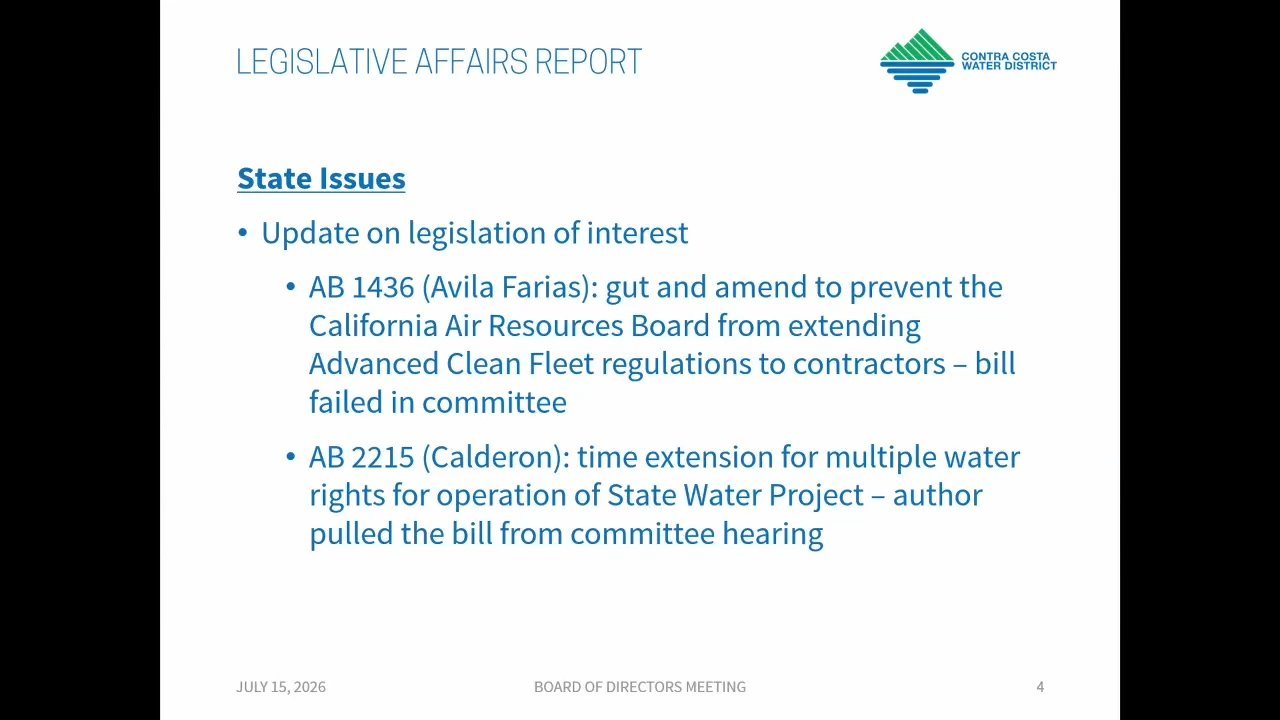
AB 2215, which would have allowed Department of Water Resources and state water contractors to seek legislative water rights extensions — bypassing State Water Resources Control Board hearings — was pulled by its author after Senate amendments gutted the water rights provisions. Allen explained: "It was pretty much because of the special treatment for one water contractor. I think there was agreement of the challenges that everybody faces in doing those water right hearings, but not wanting to create a new precedent, a new process, and then circumvent the public process too, rang a bell." The bill was controversial at the Association of California Water Agencies.

Bills to Watch

The district supports several active measures: AB 2032 (golden mussel research, co-sponsored by CCWD), AB 2180 (Prop 218 rate proportionality), AB 2739 (Water Affordability Fund), SB 1085 (East Bay MUD-sponsored water supply assessments for CEQA-exempt housing), SB 1125 (water rate assistance program), and SB 1153 (wildfire disaster preparedness for water agencies).

CCWD opposes SB 601, a complex nexus waters bill addressing the boundary between federal and state water regulation. Allen called it "a beast of a bill … a really complex bill dealing with nexus waters and then how that applies between federal regulations versus state regulations."

Wildfire Liability Context

Legal Counsel Doug Cody provided context on why wildfire legislation matters to water districts, citing the Yorba Linda Water District case: "Yorba Linda Water District … had their own facilities destroyed by the freeway complex fire and were eventually sued by certain homeowners, and their insurance company said, 'not our problem to help you out with this.' And ultimately they lost the case." The case involved both tort and inverse condemnation claims — a cautionary tale for water agencies in fire-prone regions.

Federal Engagement

On the federal side, Sen. Alex Padilla secured $1 million for the Water Research Foundation's golden mussel research. Rep. Mark DeSaulnier toured the Marine Ocean Terminal, Concord site relevant to the canal replacement program. Allen noted: "We took him out to a site that oversaw the Marine Ocean Terminal, Concord, the MOTCO site, because that will become part of his district when redistricting goes into effect in November." GM Murphy also met with the Office of Local Defense Community Cooperation in Washington, D.C. to advance canal replacement project funding.

Why it matters: Multiple pending bills could create new compliance costs, shift wildfire liability exposure, or unlock critical funding for the district's canal replacement program and water affordability efforts. The failed AB 2215 signals that legislative shortcuts on water rights remain politically untenable — even when the underlying frustrations with the hearing process are widely shared.


CCWD Teams Shine at National Water Competition

The board meeting opened with a celebration: AWWA Cal-Nevada Section leaders Sue Mossberg, the section's executive director, and Gordon Williams, section chair and East Bay MUD employee, presented awards to two CCWD teams for their finishes at the 2026 Water Conference of the West in San Diego.

The "Regulators" Top Ops team — Armando Mendoza, Salah Lalogo, Tracy Chilson, and coach Daniel Ellicock — placed second in the rapid-fire water knowledge competition. The pipe-tapping team — Chuck Wise, Brian Sweeney, Matt Fowler, and Daniel Hilson Dager — placed third in a timed live-pressure pipe tap competition.

Mossberg highlighted the importance of CCWD employees serving on AWWA committees, including Kyla Shandesko on the Veterans Engagement committee and Jennifer Allen on the Water Utility Council. "Those committees build the content for the training that we provide. And that really is what sets AWWA apart as a professional association, as we rely on our members to come to the table and provide that technical body of knowledge," she said.

President Avila was effusive: "You are the spirit of the heart of Contra Costa Water District. And this is nothing more than a reflection of your incredible dedication and service."

Why it matters: Competition results at the national level reflect the caliber of a district's workforce — particularly relevant for an agency serving 550,000 customers that relies on highly trained operators for water treatment and distribution. The 2027 Water Conference of the West will be held in Sacramento.


Minor Items

  • Consent calendar (items 2–5) approved 4-0 (Martinez absent), covering directors' business activities and expenses, July 1 meeting minutes, the July 16 warrant register, and Resolution 26-019 for water quality instrumentation ($478,280).
  • PG&E public safety power shutoff affected three district facilities on Kirker Pass Road in Clayton — Kirker Pass Pump Station, Kirker Pass Reservoir, and East Reservoir. GM Murphy reported advance PG&E notification allowed staff to top off reservoirs and fill generators, preventing any service disruptions. Power restoration was expected by 10 a.m. the following morning.
  • Summer internship program expanded to 16 students (seven college, nine high school), with new partnerships with Mt. Diablo Unified School District and the City of Antioch beyond the existing Biotech Partners program.
  • Director Patricia Young reported attending the OE Committee meeting, CalWEF, and a mayors' conference in San Pablo, where she noted a discussion about how "water and transportation need to do a better job of getting out to the public how interconnected some of our work projects are."
  • President Avila reported that an ACWA survey found 8 out of 10 California ratepayers believe the next governor should prioritize water supply reliability.
  • Closed session on one litigation matter under Government Code 54956.9 yielded no reportable action.