Board of Directors - Apr 01, 2026 - Regular Meeting
Board of Directors • Contra Costa Water DistrictApril 1, 2026
Locunity is a independent informational service and is not an official government page for this commission.We use AI-assisted analysis and human editorial review to publish information.
CCWD Board Co-Sponsors Golden Mussel Bill, Reviews Earthquake and Cyber Readiness
The Contra Costa Water District (CCWD) Board of Directors moved on multiple fronts at its April 1 meeting, adopting positions on five state bills — including co-sponsoring legislation the district helped write — while receiving detailed briefings on how the agency would respond to a ransomware attack, a major earthquake, or a federal web accessibility mandate. A Division 2 board vacancy also forced the general manager to extend the application timeline after too few candidates came forward.
Board co-sponsors AB 2032 on golden mussel management after CCWD staff helped draft the legislation, and opposes a wildfire water-supply bill that could create unfunded mandates for water agencies
Emergency preparedness review reveals ransomware simulation, $100M+ in seismic upgrades and mutual aid that delivered 61.5 million gallons during a Martinez refinery fire
President Avila warns EV mandates could hamper earthquake response, citing 600–800 potential main breaks in a major Bay Area quake
DOJ digital accessibility deadline looms for April 2027; district budgets $100K for compliance assessment and training
Division 2 board vacancy application period extended three weeks after insufficient applications; interviews pushed to May 13
Avila to lead new ACWA task force on how the statewide association should handle projects of state significance like the Delta Conveyance Project
Five State Bills, One Co-Sponsorship, and the Shadow of the LA Fires
The board unanimously adopted amended positions on five state bills after a detailed legislative affairs presentation from Jennifer Allen, Director of Public Affairs.
Why it matters: The positions define how CCWD will engage Sacramento on legislation sharpened by recent wildfire disasters and long-standing threats to the Delta water system — issues with direct implications for the district's infrastructure, liability, and funding.
Where things stand: The marquee action was elevating the district's stance on AB 2032 to "support and co-sponsor." The bill would establish research exemptions and best practices for managing golden mussels, an invasive species that threatens water infrastructure. CCWD staff helped draft the language.
"We have the opportunity to co-sponsor because we have been a part of working on the legislation," said Allen. "So our recommendation is for us to go support and co-sponsor on 2032."
The board also took an "oppose unless amended" position on AB 2013, which would require water agencies to provide adequate water supply for firefighting — a response to the devastating Los Angeles wildfires. Allen cautioned the bill leaves critical ambiguity about agency obligations.
"This leaves a little open area for what our role actually is in serving the community and providing water for a wildfire," Allen said. "We want to make sure that there's no expectation that water agencies are going to be the source of water for emergency catastrophic wildfires."
Three other bills received lighter-touch positions: SB 1001, which would create state-issued emergency IDs for water agency staff, earned a "favor if amended" position. SB 1139, on penalties for non-functional turf, and SB 1417, on post-emergency customer billing, were both downgraded from "oppose unless amended" to "watch" after their scopes narrowed — SB 1139 is now limited to the Monterey area and SB 1417 applies only to mutual water companies.
Allen also flagged developments beyond Sacramento. On the federal side, the DROUGHT Act would raise the Water Infrastructure Finance and Innovation Act (WIFIA) federal funding cap to 90% for drought-related projects.
"Certainly of interest to the district because it would raise up to a 90% cap on federal funding for drought-related projects," she said.
At the state level, revenue projections have improved by $14–40 billion since the governor's January budget, but Allen urged caution:
"The LAO is being a little bit more conservative on that based on a lot of unknowns. But this could mean that there will be a potential opportunity for one-time budget funded projects."
Federal funding disruptions, market volatility, and military actions create significant downside risk. The district wants Proposition 4 spending focused on safe drinking water, climate resilience, and conveyance — not used to backfill general fund shortfalls.
Allen also briefed the board on SB 872, which would create the Delta Levees and Canal Subsidence Fund with up to $150M per year each for state water conveyance subsidence and Delta levee improvements. The bill currently lacks a dedicated funding source and would exclude many organizations; CCWD is working with coalitions to broaden eligibility.
Decisions: The amended legislative positions passed unanimously (For: 4, Against: 0, Absent: 1). Motion by Director Patricia Young, seconded by Director Connstance Holdaway.
Ransomware Drills, Refinery Fires, and 800 Potential Main Breaks
Matt Hobbs, Director of Operations and Maintenance, delivered a sweeping review of CCWD's emergency preparedness program — covering the agency's incident command structure, cybersecurity exercises, real-world mutual aid, and future planning needs.
Why it matters: The district's service area faces overlapping threats — earthquakes, wildfires, cyberattacks, and industrial incidents — and the briefing exposed both the depth of CCWD's preparations and the gaps the agency is working to close.
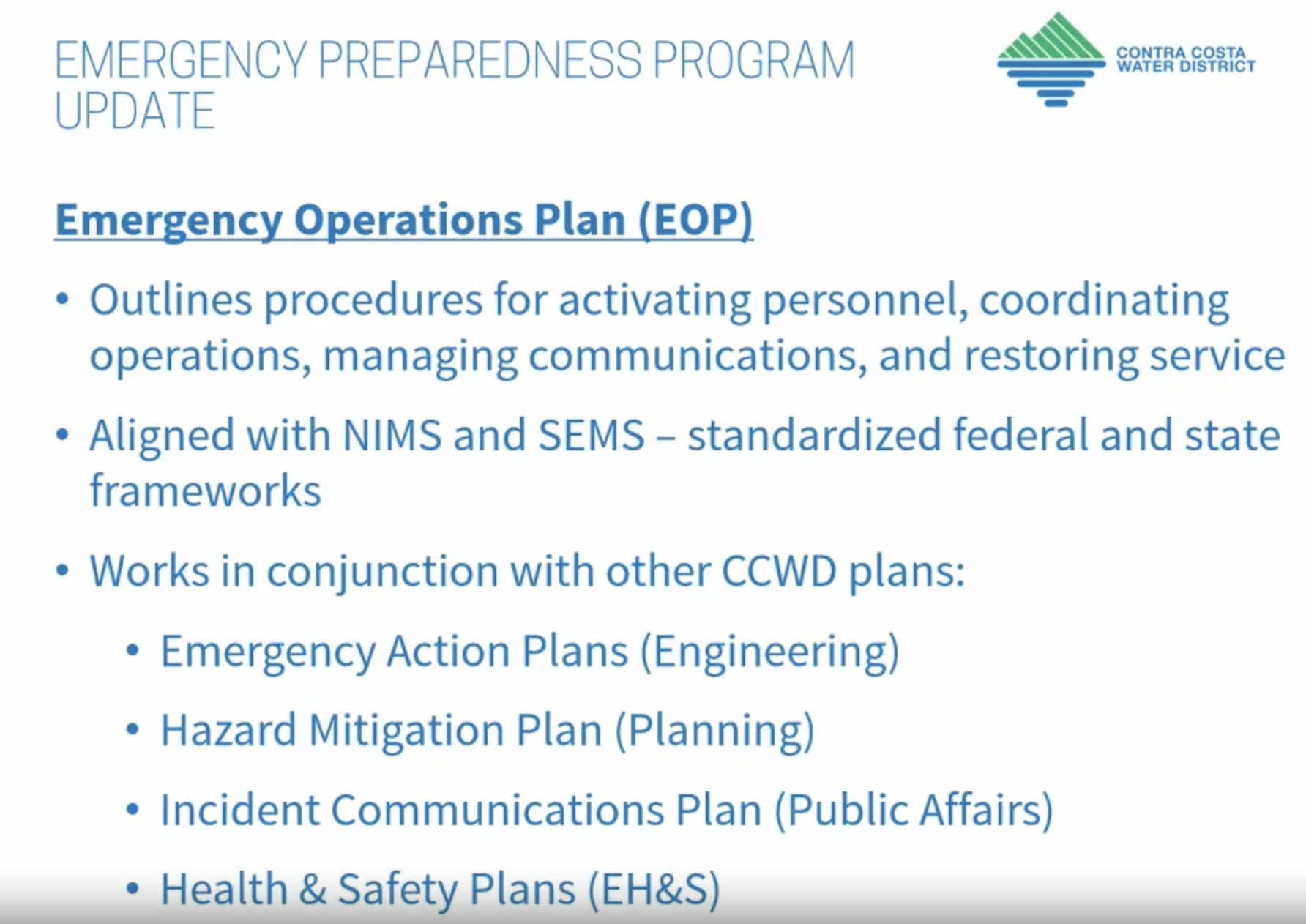
Where things stand: CCWD's Emergency Operations Plan aligns with federal NIMS and state SEMS frameworks and uses an Incident Command System structure with four core sections: Operations, Planning, Logistics, and Finance/Administration.
"We do have 24/7 staff monitoring our systems and control. We do have remote SCADA monitoring capabilities for specific personnel," Hobbs said. "They can make operational decisions and adjustments remotely."
The district also maintains backup power at critical facilities and extensive system redundancy, including infrastructure designed to survive seismic fault crossings.
Cyber Readiness
In FY25, CCWD's most notable exercise was a simulated ransomware attack targeting both IT and operational technology systems.
"The tabletop exercise focused on our initial response and recovery, our internal communications, how we would safely restore our water treatment plant," Hobbs said.
A follow-up ICS familiarization exercise reinforced lessons learned. The district also participates in CISA cybersecurity briefings, Cal OES quarterly meetings, and is a CalWARN member.
Real-World Mutual Aid
Hobbs detailed two real-world mutual aid deployments to the City of Martinez. In February 2025, a fire at the Martinez Refining Company triggered an urgent water request:
"Our staff coordinated with the city water treatment plant to almost immediately increase canal and shortcut pipeline flows to support that firefighting response. The event was just over 60 hours and we provided over 171 acre-feet or 61.5 million gallons of water."
CCWD also assisted Martinez with a 16-inch main break repair in August–September 2025.
The district additionally participated in a U.S. EPA-led exercise with Military Ocean Terminal Concord on fire response and canal service disruption scenarios.
Legal Tools in an Emergency
Doug Cody, Legal Counsel, explained that under the Brown Act, a declared emergency unlocks critical governance flexibility.
"Under a declared emergency, you can have a meeting without complying with any of the noticing rules," Cody said. "So you can meet immediately as a group. And in doing so, you can also then utilize some of the specialty provisions for remote."
Vice President Antonio Martinez emphasized the financial stakes of early action:
"The sooner we declare an emergency, the better off we're going to be, no matter how small or how large it becomes. Because when it comes to reimbursements from FEMA, that documentation that's required from them to get reimbursed is really within the ICS structure."
The EV Question
President Ernesto Avila steered the discussion toward a pointed concern: electric vehicle mandates for heavy-duty equipment and their potential impact on earthquake response.
"The average number of breaks on some major earthquakes in the Bay Area and in Japan that have had similar type earthquakes is anywhere from 600 to 800 main breaks after a significant earthquake," Avila said. "And to not have to have our vehicles ready to respond to those types of issues is just a travesty to our commitment to try to provide and restore service as quickly as possible during a major event."
Avila noted the district has invested more than $100 million in seismic capital improvements to harden its infrastructure.
What's next: FY27 and FY28 budgets each include $80,000 for professional services — FY27 to finalize a Business Continuity Plan, and FY28 to update the Emergency Operations Plan per the America's Water Infrastructure Act five-year cycle.
"The FY27 and 28 budgets include requests for $80,000 to obtain professional services each year to finalize our Business Continuity Plan and our Emergency Operations Plan," Hobbs confirmed.
Digital Accessibility Clock Ticking for April 2027
Jennifer Allen, Director of Public Affairs, outlined the district's compliance roadmap for new Department of Justice rules requiring all public-facing websites, mobile apps, and digital content to meet WCAG 2.0 AA accessibility standards under ADA Title II. Special districts must comply by April 2027.
The basics: CCWD currently uses Civic Plus as its web platform and UserWay as an accessibility overlay, supplemented by Google Translate for language access. The new federal rules extend compliance obligations to contractor-generated content and third-party service websites.
Why it matters: Failure to meet the deadline could expose the district to ADA enforcement action. Archived materials have limited exceptions, but CCWD must demonstrate good-faith effort rather than simply removing old content.
Director Connstance Holdaway zeroed in on a key implementation challenge:
"How are we going to make sure that third-party websites are in compliance and then how do we make them comply?" Allen said compliance would be enforced through contract language and the RFP process.
Allen flagged another vulnerability: once documents are downloaded from the website, they lose UserWay's accessibility features — meaning each document must be independently compliant.
General Manager Rachel Murphy noted a silver lining: because CCWD's compliance date trails cities and counties, many vendors will already be familiar with the requirements by the time the district engages them.
What's next: The compliance plan includes retaining a $100,000 consultant in FY27 for an in-depth assessment and accessibility plan, developing contract language for vendor compliance, completing digital document assessments by summer 2026, finalizing the accessibility plan by October 2026, and conducting district-wide training in fall/winter 2026.
Division 2 Vacancy: Not Enough Applicants
General Manager Rachel Murphy announced a three-week extension to the application period for the Division 2 board vacancy left by the departure of Director John Burgh. The original April 2 deadline yielded too few applicants to meet the board's target of at least five candidates for interviews.
"Based on how the appointment process has been going to date, we need some additional time to be able to deliver on the goal of providing at least five candidates for the board's consideration," Murphy said. "So I will be extending the application filing period by another three weeks to April 23 at 5 p.m."
Additional outreach will include social media, direct contact with Division 2 community organizations, and emailing city and county representatives in the area. The revised schedule sets a special meeting at 5 p.m. on May 13 for candidate statements and board interviews, with the regular meeting that evening for the appointment decision. Alternatively, the appointment could be made on May 20.
Avila Takes the Reins on ACWA Statewide Policy Process
President Ernesto Avila reported he will lead a new ACWA task force to develop a formal process for the statewide water association to weigh in on projects and programs of state significance — issues like the Delta Conveyance Project and SGMA implementation that currently lack a structured vetting path.
"The agreement now is let's create a task force that I'll be leading to talk about how the formal process ACWA should have in place whenever we're dealing with an issue or project or program of state significance," Avila said.
Currently, such issues are typically routed to the State Legislature Committee because they trigger legislation, with the president and vice president serving as informal gatekeepers. The task force will develop a transparent process with representation from all 10 ACWA regions, targeting completion in 6–8 months. Avila emphasized the need to vet issues without fracturing the organization.
ACWA is also engaging gubernatorial candidates on water priorities, with two confirmed participants and 10 candidates invited to the ACWA Conference in May.
On the executive director front, the search has narrowed dramatically.
"We're down to two finalists. The finalists are being interviewed on April 17th with a goal that we'll hopefully be able to make an announcement after acceptance by the end of April. We started off with 52, so we're down to two," Avila said.
Minor Items
Consent calendar (items 1–5) approved unanimously (For: 4, Against: 0, Absent: 1), including approval of director business activities and ACWA conference travel, March 18 board meeting minutes, the April 2 warrant register, Resolution 26-007 authorizing sole-source procurement of water quality instrumentation for Old River and Middle River pump stations, and a $326,040 contract with Applied Technology Group for the Radio Network Redesign Project. Motion by Director Holdaway, seconded by Director Young.
H.T. Harvey and Associates agreement increased by $140,000 to a revised not-to-exceed total of $1.59 million to cover watershed mitigation pond rehabilitation and storm damage repairs that are largely FEMA-reimbursable. Passed unanimously (For: 4, Against: 0, Absent: 1). Motion by Vice President Martinez, seconded by Director Holdaway.
Finance Committee and Retirement/OPEB Committee post-meeting reports received without discussion.
Vice President Martinez reported attending an ANAC town hall on April 2 and shared insights from the WELL conference, noting CCWD is ahead of many agencies on workforce diversity and highlighting indigenous water management perspectives. "What I took most from that conference was the impact that indigenous tribes are making on the waterfront and what we can learn from them because they've been here for centuries managing water and land," Martinez said.
Director Young also attended the WELL conference and noted CCWD's progress: "Some of the things they talked about CCWD is doing already successfully. So it's always gratifying when I go and I hear that we are actually ahead of a lot of different agencies."
Vice President Martinez reported presenting CCWD's Canal Replacement program to the Antioch City Council alongside General Manager Murphy and Jennifer Allen.