Board of Directors - Mar 04, 2026 - Regular Meeting
Board of Directors • Contra Costa Water DistrictMarch 4, 2026
Locunity is a independent informational service and is not an official government page for this commission.We use AI-assisted analysis and human editorial review to publish information.
CCWD Adopts $1.7 Billion Capital Plan as Canal Overhaul Looms
The Contra Costa Water District board locked in a decade of infrastructure spending at its March 4 meeting, adopting a capital improvement program anchored by a $2.6 billion canal replacement effort that will push water rates significantly higher for years to come. The board also moved swiftly to fill a retiring director's seat by appointment, ensuring Division 2 has a voice as the district enters its most ambitious — and expensive — construction era since the original Los Vaqueros Reservoir.
- $1.7 billion capital plan adopted, driven by a multi-phase canal replacement program estimated at $2.6 billion total; untreated water rates could rise 9.5% annually during peak construction years
- Board chooses appointment over election to replace retiring Director John Burgh, with candidate interviews set for a special April 22 meeting
- Mid-year revenues track $5 million under budget as cooler weather and slowing industrial customers cut water demand; $750,000 in budget transfers authorized
- Three state water bills endorsed, protecting rate-setting authority, CEQA water supply reviews, and wildfire liability shields for water agencies
- New federal ESA lawsuit challenges Delta water export operations, adding uncertainty to CCWD's supply outlook
$2.6 Billion Canal Replacement Becomes CCWD's Defining Project
Why it matters: The canal replacement program will be the largest infrastructure investment in Contra Costa Water District history — more than double the cost of the original Los Vaqueros Reservoir project — and will shape customer rates for decades.
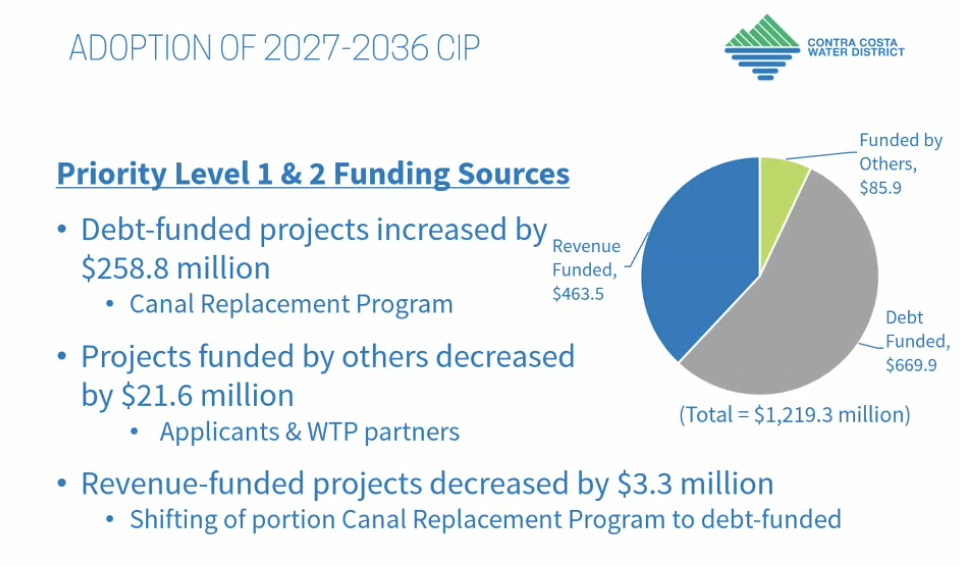
Where things stand: Assistant General Manager Jeff Quimby presented the updated 10-year CIP for fiscal years 2027 through 2036, a follow-up to a Feb. 18 board workshop. The plan totals $1.7 billion, with $1.2 billion in funded priority-level projects. Debt-funded projects increased $258.8 million as more canal replacement construction moved into the 10-year window.
The canal program itself is staggering in scale. "The current estimate for the total program in all phases is $2.6 billion in current dollars," said Quimby (lightly edited for clarity). Phase one alone carries a $1.3 billion price tag with a construction timeline exceeding 10 years; roughly half falls within the CIP window. The main canal is the highest priority, while the Rock Slough system — Pumping Plant 1 to Pumping Plant 4 — is lower priority thanks to redundancy provided by the Los Vaqueros system.
Rate Impact
Base CIP projects are funded through annual revenue increases of 4–6%. But once the canal replacement is layered in, untreated water rates would climb 9.5% annually for five years and treated water rates 6% annually for five years. Quimby framed the debt load in historical terms: "At the peak of the projected debt service in about 2060, the debt would account for about 30% of CCWD's overall revenue requirement … very similar to what we saw in the early 2000s when we began to pay back the debt of the original Los Vaqueros project." The plan assumes $922 million in total debt financing at 4.5% over 30 years.
Golden Mussels, Supply Shortfalls, and Rising Costs
The CIP incorporates the district's growing golden mussels response: $750,000 in near-term spending this fiscal year, a $400,000 capital study in FY2027, and a $5.6 million priority-three placeholder, plus $300,000–$500,000 in new annual operating costs for inspections, cleaning, and water quality sampling.
Other notable additions and changes: fleet electrification adds $3.8 million to vehicle replacement costs — two-thirds driven by higher electric vehicle prices — and $8.6 million in future water supply purchases was accelerated because shortfalls are expected sooner than prior studies indicated. "The potential shortfalls that we may expect in magnitude are similar to our previous studies. However, they're likely to happen sooner than we had originally estimated," Quimby said. Meanwhile, $11 million in additional operating costs for FY2027 reflect labor, medical premiums, energy, chemicals, and property and liability insurance that has doubled in four years.
The Los Vaqueros Reservoir Expansion Phase 2 was removed from the plan, and portions of the advanced metering infrastructure program were deferred.
Decisions: The board adopted the CIP and financial plan unanimously. (For: 4, Against: 0, Absent: 1 — Board President Ernesto Avila.) Staff emphasized the CIP is a planning tool — it does not commit funds, authorize specific projects, or establish rate increases.
What's next: Rate-setting decisions will come through separate proceedings. The canal replacement program's phasing and financing will return to the board as design and construction timelines sharpen.
Board Will Appoint Burgh's Replacement; Interviews Set for April 22
Why it matters: Leaving the Division 2 seat vacant through the November election would mean no representation for those residents during critical FY2027-28 budget development and canal replacement program deliberations.
Where things stand: Executive Management Analyst Shelley Wise laid out the board's options under Government Code Section 1780: appoint within 60 days of the vacancy or call an election. An election would effectively leave Division 2 unrepresented for the rest of the term ending December 2026, since both Division 1 and Division 2 seats are already on the Nov. 3 general election ballot.
"For the rest of this term, we would have no representation for District 2. There would be no input related to the fiscal year 2027-28 budget that's in development and review, canal replacement program updates, or committee activities," Wise said.
Director John Burgh, who is retiring effective March 31, recused himself from the room. "I have a potential conflict on this item, so I'm going to excuse myself from the room in accordance with our established policy," Burgh said before departing.
The appointment process follows an established playbook: a public notice of vacancy, application period, director ranking to identify a top five, then public interviews at a special board meeting. The estimated cost is roughly $2,500 for advertising.
Two schedule options were presented. Vice President Antonio Martinez indicated he was unavailable for the accelerated option one timeline (April 15 interviews), so the board selected option two: applications due April 2, director ranking sheets due April 15, and candidate interviews at a special meeting April 22. Any appointed director would still need to run in the November election to retain the seat.
Steven Maris, a public commenter and 14-year Division 2 resident, spoke in favor of appointment, noting that nobody has ever pulled papers to run for Division 2 during Burgh's 22 years on the board. He expressed intent to apply.
Director Patricia Young welcomed the outcome: "Good things. So Division 2 doesn't have to wait all these months for representation."
Decisions: The board approved the appointment process 3-0 (Burgh recused, Avila absent) and selected schedule option two, also 3-0.
What's next: Applications are available online and at the district center. The deadline is April 2, with public interviews at a special board meeting on April 22.
Revenues Dip as Cooler Weather, Industrial Slowdown Cut Water Sales
Why it matters: CCWD's revenue is weather-sensitive and depends heavily on a small number of large industrial customers — making the mid-year picture a useful barometer of the district's fiscal resilience heading into a period of massive capital spending.
Where things stand: Director of Finance Herman Williams reported that operating revenues are projected to finish the fiscal year $5 million under the $204 million budget. "This is primarily due to lower water sales as well as FRC revenues," Williams said.
Treated water sales are tracking $1.8 million below budget thanks to a cooler summer and fall. Untreated water sales are $2.6 million short, driven by reduced consumption from the district's two largest industrial customers, Marathon Renewable Fuels and Martinez Refining Co. Wholesale treated water sales were a bright spot at $1.2 million above the $4.8 million budget.
Facility reserve charge revenues — fees paid by new development — also lagged. Treated water FRC revenues came in $1.6 million under their $4.8 million budget (30 accessory dwelling units were added, generating $365,000). Untreated water FRC revenues fell $2.3 million short of the $5.3 million budget.
On the expense side, operating costs are projected $1.8 million under the $139.5 million budget due to position vacancies. Capital expenditures are $10.8 million under the $69.7 million budget, driven by project schedule changes and projects completed under budget.
Decisions: The board unanimously authorized $750,000 in budget transfers to cover higher-than-expected workers' compensation claims and bad debt write-offs from large invoices, funded by savings in property/liability insurance and reduced purchased water costs. (For: 4, Against: 0, Absent: 1 — Avila.)
Board Backs Three State Bills on Rates, Environmental Review, and Wildfire Liability
Why it matters: All three bills address emerging legal and regulatory vulnerabilities for California water agencies — from lawsuits challenging rate structures to CEQA streamlining that inadvertently weakened water supply reviews, to wildfire-era liability exposure.
Where things stand: Director of Public Affairs Jennifer Allen presented the monthly legislative affairs update. Nearly 1,800 new bills were introduced before the Feb. 20 deadline.
Three bills drew formal support positions:
-
AB 2180 (Assemblymember Ward), sponsored by the Association of California Water Agencies, responds to recent Proposition 218 lawsuits by codifying a proportionality framework for water rate-setting. "This would codify a framework to demonstrate that proportional cost of service for water agencies, which would be really helpful not only for tiered rates, but then also for uniform rates," Allen said.
-
SB 1085 (Senator Dazo), sponsored by East Bay Municipal Utility District, reinstates water supply assessment requirements for developments of a certain size — requirements that were eroded by recent CEQA streamlining legislation.
-
SB 1153 (Senator Caballero), also ACWA-sponsored, requires urban water agencies in high fire severity zones to incorporate response procedures into disaster plans while establishing that "water agencies or water urban water systems are not held liable if there's a wildfire that comes through and we lose pressure or we lose water service during wildfire," Allen explained.
On the federal front, Allen reported from the ACWA D.C. conference that 11 of 12 FY2026 appropriations bills passed with improved EPA and Interior allocations. Golden mussels are gaining attention from both parties for management and research funding, and a federal low-income rate assistance program is under discussion in both chambers.
Decisions: The board adopted support positions on all three bills unanimously. (For: 4, Against: 0, Absent: 1 — Avila.)
New Federal Lawsuit Clouds Delta Water Supply Picture
Legal Counsel Doug Cody flagged that environmental groups have filed an Endangered Species Act lawsuit against the Bureau of Reclamation over Central Valley Project operations, challenging increased Delta water exports under current federal executive orders. The lawsuit could affect CCWD's Delta water supply reliability if courts restrict diversions.
Cody noted that federal litigation is being slowed broadly by depleted government attorney ranks: "There is simply not enough lawyers to handle the lawsuits in which they're engaged in recently."
Minor Items
- Consent calendar items 1–3 approved unanimously without discussion. (For: 4, Against: 0, Absent: 1 — Avila.)
- General Manager Rachel Murphy announced CCWD is launching a "9 for 90" public outreach campaign celebrating the district's 90th anniversary, with a May 9 open house at the Bowman Water Treatment Plant.
- Vice President Martinez reported attending the Pleasant Hill State of the City event, a finance committee meeting, an East Bay Leadership Water and Environment Task Force meeting in Antioch highlighting the city's desalination facility, and an industrial association meeting.
- No meeting schedule changes were requested under the upcoming meetings item.