
Contra Costa Water Board Weighs Leadership Overhaul as Retirements Loom
Board of Directors • Contra Costa Water DistrictOctober 7, 2026
Locunity is an independent informational service and is not an official government page for this commission. All information is sourced from public footage and an analysis of official agendas with the aid of responsible, fact-checked AI. to report an error or omission.
About 35% of the Contra Costa Water District's workforce could retire within five years, just as the district gears up to replace its 90-year-old canal. On Oct. 7, 2026, General Manager Rachel Murphy presented a multi-year plan to restructure the district's leadership. Directors backed the plan's direction but questioned a new "Deputy GM" title and pressed for early talks with unions. The board also voted 5-0 to clear an environmental review step needed to protect a water right of nearly 96,000 acre-feet tied to Los Vaqueros Reservoir.
Phased realignment roadmap adds a Deputy GM, three Assistant GMs and a new Innovation and Technology Department.
Retirement cliff: about 35% of staff and 45% of leadership are retirement-eligible within five years.
Directors split on the "Deputy GM" title, and Director Martinez urged early union engagement.
Resolution 26-021 adopted 5-0, supporting a time extension for the Los Vaqueros water right permit.
Federal advocacy: directors briefed Washington, D.C., officials on golden mussels and canal replacement.
A Leadership Rebuild Before the Retirement Wave
Why it matters: The district faces a large wave of potential retirements while major capital work is ramping up. How it restructures leadership now will shape who runs the canal replacement program and how the district handles regulatory pressure.
"About 35% of our workforce is eligible for retirement within the next 5 years," said General Manager Rachel Murphy. The figure is 45% among leadership. Murphy said the review was also driven by expected capital growth, regulatory pressure and golden mussels.
Where things stand: Consultant MRG interviewed managers and found strong alignment with the district's mission. The review set three priorities:
Organizational alignment
Culture and communication
Workforce sustainability
Today the general manager oversees a wide range of direct reports, and the Assistant GM of Engineering post is vacant. The proposal would:
Create three Assistant GMs for operations, infrastructure and administration
Add a Deputy GM for policy and external affairs
Create an Innovation and Technology Department
Fold Water Resources into Planning
Set up a standalone enterprise risk management function
The first phase, Tier 1, would arrive in about six months. New job classifications are likely to reach the board in early November, and recruitment could begin in late 2026 or early 2027.
The other side: The Deputy GM title drew the sharpest debate. Vice President Antonio Martinez questioned whether it could cause confusion when the district hires: "When we go out to recruit, is that going to be — might that be an issue?" Director Connstance Holdaway agreed: "I just want to agree with Director Martinez about the deputy verbiage."
Board President Ernesto Avila disagreed: "I don't see a problem with the deputy GM versus the assistant GM." He argued the role would strengthen the district's state and federal strategy.
Director Dan Fitzpatrick pushed in the other direction, toward speed: "If the perfect candidate for, say, the deputy general manager came through the door tomorrow, could we expedite that, or?" Murphy said the timing is flexible.
Labor and morale: The bottom-up pitch. Martinez described the effort as a bottom-up realignment rather than a top-down reorganization. "I do want to just make sure that we engage the unions," he said, pointing to performance duties and terms that may be subject to bargaining. Murphy agreed. She said the framework is now set at the department-head level and more employees will now help shape the details. She also acknowledged that open questions can create fear of change among staff.
Director Patricia Young asked about Murphy's plans to improve how staff meetings run: "Who's going to conduct that assessment and how much input will staff have?" Murphy described planned tools and at least one training module. Avila suggested adding the job application process to the feedback the district gathers through exit and stay interviews.
Decisions and stakeholder impacts: This was an informational item, so the board took no vote. Directors broadly supported the plan, and Young and Martinez praised its logic and intent.
Employees and unions face new reporting lines and possible changes to their duties.
Department heads will see the first structural shifts.
Ratepayers have a stake in the district keeping its expertise as veteran staff retire during the canal program.
What's next: Position classifications and pay are expected to come to the board in early November.
Los Vaqueros Permit Extension Clears an Environmental Hurdle
The basics: CEQA, the California Environmental Quality Act, requires agencies to study the environmental effects of their decisions. An addendum updates an existing environmental review when no new significant impacts are found. Here, that existing review is the Los Vaqueros Reservoir Expansion Project's Final EIS/EIR, a joint federal-state environmental document.
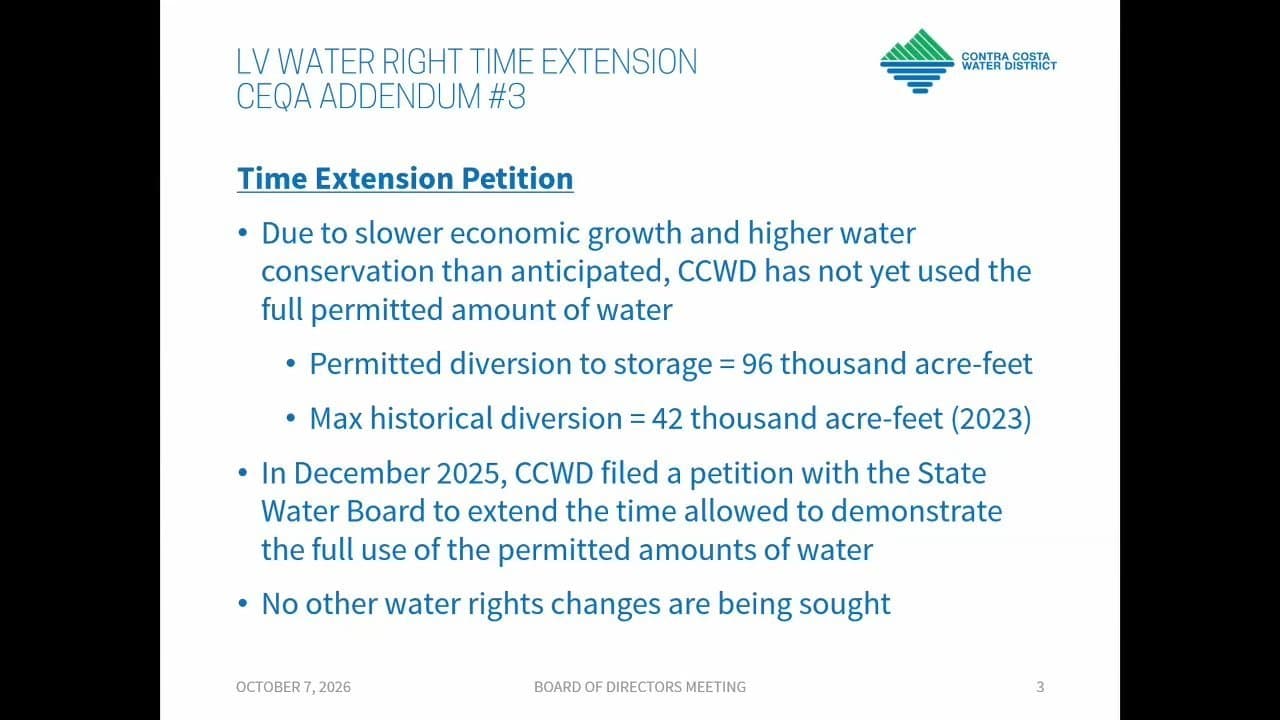
Why it matters: Water right Permit 20749 covers nearly 96,000 acre-feet. Losing part of it would reduce the district's flexibility as the climate grows less predictable and regulation of the Sacramento-San Joaquin Delta tightens.
Where things stand: The State Water Resources Control Board issued the permit in 1994, with a Dec. 31, 2025, deadline to show full use of the water. In 2023 the district used only about 42,000 acre-feet. "Our customers conserved more water than we anticipated when we were doing the planning for the original reservoir in the '90s," said Water Resources Manager Lucinda Shi. She said a slower economy also reduced demand.
The district filed for a time extension before the deadline passed. State Water Board staff then asked for a narrower environmental analysis limited to the district's own operations. District staff prepared Addendum No. 3, which found no new or more severe impacts. Shi said the request is narrow: "There are no other water rights changes being sought with this petition." The costs were already in the budget.
Martinez asked how often extensions are granted and whether the timing of the filing matters. "The success rate is very high for permit extensions of time," said Legal Counsel Doug Cody. He added that the environmental review does not have to be completed when the petition is filed. Murphy confirmed the petition was filed before the deadline.
Avila stressed that regulatory limits, not only conservation, have held down the district's water use: "It's not just because we have less demand than normal."
Decisions and stakeholder impacts: The board adopted Resolution 26-021, approving Addendum No. 3, on a motion by Martinez seconded by Young. The voice vote was unanimous (For: 5, Against: 0, Absent: 0). The vote preserves the district's ability to use its full permitted amount in the future.
What's next: The extension petition remains before the State Water Resources Control Board.
Directors Take Canal and Mussel Concerns to D.C.
Why it matters: The district is seeking federal and state support for its largest challenges. Meanwhile, regional housing and parks decisions may affect its finances and operations.
Where things stand: Holdaway described meetings in Washington, D.C., with legislators, their staff and the U.S. Bureau of Reclamation. "We were providing updates and information regarding tidal transfer, canal replacement project, golden mussels, and a discussion on water affordability," she said.
Martinez reported on a Contra Loma Lagoon workshop and a presentation by the Bay Area Housing Finance Authority. He warned that regional housing initiatives "will have an impact on how we provide service and how we are paid or not paid for connections, connection fees."
What's next: Avila said the district will finish evaluating a possible Project of Statewide Significance designation only after its vision rollout in early 2027. Murphy also highlighted Water and Wastewater Professionals Appreciation Week.
Calendar contest: The district recognized 14 young artists, ages 8 to 18, chosen from 114 entries submitted from 12 of the district's 13 cities. The 2027 calendar features the Contra Costa Canal, and the district will print 5,000 copies.
Consent calendar: Items 2 through 7 passed unanimously, 5-0, on a motion by Young seconded by Holdaway.
Retirement benefits report: Directors offered no comments on the Sept. 3, 2026, report from the Retirement and Other Post-Employment Benefits Committee.
Closed session skipped: A planned closed session on labor negotiations related to the general manager's employment was not held.
Looking ahead: The board's next meeting is Oct. 21, 2026, at 6:30 p.m. Watch for the realignment job classifications in early November.