Board of Directors - Apr 15, 2026 - Regular Meeting

Board of Directors - Apr 15, 2026 - Regular Meeting

Board of DirectorsContra Costa Water DistrictApril 15, 2026

Sources:

Locunity is a independent informational service and is not an official government page for this commission.We use AI-assisted analysis and human editorial review to publish information.

Bay-Delta Plan Threatens 12% Water Supply Cut as Golden Mussels Spread Across District

The Contra Costa Water District Board of Directors faced a pair of sobering briefings April 15 — one on an invasive species now confirmed at virtually every intake, the other on a state regulatory plan that could slash water deliveries in the years the district needs them most. Together, the two threats signal a new era of rising costs and operational complexity for the East Bay water provider.

  • Bay-Delta Plan nearing October 2026 adoption could reduce water supply by 12% in critically dry years — and up to 34% under a stricter flow threshold
  • Golden mussels detected at all CCWD intakes and Los Vaqueros Reservoir, with $925,000 in response costs this fiscal year alone
  • Staff identifies likely errors in the state's environmental analysis that underestimate impacts on the district
  • District doubles employee participation in educational programs, builds new internship pipeline with City of Antioch and Mt. Diablo Unified School District
  • Canal pool cleaning complete; Rock Slough diversions and Los Vaqueros filling resume, adding roughly 5,000 acre-feet of stored supply

The Water Supply Squeeze: State Plan Poses Biggest Regulatory Threat in Years

The basics: The State Water Resources Control Board released a revised draft Bay-Delta Plan in December 2025 that would reset how much water can be drawn from the Sacramento-San Joaquin Delta — the source that supplies CCWD and much of the state. The plan offers two implementation pathways: a voluntary agreements track called Healthy Rivers and Landscapes, and a regulatory track requiring 55% of unimpaired flow year-round (adjustable to 35% for water supply). The State Board is targeting adoption by October 2026, with implementation taking two or more years beyond that.

Why it matters: Under the 55% unimpaired flow pathway with water supply adjustments, total Delta water supply would drop by an average of 5% — but by 12% in critically dry years, exactly when the district's customers and ratepayers are most vulnerable. At a higher 65% threshold, the dry-year cut reaches 34%.

Where things stand: Science and Policy Manager Deanna Sereno walked the board through a detailed technical review finding the state's own CEQA analysis contains likely errors. "We identified likely errors in the CEQA analysis. And it means that it really underestimates impacts on us and it could really change impacts on others as well," she said. The key flaw: the state's modeling assumes CCWD can offset lost water rights by purchasing additional Central Valley Project supply — an assumption contradicted by recent CVP allocation cuts to public health and safety levels.

Sereno quantified the stakes bluntly: "The change in water supply in the average of the critically dry years is 1,166,000 acre-feet. And that's a 12% reduction in water supply." She warned that the 65% flow scenario was even more dire: "That's a 34% reduction in water supply in critical years. So 65% unimpaired flows is a substantial water supply impact in times where we're really at public health and safety. There is no more juice in that lemon."

The other side: The voluntary agreements pathway — which would cost CCWD roughly $1 million per year — has been shortened from 15 to 8 years, but Sereno flagged fundamental enforceability concerns. "For the voluntary agreements or the Healthy Rivers and Landscape Program to be successful, it must be enforceable. Absolutely must be enforceable. There must be new water in the system," she said.

Complicating the picture further, federal and state executive orders issued in late 2025 directed agencies to increase Delta water supply, creating inconsistencies between federal and state Endangered Species Act requirements. New litigation filed in March 2026 challenges compliance with the federal permits. And a separate initiative — the "Water Blueprint for the San Joaquin Valley" — advocates taking an additional 1.3 million acre-feet from the Delta, which CCWD staff are monitoring closely to ensure any changes remain science-based and do not degrade Delta water quality.

Sereno also detailed the stark difference between CCWD's fish screen technology and the louver systems at the state and federal export facilities in the South Delta: "Of the salmon that reach that facility, 75% are eaten before they even get collected and trucked into the Delta. For smelts, it's more like 95%."

Decisions: No action was required. Board President Ernesto Avila praised staff expertise and framed the issue in household terms: "These regulations are unfunded mandates that we have to deal with. Those are just the parameters that are given to us and we have no choice but to abide by them and accommodate them or mitigate them in some way."

What's next: The State Board targets Bay-Delta Plan adoption by October 2026. CCWD staff will continue engaging in the regulatory process, and the district's identification of CEQA errors gives it potential leverage in proceedings and any subsequent litigation.


Nearly $1M and Counting: Golden Mussels Reach Every Corner of the System

Why it matters: Golden mussels — first detected in the Delta in fall 2024 — have now been confirmed at Old River, Middle River Pump Station, Contra Loma Reservoir, Mallard Reservoir, and Martinez. Most alarmingly, environmental DNA testing has detected the invasive species at Los Vaqueros Reservoir, the district's primary storage facility. The organisms clog small-diameter cooling lines that protect the district's largest pumps — infrastructure that would take years to replace if damaged.

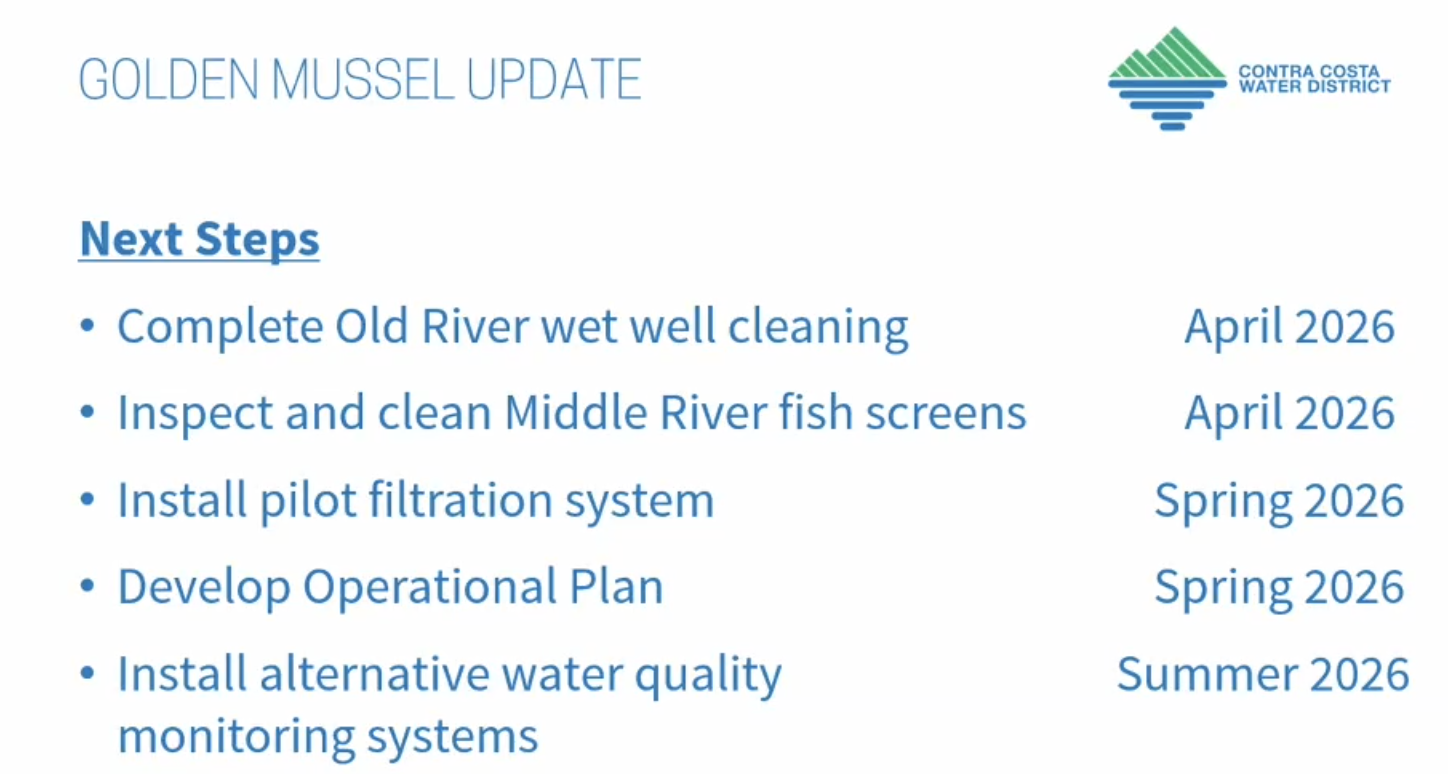
Where things stand: Water Operations Manager Daniel McVeigh laid out a five-pronged response: doubled inspection frequency, operational adjustments to intake cycling, expanded monitoring with artificial substrates and bio boxes, regional research partnerships with UC Berkeley, UC Santa Barbara, and the University of Toronto, and development of a formal invasive species control plan. The maintenance team is fabricating in-house filtration devices for pump cooling lines at Old River, and the district is piloting UV treatment with University of Toronto researchers.

McVeigh was direct about the scope: "So to date we have spent $200,000 on our golden mussel response. We do anticipate another $725,000 through the end of fiscal year 2026." Ongoing costs are expected to run $100,000 to $300,000 annually, and golden mussels have been added to the FY27 capital improvement plan. The district has secured $130,000 from the Water Research Foundation and $72,000 from the Bureau of Reclamation, with efforts underway to obtain $2 million in federal appropriations.

On the Los Vaqueros detection, McVeigh acknowledged the operational tension: "It could very well be that we have golden mussels there already. So I think a conversation that we would have as a leadership group and operations team to say, is this the right time? Do we have a window?" Director Patricia Young asked whether adjusting reservoir filling schedules to avoid mussel spawning periods would limit water supply. McVeigh confirmed it would, calling it a leadership-level operational decision.

Board President Avila underscored the systemic risk: "These are small piping that are impacting some of the largest pumps in our system. If something goes wrong with one of those pumps, we're not talking about something we're going to order right away and get a replacement. These take years to fabricate and to get set in place."

He also highlighted AB 2032, legislation co-sponsored by CCWD that would streamline chemical treatment approvals and fund mussel research. Avila testified before the Assembly Water, Parks and Wildlife Committee in support of the bill.

What's next: Staff will continue pilot filtration and UV testing, finalize the invasive species control plan, and bring the board ongoing cost estimates as the response matures.


Workforce Pipeline Takes Shape as 40% of Staff Near Retirement

Why it matters: With nearly 40% of CCWD's workforce eligible to retire, the district is racing to build a recruitment and development pipeline that can sustain reliable water service for the next generation.

Where things stand: DEI Manager Toya Cooper reported significant progress on several fronts. The district replaced its former Supervisors Academy with the DEAL program — Discover, Explore, Advance, Lead — which opens leadership development to all employees regardless of position. "The framework for DEAL is leadership at every level. So that you don't need to hold a formal leadership position in order to develop your leadership skills," Cooper said.

The rebranded Educational Assistance Program, which reduced barriers to access, has doubled participation compared to all of FY2025. New workforce pipeline partnerships were established with the City of Antioch and Mt. Diablo Unified School District, joining existing programs with Central San and CAAWEF. A summer internship program will bring up to nine high school students to CCWD.

Cooper also presented a finalized management vision statement for DEI at CCWD: "Our mission demands it. Our employees represent it. Our community deserves nothing less."

Director Young praised the program's inclusive approach: "What really impresses me is that the inclusiveness of everything that you're doing. Sometimes people feel left out of DEI if they don't fit into certain little niches here and there, and everything that you're promoting is on the other end of that spectrum. It's inclusive."

Board President Avila connected the work directly to operations: "When you've got nearly 40% of the workforce that could retire, that qualifies for retirement right now … we need to have that pipeline up and running."

What's next: A DEI strategic plan update is targeted for November 2026. Updated DEAL programming is expected by fall 2026, career pathway infographics for five job classifications by October 2026, and a mentorship pilot program launching in 2027.


Canal Cleaning Complete, Los Vaqueros Filling Resumes

General Manager Rachel Murphy reported that canal pool cleaning is finished and CCWD has resumed diversions at Rock Slough — its freshest, cheapest water source. Los Vaqueros Reservoir filling has also resumed, with approximately 5,000 acre-feet expected to be added through the end of May. The reservoir currently holds about 146,000 acre-feet.

Murphy also briefed the board on her attendance at an AMWA conference in Washington, D.C., where she noted growing bipartisan support for federal water affordability programs. "I'm seeing more of a recognition that if they continue to debate which agency should house the program, they're going to miss the affordability moment altogether," she said. A major failure of the Potomac Interceptor wastewater pipeline — releasing 240 million gallons of untreated sewage — has elevated infrastructure funding discussions in Congress.


Minor Items

  • Consent calendar approved 3-0 (For: President Avila, Director Young, Director Connstance Holdaway; Absent: Vice President Antonio Martinez (excused), Director John Burgh). Items included directors' business activities and expenses, April 1 meeting minutes, the April 16 warrant register, a $30,000 authority increase for Civicorps vegetation management services (new total: $230,000), and a $170,000 agreement with Paramount Elevator Corporation for District Center elevator modernization.
  • Director Young reported attending the Concord Mayor's conference on human trafficking, an East Bay MUD event, and ACWA Communications Subcommittee work on the use of AI.
  • Board President Avila detailed ACWA Region 1, 2, and 5 board meetings and noted the ACWA executive director recruitment is in finalist interviews. He also described a new state task force on projects of statewide significance, with its first meeting scheduled for May 22.
  • Closed session: The board met in closed session regarding potential initiation of litigation (one case). No reportable action was taken. The meeting adjourned at 8:49 p.m.