Board of Directors - Jun 17, 2026 - Regular Meeting
Board of Directors • Contra Costa Water DistrictJune 17, 2026
Locunity is a independent informational service and is not an official government page for this commission.We use AI-assisted analysis and human editorial review to publish information.
CCWD Adopts $516.6M Budget as Chemical Costs Surge and Federal Grant Opens New Funding Pipeline
The Contra Costa Water District (CCWD) board locked in a half-billion-dollar spending plan Tuesday night, absorbing a 47% spike in water treatment chemical costs while positioning the district's landmark Canal Replacement Program to tap an unlikely funding source: the U.S. Department of Defense. The budget and a string of unanimous procurement votes set the district's financial trajectory for the next two years amid tariff uncertainty, tightening regulations, and aging infrastructure.
$516.6M biennial budget adopted with a 4% first-year increase driven by chemical costs, insurance hikes, and new state fleet mandates
Water treatment chemicals approved at $7.5M — up 47% from last year — after aluminum sulfate and sulfuric acid prices spiked
$1.3M federal defense grant secured for geotechnical work at the Military Ocean Terminal Concord, linking canal replacement to military readiness
$57M in routine procurement authorized over two years, with a new electronic bidding platform and a potential increase in the general manager's spending authority under review
Dam safety contract extended to $2.4M for Contra Loma and Martinez title transfers from federal to state oversight
Half-Billion-Dollar Budget Absorbs Cost Shocks
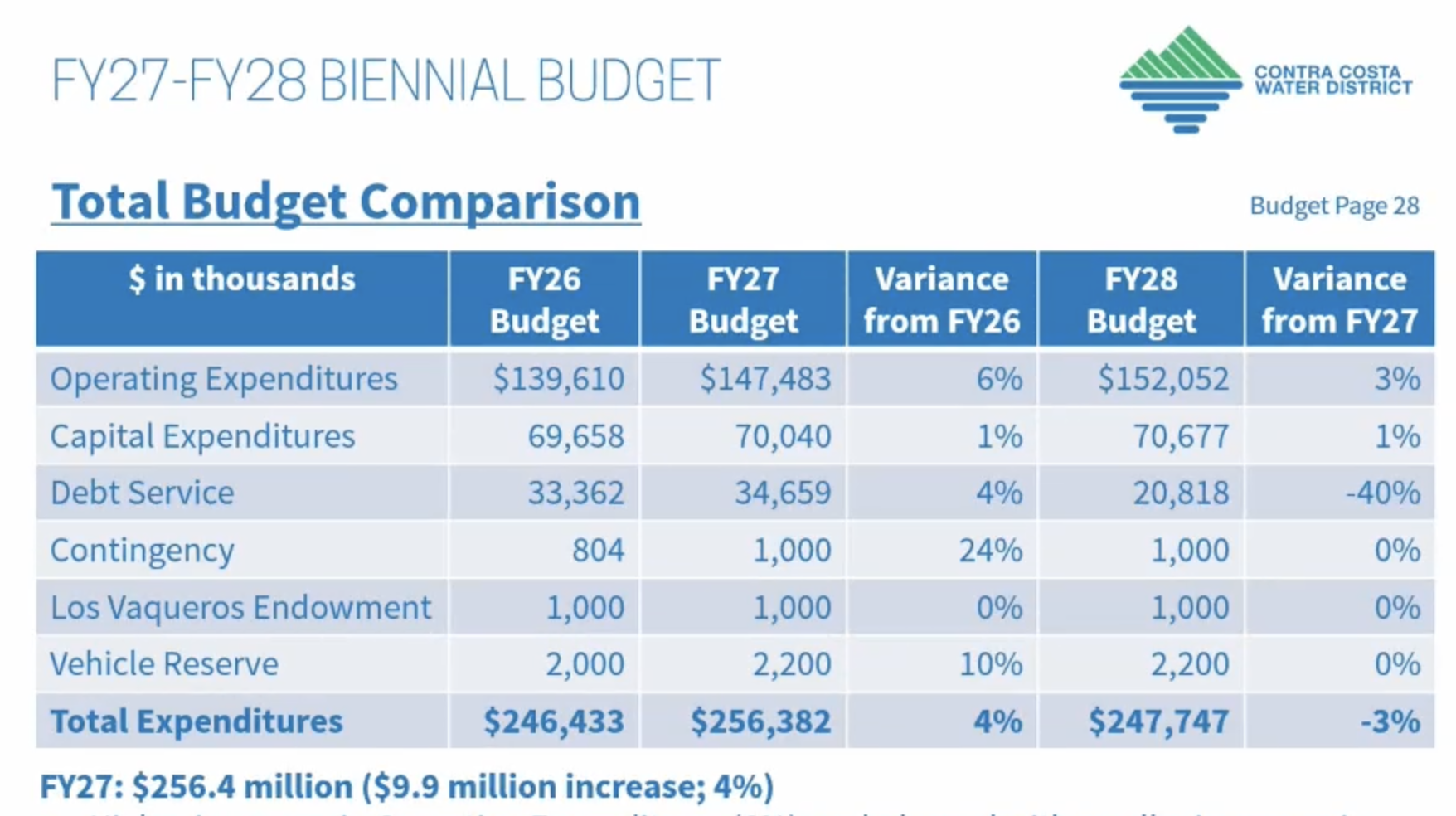
The board unanimously adopted Resolution 26-014, approving a $516.6 million biennial budget for fiscal years 2027 and 2028 — a plan shaped less by district ambition than by forces largely outside its control.
Why it matters: External cost drivers — from chemical prices to state mandates — are growing faster than the rate increase the district is asking customers to absorb. The budget signals that CCWD is eating some of those costs internally, a dynamic that could prove unsustainable if commodity prices stay elevated.
Where things stand: FY27 spending rises 4% overall (6% on the operating side, 1% on capital), with the largest single driver being a 47% increase in treatment chemical costs. Liability insurance is up 10–11%. Purchased water costs rise 6%. New regulatory obligations include a $4.2 million incidental take permit mitigation credit and $300,000 in annual fish monitoring. The California Air Resources Board's Advanced Clean Fleets rule requires a new fleet supervisor position, $200,000 in charging infrastructure, and 30–50% higher vehicle purchase costs.
Staffing grows from 329.75 to 337.5 full-time equivalent positions in FY27, with 4.75 permanent additions and three positions tied to the Canal Replacement Program. FY28 adds another three positions to reach 340.5 FTE.
FY28 projects a 3% operating increase but a 3% overall budget decline, thanks to the payoff of Series T bonds. Up to $12.45 million in capital spending delayed in FY26 by permitting and equipment issues is being re-budgeted into FY27 across 23 programs.
Board President Ernesto Avila framed the cost picture bluntly:
"If you were to total up all the external cost drivers impacting us, it's beyond the request you're actually asking for tonight. What's happening is that this district is doing what it can to reduce cost in other areas, to mitigate and try to minimize the impact of these external cost drivers."
He underscored the staffing additions as essential to the district's largest-ever infrastructure initiative:
"These are positions we're going to need because the program we are about to undertake is a 10-year-plus project."
Vice President Antonio Martinez pointed to compounding pressures from Washington.
"The president's administration at the federal level has created tariffs and uncertainty in all kinds of sectors," he said, noting diesel prices at $8 per gallon and the challenge of insulating ratepayers from supply chain volatility.
Director of Finance Herman Williams summarized the budget's central tension:
"This budget balances rising operating costs with strategic capital investments from the 10-year capital improvement plan while also managing debt."
Decisions: Adopted unanimously by voice vote (For: 5, Against: 0, Absent: 0).
What's next: The budget takes effect July 1. Board members will monitor whether the cost pressures that shaped this plan — particularly chemicals, tariffs, and fleet mandates — intensify enough to force a mid-cycle adjustment or accelerate the next rate discussion.
Chemical Costs Spike 47%, Board Awards Dual Vendors
The board authorized $7.5 million in water treatment and aquatic chemical purchases for FY27 — a 47% increase over FY26's $5.1 million budget, and 26% above the adjusted $6 million figure approved at the June 3 workshop.
Why it matters: Water treatment chemicals are a non-negotiable operating cost: the district cannot deliver safe drinking water without them. A nearly 50% cost jump in a single year, driven by global commodity markets, illustrates how quickly external forces can reshape a utility's finances.
Where things stand: CCWD solicited bids for 25 chemicals — 12 for treatment, 13 for aquatic management. Five treatment chemicals are procured through the Bay Area Chemical Consortium, a cooperative of 65 agencies representing roughly $3.8 million in purchasing power. Six chemicals saw average price decreases of 8% (cationic polymer down 10.1%, liquid oxygen down 7.1%), but six others rose an average of 17.5%. The sharpest increases hit aluminum sulfate at 47% and sulfuric acid at 22%. All 13 aquatic chemicals rose between 2.5% and 33.6%.
Volume changes reflect two operational shifts: the Randall Bolt Treatment Plant is converting from chlorine gas and aqueous ammonia to sodium hypochlorite and liquid ammonium sulfate for safety reasons, and the Brentwood treatment plant is implementing EarthTech at full scale.
Director of Finance Herman Williams recommended awarding two vendors per chemical:
"Our recommendation this year includes approval of two vendors for each chemical to provide" supply chain flexibility.
The other side: Vice President Antonio Martinez asked whether additional chemicals would be needed for golden mussel control beyond EarthTech:
"Are there any other chemicals that we're looking at that are not on this list that we might be getting adding to the list?"
General Manager Rachel Murphy said no additional chemicals are currently planned, noting that
"UV is something that is being pilot-tested by some agencies to look and see how that might help with golden mussel control," along with different filtration systems.
Decisions: Approved unanimously by voice vote (For: 4, Against: 0, Absent: 1). Board President Ernesto Avila departed due to an emergency.
Defense Department Grant Opens New Funding Avenue for Canal Replacement
In a novel military-civilian partnership, the board adopted Resolution 26-015 to enter a $1.4 million financial assistance agreement with the Office of Local Defense Community Cooperation (OLDCC), a Department of Defense agency, for geotechnical work at the Military Ocean Terminal Concord (MOTCO).
Why it matters: The OLDCC grant — $1.3 million federal, roughly $100,000 in CCWD cost share — is the district's first federal defense grant. If the relationship deepens, it could open a significant new pipeline of funding for the broader Canal Replacement Program, the district's most expensive infrastructure initiative.
The basics: MOTCO was identified as a priority military installation whose readiness benefits from the Canal Replacement Program. Grant Specialist Katie Kelley explained the connection:
"The Canal Replacement Program contributes to MOTCO's resiliency and readiness by reducing inundation risk, improving water supply resiliency to support firefighting capabilities, and providing an opportunity for improved access for the installation."
Staff pursued the MOTCO partnership in summer 2025, leading to an OLDCC nomination in April 2026. The 18-month grant, running August 2026 through January 2028, funds geotechnical evaluations, aerial surveying, potholing, and soil corrosivity testing to advance 30% design for the canal replacement segment through the military base.
Vice President Antonio Martinez thanked staff and encouraged leveraging the relationship for other Canal Replacement locations.
Decisions: Adopted unanimously by voice vote (For: 4, Against: 0, Absent: 1 — Avila).
What's next: GM Rachel Murphy announced she will travel to Washington, D.C., for meetings including a briefing with OLDCC headquarters leadership to present the broader synergies between the military base and canal replacement.
$57M in Routine Procurement Gets New Electronic Platform
The board authorized $28.3 million in FY27 and $28.7 million in FY28 for routine goods and services exceeding the general manager's $150,000 delegated spending authority — a consolidated procurement list covering everything from facility security and canal liner repairs to vegetation management and road repairs at Los Vaqueros.
Why it matters: The district is transitioning to the Planet Bids electronic procurement platform and expanding vendor outreach through community events and an open house workshop — steps designed to increase competition and reduce costs.
Where things stand: Items are procured through invitation to bid (lowest responsive bidder), request for proposal (technical evaluation), or sole source (proprietary/unique knowledge). Key increases cover diving services, electrical maintenance, tree trimming at the Military Ocean Terminal Concord, and canal liner repairs.
Vice President Antonio Martinez raised a broader governance question, asking whether the $150,000 delegated authority threshold — the level above which the board must approve individual purchases — should be increased.
"I do have a question about the delegated authority number — $150,000 for the general manager. Because we discussed, I think, a couple years back of increasing that amount."
GM Rachel Murphy committed to analyzing the question and bringing a recommendation to the finance committee.
Decisions: Approved unanimously by voice vote (For: 4, Against: 0, Absent: 1 — Avila).
Dam Safety Contract Extended for Federal Title Transfer
The board authorized a sole-source amendment to GEI Consultants' dam monitoring contract, bringing the total agreement to $2.4 million. The work supports compliance with dam safety requirements from the California Division of Safety of Dams, the U.S. Bureau of Reclamation, and local reclamation districts, and assists with transferring jurisdictional oversight of Contra Loma and Martinez dams from the Bureau of Reclamation to the state.
President Ernesto Avila explained the rationale for the sole-source approach:
"The thing that's always been beneficial about GEI is the fact that they have former Division of Safety of Dams chiefs that actually work for them at the staff level."
Decisions: Approved unanimously by voice vote (For: 5, Against: 0, Absent: 0).
Looking Ahead: Golden Mussel Bill, D.C. Travel
GM Rachel Murphy reported on several developments: the East Cypress Road widening project in Oakley, where the contractor has shifted traffic to complete a canal box culvert replacement, and her upcoming D.C. travel for AMWA board meetings, the AWWA Annual Conference, legislative visits, and the OLDCC headquarters briefing.
A Senate hearing on AB 2032, the golden mussel bill co-sponsored by CCWD that includes permit streamlining provisions, is scheduled for next Tuesday. President Ernesto Avila will testify alongside Assemblymember Rhodesia Ransom (AD 13).
Vice President Antonio Martinez reported on CSDA board and fiscal committee meetings, CARB Advanced Clean Fleets working group activities — noting comment letters from ACWA and CMUA opposing language on rents and leases — East Bay Leadership Council meetings with Assemblymember Buffy Wicks (AD 14) on housing and ADU permitting, Central Sanitary District's 80th anniversary, and Sites Reservoir water rights petition discussions.
Minor Items
Consent calendar (items 1–8) approved unanimously (5-0), including: Resolution 26-012 adopting the 2025 Urban Water Management Plan; Resolution 26-013 certifying the FY27 property tax levy; a two-year, $448,000 materials testing contract with Consolidated Engineering Laboratories; a five-year extension of the levee road access license with Contra Costa County Flood Control and Water Conservation District (up to 20 years total); directors' compensation and ACWA travel expenses; the June 18 warrant register; the June 3 meeting minutes; and a modified pressure service agreement for a Walnut Creek property.
Operations and Engineering Committee post-meeting report (May 21) received with no discussion.