Board of Directors - Mar 18, 2026 - Regular Meeting
Board of Directors • Contra Costa Water DistrictMarch 18, 2026
Locunity is a independent informational service and is not an official government page for this commission.We use AI-assisted analysis and human editorial review to publish information.
Board Honors Retiring 22-Year Director as Snowpack and Grant Funding Pressures Mount
The Contra Costa Water District Board of Directors said goodbye to one of its longest-serving members Wednesday, unanimously adopting a resolution honoring Director John Berg for 22 years of service — a farewell that drew commendations from Congress, the County Board of Supervisors, and the City of Concord. Beyond the tributes, the board received sobering updates: California's snowpack has cratered to 40% of average, and competition for the grant dollars that keep water bills down is only getting fiercer.
Board unanimously honors Director John Berg's 22 years of service with Resolution 26-006 and commendations entered into the Congressional Record
California snowpack plummets to 40% of average despite reservoirs remaining at least 80% full; Colorado River runoff projected at just 27%
District managed $12 million in grant agreements in 2025, but board members warn that shrinking federal and state budgets threaten future funding
Healthcare funding cuts flagged as a water affordability risk — more customers may need bill assistance
Capitol Outreach Day set for next week to push Sacramento on canal replacement, Golden Mussel response, and infrastructure funding
A 22-Year Tenure Comes to a Close
The centerpiece of the meeting was the adoption of Resolution 26-006, a formal tribute to Director John Berg, who represented Division 2 — covering Martinez, Pleasant Hill, Port Costa, and part of Concord — since his appointment in 2004. Berg, a retired environmental engineer with 42 years of experience in water and wastewater projects, served on nearly every standing committee, chairing the Public Information and Conservation Committee and sitting on Operations and Engineering, Finance, and the Retirement and OPEB Joint Advisory Committees.
Why it matters: Berg's departure removes deep institutional engineering expertise from a five-member board and opens a Division 2 seat at a time when the district faces major infrastructure decisions, including the Canal Replacement Program and ongoing Los Vaqueros Reservoir management.
Where things stand: The tributes were extensive and personal. Gabriella Amini, representing Congressman Mark DeSaulnier's office, read a statement entered into the Congressional Record of the 119th Congress. "John's wealth of knowledge has provided him with the tools necessary to guide the district as it prioritize regional collaboration, transparency, spending and making evidence-based decisions that will benefit customers for generations to come," she read on behalf of the congressman.
Concord Mayor Laura Nakamura presented a certificate of appreciation, praising Berg's volunteerism with Meals on Wheels and his leadership philosophy. "You are a respected community leader who has added immeasurable value to Contra Costa Water District, championing the way forward for the organization while keeping the customer's best interests at heart," Mayor Nakamura said. The Contra Costa County Board of Supervisors also approved a resolution, and the Pleasant Hill City Council plans to present a separate resolution at a future Rotary meeting.
Board members each delivered personal tributes. Board President Ernesto Avila recounted a 36-year friendship, describing how Berg mentored him through key career decisions. He recalled Berg winning a major ozonation project contract with nothing but an overhead projector and a transparency while competitors arrived with polished digital presentations: "John walks in with an overhead projector and a transparency, and he starts writing. That's his presentation. He won the job and it was a great, successful project," President Avila said.
Vice President Antonio Martinez credited Berg's institutional memory with keeping the board grounded during the Los Vaqueros Reservoir expansion discussion. "Your historical background and your knowledge kept us on the rails when it came to the principles that you participated in at the very beginning of the initial creation of Los Vaqueros Reservoir," Vice President Martinez said.
Director Patricia Young praised Berg's character alongside his technical acumen: "Your engineering knowledge and expertise has certainly been an asset for the board and the community we serve. What I have found to be the most valuable, enduring is your grace and eloquence."
In his farewell, Director Berg reflected on his accidental entry into public life — "I was the most apolitical professional engineer in this county for sure. I don't think I ever had a bumper sticker on my car ever" — before urging staff and attendees to consider public service. "The world, our community, the cities we live in, are all filled with problems and challenges and needs that all of you can contribute to solving," he said. "The future will be better than the past has been because of the contributions that all of you can make."
During general public comment, Robyn Kuslits, a Concord resident, also congratulated Berg on his retirement, praising his leadership in ensuring clean water during the 10 years she has lived in the area.
Decision: Resolution 26-006 adopted unanimously (For: 5, Against: 0, Absent: 0), moved by Vice President Martinez, seconded by Director Connstance Holdaway.
$12 Million in Grants, Growing Competition
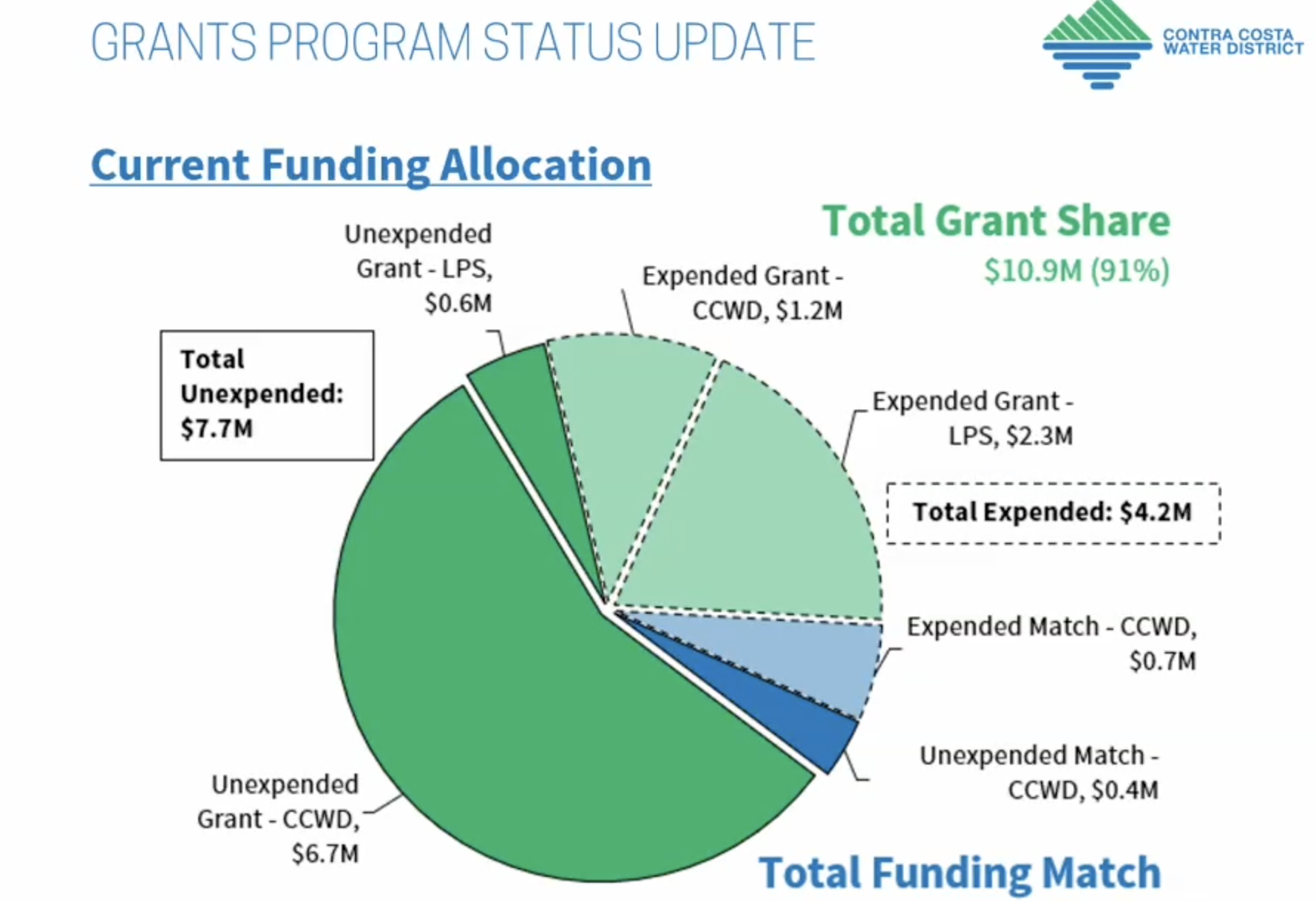
Grant Specialist Katie Kelly presented a comprehensive update on the district's grants program, reporting that CCWD managed seven agreements totaling $12 million in calendar year 2025 — $10.9 million in grant funding and $1.1 million in district match. The portfolio included one federal agreement, four state agreements, one FEMA public assistance claim, and one California Conservation Corps CivicCorps partnership.
Why it matters: Every grant dollar won reduces pressure on customer water rates. With both state and federal budgets tightening, the pipeline that offsets rate-funded expenditures faces increasing risk.
Where things stand: By year-end, approximately $4.2 million — about 35% — had been expended, with $7.7 million remaining. Staff submitted five new funding applications totaling approximately $1.2 million, with one partial award of roughly $71,000 from the Bureau of Reclamation for UC Berkeley and UC Santa Barbara research on the Golden Mussel life cycle. Both fiscal-year KPIs were met at 100%: all deliverables submitted on time and all eligible projects pursued.
The Canal Replacement Program funding strategy — developed across departments — targets four areas: monitoring debt financing options including WIFIA loan eligibility, tracking grant opportunities including military MOTCO funding and congressional directed spending, initiating advocacy, and updating funding projections. A draft Grants Program Strategic Plan covering fiscal years 2026 through 2032 is under final review.
The other side: Vice President Martinez raised pointed concerns about whether the grants team is adequately staffed for a more competitive environment. "The competition is going to become more fierce when it comes to grants. The budget for the state is really tight and it will continue to be tight for the next at least five years," he said.
General Manager Rachel Murphy acknowledged the challenge but noted the team brought on consulting support to help triage applications. President Avila emphasized inter-agency collaboration as a force multiplier: "The more we're able to work with other agencies and collaborate, that enhances the ability to get enhanced the prioritization of our grant requests."
What's next: Key 2026 activities include executing two new agreements for Golden Mussel research and a Future Water Supply Study, potentially two more for Advanced Metering Infrastructure and Lawn/Garden programs, continued Canal Replacement Program funding strategy implementation, and ongoing pursuit of new opportunities.
Snowpack Crash Signals Uncertain Water Year
General Manager Rachel Murphy delivered a hydrology update that underscored how quickly California's water outlook can shift.
Why it matters: Despite a strong start to the precipitation season with November storms and good early snow, the state experienced a sudden dry turn. Snowpack across California has dropped to about 40% of average, with concerns about accelerated snowmelt and evaporation. Colorado River basin runoff projections for 2026 sit at roughly 27% of average — at a time when the seven basin states have not reached agreement on new operating rules.
The silver lining: upstream California reservoirs are at least 80% full, and Los Vaqueros Reservoir is over 90% full. CCWD's current Bureau of Reclamation allocation is at 100% with no anticipated change, though South-of-Delta Central Valley Project and State Water Project contractors face lower and adjustable allocations. Murphy reinforced a message of prudent water use, noting that these sudden extremes require active engagement and careful storage and outflow management.
What's next: President Avila, Director Holdaway, Public Affairs Director Jennifer Allen, and General Manager Murphy will travel to Sacramento next week for the annual Capitol Outreach Day, meeting with state legislators to advocate for Canal Replacement Program funding, Golden Mussel response, infrastructure investment, and water affordability.
Minor Items
Consent calendar items 1 through 5 approved unanimously (For: 5, Against: 0, Absent: 0), including a revised board activities calendar adding a conference. Moved by Director Young, seconded by Vice President Martinez.
Director Young flagged that healthcare funding cuts discussed at a Hercules Mayor's Conference could push more customers to need water bill assistance — "there probably will be a rise in people who will need assistance for their water," she said.
Vice President Martinez reported a clean audit opinion approved by the CSDA audit and fiscal committee for 2025, and noted an ACWA Energy Committee discussion on the CARB 15-day comment period and Terra Verde energy project management options.
Vice President Martinez highlighted an impressive Contra Costa County Science Fair project by a high school student on spiral wound solar evaporation technology for ammonia recovery from wastewater.
President Avila reported on an international trip to South Korea, Japan, Taiwan, and Hong Kong, observing community-based water conservation practices that he said validate CCWD's education-first approach: "They've done such a great job in educating the community that the community responds when drought occurs."
President Avila noted that Central Valley subsidence is reducing State Water Project conveyance capacity by 10–15%, based on discussions at ACWA Region 6/7 and Region 8 meetings, and flagged San Diego desalination cost challenges as a cautionary data point.