
CCTA Ties $1.4M Mobility App Rescue to Federal Sign-Off
Authority Board • Contra Costa Transportation AuthorityNovember 19, 2026
Locunity is an independent informational service and is not an official government page for this commission. All information is sourced from public footage and an analysis of official agendas with the aid of responsible, fact-checked AI. to report an error or omission.
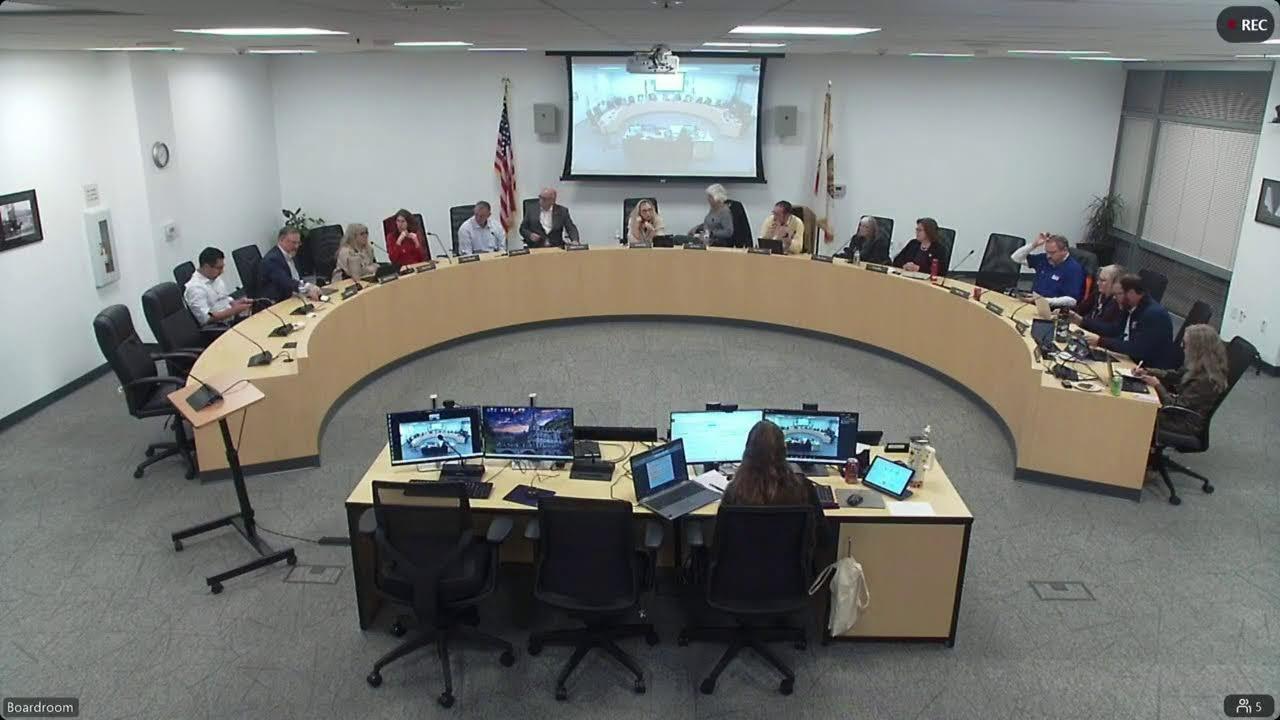
The Contra Costa Transportation Authority (CCTA) board spent nearly an hour on its Nov. 18, 2026 agenda deciding whether to put more local money into a nine-year-old federal pilot that has yet to carry a passenger. Commissioners approved roughly $1.4 million from the Fund Exchange Reserve, with a condition that no money moves until the Federal Highway Administration extends an expired grant. The board also unanimously advanced a $208M freeway interchange, an El Cerrito street safety contract and a 365-intersection signal upgrade.
- Mobility On Demand pilot gets reserve funding, 10-0, but only after FHWA approves a grant extension
- $208M I-680/SR-4 interchange cleared for bidding; Phase 1 connector still unfunded
- $5.62M countywide smart signals contract goes to D.C. Electric after the board rejects a rival's protest
- $8.29M Richmond Street safety contract awarded in El Cerrito despite some resident objections to parking removal
- Leaders previewed "difficult" expenditure plan trade-offs ahead of a Jan. 28-29 workshop and a possible 2028 measure
A Stalled Pilot Gets One More Chance
The basics: Innovate 680 Mobility On Demand is a trip-planning and on-demand travel app funded by a roughly $12 million federal Advanced Transportation and Congestion Management Technologies Deployment (ATCMTD) grant. The effort began in 2017-18.
Why it matters: The board is weighing sunk costs against federal credibility. A walkaway could hurt CCTA's standing for future federal grants. Spending more without guarantees risks reserve dollars on a project commissioners openly doubted.
Where things stand: Executive Director Timothy Haile walked through a troubled history. Partners failed during the pandemic, AAA left the GoMentum Station test site, and a BART extra-work claim was negotiated down from $1.3M to $550,000. The FHWA grant agreement expired in September 2025.
The requested contract amendments total $1.476 million:
- BART: $947,000, including the $550,000 previously approved
- Excelsior: $799,000, swapping 10 Chevy Bolts for leased Priuses and adding fleet software
- AMG: project management
The draw would cut the Fund Exchange Reserve to $5.5M. Haile said the pilot would run as an 8-month demonstration on the 680 corridor, followed by a UC Berkeley evaluation. He acknowledged staff has not been able to prioritize this grant over the agency's MEGA grant work. "We do have to finish this project," said Haile, pointing to federal commitments and CCTA's reputation.
The other side: Skepticism ran deep. "I don't know if I would jump into something like this again so rapidly," said Commissioner Chris Kelley.
Commissioner Ken Carlson questioned committing reserve money before FHWA acts. "I'm really cautious about throwing money after bad money because we've clearly spent 8 years and we don't even have a beta version to test any of this," Carlson said.
Amy Worth, ex officio member representing bus operators, made the case for demand. "People are really looking to find innovative ways of traveling beyond cars," Worth said, pointing especially to seniors.
Decisions and stakeholder impacts: Vice Chair Sue Noack proposed the compromise that carried the vote: "Not a single dime moves until FHWA says okay." Noack moved the resolution and Commissioner Aaron Meadows seconded it. It passed with For: 10, Against: 0, Absent: 1 (Arnerich). Kelley called his vote "a very weak yes."
The condition limits CCTA's financial exposure while keeping BART, Excelsior and AMG engaged. Corridor travelers, particularly seniors, are the intended beneficiaries if the app ever launches.
What's next: The money stays frozen until FHWA approves the grant extension. The 8-month demonstration and Berkeley evaluation would follow.
Interchange Fix Heads to Bid, Phase 1 Still Unfunded
Why it matters: The I-680/State Route 4 interchange in central Contra Costa has a short "weave," where merging and exiting traffic cross paths in a tight stretch. Commissioners called it a decades-old safety problem.
Where things stand: Staff member Brandon Hays described the Phases 2A and 4 package:
- A 2,500-foot flyover
- Auxiliary lanes
- A widened Walnut Creek bridge
"The estimated construction cost for the projects is $208 million, with the funding coming from RM3 and TCEP," Hays said. RM3 is the Bay Area's bridge toll measure. TCEP is the state's Trade Corridor Enhancement Program.
Plans, permits, environmental revalidation and utility agreements are complete. Right-of-way certification is still pending at Caltrans and FHWA, which could delay the schedule. Staff targeted the following timeline:
- Dec. 4, 2026: California Transportation Commission allocation
- December: bids advertised
- March 2027: contract award
- May 2027: construction start
- End of 2030: completion
"It's been an issue for many decades, and I am so glad that we are fixing it," said Commissioner Diane Burgis.
The other side: Kelley asked about Phase 1, the next connector. Haile said the $210M in RM3 funds set aside for it fell short because of cost escalation. Federal applications also failed on scope. Interchange projects like this one "don't necessarily align with some of the current funding programs that are available," Haile said. He named the next expenditure plan as a potential source.
Decisions and stakeholder impacts: Resolution 26-55-P passed with For: 9, Against: 0, Absent: 2 (Arnerich, Banales). Burgis moved it and Carlson seconded. Commuters gain a safer merge. Phase 1 now competes with every other priority in the next sales tax plan.
Signal Upgrade Survives a Bid Protest
Where things stand: The countywide smart signals project will upgrade 365 intersections in every jurisdiction with video detection, cloud-based traffic management and transit signal priority, which gives buses extra green time. Design is split between two firms:
- DKS: east and central county
- HNTB: west and south county
Equipment from 13 vendors is already arriving.
Four responsive bids came in. D.C. Electric Group bid $5,621,334, far below the $10,037,287 engineer's estimate. Engineering Manager Andy Dillard said the savings came from traffic control, mobilization and systems integration.
The other side: Second-low bidder Tennyson Electric filed a protest on Oct. 19, 2026. "Ultimately, we rejected the bid protest and confirmed the intent to award," Dillard said.
Commissioner Mark Armstrong asked about redundancy, so that a single failure could not take down the whole network. "We don't have that concern of a system-wide or a county-wide failure at this stage," Dillard answered.
Decisions and stakeholder impacts: Resolution 2661-P passed with For: 10, Against: 0, Absent: 1 (Arnerich). Commissioner Carlyn Obringer moved it and Meadows seconded. The allotment is $6,745,601, which includes a 20% contingency.
Responsibilities are divided:
- Cities will own and maintain field hardware.
- CCTA will maintain the center-to-center and transit signal priority systems.
That leaves ongoing maintenance costs on local public works budgets.
What's next: Drivers should see improvements arrive incrementally starting in mid-2027.
El Cerrito Trades Parking for Safer Streets
Where things stand: The roughly $13M Richmond Street project covers about 1.8 miles between the El Cerrito del Norte and El Cerrito Plaza BART stations. It is backed by $8M in federal Safe Streets and Roads for All (SS4A) funds and includes:
- Curb bulb-outs at 15 intersections
- ADA ramps and rectangular flashing beacons
- Raised intersections and street trees
- Alternating-side parking with raised chicanes north of Mosier Lane
- Speed tables south of Mosier Lane
Eight responsive bids came in under the $9.5M estimate. McGuire and Hester won at $8,292,374. The resolution sets a $9,536,230 allotment, including a 15% contingency. It also authorizes a $150,000 purchase of 24 solar streetlight fixtures from VonRoche Lighting America. Kelley asked about the lights and the chicanes.
The other side: Some residents object to losing parking. Steve Price, founding member of El Cerrito Richmond Annex Walk and Roll, acknowledged those objections. He cited preschools, daycares and schools along the corridor, and argued a bike network needs more streets than the Ohlone Greenway. "My group feels that safe mobility should carry more weight than minor convenience," Price said. The board also received 15 written comments.
Decisions and stakeholder impacts: Resolution 26-59P passed with For: 10, Against: 0, Absent: 1 (Arnerich). Commissioner Rita Xavier moved it and Noack seconded. Families, cyclists and BART riders gain protected space, while drivers who park on the street lose some spaces.
What's next: Construction is expected to start in January 2027 and last about 10 months. It is one of five SS4A projects that must be delivered by April 2029.
Measure Win Sets Up Expenditure Plan Fight
Why it matters: CCTA is drafting its next transportation expenditure plan, which sets priorities for a possible 2028 ballot measure. That plan will divide limited dollars among three competing uses:
- "Return to source" money that flows directly to cities
- Transit
- Capital projects such as the interchange's Phase 1
Where things stand: "I would like to congratulate and thank everyone that had effort toward passing the RTM measure," said Board Chair Darlene Gee, referring to the regional transit measure.
Noack noted the measure's oversight requirement. "We have 18 months to come up with a very in-depth financial efficiency plan," Noack said.
Haile reported good financial news:
- The agency's AAA credit rating was reaffirmed.
- A bond sale saved $7.1M.
He also warned that adding money for return to source or transit means less for capital projects. "We're spreading around the same peanut butter," Haile said.
The other side: In his farewell remarks, Kelley urged colleagues to verify operating costs before adopting autonomous first/last-mile options. "Please don't abandon the fixed route buses," Kelley said.
During public comment, Chad Houston of the California Alliance for Jobs offered support for the next measure. "We are happy to assist, especially with polling as you ramp up for 2028," Houston said.
What's next:
- Jan. 28-29, 2027: board workshop on the draft expenditure plan
- December: regional transportation planning committee visits
- Ongoing: meetings with city managers and transit agencies
- Consent calendar approved with For: 9, Against: 0, Absent: 2 (Arnerich, Banales); no items were pulled.
- Federal grants: CCTA secured a new SS4A grant and an Intersection Safety Systems Challenge grant; the proposed MEGA grant obligation date is Dec. 7.
- Youth Transportation Working Group held its first meeting; youth survey results will be a board focus in December.
- Bollinger Canyon and Walk and Roll projects won awards; Haile also reported a GO-Biz trip to Singapore.
- Farewells: Kelley and Xavier attended their last meeting. "I'm going to miss every one of you," said Xavier.
The board met in closed session on the executive director's performance evaluation and reported no action.