
Transit Operators Warn of Deep Cuts if November Measure Fails
Authority Board • Contra Costa Transportation AuthoritySeptember 17, 2026
Locunity is an independent informational service and is not an official government page for this commission. All information is sourced from public footage and an analysis of official agendas with the aid of responsible, fact-checked AI. to report an error or omission.
BART, AC Transit and Contra Costa's local bus systems brought the same message to the Contra Costa Transportation Authority (CCTA) board on Sept. 16, 2026: without the regional sales tax measure on the Nov. 3 ballot, service cuts are coming. The briefing was informational, with no vote taken. The board then approved four regular items and its consent calendar, all 11-0, including a $2M creek restoration deal and a federally funded study of private financing for mobility hubs.
- BART contingency plan: 9 p.m. closures, 30-minute waits and up to 15 station closures by July 2027 if the measure fails
- AC Transit projects a $200M four-year deficit, with up to 16% service cuts and about 300 layoffs
- Local bus operators say the measure is County Connection's largest new revenue in over three decades, while paratransit demand climbs
- Commissioner Newell Arnerich presses BART on cost growth and the size of planned cuts
- Board approves RFP for a $1M study on private funding for a $720M mobility hub network
- $2M Galindo Creek agreement keeps interchange mitigation dollars local, 11-0
BART Defends Its Books, Details a Grim Backup Plan
Board Chair Darlene Gee framed the evening plainly: "So, we want our board and the public to be well informed on where our operators stand."
Why it matters: The measure, enabled by SB 63, the Connect Bay Area Act, would be a roughly 14-year half-cent sales tax (1 cent in San Francisco). AC Transit said it would raise about $980M a year regionally. "Without additional funding, transit in Contra Costa is not going to look the way it does today," said Vice Chair Sue Noack.
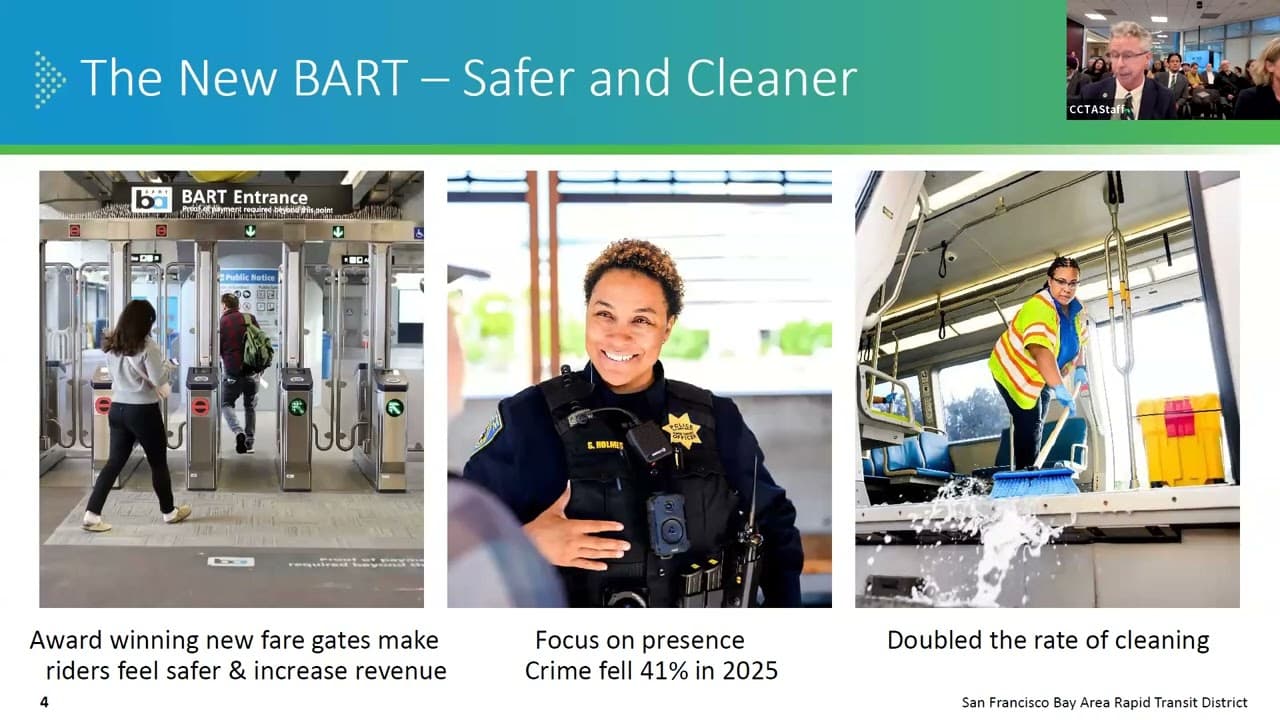
Where things stand: BART Chief Financial Officer Joe Beach and Assistant General Manager Pam Herhold cited progress: new fare gates adding about $10M in revenue, Bay Pass riders taking 35% more transit trips, and Contra Costa station ridership tripling since FY21 to nearly 15 million. Customer satisfaction tops 90%, they said. Still, lost post-pandemic fare revenue leaves a gap of about $400M, and staff cited a $375M shortfall.
If the measure fails, the BART board has initially approved an alternative service plan. It could start as soon as January, with service ending at 9 p.m., three lines instead of five and 30-minute waits. A second round in July 2027 could close as many as 15 stations. "Hopefully we never have to execute on it," Beach said.
Asked by Commissioner Carlyn Obringer about North Concord, Beach said, "When the board reviewed that plan, they removed the reference to specific stations." When she asked whether the measure would truly keep service running, he said measure proceeds "would all go to operating support for BART."
The other side: Commissioner Newell Arnerich challenged BART's operating cost increase from $943M to $1.2B and its 312 hires since 2020. "So how can you say I have to eliminate 33% and I'm 15 to 18% short on revenue?" he asked. Staff said costs are flat since FY19 after adjusting for inflation. They pointed to benefit costs, about 177 positions tied to the VTA extension, and fixed costs. They added that in 2020 a 40% service cut saved only 12%.
Commissioner Zepeda, sitting as alternate for Commissioner Kelley, pushed for employers to help fund transit: "The employers are supposed to provide a commuter benefit." Commissioner Aaron Meadows asked how peer systems nationwide are funded.
Decisions and stakeholder impacts: No action was taken. East County riders and the feeder buses that serve them face the most exposure. Commissioner Amy Worth, the board's bus operator ex officio member, called the situation "this existential crisis, really."
What's next: Noack, who also chairs the Metropolitan Transportation Commission (MTC) and the measure's Financial Efficiency Oversight Committee, urged operators to explain what happens if the measure passes. "The measure is only 14 years long," she said. SB 63 requires a two-phase financial efficiency review by MTC.
Bus Systems Brace for Cuts
Why it matters: Bus riders in West and East County rely heavily on transit, and the measure is the main lifeline.
Where things stand: AC Transit Ward 1 Director Harpreet Sandhu described a special district serving 13 cities and eight unincorporated communities. "AC Transit supports more than 5,100 jobs across the East Bay," he said.
General Manager Salvador Lamas cited a $200M deficit over four years and an annual gap of at least $50M starting in 2027. He warned of service reductions of up to 16% and about 300 layoffs, and noted a $55M state bridge funding package is a loan. "AC Transit will receive approximately $52 million per year, helping to protect the existing bus service and prevent layoffs," Lamas said of the measure. AC Transit described the measure as protecting existing service, not expanding it.
Service Planning Manager Sean DeJesus-Loren said AC Transit's contingency plan "would only take effect if no long-term funding is secured by December of 2026." It keeps 15-minute weekday service on the San Pablo and Cutting corridors. It would eliminate weekend Transbay lines, change Line 70 weekend service at Richmond Park BART and limit some lines to 7 a.m.-7 p.m. Reductions could come as early as June 2027.
Commissioner Rita Xavier asked whether the 72R rapid line could return. An AC Transit staffer said a "Realigned Plus" plan is on hold. "We are prepared to bring back some of the lines that we had before," the staffer said.
The local operators: County Connection and Tri Delta Transit described themselves as connective tissue to BART. They pointed to a regional fare cap, free transfers among four operators, a youth ride-free program and a One Seat Ride paratransit service that drew Federal Transit Administration attention. "Tri-Delta Transit, for example, is moving over 120% more paratransit users, paratransit trips than we were in 2019," said Tri Delta CEO Rashidi Barnes. He said BART closures east of North Concord would leave Tri Delta unsure what service it could run.
County Connection faces a $6.5M deficit, plus a $1.5M funding cut following state air board (CARB) amendments. Presenters cited potential cuts of 22% and, at WestCAT, 35% without new funds.
Decisions and stakeholder impacts: Seniors and disabled riders who depend on paratransit stand to lose the most. Members cited a state legislative audit finding that consolidation would not fix operator finances. "What a good job you guys have done coordinating with each other without any heavy hand forcing you to do that," Noack said.
What's next: AC Transit holds a public hearing and open house on its contingency plan Oct. 14.
Can Private Partners Pay for Mobility Hubs?
The basics: Shared mobility hubs cluster transit, bike, scooter and charging options at a single site. A public-private partnership, or P3, shares costs and operations with private firms.
Why it matters: The Integrated Transit Plan identifies 35 hubs carrying $720M in capital costs before operations.
Where things stand: The board authorized an RFP for a feasibility study funded by a $1M Build America Bureau grant that requires no local match. The study covers 12 publicly owned sites and includes outreach and market sounding, with an award expected in December. Commissioner Juan Antonio Banales confirmed the scope: "So the million dollars is going to investigate these sites and investigate funding for both, both capital and maintenance."
Obringer asked whether city staff "in the different cities where the sites have been identified" would be involved. Staff said yes. Sites came from MTC-based criteria, transit corridors and public ownership, and a listed site need not be final. Xavier flagged a location error for the Contra Costa College hub, which staff will fix in the RFP. Arnerich stressed it is only a study, though one that could inform the next Transportation Expenditure Plan (TEP).
The other side: Public commenter Brian Swanson, a San Ramon resident, said much of the concept requires San Francisco-like density. He cited competing parking lots, existing EV charging such as Tesla's, and safety concerns, and urged starting small rather than studying 12 sites.
Decisions and stakeholder impacts: The RFP passed (For: 11, Against: 0, Absent: 0). Noack moved and Arnerich seconded. Cities hosting candidate sites and private mobility firms are the most direct stakeholders.
$2M Keeps Creek Mitigation Close to Home
Where things stand: Interchange improvements require 0.36 acres of creek mitigation. Staff said alternatives, including the Flood Control District, the Walnut Creek Watershed Council, Solano Land Trust and a Ducks Unlimited bank, were unavailable. Agreement 768 with the Contra Costa Resource Conservation District instead funds in-kind work restoring about 300 feet of Galindo Creek at Newhall Community Park. The project is shovel-ready on public land and has a nonprofit partner.
Obringer asked whether "the $2 million amount is enough to cover everything, including the full 10 years of maintenance." Brandon Hayes, CCTA staff, replied: "Yep, that's correct."
Decisions and stakeholder impacts: The agreement passed (For: 11, Against: 0, Absent: 0), moved by Obringer and seconded by Commissioner Ken Carlson. Construction bids are expected in 2029. The City of Concord takes over maintenance after three years, for the remaining seven.
- Moraga Road/Canyon Road Complete Streets: Contract 766 awarded at $2.03M, with a $2.33M allotment, under Resolution 2646P. Ten bids came in against a $2.33M engineer's estimate, and federal Safe Streets for All funding covers $3M. The work adds 17 ADA ramps, buffered bike lanes and a new signal, 11-0.
- Clean air grants: Resolution 2644G funds nine of 16 Transportation Fund for Clean Air proposals, about $2.08M, including Walk and Roll and countywide vanpool, 11-0.
- Consent calendar: Approved 11-0 after a member warned county sales tax growth is lagging the state, a concern for Measure J funding.
- Caldecott Tunnel: Executive Director Timothy Haile said Caltrans plans to "temporarily close one of the tunnels," from 2027 through October 2028, and will brief the board.
- Labor-business coalition: Chad Houston of the California Alliance for Jobs, which represents 70,000 union construction workers and 2,000 employers, offered to partner on the expenditure plan.
Looking ahead: Pedal Fest takes place in Concord on Sept. 27. AC Transit's contingency hearing is Oct. 14, and the board holds a special TEP workshop Oct. 21 at 4:30 p.m. Haile said SB 1408 has passed both houses and heads to the governor. Voters decide the regional transit measure Nov. 3.