
Contra Costa Commissioners Demand 2,000-Foot Notice in Interim Zoning Plan
Planning Commission • Contra Costa CountyNovember 19, 2026
Locunity is an independent informational service and is not an official government page for this commission. All information is sourced from public footage and an analysis of official agendas with the aid of responsible, fact-checked AI. to report an error or omission.
Contra Costa County's Planning Commission spent more than 90 minutes on Nov. 18, 2026, on a stopgap zoning district meant to limit the county's legal exposure under state housing law. Commissioners voted 6-0 to send the interim Land Use Element Consistency district to the Board of Supervisors, but only after widening who gets notified about new projects and lowering the bar for a public hearing. Commissioners also overturned a staff-backed denial for a Brentwood family caring for an elderly parent and advanced a Lafayette subdivision over neighbors' creek erosion objections.
- Interim LUE-C zoning recommended 6-0 with 2,000-foot notice and a 20 peak-hour-trip hearing trigger
- Brentwood caretaker mobile home appeal granted 6-0, reversing the Zoning Administrator's denial against staff's recommendation
- 85 Ariey Lane three-lot subdivision approved 6-0 over creek erosion objections; P-1 rezoning heads to supervisors
- First full zoning code rewrite since 1947 previewed; commissioners make notice reform a priority
Notice Fight Reshapes Interim Zoning Plan
Why it matters: The county's 2045 General Plan, adopted in November 2024, requires zoning that matches it. Without objective standards on high-density and mixed-use parcels, staff said the county risks exposure under the Housing Accountability Act. That state law limits a local government's ability to deny housing projects that meet objective standards.
The basics: Planner Joe Lawler said the LUE-C district would apply to parcels designated RH, RVH, MUL, MUM, MUH and MUC in communities including Alamo, Crockett, Kensington and El Sobrante.
- It sets density, floor-area ratio, setbacks and parking of 1, 1.5 or 2 spaces per unit.
- Projects need a development plan, which can be approved administratively.
- The package also adopts parking standards and cleanup rezonings.
- The General Plan's environmental impact report (EIR) covers the action.
"So this isn't a permanent solution, it's an interim zoning code district," said Lawler. "This is to limit our exposure for projects that could come through the door tomorrow."
Where things stand: Under staff's proposal, notice of an administrative review would go to owners within 300 feet and to municipal advisory councils (MACs). A hearing would be held on request. Only projects generating more than 100 peak-hour trips, a Measure J threshold, would go automatically to the commission. Because so many parcels were affected, Lawler said, the hearing was noticed with a newspaper display ad.
The other side: Eight public commenters spoke, most from Alamo, and several said the ad was how they learned of the item. Sandra Fink, a public commenter, said the proposal continues a trend of cutting resident input and that it tells residents "the public should sit down and shut up and let elected and civil servants do their job."
"There's no requirement of state law to eliminate public notice and participation in land use decisions," said Roger Smith of the Alamo Improvement Association.
"It's very hard to follow a project that's done administratively," said Michael Gibson, an Alamo resident. He said the 100-trip threshold is practically unreachable on small downtown parcels. Robbie Holtzinger said a 300-foot radius on a cul-de-sac could notify only one neighbor.
Gail Feldman, President of the Kensington Property Owners Association, said including R-6 parcels could conflict with the Kensington Overlay ordinance. She asked commissioners to "just continue this for another meeting so more people can have an opportunity to comment." David Fowler, a Crockett property owner, cited small lots and fire evacuation access in Crockett's Valona area.
Commissioners shared the concern. Commissioner Calabrigo said he was not comfortable letting projects with up to 100 peak-hour trips skip a public hearing. Chair Kevin Van Buskirk said it "worries me to take CEQA out of the process in any way."
Decisions and stakeholder impacts: Commissioner Ross A. Hillesheim first proposed a 1,320-foot radius and then backed 2,000 feet. Commissioner Bhupen Amin moved staff's recommendation with "20 peak hour trips, and the added clarification that notice shall be given to residents within 2,000 feet." Staff clarified that the notice applies to the administrative process. The commission did not grant the requested continuance.
The motion passed (For: 6 — Van Buskirk, Amin, Allen, Mankin, Hillesheim, Calabrigo; Against: 0; Absent: 0).
If supervisors adopt the changes, far more neighbors would hear about projects before administrative approval. Developers would face a hearing at a much lower traffic threshold.
What's next: The Board of Supervisors will take up the recommendation and may change it.
Ariey Lane Advances Despite Creek Fears
Where things stand: The commission approved a three-lot minor subdivision at 85 Ariey Lane in Lafayette for MGJ Development LLC. Staff described the project this way:
- A 6.18-acre site with fewer than 3 developable acres
- Removal of 14 protected trees
- 3,500 cubic yards of cut and 3,100 of fill
- A creek structure setback exception for a private road extending from an existing bridge
The application was deemed complete before the current General Plan was adopted. "This used to be a 9-lot subdivision that was approved," said Newell Arnorich, President and CEO of 80 Architects, who represented the applicant. He said the neighborhood's CC&Rs, or covenants, conditions and restrictions, no longer exist and that no agreement with neighbors binds the developer.
The other side: "There is a severe erosion problem going on there right now," said Philip Barton, who owns 50 Ariey Lane. He said a four-year-old agreement to share mitigation costs was never honored.
Roger Chalamidas of 55 Ariey Lane said earlier stabilization work made the creek worse and that the Regional Water Board requires retroactive permitting. "Why is the planning commission considering approval of additional development when the consequences of the previous emergency work remain unresolved?" he asked. He urged commissioners to recommend denial until the remediation is done.
Decisions and stakeholder impacts: Commissioners answered by pointing to oversight from the Water Board, the state Department of Fish and Wildlife and the Army Corps of Engineers, plus 28 replacement trees. "Over 50% of this property is going to be dedicated to open space," said Hillesheim, who made the motion. Van Buskirk seconded it and said the project "will be done correctly because it has to be with the permit process."
The vote was 6-0. It adopted a mitigated negative declaration and monitoring program and approved the subdivision, development plan, setback exception and tree permits. Neighbors' erosion dispute remains unresolved at the commission level.
What's next: The rezoning from R-10 to P-1 planned-unit zoning goes to the Board of Supervisors.
Commission Sides With Family Over Staff
Where things stand: Janelle Craig appealed the Zoning Administrator's denial of a land use permit for continued caretaker occupancy of a mobile home at 16 Hoffman Lane in Brentwood. The home is 1,730 square feet and 24 years old and sits in an A-40 agricultural district.
Staff argued the home no longer qualifies as temporary. "There is a zoning-compliant alternative that is ministerial," said Allison Sioni, project planner. That alternative is an accessory dwelling unit (ADU) capped at 1,200 square feet, which would require major work. The project planner had recommended approval at the Zoning Administrator hearing.
The other side: "My mom has dialysis three times a week," said Craig. Her husband, John Craig, told commissioners: "It's definitely not permanent."
Van Buskirk posed six questions on ordinance language, Fair Housing accommodation and conditional permits. Staff confirmed the code has no specific provision limiting occupancy. Hillesheim invoked Milton Friedman: "Nothing is so permanent as a temporary government program."
Decisions and stakeholder impacts: "The tipping point for me was the fact that we don't have a definition of temporary," said Commissioner Bob Mankin, who seconded Calabrigo's motion to grant the appeal. The motion was amended to adopt the Aug. 3 Zoning Administrator findings and a CEQA categorical exemption under Guidelines Section 15301. It passed 6-0.
The family can continue caregiving. The ruling also highlights a gap in the code's definition of "temporary." Staff read appeal instructions after the vote.
Zoning Rewrite Preview Puts Notice First
The basics: Lawler previewed Envision Contra Costa, the county's first full zoning code rewrite since 1947. Consultant PlaceWorks is assisting.
Where things stand: The rewrite will move through three phases: drafting, public review and adoption. Proposed changes include:
- Moving administrative procedures into the zoning code
- Consolidating residential districts
- Removing unused overlays
- Retiring 11 or 12 specific plans
Gibson said blanket thresholds were a symptom of relying on a single zoning district and hoped the new code offers multiple mixed-use zones. Sarah Combs, policy associate with Save the Bay, asked whether the rewrite will include sea level rise or flood overlay zones. Staff said the issue will be addressed and pointed to the county's separate Resilient Shoreline Plan.
Why it matters: Contra Costa hosts four Bay Area refineries. Hillesheim asked for a "pathway understanding for a refinery to repurpose itself," along with room for sustainable fuels and data centers. Van Buskirk raised concerns about data centers' power use and asked about hiring local skilled trades. County counsel said hiring requirements generally fall outside land use regulation.
What's next: No action was taken. Commissioners asked staff to prioritize notification reform, outreach to adjacent cities and developer-provided notice through title companies in future study sessions.
Minor Items
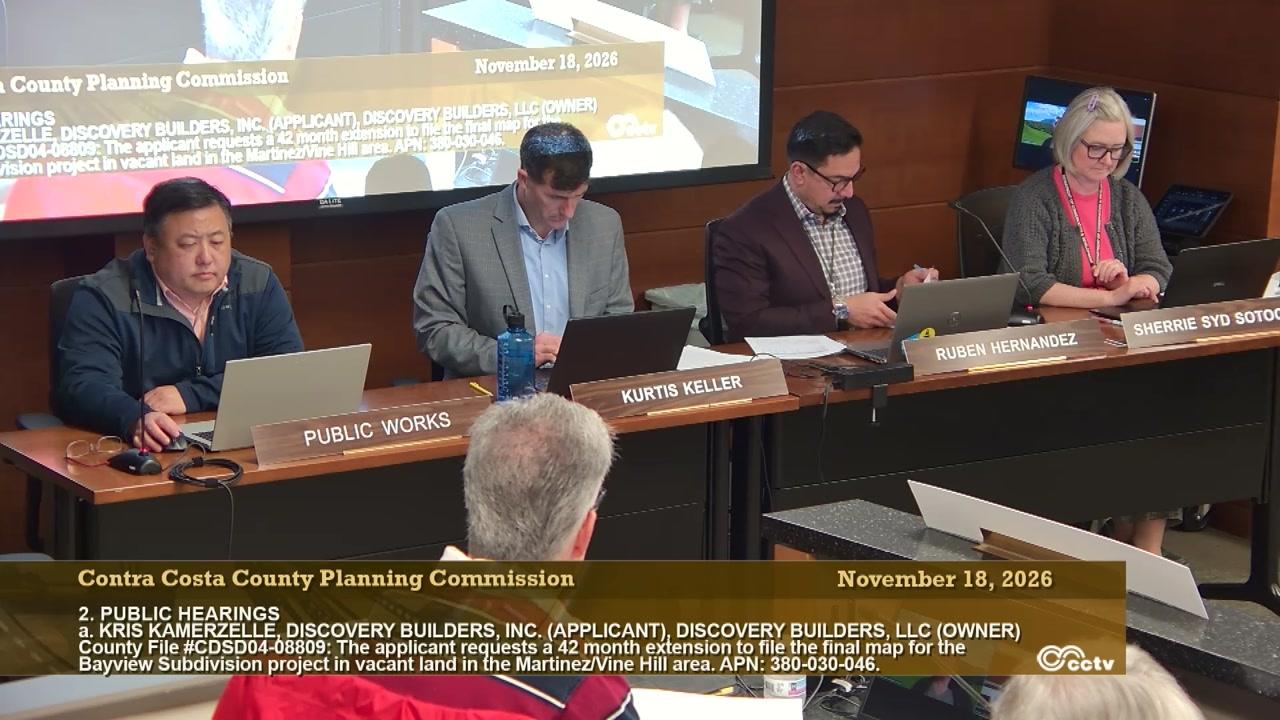
- Bayview subdivision gets map extension: The commission voted 6-0 to extend Discovery Builders' 144-lot Martinez/Vine Hill final map to Oct. 26, 2028. The company plans a 67-lot first phase and hopes to break ground in 2027.
Looking Ahead
The commission's next meeting is Dec. 9, with at least one item scheduled: a Northgate-area subdivision.