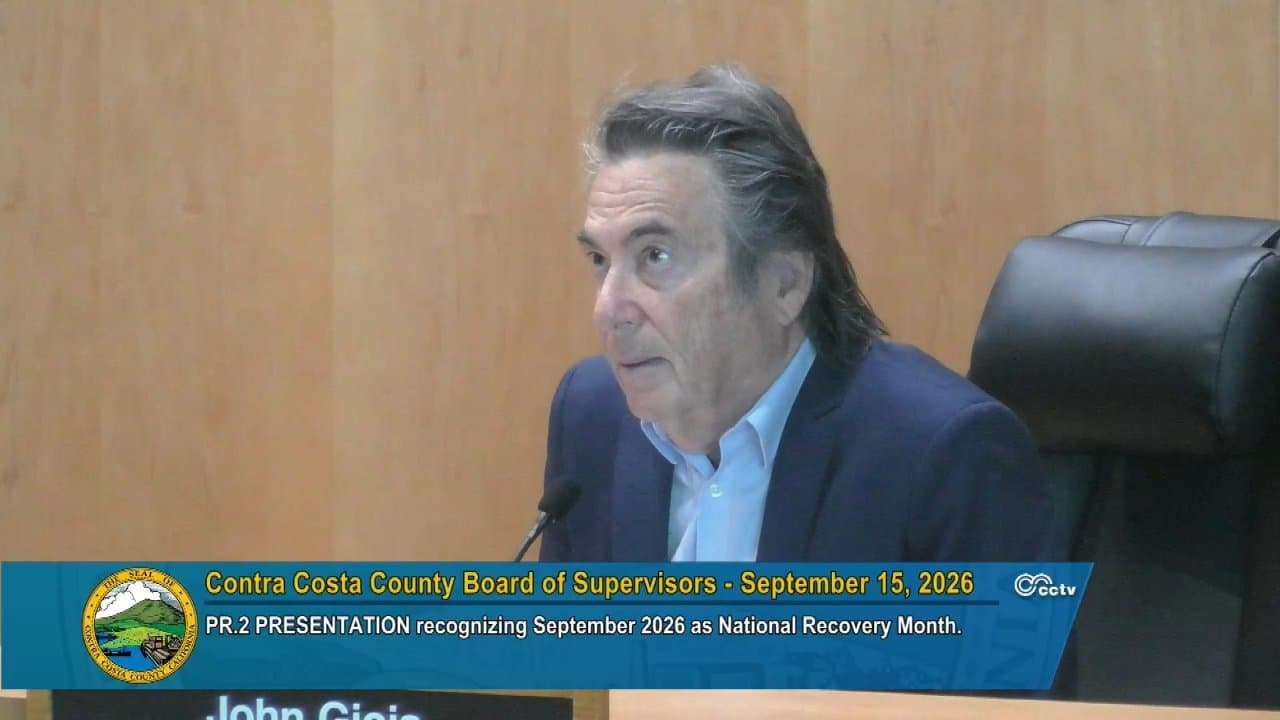
Board of Supervisors - Sep 15, 2026 - Meeting
Board of Supervisors • Contra Costa CountySeptember 15, 2026
Locunity is a independent informational service and is not an official government page for this commission.We use AI-assisted analysis and human editorial review to publish information.
Board Approves 73% Health Plan Premium Hike in Contentious 3-2 Vote
The Contra Costa County Board of Supervisors forced a reckoning over the future of its financially distressed county health plan, voting 3-2 to raise premiums by as much as 73% over the objections of employees, unions, and two supervisors who called for labor negotiations instead. The decision, driven by state regulators now monitoring the plan monthly, landed hardest on roughly 500 non-nurse employees who will absorb the full increase while their CNA-represented colleagues enjoy a 98% county subsidy negotiated in a separate labor deal.
- Board approves 73% premium increase for county health plan, splitting 3-2 as employees warn of financial devastation
- Sheriff confirms surveillance camera data contractually barred from federal agencies; county ineligible for $3B policing grant over sanctuary policy
- Fire Station 90 gets year-end deadline — Board authorizes backup sites in Oakley and Antioch if Brentwood stalls
- Consent calendar includes final FY 2026-27 budget adoption and JPA withdrawal that drew opposition from State Treasurer and a State Senator
Health Plan Premium Shock Divides Board, Leaves Employees Scrambling
The basics: The Contra Costa Health Plan, the county's homegrown HMO serving about 1,000 active employees and 1,200 retirees, has been hemorrhaging money — $10.6 million in operating losses for Plans A and B in FY 2025-26, plus $15.8 million for IHSS. The state Department of Managed Healthcare placed CCHP under monthly monitoring due to declining reserves and an elevated medical loss ratio, giving the Board little room to maneuver. The original staff proposal called for an 86.8% increase for Plan A and 50.6% for Plan B, along with removal of the Contra Costa Regional Medical Center from the network. After Board direction at a prior meeting, revised rates came back at 73% for Plan A and 39.5% for Plan B, with CCRMC remaining in-network.
Why it matters: The rate increase represents one of the largest single premium jumps facing any public-employee group in the region, and it lands amid a structural equity problem the Board itself struggled to resolve. CNA-represented nurses negotiated a four-year deal providing a 98% county subsidy — estimated at $12 million annually — while other represented and unrepresented employees must absorb the full increase or switch plans.
Where things stand: Health Director Grant Colfax laid out the stakes in blunt terms: "If we continue on the path that we're currently on without action, the state could shut the plan down. They have the power to do that." He warned that CCHP faces a projected $700 million deficit over the next five years and that the county is simultaneously bracing for thousands of residents losing Medi-Cal coverage due to federal cuts. "We have thousands of people in Contra Costa County who are going to lose all their coverage through Medi-Cal cuts. We are going to have people who need care," he said.
CCHP Director Irene Lowe detailed the mechanics: CCHP's tangible net equity has been declining steadily, and the plan's medical loss ratio remains above sustainable levels. Staff framed the increase as the minimum needed to stabilize the plan and avoid a state-ordered shutdown that would strand all enrollees.
Employee after employee described the personal toll. A public commenter identified as Latasha told the Board her family's Plan B premium would nearly double from $1,256 to $2,472 per month. Christy, a 20-year county employee on Plan A, said her family premium would jump from $817 to more than $2,700 per month, warning that switching plans would disrupt continuity of care and medication access. Sean Stahlbaum, representing IFPTE Local 21, argued the county has a legal duty to bargain over rate changes and called the county administrator's refusal to negotiate a breach of trust and labor law. Lisa Harlow of AFSCME Local 2700 said premiums equaling mortgage payments are morally wrong, noting the CCHP deficit equals 0.17% of the county's $7 billion budget and could be absorbed. Dr. Joanna Chin, a PDOC pediatrician, asked why the county can subsidize CNA members but not others.
The other side: The debate cleaved along philosophical lines. Supervisor John Gioia said he arrived undecided but reached his conclusion during the discussion: "I believe, and I'm sort of reaching this conclusion during this discussion, is that we should figure a way to negotiate this with labor unions." He pressed the point that the county had long known premiums were not covering costs, and highlighted the CNA equity gap: "500 of those thousand are going to be paying for this increase. The other 500 — we're paying for the increase."
Supervisor Shanelle Scales-Preston proposed a middle path, suggesting the Board subsidize part of the deficit from the general fund to blunt the impact on workers.
Supervisor Candace Andersen, who moved the motion to approve, argued delay was not an option with open enrollment approaching: "We cannot expect us to close the $700 million gap over the next five years and help by delaying hard decisions."
Decisions: The motion passed 3-2 (For: Andersen, Carlson, Burgis; Against: Gioia, Scales-Preston). The revised premiums take effect Jan. 1, 2027.
What's next: Supervisor Gioia asked the Board to consider a future agenda item exploring ways to soften the impact on remaining CCHP members, potentially through a general fund subsidy or other mechanism. The state Department of Managed Healthcare will continue monthly monitoring of the plan's financial position.
Sheriff Confirms Surveillance Data Firewalls, Notes Federal Grant Loss
Why it matters: In a political climate where local sanctuary policies carry real fiscal consequences, Sheriff David Livingston reported the county is ineligible for a $3 billion federal policing grant because it does not participate in the 287(g) immigration enforcement program. At the same time, he offered the Board new assurances on data privacy for the county's expanding Flock automated license plate reader network.
Where things stand: The Q2 2026 oversight report covered detention, field operations, coroner cases, and the Flock ALPR program. Key data points: four custody deaths (all natural causes), declining narcan deployments suggesting progress on fentanyl intervention, 135 ICE notification requests with only 14 actual notifications under the Truth Act, 94 eviction orders processed with just one physical removal, and 174 coroner cases including 19 suicides.
On surveillance, Sheriff Livingston was direct: "We specifically have a term and a clause in our contract with all the providers, including Flock, that prohibits the use of our data that's obtained in Contra Costa County from being shared with any federal agency." He added that a new audit capability is rolling out by year-end to allow independent verification of compliance. Supervisor Andersen pressed for additional guardrails against personal misuse of the system by individual officers.
Decisions: The report was received unanimously (For: 5, Against: 0, Absent: 0).
What's next: The Flock audit tool is expected to be operational by year-end, providing the Board with a concrete accountability mechanism on data-sharing prohibitions.
Brentwood Fire Station Hits Planning Wall; Board Sets Year-End Deadline
Why it matters: A Measure X-funded fire station in Brentwood — already years in the making — faces jurisdictional friction reminiscent of the downtown Fire Station 94, which racked up more than $1 million in change orders due to the city's aesthetic requirements. The Board is now laying groundwork to walk away if the city doesn't cooperate.
Where things stand: Fire Chief Aaron McAlister reported that the Brentwood City Council voted in closed session to advance the Fire Station 90 property sale contingent on entitlements, and the fire district submitted its planning applications. But the Brentwood Planning Commission was expected that same evening to consider a resolution declaring the planned East County Service Center incompatible with its general plan — a potential deal-breaker.
The chief framed the situation in operational terms: "We use an acronym in the fire department, and that's PACE — Primary, Alternate, Contingency, and Emergency. And so clearly, we are at the phase where this new site at Lone Tree and Windy Springs is our alternate site." Neighbors have submitted a petition supporting the station. McAlister sent a rebuttal letter to the planning commission's proposed resolution.
Supervisor Ken Carlson pushed for concrete contingency planning, and the Board directed the chief to identify alternate sites in Oakley and Antioch.
Decisions: The Board voted unanimously (For: 5, Against: 0, Absent: 0) to direct the fire chief to pursue planning commission approval by year-end and develop contingency site options. If Brentwood does not approve by year-end, the Board will consider relocating the project — potentially losing the co-located youth center that was part of the original vision.
Climate Academies Graduate First Cohorts, Push for Permanence
Why it matters: Two new county programs — the Tree Planting Academy and the Shoreline Leadership Academy — graduated their first classes, and participants are already lobbying to make them permanent fixtures of the county's environmental justice work.
The Tree Planting Academy drew more than 80 applicants and graduated 25 residents across east and west county cohorts after five months of training. The Shoreline Leadership Academy met every other Saturday for six months, conducting 12 site visits from the Bay to the Delta. Jody London and Ryan Hernandez from the Department of Conservation and Development presented the results.
Graduates made the case in personal terms. One graduate, Petronila Fernandez, called for making the academy permanent for environmental justice. Another graduate, Mariana Burns y Perez, credited the Shoreline Academy with connecting her to the Richmond Shoreline Alliance, where she now works. Multiple supervisors praised the programs as community empowerment tools. The county is exploring an ongoing climate action academy.
Minor Items
- 96-item consent calendar approved unanimously, including final adoption of the FY 2026-27 budget (Resolution 2026-341), an $8M CORE homeless services contract, and a $3.5M airport environmental services contract. Felicia, executive director of CSCDA, urged removal of item C.34 (withdrawal from conduit-issuer JPAs), arguing it could harm JPAs statewide; the item had drawn written comments from State Treasurer Fiona Ma and State Senator Tim Grayson but remained on consent.
- National Recovery Month proclaimed; Supervisor Ken Carlson detailed the county's continuum of behavioral health care. Pablo Martinez, programs director for Support for Recovery, described how Measure X funding helped serve over 70 families in the Hispanic community through Spanish-language sober living.
- Dolly Parton Day proclaimed for Sept. 25 in memory of the late icon, who passed away Aug. 25, 2026. The Board encouraged book donations to local libraries and elementary schools, highlighting the Imagination Library program and California's pending SB931.
- Eight county employees honored for 20 to 35 years of service across public works, risk management, health services, the auditor-controller's office, and EHSD. EHSD Director Marla Stuart noted 74 employees in her department alone reached service milestones this year, with 280 total staff at 20-plus years — 14% of the department's workforce.
- Head Start monthly update accepted unanimously. The program secured a $274,800 federal supplemental grant for nutrition facilities. Federal funding was extended through Dec. 11 via continuing resolution. The Office of Head Start issued proposed rulemaking on Aug. 7 with a comment deadline of Oct. 6; the county will submit comments through its legislative committee. Two licensing citations — one for a staff member who was separated from the program — were reported and cleared.
- Public commenters Keisha Johnson and Maeve Lillis raised concerns about hyperscale AI data center construction in the county, citing light pollution, infrastructure threats, and wildlife impacts. Lillis asked the Board to add data centers as a future agenda item, noting Oakley and Brentwood are already considering bans.