Board of Supervisors - Jun 23, 2026 - Meeting
Board of Supervisors • Contra Costa CountyJune 23, 2026
Locunity is a independent informational service and is not an official government page for this commission.We use AI-assisted analysis and human editorial review to publish information.
Board Clears $150M-Plus Consent Calendar, Confronts Vote-by-Mail Threat
The Contra Costa County Board of Supervisors moved swiftly through a 205-item consent calendar worth hundreds of millions of dollars, then slowed down for presentations that surfaced two very different threats: an invasive mosquito capable of spreading Zika and dengue has now been found in Antioch three years running, and a pending U.S. Supreme Court case could upend how 90% of Californians cast their ballots.
- 205 consent items approved unanimously, committing $105M for hospital construction, $44M for a behavioral health center, 1,111 acres of development rights to parks, and a 19-year waste franchise
- Clerk-Recorder reports 45% primary turnout — up 10 points — but warns Watson v. RNC could force California to stop counting ballots received after Election Day
- Disease-carrying mosquito found in Antioch for third straight year; district weighing a Wolbachia-treated male mosquito release pilot
- Board votes 5-0 in closed session to join amicus in County of Santa Clara v. ICE immigration enforcement case
- EMS assessment renewed at 1988 rates with no inflation adjustment; any change would require a two-thirds ballot measure
- Head Start hits record enrollment of 4,034 children despite federal COLA of less than 1%
- Brown Act telecom disruption policy adopted before July 1 deadline, with debate over whether meetings should ever continue without remote public access
Watson v. RNC Looms Over Vote-by-Mail as Turnout Surges
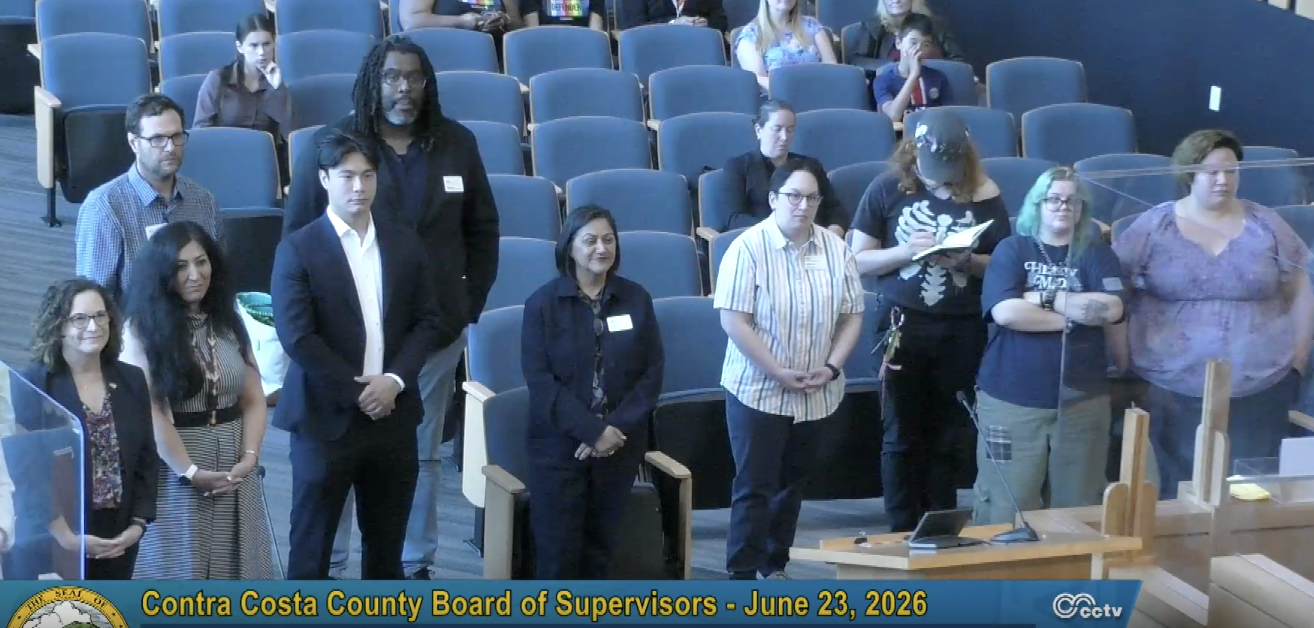
Clerk-Recorder Kristin Connelly celebrated the sixth graduating cohort of the county's Certified Election Observer Program — five residents who completed more than 12 hours of training covering voter registration, ballot design, signature verification, and tabulation. But the most significant exchange came when supervisors turned to what could be a seismic shift in how California runs elections.
Why it matters: The U.S. Supreme Court case Watson v. Republican National Committee could require ballots to be received by Election Day, eliminating California's current policy of counting ballots that arrive up to seven days after the election. In a state where 90% of voters cast ballots by mail and many submit at the last minute, the disruption would be enormous.
Where things stand: Connelly reported the county saw nearly 45% turnout in the June 2 primary — "a 10% improvement over the last direct gubernatorial primary four years ago." She has signed on as amicus in the Watson case and is co-chairing the statewide elections legislative committee working on contingency plans. "If the holding at the Supreme Court in Watson requires us to go to an Election Day deadline, we're going to need to implement that. And that will be a change for voters," she said.
Supervisor John Gioia, District 1, pressed on preparations, asking what would happen "if some court rules that we can only count the ballots that were received by Election Day and contrary to state law." Connelly confirmed discussions are underway among elections officials statewide but did not detail specific contingencies.
Supervisor Candace Andersen, District 2, praised the observer program for building confidence and countering misinformation. "We want to instill confidence in our elections. We want to instill confidence in how votes are tallied and we want people to understand it. You're our ambassadors now," she told the graduates.
Decisions: No vote was taken on the presentation. The June 2 primary election has not yet been certified and is expected to come before the board at its next meeting.
What's next: The Watson v. RNC ruling could come at any point during the Supreme Court's current or next term.
Invasive Mosquito Capable of Spreading Zika Found in Antioch Three Years Running
The basics: Aedes aegypti, the yellow fever mosquito, is not native to Contra Costa County. Unlike the local Culex species that carries West Nile virus, Aedes aegypti can transmit Zika, dengue, yellow fever, and chikungunya from person to person — meaning one infected traveler returning home can spark a chain of local transmission.
Why it matters: Southern California is already experiencing local dengue transmission from this species. The Contra Costa Mosquito and Vector Control District has found the mosquito in Antioch every year since 2024 and has been unable to eradicate the population.
Where things stand: Public Affairs Director Nola Woods told the board the district previously controlled small populations in Martinez and North Concord, but the Antioch infestation has persisted. "If someone goes to travel and they come back home to Contra Costa County with Zika or dengue fever, one of our local Aegypti mosquitoes can bite that person and become infected and then transmit it to another person," she said.
The district is considering a pilot project to release Wolbachia-treated male mosquitoes. The males cannot bite, and when they mate with wild females, the offspring are not viable. "When Wolbachia-treated male mosquitoes mate with a female Aedes aegypti mosquito, they cannot produce living offspring. That is the key," Woods explained. The technique has precedent: the U.S. used a similar approach to eliminate screw flies in the 1950s and Mediterranean fruit flies in the 1990s.
What's next: A community meeting is scheduled for Saturday in Antioch to discuss the pilot program and answer residents' questions. The district, founded in 1927, will celebrate its 100th anniversary next year.
$150M-Plus Consent Calendar Approved Without a Single Item Pulled
All 205 consent items passed unanimously (For: 5, Against: 0, Absent: 0) without a single item being pulled for separate discussion and with no public comment — a notable feat for a calendar loaded with high-dollar commitments at the close of the fiscal year.
Deal math — the biggest line items buried in consent:
- $105.1M Phase 2 construction contract for Contra Costa Regional Medical Center cafeteria building upgrades (C.169)
- $43.7M Program Funding Agreement for the Delta Recovery Center in Antioch (C.142), a behavioral health facility
- $10.1M mainframe migration contract with Ensono, Inc. (C.148)
- $4.07M in Measure X Housing funds (C.34)
- 1,111 acres of development rights transferred via quitclaim deeds to the East Bay Regional Park District (C.171)
- 19-year solid waste franchise agreement for Crockett (C.32)
- Ordinance No. 2026-11 amending the Industrial Safety Ordinance (C.83)
Why it matters: The consent calendar commits the county to major construction, behavioral health infrastructure, land conservation, and long-term waste management in a single vote — the kind of end-of-fiscal-year package that can escape scrutiny precisely because of its size.
EMS Assessment Stuck at 1988 Rates, No Fix Without a Supermajority Vote
The basics: Community Service Area EM-1 funds enhanced emergency medical services through Measure H, approved by voters in 1988. The assessment charges $3.94 per unit in Zone A (San Ramon Valley) and $10 per unit in Zone B (the rest of the county).
Why it matters: Those rates have never been adjusted — not once in 37 years. The real purchasing power has eroded significantly, and the assessment generates approximately $5 million annually.
Where things stand: EMS Director Marshall Bennett presented the FY 2026-27 tentative report with no change to the rates. Supervisor Gioia highlighted the structural problem: the original measure included no CPI inflator, and any increase — even simply adding an inflation adjustment — would require a new two-thirds ballot measure.
Decisions: The board adopted Resolution 2026-225 unanimously (For: 5, Against: 0, Absent: 0).
Head Start Hits Record Enrollment as Federal Dollars Flatline
Why it matters: The county's Head Start program served a record 4,034 children in April, with 1,957 meals served daily, even as the federal government delivered a COLA of less than 1% — just $128,000.
Where things stand: Dr. Marla Stewart and Sarah Reich of the Community Services Bureau reported 100% enrollment and strong attendance: 77% on federal measures (primarily due to child illness) and 98% on state measures. At the national level, the House Appropriations Committee approved a roughly flat FY 2027 Head Start budget with only a $10 million increase nationwide. A second round of one-time nutrition funding applications is due July 3.
Supervisor Gioia questioned how the program would absorb salary increases with such minimal federal support. "The fact that we're getting less than 1% of a COLA increase, that is not keep up with the cost of salaries," he said. Dr. Stewart explained the gap is bridged by state-funded slots, which grow with enrollment. "As we increase our enrollment, state revenue does increase because the state slots are pretty much not capped," she said. No layoffs are anticipated.
The board also learned that eight Type B licensing citations were issued at one partner center, leading to the termination of a teacher and appointment of a new director. CalWORKs Stage 2 funding was reduced by $2.2 million due to a one-time state extension of Stage 1.
Decisions: The board unanimously approved FY 2026-27 admission priorities, recruitment and enrollment plan, and planning calendar (For: 5, Against: 0, Absent: 0).
Brown Act Telecom Policy Adopted, but Unresolved Questions Remain
The basics: Recent amendments to the Brown Act require every legislative body to adopt a policy by July 1, 2026, governing what happens when remote public access — typically Zoom — fails during a meeting.
Where things stand: County Counsel Thomas Geiger presented a policy requiring the board to recess for at least one hour if Zoom service is disrupted. If service cannot be restored, the board may either reconvene after making roll call findings that the public interest in continuing outweighs remote access, or adjourn.
The other side: Supervisor Gioia expressed concern that the policy's broad language could let a board continue important meetings without the public watching remotely. "It seems to me that if we're coming back and it's a really important issue that involves public input, that we not continue the meeting if we don't have remote access," he said.
Supervisor Andersen raised a separate but related question: what happens when an individual board member's noticed remote location goes down? She cited the Metropolitan Transportation Commission's position that "if one of our remote locations is not up and running, their opinion is this meeting cannot continue." Geiger clarified that the policy addresses public participation only, not member attendance, and offered to provide a separate legal analysis.
Decisions: The policy passed unanimously (For: 5, Against: 0, Absent: 0). County Counsel will return with guidance on the remote-location question.
Board Joins Amicus in Immigration Enforcement Case
During a roughly one-hour closed session, the board voted 5-0 to join as amicus in County of Santa Clara et al. v. U.S. Immigration and Customs Enforcement (U.S. District Court, Case No. 526cv05604svk). The action signals the county's opposition to federal immigration enforcement practices and places Contra Costa among a coalition of California counties taking a legal stance on the issue.
Minor Items
- Two road closures extended 18 months to combat illegal dumping: South Broadway Avenue in Bay Point (full closure) and Carquinez Scenic Drive in Martinez (nighttime, sunset to sunrise), both through December 2027. Both passed 5-0. Supervisor Shanelle Scales-Preston, District 5, noted the county is "taking a proactive role in prevention and really engaging in those hot spots."
- Eminent domain resolution adopted for Phase 2 of the I-80/San Pablo Dam Road interchange improvement, 100% funded by the Contra Costa Transportation Authority. Passed 5-0. Supervisor Gioia noted the San Pablo city manager's appreciation for county collaboration.
- ZEV Readiness Award: The California New Motor Vehicle Board recognized Contra Costa County for its Diesel Free by 33 pledge, California Energy Commission-funded fleet charging infrastructure, and EV technician training programs with local school districts and community colleges.
- Pride Month proclamation honored Diablo Valley College's Community of Pride, described as the first LGBTQ-focused learning community in California, serving approximately 50 students and allies per semester. Counselor Christy Harrington Tsai cited Trevor Project research showing "our LGBTQ youth are over four times more likely to consider or attempt suicide than their peers."
- Meeting adjourned in memory of Jack Lloyd, inventor of the pulse oximeter, his wife Lynne Lloyd, and Sue Rainey, a trailblazing local elected official.