Board of Supervisors - Jul 07, 2026 - Meeting

Board of Supervisors - Jul 07, 2026 - Meeting

Board of SupervisorsContra Costa CountyJuly 7, 2026

Sources:

Locunity is a independent informational service and is not an official government page for this commission.We use AI-assisted analysis and human editorial review to publish information.

Housing Authority Warns 15,000 Residents Could Lose Rent Subsidies by December

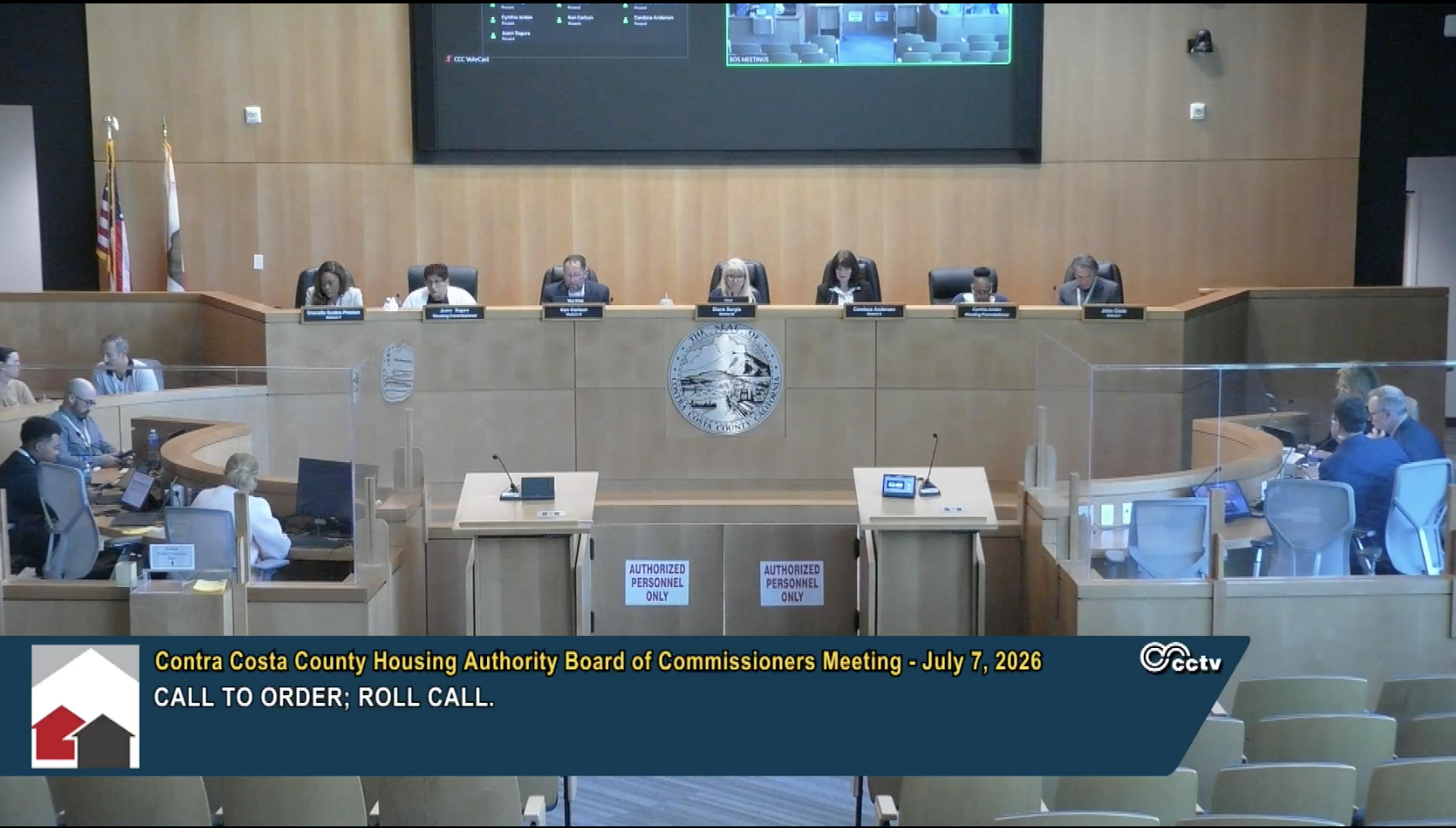
The Contra Costa County Board of Supervisors, sitting as the Housing Authority Board of Commissioners, received back-to-back reports on July 7 that laid bare the scale of a federal housing funding crisis bearing down on the county. A $13.3 million shortfall in the Housing Choice Voucher program - confirmed by HUD just 11 days before the meeting - could cut off rent subsidies for nearly 6,500 households by year's end, while deeper-than-expected cuts to federal homeless programs are shrinking a supportive housing pipeline the authority has operated for three decades.

  • $13.3 million voucher shortfall could leave roughly 15,000 people without rent subsidies by December if HUD does not provide relief funding

  • HUD labels the authority a "Group 3" agency - the most severe shortfall category - and is pushing for immediate subsidy cuts of $300–$400 per month

  • 230 emergency housing voucher holders converted to permanent vouchers to dodge early program termination, losing wraparound services in the process

  • Continuum of Care cuts raised to 60%, forcing the authority to shed 38 of 252 permanent supportive housing households over the next year

  • Board chair signs letter acknowledging risk of assistance termination for up to 6,497 households, triggering the shortfall application process


$13.3M Shortfall Puts Thousands of Families on the Clock

The basics: The Housing Choice Voucher program — commonly known as Section 8 — provides rent subsidies to low-income households that pay the difference between a tenant's contribution and the actual rent. HUD funds these "housing assistance payments" (HAP) annually. When an agency's costs exceed its allocation, it must apply for shortfall relief or cut subsidies.

Why it matters: The authority's $224 million HAP budget falls $13.3 million — 5.6% — short of its $237 million projected need. If HUD does not cover the gap, funding runs out in December, and 6,497 households — approximately 12,000 to 15,000 people — could lose their rent subsidies entirely.

Where things stand: Joseph Villarreal, the authority's executive director, told commissioners that HUD confirmed the shortfall only 11 days before the meeting, placing the agency in HUD's most severe "Group 3" category — defined as six or more shortfalls since 2016. The authority has been in shortfall in 2017, 2018, 2019, 2020, 2021, 2022, and now 2026.

"We have demonstrated that our programs likely do not have adequate financial management oversight and are at a higher risk of terminating assistance to address cost overruns," Joseph said, reading HUD's characterization of Group 3 agencies.

The executive director pushed back hard on that framing. He argued the authority's average HAP has grown 50.2% since 2017 — from $1,315 to $1,975 — while market rents in the region have surged 57.1%, from $1,600 to $2,514. The program's growth from 6,283 to 8,864 units — a 41.1% increase representing $117.3 million in additional spending — was driven entirely by HUD-approved actions: the transfer of the Richmond Housing Authority, more than 1,200 new project-based vouchers, RAD conversions, and federal homeless voucher programs.

"So we increased by 2,581 units, 41.1% increase. And then in dollars, we went up $117.3 million," Joseph Villarreal told the board, noting the growth makes the authority stand out in HUD's shortfall analysis despite being HUD-directed.

The other side: HUD is requiring Group 3 agencies to review and potentially decrease payment standards — the maximum rent subsidies the authority pays. Staff estimated this would mean cuts of $300 to $400 per month for voucher holders, many of whom are already at their financial limits. Critically, HUD is pushing for agencies to implement the cuts immediately through a waiver rather than using the traditional one-year phase-in.

"They want us to basically get a waiver and do it right away. So this will hit people in a month or two if we did it today," Joseph Villarreal warned.

He also noted a contradiction in federal policy: in 2023, HUD told the authority to raise payment standards because 4,571 households were rent-burdened by HUD's own calculations. "So today we're being told to lower them," he said. Compounding the problem, HUD offset $3.6 million of the authority's reserves in 2024 to cover shortfalls at other agencies.

Joseph Villarreal added a political dimension, warning that housing authorities that have participated in lawsuits against HUD or signed letters opposing administration policies are being told their requests for help would be deprioritized. "They've called for help and they've been told that, well, you're suing us, so we'll talk to you later, basically," he said.

Decisions: Chair Candace Andersen signed the required HUD letter acknowledging the risk of assistance termination for up to 6,497 voucher households, a prerequisite for the shortfall application.

"With this letter, we are acknowledging that we're at high risk of having to terminate assistance to as many as 6,497 voucher households. And you just said it was about 15,000 people," Vice Chair Diane Burgis said.

The board unanimously accepted the shortfall report (For: 5, Against: 0, Absent: 0; motion: Commissioner Segura, second: Commissioner Ken Carlson). Staff will submit the shortfall application immediately, given HUD's first-come-first-served approach to relief funding.

What's next: Staff plans to return in September with an updated termination of assistance policy. The December deadline looms: if shortfall relief does not materialize, the authority faces an unprecedented choice between slashing subsidies mid-year or terminating assistance for thousands of families. The crisis is not unique to Contra Costa — roughly half of all U.S. housing authorities now face shortfalls, raising questions about whether HUD's relief fund can cover them all.


Federal Cuts Narrow the Safety Net for Formerly Homeless Residents

Why it matters: The Contra Costa County Housing Authority was one of the first agencies in the nation to receive Shelter Plus Care funding in 1994, building a three-decade pipeline of tenant-based rental assistance for formerly homeless individuals with severe mental illness, chronic substance abuse, and AIDS. That pipeline is now shrinking under federal budget pressure.

Where things stand: Joseph Villarreal, the authority's executive director, reported that the Shelter Plus Care program — which provides tenant-based rental assistance — is protected through its March 31, 2027, grant expiration under the federal budget resolution that shields first-quarter expiring grants. However, Continuum of Care (CoC) permanent supportive housing cuts have been raised from a previously discussed 30% cap to 60%. The authority currently applies for $8.6 million but expects to receive only $7.1 million — enough to support approximately 214 of the current 252 households, requiring the attrition of about 38 more households over the coming year.

On the growth side, the authority received five new VASH (Veterans Affairs Supportive Housing) vouchers and expects to compete for 25 to 100 more. The Foster Youth Initiative has 10 to 15 new vouchers pending.

Decisions: The item was informational; no vote was required.

Emergency Voucher Conversion

In a significant defensive move, the authority converted all 230 remaining Emergency Housing Voucher (EHV) households to regular Housing Choice Vouchers effective April 1. The EHV program is being terminated five years early. The conversion gives those households lifetime housing eligibility but eliminates the wraparound services — case management, substance abuse treatment, mental health support — that came with EHV funding. About 60 to 70 of these households originally came from San Francisco, Oakland, and Alameda.

"It's also significantly better than being homeless," Joseph Villarreal said, acknowledging the trade-off.

The authority also converted project-based rental assistance units at Lakeside Apartments in Concord, Ohio Avenue in Richmond, and Villa Vasconcellos in Walnut Creek to project-based vouchers, maintaining the same net impact for tenants and owners while giving the CoC more flexibility.

What's next: The administration's policy shift toward treatment over housing-first approaches means CoC programs will continue shrinking while voucher-side programs are expected to grow. The Shelter Plus Care grant remains safe through March 2027, but the authority faces a year of managed attrition to bring its caseload in line with reduced federal funding.


Minor Items

  • Consent items C1 through C9 approved unanimously (For: 5, Against: 0, Absent: 0; motion: Commissioner Ken Carlson, second: Chair Candace Andersen).

Housing Authority Warns 15,000 Residents Could Lose Rent Subsidies by December | Board of Supervisors | Locunity