
Contra Costa County, CA – Board of Supervisors – May 12, 2026
Board of Supervisors • Contra Costa CountyMay 12, 2026
Locunity is a independent informational service and is not an official government page for this commission.We use AI-assisted analysis and human editorial review to publish information.
Board Makes Home Kitchen Businesses Permanent as Operators Share Life-Changing Stories
The Contra Costa County Board of Supervisors unanimously advanced an ordinance to make its home kitchen business program permanent after a two-year pilot that permitted 128 micro restaurants with zero foodborne illnesses — then turned its attention to striking refinery workers, a plea to save the county's only Spanish-language addiction recovery beds, and a sweeping celebration of the county's Asian American, Native Hawaiian and Pacific Islander communities.
Steelworkers urge Board support for 110 workers striking Marathon's Martinez refinery over proposed 16- to 18-hour shifts with hazardous chemicals
Home kitchen pilot goes permanent after 128 permits, zero illnesses, and seven operators testifying the program changed their lives
Spanish-language recovery program fights for survival, reporting 48 clients served, 90% diverted from custody, and $5.5 million in county savings
Fourth annual AANHPI Heritage celebration honors immigrant justice leader Susan Kim and community bridge-builder Annie O with cultural performances and personal stories
Mother describes daughter's traumatic involuntary 5150 hold at John Muir ER, where no behavioral health professionals were on staff or on call
Foster Care Month proclamation spotlights 646 children in county placements and the ongoing need for resource families
Editor's Note: Due to a technical issue, Locunity's systems missed the May 12, 2026, meeting. The issue is now resolved.
Zero Illnesses, 128 Permits, and a Unanimous Vote: Home Kitchens Get a Permanent Home
Why it matters: A two-year experiment allowing residents to run micro restaurants from their home kitchens — capped at 30 meals per day and $100,000 in annual sales — is becoming a permanent fixture of Contra Costa County's economic development landscape, with a strong safety record and a client base that is overwhelmingly women-owned and drawn from historically underrepresented communities.
Where things stand: Christian Lucas, Director of Environmental Health, presented detailed results from the pilot program authorized under state law AB 626. Since launching in June 2024, the county has issued 128 permits, including 34 since March 2026 alone. Staff conducted 369 technical assistance consultations — a 60% year-over-year increase — and held 16 bilingual workshops reaching 374 participants. Contra Costa is one of 18 California jurisdictions with such programs.
The safety data was unambiguous. "Most importantly, no foodborne illness complaints were observed or recorded by our officers during this two-year pilot program," said Lucas. Only two complaints were filed — both about the same operator — and code enforcement jurisdictions reported minimal quality-of-life issues involving parking and signage that were resolved locally.
Lucas highlighted that six unpermitted food operations transitioned to legal, permitted businesses through the program. "There were six food operations that we inspected over this two-year pilot program that ended up transitioning from informal food operators into regulated, compliant and permitted businesses because we had this option to present to them," he said.
The program's demographic profile also stood out. Lucas reported that "the permanent operators indicate to us that the program is predominantly supporting women-owned microenterprises and individuals from historically underrepresented backgrounds, including the Hispanic, Latinx communities, as well as the communities of Asian American, Native Hawaiian and Pacific Islanders."
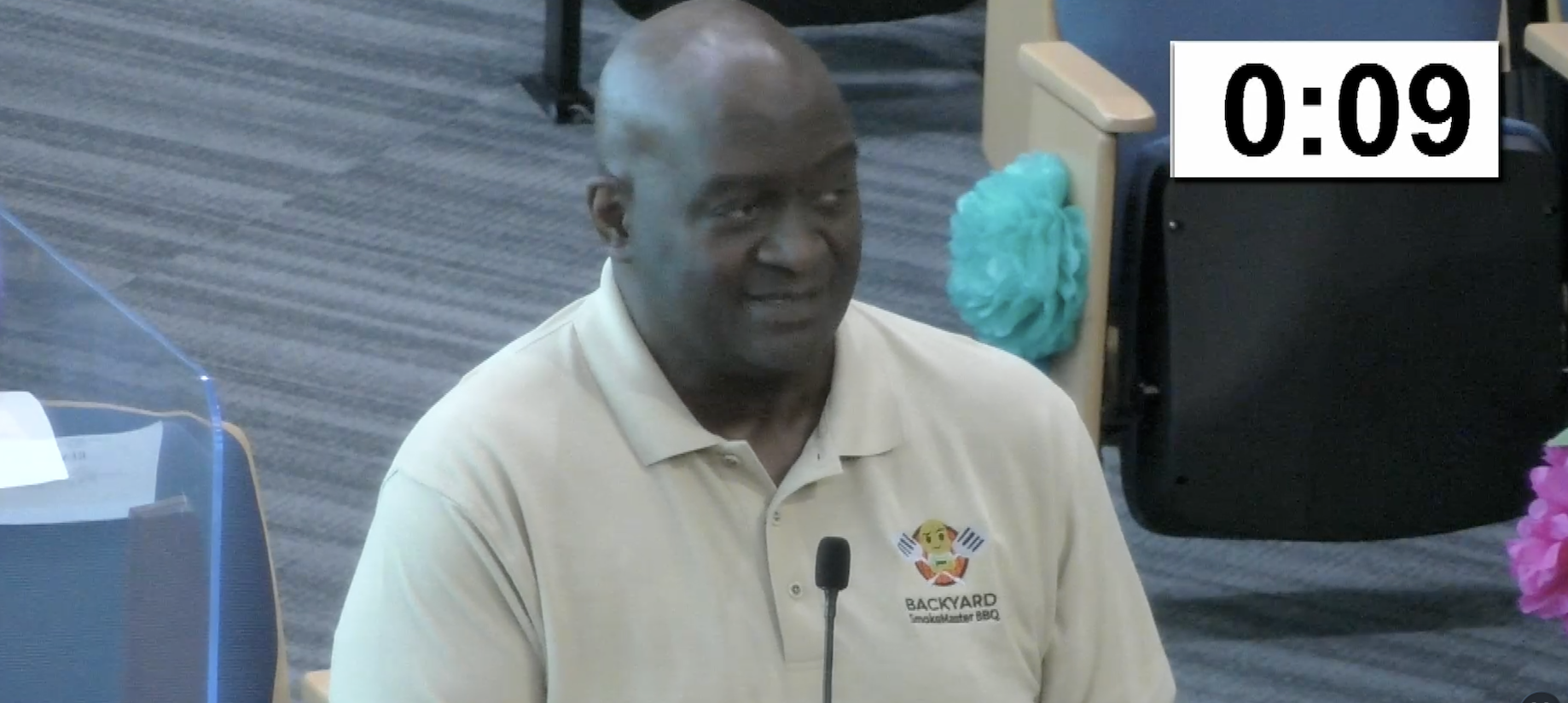
The operators: Seven home kitchen entrepreneurs testified, painting a picture of a program that reaches far beyond food. Kenyetta Robinson, owner of Backyard Smokemaster Barbecue in Clayton, described the program arriving at a breaking point in her life. "The MECO program came into my life at the most pivotal moment. After more than 20 years in a corporate career, I was laid off soon after, my father suddenly passed and my mother's health began to decline," she said.
Chef Kelly Jo, operator of Chicks and Love Pizza in Pleasant Hill, was the county's first permit holder — a 30-year professional chef who transitioned from teaching to full-time food entrepreneurship. Chris, who runs Cafe Lujan in Pittsburg, framed the program in stark terms, arguing that rejecting it would only encourage illegal street food operations. Maria, also from Pittsburg, described how her home kitchen helped her recover from workplace trauma and depression. Robert, representing Tia Carlota's Kitchen in Martinez, emphasized the financial freedom the program provides while offsetting college costs for three children. And Tanya Lopez, co-owner of Eat Your Roots Vegan Fun Meats in Antioch, described an unexpected pathway: using her MECO permit to provide meals for Alzheimer's respite care centers through an Alzheimer's Association grant.
The other side: No opposition was raised. Supervisor Candace Andersen (District 2) cited demand from diverse communities in her district. "In San Ramon, particularly where I have a very diverse community, particularly my Indian Chinese population, people want food from their regions and they may not have enough restaurants," she said. "I think it's great that it has been so successful."
Supervisor John Gioia (District 1) placed the program in a broader governance context, calling it "a perfect example, I think, how in government we sort of respond to community needs and don't do this, the normal bureaucratic thing, which is to have environmental health permitting restaurants, but have really been open to this new business model and have figured a way to make it work in a way that's business friendly and healthy and safe."
Decisions: The Board unanimously introduced Ordinance No. 2026-10 to repeal the pilot's sunset provision, establishing a permanent countywide MECO permitting program. (For: 5, Against: 0, Absent: 0.)
What's next: The ordinance adoption hearing is set for May 19, 2026.
Striking Steelworkers and Labor Council Plead for Board Support at Marathon Refinery
Why it matters: Roughly 110 United Steelworkers Local 5 members have been on strike at Marathon's Martinez refinery since April 27, raising worker safety and community safety concerns at a facility that sits on county land and handles hazardous chemicals.
Where things stand: Tracy Scott, past president of **United Steelworkers Local 5 **— a union with nearly 100 years of presence in Martinez — told the Board that the company presented a regressive contract proposal. The core dispute centers on scheduling: "The workers basically are being asked to — they work 12-hour shifts. There are proposals on the table that they would be subject to 4-hour and 6-hour holdovers or having them come out in addition to that 12-hour shift. So you're talking about workers working 16 and 18 hour days," Scott said.
Scott referenced the November 2023 injury of Jerome Serrano, who was burned over 80% of his body at the facility, underscoring the stakes of fatigue-related accidents with hazardous chemicals.
Rebecca Barrett of the Contra Costa Labor Council reinforced the message, connecting the fight to the historical origins of May Day and the labor movement's struggle against 18-hour workdays. Barrett thanked Supervisor Shanelle Scales-Preston (District 5) for already visiting the picket line and urged all supervisors to attend, especially on Mondays at 5:30 p.m.
What's next: No formal Board action was taken; both speakers asked supervisors to show solidarity by visiting the line.
Only Spanish-Language Recovery Beds in County Face Closure Without New Funding
Why it matters: If Support for Recovery loses its funding, the county would have zero dedicated Spanish-language residential addiction recovery beds for women — at a moment when the program is reporting dramatic outcomes and substantial cost savings.
Where things stand: Four representatives of Support for Recovery made the case during public comment. Tom, the organization's leader, told the Board that more than two years ago, no treatment providers in the county could adequately serve the Spanish-speaking population. Support for Recovery now operates two homes: Raices Fuertes for women and Casa Andreas for men.
Pablo Martinez laid out the numbers: "In these 12 months alone we have helped over 48 individuals, 90% of them diverted directly from custody — from county custody. These men and women are now sober, employed and or in training and rebuilding their families. Our program has generated more than $5.5 million in documented cost savings to the county taxpayers."
Anastasia Stephanopoulos, a board member of the organization whose son Andreas died of an accidental overdose, spoke about the home named in his honor. Michelle Gutierrez, a mental health therapist with the program, reported a 96% improvement rate in anxiety, depression and PTSD screeners among participants. She emphasized that the women's home provides six beds that do not otherwise exist anywhere in the county.
Tom urged the Board to consider Livable Communities funds as a potential funding source, warning that elimination of funding means zero services for this population.
A Name Reclaimed, a War Survivor's Return: AANHPI Heritage Celebration Marks Fourth Year
Why it matters: AANHPI residents make up more than 21% of Contra Costa County's population — over 217,000 people. The annual celebration, born from the county's response to anti-Asian hate during COVID, has grown into a signature cultural event featuring performances, personal stories and community honors.
Where things stand: The Board's fourth annual celebration featured performances by the Nepali Cultural Dance Group, Mongolian horsehead fiddle (morin khuur) players from the Ger Youth Center, and the Muktatan Bengali dance group performing a Durga Puja celebration.
Two keynote speakers delivered deeply personal stories. Vaishnavi Vasudeva, a county employee and nonprofit founder, spoke about reclaiming her full Sanskrit name and South Indian heritage after years of cultural assimilation pressure. "We do not need to shorten our stories to make others comfortable. Our names, our languages, and our cultures are not obstacles. They are power," she said.
Julie Ormerod, a fire prevention specialist with the Contra Costa County Fire Protection District, shared her journey as a Vietnam War Operation Baby Airlift survivor who returned to Saigon and connected with someone who recognized her birth mother.
The Board honored two community leaders: Susan Kim, founding executive director of the Family Justice Center and the Immigrant Action Network (SAFE Center), who was named 2026 California Nonprofit of the Year; and Annie O, former chief of staff to Supervisor Karen Mitchoff, who spearheaded the county's first Lunar New Year celebration in 2022 and now works at the California Public Utilities Commission.
Chair Diane Burgis (District 3) traced the celebration's origins to O's initiative: "We had this darkness, this otherness that people talk about as a result of COVID and it's not just Covid that has created that, but it was more pronounced. And we were trying to figure out a way to put more light in this world and take away some of that darkness."
Supervisor Gioia urged recognition of the community's internal diversity: "I think we often stereotype the Asian American, Native Hawaiian, Pacific Islander culture to being homogenous and uniform. It isn't. It's different. There's so many wonderful, unique features that we all appreciate, enjoy and provide us ultimately, strength and power."
Saranap Mother Describes Daughter's Traumatic ER Experience
Anna Jurgens of Saranap described taking her 23-year-old daughter to John Muir ER in Walnut Creek during a mental health crisis seeking an anti-anxiety medication, only to learn there were no behavioral health professionals on staff or on call. The ER doctor said the only pathway to treatment was an involuntary 5150 commitment — requiring her daughter to be stripped down, guarded and transported alone by ambulance to John Muir Psychiatric Hospital in Concord.
Jurgens said John Muir has acknowledged it lacks behavioral health services in its ER. She has been in discussions with the hospital and Supervisor Andersen's office, noting the county is responsible for implementing Section 5150 code enforcement. No Board action was taken.
Foster Care Month: 646 Children, and a Call for More Families
Rosalind Gentry, Director of Children and Family Services, reported 646 children and youth in out-of-home placements and 196 in kinship support services. The county's kinship placement rate sits at approximately 38%, meeting the state requirement of over 35%. The process to become a resource family takes a minimum of six months.
A video featured the Castro family as resource parents and Foster Friends, a community nonprofit providing essential supplies. Supervisor Gioia called foster families "heroes and sheroes." Chair Burgis asked staff to share outreach information so the public can donate to foster family support nonprofits.
Board Celebrates 1,669 County Nurses
Iris Sabio, Director of Inpatient Nursing Operations, noted Contra Costa Health employs more than 1,669 registered and licensed vocational nurses, nurse practitioners and nurse managers serving patients across hospitals, clinics, detention facilities and behavioral health programs.
Board members shared personal stories. Supervisor Andersen spoke of nurses caring for her six children and her 96-year-old father, declaring: "AI can never, ever replace the value of a nurse being right there by a patient." Supervisor Gioia described watching nursing shifts during his son's three-month hospitalization. Chair Burgis spoke of her lifelong experience with nurses due to a congenital birth defect, saying: "It's the nurses that are the eyes and ears. It's the nurses that are not only paying attention to the condition that you're treating, but they're also treating the whole person."
Minor Items
Consent calendar (C.1–C.129) approved unanimously, 5-0. Motion by Supervisor Andersen, seconded by Supervisor Ken Carlson (District 4).
Brian of the Food Bank of Contra Costa and Solano thanked the county for consent item C.4 recognizing CalFresh Awareness Month.
Board adjourned in memory of Delano Johnson, founder of Bay Point Community All in One, Inc. His nonprofit served up to 200 families weekly with housing, food, clothing and hygiene products and distributed more than 1,000 turkeys annually. Supervisor Scales-Preston delivered the tribute: "Delano didn't talk about helping others. He lived it day after day. He showed up, he served, he gave. And in doing so, he touched countless lives and left a mark that will endure for generations to come."