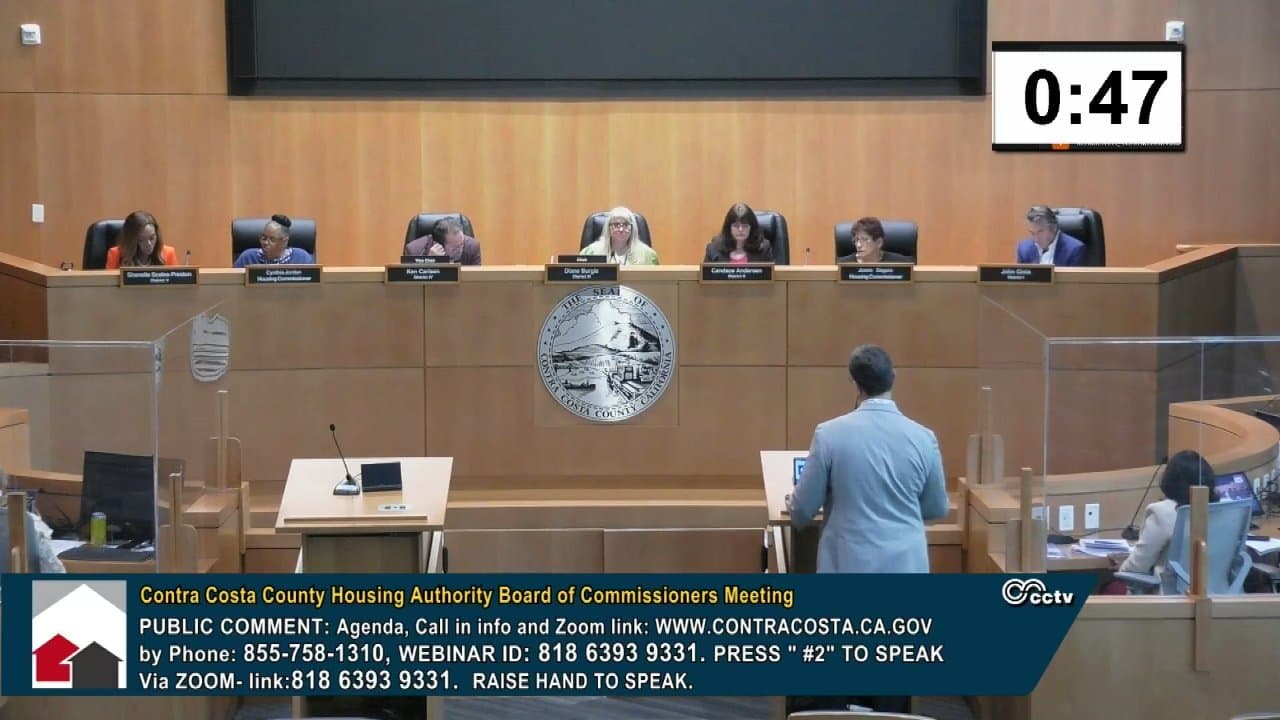
Board of Supervisors - Aug 11, 2026 - Special Meeting
Board of Supervisors • Contra Costa CountyAugust 11, 2026
Locunity is a independent informational service and is not an official government page for this commission.We use AI-assisted analysis and human editorial review to publish information.
Housing Authority Lays Out Plan to Convert All 963 Public Housing Units as Federal Pressure Mounts
The Contra Costa County Housing Authority is preparing for the most sweeping transformation of its housing portfolio in decades — a phased exit from the federal public housing program that would convert all 963 units to Section 8-based financing, rehabilitate aging buildings from top to bottom, and potentially add hundreds of new affordable units across the county. The plan landed at a moment of unusual urgency: the authority simultaneously disclosed it received a zero score on its HUD financial assessment due to a missed deadline, with federal reviewers scheduled to arrive Aug. 25, and reported a $12 million shortfall in its voucher program that will likely push tenant rents higher this fall.
- Housing Authority unveils plan to convert all 963 public housing units to Section 8 financing, rehabilitating 12 properties in three phases while preserving 30%-of-income rent protections
- Authority receives zero HUD financial score after a missed email and staff cuts trigger a federal on-site review Aug. 25-26
- Voucher program faces $12 million shortfall; tenants could see rent increases starting in late 2026
- Commissioners call for aggressive community engagement, drawing on a 14-year repositioning experience in North Richmond
- $10 billion state bond on the November ballot could unlock major funding for redevelopment at multiple sites
A New Financial Future for Nearly 1,000 Households
The Housing Authority's development consulting team — Jeremy Hoffman of Zen Development Consultants, Mike Andrews of Structured Development Advisors, and Atisha Varshney of Forward City Labs — delivered an extensive presentation outlining why the authority's 963-unit public housing portfolio, spread across 12 properties from San Pablo to Brentwood, cannot survive on its current federal funding.
The basics: HUD provides under $4 million annually in capital funds against $9.3 million in immediate capital needs and $36.5 million in needs over the next three to five years. Operating subsidies are also insufficient and unpredictable. The repositioning would move units from the traditional public housing program to Section 8-based subsidies using HUD's Rental Assistance Demonstration (RAD) and Section 18 programs, allowing the authority to tap tax credit equity, debt, and state development subsidies for comprehensive renovations. Current tenants would continue paying 30% of their income as rent.
Why it matters: The gap between what HUD provides and what these buildings need is not fixable within the public housing program. "Nationally, housing authorities don't receive enough capital improvement money to address the current and the immediate needs of the real estate," said Mike Andrews, Structured Development Advisors. "This is a challenge that many housing authorities are wrestling with, which is why they're looking at repositioning or converting through programs such as RAD or Section 18."
Executive Director Joseph framed the plan as an acceleration of a process already underway. "We've been working on slowly getting out of the public housing program, mostly because our North Richmond project, Las Deltas, has taken about 14, 15 years," he said. "Now we are prepared to start the rest of the process, which will include all the units."
The revenue case is stark. Joseph pointed to De Anza, a former public housing property already converted to a tax credit, project-based voucher property: it now generates roughly $2,200 per month in rent, compared to $1,082 for comparable public housing units.
Phasing and Feasibility
The consultants recommended six transaction groupings across three phases:
- Phase 1: Martinez properties (Hacienda and Alhambra Terrace) and East County properties (Los Arbolis, Casa de Manana, Los Nogales). "Both check a lot of boxes in terms of financial feasibility. They're geographically very proximate to one another. So there's operational and construction efficiencies," said Jeremy Hoffman, Zen Development Consultants.
- Bay of Vista (244 units): Standalone due to its scale, but faces environmental review challenges because of proximity to an oil refinery.
- Later phases include Kidd Manor, El Pueblo, Elder Winds, and Bridgemont.
Hoffman described the rehabilitation scope as comprehensive: "This is not a fix-it-if-it's-broke rehabilitation, but a comprehensive, really make these buildings nice and return them to their original state. And all new kitchens and bathrooms and envelopes and sustainability measures."
Andrews emphasized that selecting the right development partners would be critical: "The most important thing here is to pick partners that are compatible. It's really important to find a partner that will embrace the things that the housing authority says are important."
New Units on the Horizon — With a Catch
Land use studies identified infill potential at several sites — four to 100 additional affordable units at El Pueblo, Elder Winds, and Bridgemont. Vista del Camino, near a community college, emerged as a strong redevelopment candidate with potential for up to 500 units, but Hoffman warned that financial feasibility depends on outside funding. "In California, the state programs are extremely underfunded. There is a $10 billion bond going to the voters in November. If that passes, that may unlock a lot of potential subsidy for redevelopment projects," he said.
Hoffman also flagged a core tension: "There is a tension between speed of execution and building additional housing. Building additional housing will take a long time and Joseph has mentioned that HUD is very eager for the repositionings to happen more quickly."
The Pittsburgh Preschool site was recommended for disposal. The State Surplus Land Act complicates plans for certain parcels, as Joseph acknowledged.
Community Stakes
Commissioner Shanelle Scales-Preston pushed hard for preserving the character of existing communities, particularly green spaces and the Healthy Hearts farm at El Pueblo in Pittsburgh. "I would not want to see a space where there's no park and it's just all housing. With project housing, it already feels like doom and gloom sometimes," she said.
The Chair echoed those concerns, noting that many of these properties, originally built on the edges of towns, are now embedded in established neighborhoods. "A lot of these were originally built maybe kind of further out, and they weren't as integrated into communities. I imagine a lot of these that are in the cities, the communities are going to want to have some sort of say," the Chair said.
Commissioner Candace Andersen drew on the authority's own history to set expectations. "Having been through this in North Richmond, I think it is a long road. It does take a lot of intense ongoing work with residents. I think in the end it can hopefully move us to a better place," she said.
Atisha Varshney of Forward City Labs offered a legislative bright spot, noting the governor recently signed a law exempting affordable housing from development impact fees statewide. "A lot of cities and agencies will have to restructure around it," she said.
Princess Robinson, executive director of Richmond Land, a community land trust, asked about community input in surplus land decisions and emphasized the generational ties families have to public housing communities.
Craig, a public commenter, raised concerns about attracting developers given rising labor and material costs, including tariff impacts, and suggested waiving development fees for affordable projects.
What's next: The authority plans to return in September seeking formal adoption of the repositioning plan and authorization to proceed with Phase 1 transactions.
Zero Score, Federal Reviewers Incoming
In a separate but related discussion, Executive Director Joseph disclosed that the Housing Authority received a "late presumptive failure" on its annual HUD financial assessment, resulting in a zero score that triggered the Public Housing Agency Recovery and Sustainability Initiative (PARSI/FARS).
The basics: The underlying issue was a longstanding accounting discrepancy between GASB and HUD standards related to Other Post-Employment Benefits (OPEB) — a difference HUD has historically accepted after brief review. This year, a HUD reviewer whose workload had more than doubled rejected the submission without the customary back-and-forth. The rejection notification went to the wrong contact and was caught by a spam filter.
"HUD has lost 60% of their staff. She told us her workload has more than doubled. She saw that the number was different and she just rejected it," Joseph explained.
The authority's actual financial score would have been 18.57 — roughly a C grade — and HUD has since accepted the corrected numbers. But the technical failure now requires a recovery plan and an on-site HUD assessment, scheduled for Aug. 25-26.
Why it matters: Joseph presented data showing the authority consistently receives "shortfall funding" — 19.1% above its base operating subsidy over the 2020-2026 period — which he suspects is a factor in HUD's scrutiny. "I am certain, even though I can tell you that we absolutely need more money to operate it effectively, HUD does not want to keep giving us shortfall funding," he said.
The staffing picture underscores the systemic challenge. Joseph showed a comparison: maintenance staff has declined 59% while the unit count dropped only 18%.
The Chair framed the situation as an accountability moment. "Marginal is not acceptable in my book. And I want us to be excellent. And so I think that there is a lot of room for us as the Housing Authority to do better, to be more involved and to hold our staff accountable," the Chair said.
Commissioner Andersen pressed on what happened with the missed email and the process to prevent recurrence. Joseph outlined corrective measures including daily monitoring of HUD's REAC website for submission status.
Craig, a public commenter, argued that housing affordability is the preeminent issue for voters and urged elected officials to make it their top priority, suggesting that tailored housing-specific tax measures could win stronger voter support than general-purpose measures.
Commissioner Andersen pushed back on the framing, noting that blame for housing inaction extends beyond elected officials. "The blame doesn't just go to elected officials or council members. It goes to the public that, on one hand, says they want affordable housing, and then on the other hand, when there's a proposal to do it in their neighborhood, say no," she said.
Decisions: The report was accepted unanimously (For: 6, Against: 0, Absent: 1; Commissioner Andersen had stepped out for another meeting).
What's next: The HUD on-site assessment is scheduled for Aug. 25-26. The authority's recovery plan is due this week.
Voucher Tenants Brace for Rent Increases
Executive Director Joseph reported that the Housing Choice Voucher (Section 8) program faces an approximately $12 million shortfall — revised upward from an earlier $11 million estimate. The authority has already saved $1.3 million through administrative actions that do not affect tenants, but starting potentially in October, the authority will likely need to lower its payment standards, effectively raising what tenants pay.
Why it matters: Joseph said the authority plans to request a HUD waiver to implement subsidy changes more quickly than the standard timeline, applying reductions at tenants' next annual recertification. He noted that just two years ago, HUD was pressing the authority to raise subsidies because too many tenants exceeded the 30%-of-income threshold.
Nationally, HUD's shortfall pool has grown to $400 million and could reach $800 million to $1 billion as housing costs outpace federal subsidies even in traditionally affordable markets. "Probably people will start paying a little bit more for rent later this year or early next year," Joseph said.
The Chair pressed for clarity on bottom-line impact: "Are people going to lose their housing or are they going to get hit with a hard increase in rent, like out of the blue, and they're not going to have a time to be able to deal with it?" Joseph indicated increases would come but would not be extreme.
On a positive note, the authority is rated a "high performer" on the Section 8 program — a contrast with its public housing scores.
What's next: Staff will return in September or October with specific subsidy reduction proposals and a HUD waiver application.
Minor Items
- Consent calendar approved unanimously (For: 7, Against: 0).
- Princess Robinson of Richmond Land invited the public and commissioners to a housing resource fair Sept. 26 at Shields Reed Community Center in North Richmond, honoring community members who purchased former Las Deltas public housing properties.