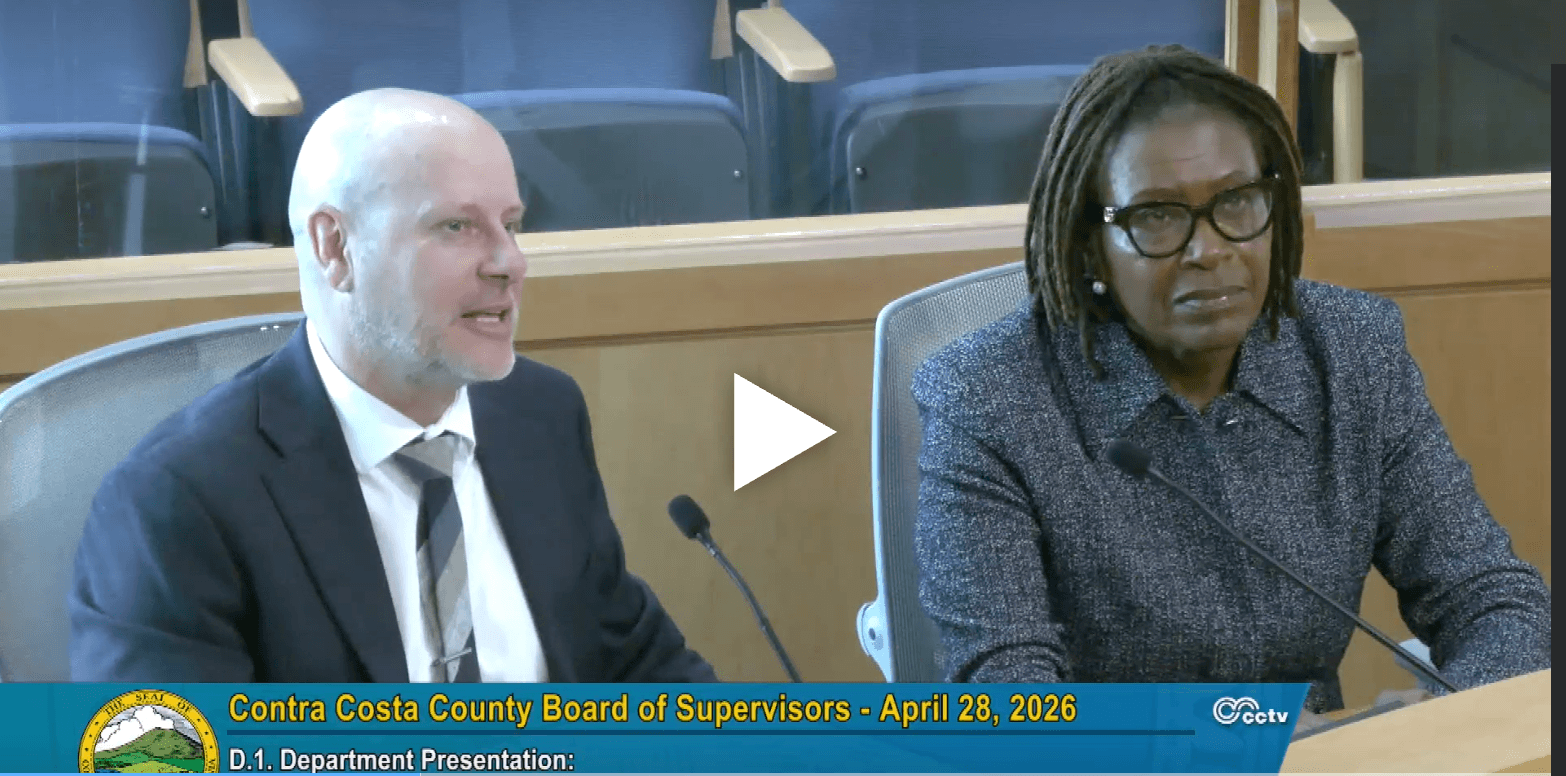
Contra Costa County, CA – Board of Supervisors – Apr 27, 2026
Board of Supervisors • Contra Costa CountyApril 27, 2026
Locunity is a independent informational service and is not an official government page for this commission.We use AI-assisted analysis and human editorial review to publish information.
Part 2: Board Approves Budget Framework Amid Deep Fiscal Uncertainty as Federal Cuts, State Unknowns Loom
The Contra Costa County Board of Supervisors unanimously approved FY 2026-27 budget recommendations during the second part of budget hearings, continued on April 28, but the real decisions lie ahead: with a state budget revision pending, federal cuts threatening safety-net funding, and the fate of the county's Measure B half-cent sales tax still unknown, supervisors openly signaled they may tap reserves and revisit spending rules as soon as June. Across five hours of public safety presentations, a throughline emerged — rising caseloads, shrinking state dollars, and a Measure X cost-of-living gap quietly eroding the buying power of voter-approved tax revenue.
Budget framework approved 5-0 with $20M contingency, but major spending decisions deferred to June when fiscal picture clarifies
Public Defender reports 34% felony surge — half of all Prop 36 defendants are Black, intensifying equity alarms as office loses two positions
DA secures first convictions in Heller's Jewelers smash-and-grab, seeks federal-funded retail theft prosecutors
Measure X COLA gap widens across fire, sheriff, probation and nonprofits as 1.1% adjustment can't match 5% labor costs
WORTH detention facility on track for July 1 opening, replacing aging Martinez jail modules with modern mental health treatment
Community groups urge protection of safety-net services, warn of 2008-level cuts if Measure B fails
Felony Referrals Spike 34% as Public Defender Loses Staff
Why it matters: The office that represents nearly 9 in 10 criminal defendants in Contra Costa County is shrinking at the exact moment its caseload is exploding — and the racial data on who's being charged is stark.
Where things stand: Chief Public Defender Ellen McDonnell told the board that felony referrals jumped from an average of 250 per month to 335 per month in the first quarter of 2026 — a 34% increase. The office handles nearly 13,000 annual case referrals across criminal, conservatorship, immigration, and CARE Court matters, and misdemeanor referrals were already up 18% over the prior fiscal year.
The sharpest edge: Proposition 36, the statewide ballot measure that reclassified certain thefts as felonies, has generated 295 new felony cases in its first 10 months. Three-quarters involve petit theft. "The demographics of these cases is that 50% of those charged in these first nearly 300 cases were Black," said McDonnell. "The racially disparate impact of Prop 36 is very clear in what we're seeing." Black residents make up roughly 8-9% of the county's population.
A California public defense workload study found the office is 45 support-staff positions short of recommended ratios — the office has 88 support staff compared to the District Attorney's 133 non-attorney employees. Despite this gap, McDonnell's office is one of only a few county departments actually losing positions this year, shedding two due to the expiration of Prop 47 and post-conviction grants.
The other side: Supervisor Candace Andersen pushed back on direct DA-to-PD comparisons. "I've got to really disagree with those of you who say they're supposed to be equal and parity. They do very, very different roles," she said. Andersen praised the office's CARE Court and social work programs but reiterated her long-standing position that immigration defense should be handled by a nonprofit, not the Public Defender. "While absolutely I support people having lawyers in immigration court, I don't think it should be from the public defender's office."
Supervisor John Gioia acknowledged the structural imbalance more directly: "There's not parity. And how do we fix that? It does get to the larger issues of balance in the criminal justice system."
Bright spots amid strain: CARE Court has been a notable success, with 100 active participants as of the hearing — far exceeding comparable counties. Mental health diversion more than doubled to 140 active participants. The Stand Together Contra Costa immigration program fielded 3,875 hotline calls and 900 legal consultations this fiscal year through a mobile legal clinic. And new state funding for retroactive Racial Justice Act work was secured effective July 1, 2023, providing a partial new revenue stream.
McDonnell noted the conflict panel contract has held at roughly $5M per year, and no cases have been sent out for capacity reasons since her 2021 appointment — a point of professional pride amid a system under growing pressure.
DA Touts Retail Theft Wins, Faces Unfunded Mandates
Why it matters: The District Attorney's office is managing an expanding portfolio — organized retail theft prosecutions, race-blind charging requirements, and immigration-related victim reluctance — with a mix of one-time federal money and unfunded state mandates.
Where things stand: District Attorney Diana Becton and Chief Assistant District Attorney Simon O'Connell presented a $74M budget supporting roughly 250 staff, including 115 attorneys. The office reported a 92% felony conviction rate, compared to 85% statewide, and $9.8M secured in victim restitution.
The headline case: the Heller's Jewelers smash-and-grab in San Ramon, involving 26 masked perpetrators. "In total, 21 of the 26 perpetrators have been identified," O'Connell told the board. "Our organized retail theft team, in conjunction with our law enforcement partners, is already catching up to those remaining. I am quite confident that this will be a statewide hallmark prosecution." The first three defendants were convicted at trial, with 19 more indicted by a grand jury. The organized retail theft unit currently has three prosecutors; the DA is requesting two more, backed by $600K in federal earmarks from Congressman Mark DeSaulnier.
Three key asks framed the presentation: a roaming prosecutor at Family Justice Centers to serve immigrant victims reluctant to enter government buildings amid federal immigration enforcement; continued support for the nine-prosecutor filing unit handling 20,000 cases per year under the state's race-blind charging mandate (AB, effective January 2025), which doubles review time and is entirely unfunded by the state; and the ORT expansion.
O'Connell described the chilling effect of federal immigration policy: "Federal immigration laws and enforcement through Washington have had a chilling effect on individuals within our community, whether they're documented or undocumented immigrants who have a reluctance and a concern to participate or engage with the formal institutions."
The office also detailed a new auto theft task force, a Pittsburgh office opening, $1.2M in copper theft losses countywide in 2025, and forthcoming public-facing data dashboards. Supervisors flagged the one-time nature of the DeSaulnier earmarks and questioned long-term sustainability.
Measure X's Growing COLA Gap Squeezes Departments Countywide
The basics: Measure X, the countywide half-cent sales tax approved by voters, includes a 1.1% annual cost-of-living adjustment for funded programs. But labor contracts are running at 5% annual increases — and the math is catching up to every department.
Why it matters: The gap isn't abstract. It's forcing departments to subsidize voter-approved programs from their own general funds, eroding the very services the tax was meant to sustain.
Where things stand: Fire Chief Broschard told the board the fire district has begun dipping into its general fund to cover the shortfall. "The fire district for the last year, maybe two, has started to dip into the general fund to augment and support the Measure X program, specifically in those areas where staffing is concerned," he said. The district is spending $500,000-$600,000 annually to maintain Measure X-staffed fire stations and over $1M per year for wildfire mitigation programs.
Supervisor Gioia put a fine point on the arithmetic: "If you take one of the allocations for fire, and that's wildland fire mitigation, it's roughly a $5 million program. One percent for a Measure X COLA that we apply is roughly $50,000, but the cost of doing business for them is $250,000. That opens up a $200,000 gap."
Chair Diane Burgis said the pattern extends well beyond fire. "I think it's really important for folks to know that, yes, you were awarded Measure X dollars, but it's also committing to those things that does still cost," she said, noting the COLA gap affects nonprofits receiving Measure X grants as well.
The sheriff's body-worn camera program, probation initiatives, and community-based organizations all face the same compounding pressure. Without reform to the COLA formula, general fund subsidies will grow each year — a structural issue with no current fix on the table.
Fire District Absorbs Hazmat, Opens New Station, Expands Wildfire Aviation
Why it matters: The Contra Costa County Fire Protection District is simultaneously expanding operations on three fronts — hazardous materials, new stations, and wildfire readiness — while managing the Measure X funding squeeze described above.
Where things stand: Chief Burchard outlined a budget that operates outside the county general fund through property taxes, an EMS Transport Fund, and a new Hazardous Materials Fund. The most significant change: the July 1 annexation of county hazardous materials programs (CUPA) into the fire district, requiring coordination with Cal EPA and the city of Richmond's Industrial Safety Ordinance.
Supervisor Gioia pressed on ensuring the hazmat transfer to Richmond proceeds on schedule given city council processes and a tight timeline.
Station 94 in Brentwood will open by year-end with staff already in place. The district's $2.7M aviation and helicopter program is expanding with $1M in PG&E funding, with wildfire season starting earlier this year. Chief Burchard also announced plans to request 15 temporary fire recruit positions to staff a 30-person academy ahead of 28-30 anticipated March 2027 retirements, returning to the board within approximately 60 days.
The district uses $4.8M from EMS fund balance for 20 ambulances and a communications center Phase 2, and proposes adding six full-time positions across funds, including three shift training captains for West County.
Sheriff Readies WORTH Facility as Consent Decree Wraps
Why it matters: A decade-long effort to modernize Contra Costa County detention — driven by a consent decree with the Prison Law Office — is reaching completion with a facility designed around mental health and medical treatment rather than traditional incarceration.
Where things stand: Sheriff David Livingston presented a $355M recommended budget anticipating approximately 16,000 bookings, down from 17,500 in the current fiscal year, and more than 300,000 calls for service. The department has 144 total vacancies, but 55 of the 76 sworn vacancies are deputies currently in the academy.
The WORTH (West County Reentry, Treatment and Housing) facility is the centerpiece. "We expect to actually move detainees into that facility sometime around July 1," Livingston said. "As a reminder, we're not adding capacity. We'll be closing two modules in MDF." The facility was 80% state-funded through AB 109 jail construction grants and vastly improves mental health treatment, medical facilities, and family reunification capacity. The move is cost-neutral in staffing.
The Prison Law Office consent decree is concluding with all goals met. Priority-one response times are trending down with additional beats funded by the board. Measure X provides $2M for body-worn camera systems — also subject to the COLA gap.
The sheriff requested emergency planning coordinator positions but was denied due to budget uncertainty. Marine patrol lost approximately $500,000 in state and federal funding. Livingston praised the board's working relationship: "The quality and the collegiality and the professionalism that we share as elected leaders is very much appreciated. We're not going to agree on policy necessarily in every case, but this board and the relationships that we have, I think in the end serves the people of this county."
Supervisor Andersen praised the department's recruitment success, transparency through quarterly oversight reports, and new public dashboard.
Probation Faces State Cuts as Juvenile Staffing Forces Co-Ed Housing
Why it matters: The closure of the state Division of Juvenile Justice shifted the most serious youth offenders to counties — but state funding covers only $5M of the roughly $7M program cost, and the gap is growing.
Where things stand: Chief Probation Officer Issa Eamon Kraus reported an 18% increase in adult supervision referrals and 10% increase in juvenile referrals. The department received seven positions back last fall but still lacks a full sworn staffing complement. Juvenile hall is operating a co-ed housing unit due to minimum staffing ratios — six other Bay Area counties face the same challenge.
"Currently we receive right around $5 million in juvenile justice realignment block grant funding, but the total cost to operate that program is about $2 million more," Kraus told the board. Reserves built from earlier years are now depleting.
SB 678 community corrections incentive funding is being reduced by approximately $1M after a state formula revision. Pre-trial services expanded under SB 129, but a 30% court fund retention now reduces probation's share. Kraus described the process of reviewing all contracts for potential savings: "A number of them, I think, honestly, can be right-sized because there's typically an amount that is unspent at the end of the contract."
The Measure X-funded restorative justice pilot wraps in December 2027, with the department building capacity for community organizations to sustain the work. Demolition of the former juvenile hall is funded by $1.9M from the Byron Boys Ranch sale. Supervisors discussed the pipeline challenge of recruiting juvenile institutional officers who then promote out, and the need for state legislative advocacy through CSAC on juvenile funding formulas.
Board Deliberation: Reserves, Contingency, and a June Reckoning
Decisions: The board voted 5-0 to approve 12 FY 2026-27 budget recommendations, including a $20M contingency appropriation; no changes to current Measure X allocations; reaffirmation of the policy prohibiting general-purpose revenue from backfilling state and federal cuts (with explicit flexibility to revisit); and direction to the County Administrator to prepare the budget for May 19 adoption with a June revisit. (For: Supervisors Burgis, Gioia, Andersen, Carlson, Scales-Preston; Against: 0; Absent: 0.)
Where things stand: Supervisor Gioia was the most direct about the policy he helped create. "Reserves and rainy day funds are for rainy days," he said. "I don't think anyone can doubt that if we don't get state help or revenue measure, the rainy day gets that much rainier and we just don't want money sitting there and unused when it can be used to help improve people's lives."
Supervisor Ken Carlson urged a cost-benefit lens on any potential service cuts, arguing the board should quantify the long-term downstream costs before reducing programs.
Chair Burgis floated a policy idea: requiring time-limited positions for grant-funded hires to set clearer expectations when one-time money runs out.
All five supervisors supported extending the timeline for the Support for Recovery Measure X innovation grant, allowing full expenditure of the $401,000 allocation for a Spanish-language women's substance use recovery program in Antioch.
What's next: The County Administrator will present the budget for adoption on May 19. A budget revisit is scheduled for June, after the state May revise and Measure B election results provide more fiscal clarity. If Measure B fails and federal cuts materialize through HR1, supervisors warned the county could face service reductions not seen since 2008.
Community Groups Sound Alarm on Safety Net
Seven public commenters — representing the Budget Justice Coalition, Racial Justice Coalition, ACCE, Ensuring Opportunity, First 5 Contra Costa, the Advisory Council on Aging, and One Contra Costa Coalition — delivered a coordinated message: protect safety-net services, address the Public Defender funding gap, and be transparent with residents about what happens if Measure B fails.
Mariana Moore of Ensuring Opportunity raised two specific equity concerns: the Public Defender's severe support-staff shortage compared to the DA, and the sheriff's budget potentially lacking a vacancy factor that could leave millions unaccounted for.
Jim Donnelly of the Advisory Council on Aging urged the board to communicate more aggressively about the consequences of Measure B's failure, recalling the painful cuts of the 2008 fiscal crisis. Melvin Willis of the Racial Justice Coalition and ACCE connected Prop 36 to increased criminalization and urged reserves be used to maintain services.
Minor Items
$1.9M from Byron Boys Ranch sale will fund demolition of the former juvenile hall.
The DA's office is launching public-facing data dashboards through the Securo platform.
The sheriff's department noted Prop 172 revenue may decline, a funding source shared with the DA and other public safety agencies.
The fire district's $4.8M EMS fund balance will fund 20 ambulances and Phase 2 of the communications center.
Public Works Director Warren Lai participated in the budget deliberation.