Board of Supervisors - Mar 03, 2026 - Meeting

Board of Supervisors - Mar 03, 2026 - Meeting

Board of SupervisorsContra Costa CountyMarch 3, 2026

Sources:

Locunity is a independent informational service and is not an official government page for this commission.We use AI-assisted analysis and human editorial review to publish information.

Board Votes 4-1 to Place Emergency Health Care Sales Tax on June Ballot

The Contra Costa Board of Supervisors approved placing a five-year, 0.625% sales tax on the June 2 ballot to stave off a projected $1 billion hospital system deficit driven by federal HR1 cuts — but not before a sharp clash over data accuracy nearly derailed the effort. The 4-1 vote, with Supervisor Candace Andersen dissenting, came after hours of testimony from health officials, private hospital leaders, labor unions, taxpayer advocates, and an attorney threatening litigation.

  • Board places emergency 0.625% sales tax on June 2 ballot (pending state legislation) to partially offset $1 billion-plus hospital deficit, 4-1

  • County forced to correct resolution after supervisor reveals projected losses were misrepresented as annual rather than cumulative

  • EHSD discloses it needs 313 new eligibility workers — $117 million — to comply with unfunded federal mandates

  • John Muir Health warns of $80–$130 million per year in additional losses when HR1 hits

  • Public Works trades workers demand 15–20% raises ahead of contract negotiations, citing $12,000–$20,000 pay gaps

  • Board honors retiring La Clinica CEO Jane Garcia after nearly 50 years building $170 million safety-net empire


Hospital Funding Crisis Goes to the Ballot — With a Data Controversy Attached

The main event of the March 3 meeting was Agenda Item D1: adoption of Ordinance 2026-05 authorizing a temporary 0.625% general retail sales and use tax for five years, paired with Resolution 2026-40 calling a June 2, 2026 special election to put the measure before voters. The tax would generate roughly $150 million annually — approximately $750 million over five years — to offset a healthcare funding crisis driven by federal HR1 cuts, state reductions, and rising costs.

Why it matters: The county operates the safety-net hospital system as the legally mandated provider of last resort. Without new revenue, staff projections show the hospital's Enterprise Fund 1 going negative by FY2029, threatening the viability of a system that serves the county's most vulnerable residents — and ultimately strains every health provider in the region.

Where things stand: Tim Ewell, Chief Assistant County Administrator, opened by noting this was the last regularly scheduled board meeting to approve the ballot items before the March 6 filing deadline — an 88-day requirement for the June election.

Dr. Grant Colfax, Director of Contra Costa Health, presented updated health impact data, warning that "over 90,000 county residents are at risk for losing their health care coverage. There are likely to be delays in vital care due to the loss of coverage." He framed the county's obligation bluntly: "The county is the provider of last resort. Regardless of the demands on the system, we are required to provide care."

Brian Buchanan, Acting CFO of Contra Costa Health, walked the board through updated financial projections extending through FY2031. The headline number was stark: "Our Enterprise Fund 1 would incur over a billion dollars of cumulative operating losses over the forecasted period through 2031."

The Data Discrepancy

The sharpest moment came from Supervisor Candace Andersen, who revealed that the county's own website and the resolution's recital language had described a $307 million projected loss as an annual, ongoing figure — when it was in fact a cumulative total through FY2028–29. Andersen said she had been citing that figure to other elected officials and members of the legislative delegation in good faith:

"I am deeply concerned because as I've spoken to other elected officials, even members of our legislative delegation, I've said we absolutely need this because we are looking at this $307 million ongoing deficit."

The error forced a real-time amendment to the resolution. Recital H was corrected to read "cumulative revenue losses of an estimated $239 million by 2029." The episode underscored tensions between the urgency of the timeline and the accuracy of the public-facing case for the tax.

Unfunded Mandates Pile Up

Dr. Marla Stewart, Director of the Employment and Human Services Department, delivered perhaps the most alarming disclosure of the evening. Her department faces 18 new eligibility changes mandated by HR1 and state law — work requirements, verification processes, and reporting obligations — with zero additional funding:

"We believe right now based on what we know so far that we will need to add 313 more eligibility workers. It's almost double the work for an additional amount of money of $117 million compared to the $137 million we receive right now."

Sharon Jenkins, Director of Government Affairs at John Muir Health, testified that the private system is not insulated. John Muir already absorbs $180 million annually in Medi-Cal underfunding. "Add to that an estimated $80 to $130 million per year in lost revenue when HR1 is fully implemented," she said, warning that uninsured patients will flood private emergency rooms when the public system buckles.

The Other Side

Supervisor John Gioia pushed back on critics who questioned the tax's impact on seniors and low-income residents, arguing the math favors action: "A senior who may pay $5 more a month under this sales tax would pay possibly hundreds more in cost for food or medical care." He also argued the visible fiscal projections understated the crisis: "The dollar impacts shown on this chart are like half of the coin. Turn the coin over and there's all these other impacts."

Opponents were vocal. **A representative of the Contra Costa Taxpayers Association **accused the board of changing projections "on the fly" and argued officials should present accurate numbers before asking voters to approve $750 million. Denise, a public commenter, noted county spending had increased 63.4% since Measure X while inflation rose only 18.4%, and urged the board to find savings instead. Jan Warren, a Walnut Creek resident, said most cities would exceed a 10% combined sales tax rate and that residents are already maxed out from tariffs and inflation.

Attorney Jason Bezis, representing the Contra Costa Libertarian Party, threatened litigation, arguing the board lacked legal authority under Revenue and Taxation Code Section 7251.1 to place the measure on the ballot without enabling state legislation. Supervisor Gioia responded that this was the same legal procedure used to place Measure X on the ballot in 2020. Nevertheless, because the tax would push some cities over a local sales tax cap of 9.25%, the county will need state legislators to pass legislation allowing the tax measure to take effect.

On the other side, Sean Stalbaum of IFPTE Local 21 urged immediate action, calling it "a temporary tax that will save lives" and warning that waiting would be too late to invest in enrollment and eligibility infrastructure before cuts hit in 2028. Jim Donnelly of the Advisory Council on Aging pledged senior advocates would campaign for the measure. The Food Bank of Contra Costa and Solano warned that HR1 will cut $200 billion over the next decade, noting a 400% increase in food assistance demand during a recent benefits pause.

Decisions

Supervisor Gioia moved to adopt Ordinance 2026-05 and Resolution 2026-40, including a $1.2 million budget amendment for the special election and the amendment to recital H. The motion passed 4-1 (For: Gioia, Burgis, Carlson, Scales-Preston; Against: Andersen). The vote met the required 4/5 supermajority threshold.

Andersen explained her dissent: "I will not be supporting us moving forward. And I'm sorry because I wanted to see this happen. But I am frustrated that we're in the situation we are in because I cannot in good conscience put this forward to voters." She called for more collaboration with cities and the legislative delegation before asking taxpayers for $750 million.

What's next: The measure goes to Contra Costa voters on June 2, 2026. Expect a contested campaign: taxpayer groups and the Libertarian Party have signaled opposition and potential legal challenges, while labor, health, and senior advocates are mobilizing in support. The corrected fiscal data will be central to both sides' arguments.


Trades Workers Tell Board: We're Underpaid and Can't Afford to Live Here

Four members of **Local One **(public works/building trades) used general public comment to deliver a coordinated message ahead of upcoming contract negotiations: the county's skilled maintenance workers are drastically underpaid, and it's costing the county in retention.

Why it matters: These workers maintain over 600 county buildings. When they leave for higher-paying jobs in surrounding jurisdictions, the county loses institutional knowledge and faces deferred maintenance on critical infrastructure.

Where things stand: Archie, a building maintenance and traffic signals worker, said skilled tradespeople are underpaid by a minimum of $12,000–$20,000 annually compared to surrounding jurisdictions. Jacob described inadequate standby compensation and hazard exposure in juvenile detention facilities and homeless shelters without Narcan training. Clint called building trades workers "the unseen and the unheard" who keep the county functioning.

Colton Shaw, a 16-year county carpenter, put the housing math in personal terms: "60% of my check goes to rent and utilities alone. That leaves me about $2,000 to pay for groceries, insurance, clothes, everything that I need to live every day." He said it would take 12 years to save for a home down payment in Contra Costa and called for a 15% cost-of-living increase, a 20% salary raise, and no reduction in retirement or health benefits.

What's next: The board took no action — public comment is informational — but the testimony puts the workers' demands on the public record as bargaining gets underway.


Board Honors La Clinica's Jane Garcia After Half a Century

All five supervisors paid tribute to Jane Garcia, retiring after nearly 50 years as CEO of La Clínica de la Raza, a federally qualified health center with roots in Oakland that now operates 35 sites across Contra Costa, Alameda, and Solano counties.

Why it matters: Garcia grew the organization from a $2 million startup to a $170 million operation serving 85,000 patients with 1,200 employees — a substantial share of the region's safety-net primary care capacity. Her departure comes just as federal healthcare cuts threaten the system she built.

Vice Chair Ken Carlson called Garcia "a healthcare giant" recognized statewide, citing awards including East Bay Business Times Woman of Distinction and San Francisco Business Times Most Admired CEO. Supervisor Scales-Preston noted Garcia's work with Congressmen George Miller and Mark DeSaulnier on the Affordable Care Act. Chair Diane Burgis said Garcia "reshaped healthcare in Contra Costa County."

Garcia pledged continued advocacy despite retirement, telling the board she had served nearly 50 years at the 54-year-old clinic.


Minor Items

  • Closed session: Board voted 5-0 to file a cross complaint for breach of contract and indemnity in Stewart v. Contra Costa County (Case No. C24 02380).

  • Consent calendar: All 138 items approved unanimously by voice vote with no items pulled and no public comment. Items included authorization for the East County Services Building in Brentwood.

  • East County Services Building concerns: Brentwood City Councilmember Jovita Mendoza warned during general public comment that the planned facility is driving gentrification, with rents across the street already rising $1,000; she urged Chair Burgis to hold a town hall with the Latino community. A separate commenter, Tracy, raised concerns about the accuracy of the project's Mitigated Negative Declaration and alleged the county had not contacted the city as claimed.

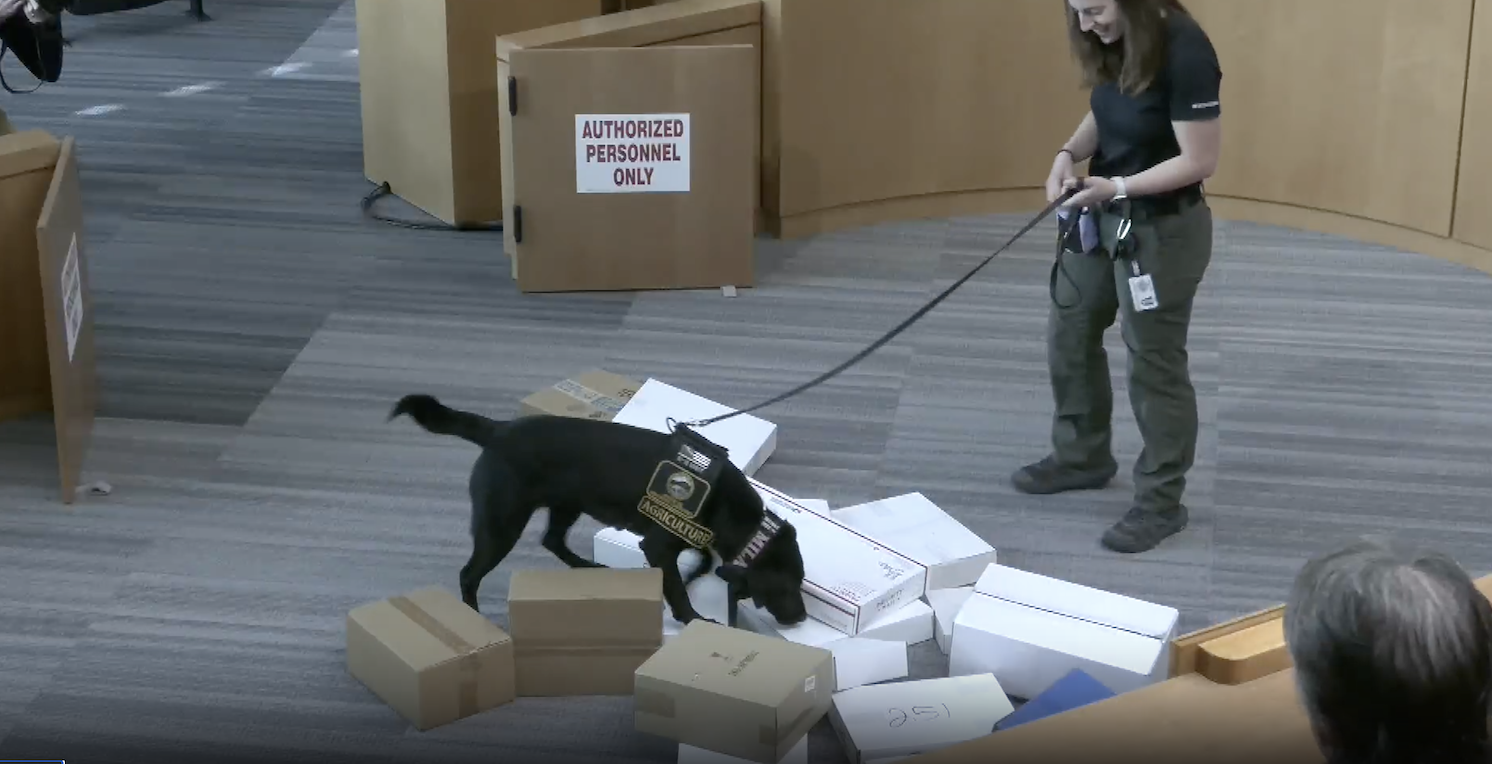
  • Invasive species awareness: Agricultural Commissioner Matt Slattengren presented the National Invasive Species Awareness Week proclamation. Intercepted e-commerce parcels with invasive species have surged from about 100 to 800 per year over the past decade. The county's canine detection teams operate at 98% accuracy; retiring detection dog Major and handler Simone will be replaced by 4-year-old Mila. Chair Burgis highlighted emerging threats including the golden mussel in Contra Loma Reservoir and nutria threatening Delta levees.

  • Social Work Month: EHSD, Contra Costa Health, and the Public Defender's Office jointly recognized over 1,100 county social workers. Key statistics: 9,100 CPS reports investigated, 879 foster youth supported, 17,500 IHSS customers served, and 1,700 criminal justice clients connected to services through the Holistic Intervention Partnership and Care Court. Chief Assistant Public Defender Brandon Banks described the forensic social work team's role in mental health diversion and youth defense.

  • Attorney Jason Bezis reiterated in general public comment that a pre-litigation demand letter had been sent regarding the sales tax measure and questioned Brown Act compliance of a recent judges' luncheon.

  • Adjournment: The board adjourned in memory of Sanjiv Bhandari, an architect and Planning Commission appointee who passed away Feb. 15. Supervisor Andersen delivered the memorial.