
Contra Costa Adopts Immigration Non-Cooperation Policy, Rejects Ordinance Push
Board of Supervisors • Contra Costa CountySeptember 8, 2026
Locunity is an independent informational service and is not an official government page for this commission. All information is sourced from public footage and an analysis of official agendas with the aid of responsible, fact-checked AI. to report an error or omission.
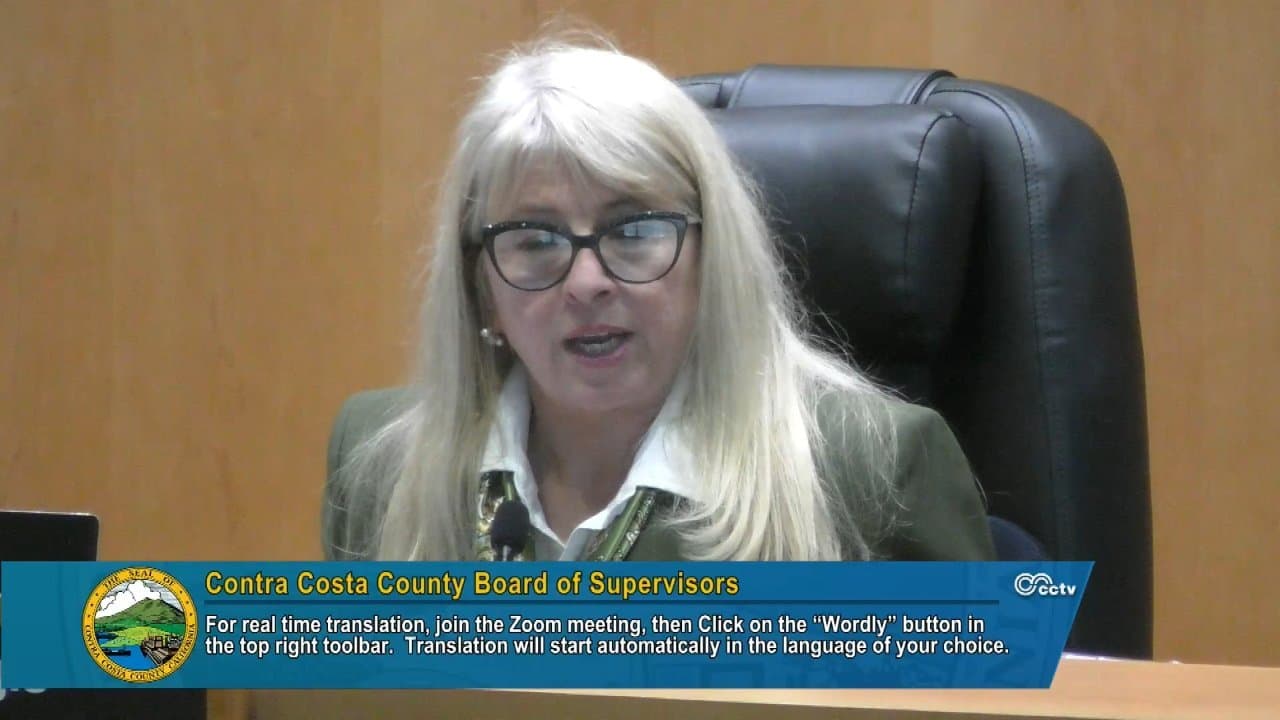
After roughly three hours of debate on Sept. 8, 2026, the Contra Costa County Board of Supervisors voted unanimously to fold the state attorney general's SB 580 model policies into a single immigration non-cooperation policy. A rival bid for a binding ordinance, backed by a broad coalition of unions, faith groups and immigrant advocates, failed on a split vote. In the same session, county workers packed the chamber to fight health premium hikes of up to 86.8%, and the board pushed those rates back a week.
- SB 580 policy adopted 5-0 after a substitute motion for an ordinance failed
- Coalition of unions, faith groups and party leaders demanded an enforceable ordinance with contractor rules
- Contra Costa Health Plan premium hikes deferred after eight speakers warned of losing their doctors
- Health director projects a deficit above $700M over five years, with 93,000 residents at risk of losing coverage
- Nurses contract approved 5-0, adding about $9M a year to Health Department costs
One Policy, Not an Ordinance
Why it matters: SB 580 requires the county to adopt immigration non-cooperation policies based on Attorney General Rob Bonta's model policies by Jan. 1, 2027. The board's choice sets how county staff, facilities and data interact with immigration authorities. It also determines how easily future boards can rewrite those rules.
Where things stand: County Counsel Thomas L. Geiger said the county's existing draft falls short. "In general, the non-cooperation policy is consistent with the Attorney General's model policies, but is not detailed enough to comply with the requirements of Senate Bill 580," said Geiger.
He laid out three options: the AG-based policies alone, those policies plus a broad policy, or those policies plus a broad ordinance. An ordinance must be introduced at one meeting and adopted at a second at least five days later, then takes effect 30 days after that. A policy can be changed at a single meeting.
On the central question of enforceability, Geiger drew no distinction. "There's no difference in enforceability between a policy and an administrative ordinance," said Geiger. He said discipline is the consequence of a violation under either approach.
Supervisor Ken Carlson, District 4, argued that flexibility is the policy's main advantage. "That's why I'm a strong advocate for a policy because we can respond immediately and we don't have to wait another 65 days to have something happen," said Carlson.
Board Chair Diane Burgis stressed the measure's limited reach. "I do want to remind people that this is really dealing with unincorporated areas of Contra Costa and county buildings," said Burgis.
The other side: Supervisor John Gioia, District 1, and Supervisor Shanelle Scales-Preston, District 5, argued that an ordinance is more durable and sets a clear public standard. "There's no real downside to doing an ordinance," said Gioia. "Ordinance doesn't cost us a thing," said Scales-Preston, who moved the substitute. Gioia seconded it.
The sheriff question: Supervisor Candace Andersen, District 2, asked whether either approach would "prevent the sheriff from doing exactly what he has been doing all along." Counsel said no. Geiger said "the sheriff has separate authority under state law to adopt that policy."
Andersen said the sheriff, who was absent, considers monthly reporting onerous and prefers quarterly reports. Carlson noted the data is already posted on the sheriff's transparency portal.
Contractors and Flock: Geiger said the AG model's only contractor provision is a requirement on page 29 to append the policy to contracts, and that the advocates' Section 6 goes further. Gioia backed complaint-driven contractor compliance for new contracts. Geiger cautioned that state-form contracts may not be amendable. He and Andersen said the current Flock Safety license-plate camera contract would not be affected, and noted Flock may not share data outside California agencies.
Decisions and stakeholder impacts: The substitute ordinance motion failed. Gioia and Scales-Preston voted yes, and Andersen and Carlson voted no. Burgis's vote on the substitute could not be confirmed, though later commenters described three supervisors as opposing an ordinance. Carlson's original motion, seconded by Andersen, then passed (For: 5, Against: 0, Absent: 0). It merges the draft policy with all of the AG model policies, including contractor and severability language, into one policy.
Immigrant families and advocates gain contractor coverage that goes beyond the state model. They did not get the permanence of an ordinance.
What's next: Geiger will return with the merged policy ahead of the Jan. 1, 2027 deadline.
A Coalition Demands Something Binding
Why it matters: The volume and breadth of public testimony turned the vote into a test of responsiveness to immigrant families. Speakers said those families now fear using county services.
Where things stand: Organized speakers urged one enforceable county standard, contractor compliance and severability.
- Katie Rickliffs, Chair, Democratic Party of Contra Costa County, cited a resolution signed by 28 officials.
- Harry Baker, representing SEIU Local 1021 and Lift Up Contra Costa, argued the county's own analysis shows an administrative ordinance need not criminalize employees.
- Danny Espinoza of Lift Up Contra Costa cited about 1,200 petition signers and asked for data protections.
- Daniela Gomez of the Latina Center said one standard extended to contractors would help families trust county services.
- Greg Colley of the Multifaith Action Coalition and Kathy DeFabio of Indivisible West Contra Costa County pressed to close the contractor loophole and bar departmental overrides.
- Cameron, of the California Immigrant Policy Center, cited Pinole's property-use ordinance as an example.
Several speakers targeted the sheriff directly. Dennis Ladd called the sheriff's 12.7% ICE referral rate unacceptable and said the goal must be zero. Ruth Horton criticized the sheriff's ICE notification criteria. Mariana Moore of Ensuring Opportunity argued the board controls the sheriff's budget. Gioia replied that the board cannot direct how the sheriff spends those funds.
The other side: A public commenter identified as Liz opposed limiting cooperation. She argued the sheriff should be able to hand over people convicted of serious felonies and called some statements inflammatory.
Andersen suggested the testimony reflected a misunderstanding, saying "many people who spoke in favor of an ordinance thought it was going to do something completely different."
Workers Push Back on Health Plan Hikes
Why it matters: County employees who rely on Contra Costa Health Plan (CCHP) specialists face steep premium increases, and open enrollment begins soon.
Where things stand: Staff reported that Kaiser premiums will rise 3.17%, while dental, life and county vision rates will not increase. About 77% of non-CalPERS medical enrollees will pay the same or less.
CCHP is the outlier. Human Resources Director Ann Elliott said listed increases are 86.8% for Plan A and 50.6% for Plan B. Those would drop to 73% and 39.5% if the Regional Medical Center stays in the network. Elliott asked the board to approve everything except CCHP.
The other side: Eight speakers opposed the hikes. Sean Stahlbaum of IFPTE Local 21 said family costs in CCHP Plan A would rise 302%. He said 96% of surveyed members have no alternative plan and accused CCHP leadership and the county administrator of refusing to bargain.
Regina Brown, an AFSCME Local 2700 member with 27 years of service, said her family depends on CCHP specialists and psychiatric care. Nilesh Katecha, a Sheriff's Department network analyst, said his son would lose his care team. Sean Kaufman, an Animal Services supervisor, said losing his doctors, including his glaucoma care, would be devastating.
The fiscal squeeze: "We have a limited amount of money and we are subsidizing health care for all of our employees out of the general fund," said Andersen.
Dr. Colfax, Contra Costa Health Director, said the health system faces a deficit of more than $700M over five years, a projection shared with the board on Aug. 25. He said the commercial plan has lost tens of millions of dollars on top of the county subsidy. "We estimate there will be 93,000 people in Contra Costa County who are at risk of losing their health care," said Colfax.
The board linked the pressure to HR 1 and state changes. Burgis said many of those at risk are people with unsatisfactory immigration status. Scales-Preston noted that an earlier tax measure did not pass. Gioia flagged Health Net's announced exit from the California market.
Decisions and stakeholder impacts: The board approved the 2027 rates as amended, excluding CCHP (For: 5, Against: 0, Absent: 0), on a motion by Andersen seconded by Carlson. Scales-Preston urged earlier communication with workers about benefit changes.
What's next: Revised CCHP rates, with the Regional Medical Center kept in network, return next week.
Nurses Contract Locked In Through 2029
The board unanimously adopted Resolution 2026-327, a 39-month agreement with the California Nurses Association running from Sept. 1, 2026, through Nov. 30, 2029. Carlson moved the item and Burgis seconded.
David Sanford of the Labor Relations office said bargaining began in July of last year and reached agreement Aug. 13, 2026. The Health Department must absorb about $9M in fiscal year 2026-27, $8.9M in 2027-28 and $8.67M in 2028-29 within its existing budget. That comes as the same department projects a $700M-plus deficit. No one spoke during public comment.
Fallout: Recall Talk and Calls for Civility
During general public comment, a commenter identified as Tracy and another speaker criticized Carlson, Andersen and Burgis, and both referenced a recall effort. Chaffee urged ending the Flock contract, citing a reported 71% inaccuracy rate. Craig offered a counterpoint, saying the policy accomplishes much the same as an ordinance.
In board reports, Gioia defended the result: "We voted unanimously for what was the substance of what advocates wanted," said Gioia. Andersen, Scales-Preston and Carlson joined him in calling personal attacks on Burgis inappropriate. "I think today we actually agreed on more than we disagreed on," said Burgis.
- Consent calendar: Items C.1 through C.83 passed 5-0, with nothing pulled and no public comment.
- Senior Legal Services: The board honored the nonprofit for 50 years of free legal aid to seniors.
- Workforce Development Month: The Workforce Development Board reported serving 5,770 businesses and about 23,715 career-service visits in FY 2025-26.
- Ovarian Cancer Awareness Month: Survivor Elizabeth McLaughlin urged attention to symptoms because no routine screening test exists.
- Data centers: A commenter identified as Angelica renewed her call for a moratorium on new data centers, saying it has not been agendized.
Looking ahead: Revised CCHP rates return next week, and County Counsel will bring back the merged SB 580 policy before the Jan. 1, 2027 state deadline.