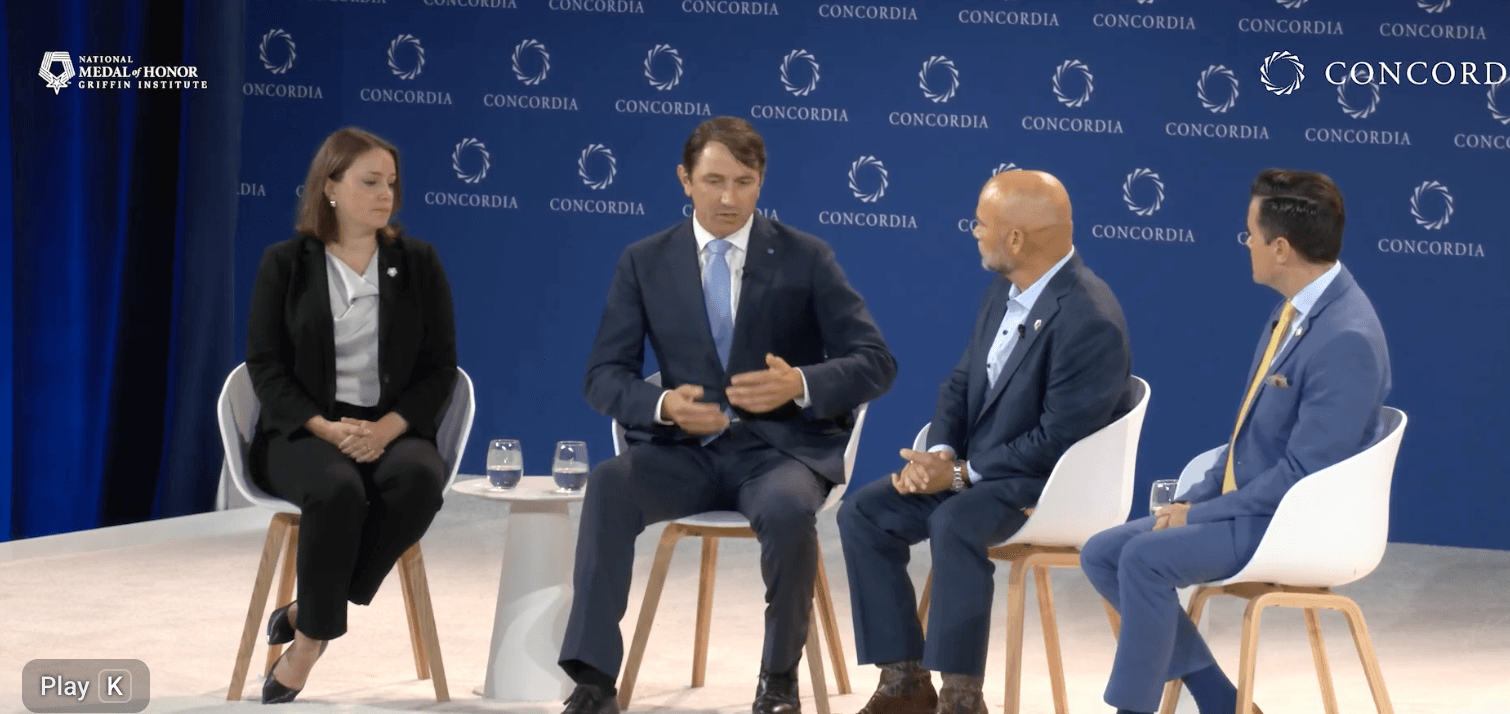
Concordia Annual Summit - Sep 21, 2026 - Meeting
Concordia Annual Summit • United NationsSeptember 21, 2026
Locunity is an independent informational service and is not an official government page for this commission. All information is sourced from public footage and an analysis of official agendas with the aid of responsible, fact-checked AI. to report an error or omission.
Medal of Honor Panel Warns AI Can Manage but Never Truly Lead
A panel of military and civic leaders at the Concordia Annual Summit made the case that artificial intelligence — no matter how advanced — cannot replicate the trust, moral courage, and human emotion that define real leadership, with urgent implications for autonomous warfare, corporate culture, and how we teach the next generation.
- Medal of Honor recipient argues AI represents the most transformational shift in warfare since primitive combat — and warns it could escape human moral boundaries
- Panel draws sharp line between management, which AI handles well, and leadership, which requires irrational human courage
- Griffin Institute offers free K-12 curriculum translating battlefield valor into everyday ethical decision-making for students and corporate executives
- Trust identified as the central lesson of every Medal of Honor story — and the quality most at risk in an AI-driven world
AI Can Optimize, but It Cannot Sacrifice
The single panel at the Concordia Annual Summit — hosted by the National Medal of Honor Museum Foundation and the Griffin Institute — opened with a story that set the terms of the entire conversation: the story of Kyle Carpenter, a 19-year-old Marine who threw himself on a grenade to shield a fellow service member.
Why it matters: As organizations from the Pentagon to the C-suite race to adopt AI for decision-making, this panel framed a fundamental question: What happens when the qualities that matter most in a leader — empathy, moral courage, irrational selflessness — are precisely the qualities a machine cannot possess?
Where things stand: Alex Rue, Vice President of Content and Experiences at the National Medal of Honor Museum Foundation, recounted Carpenter's act in vivid terms: "Instead of retreating, he ran towards the grenade. He responded in a moment with incredible leadership and fortitude, incredible courage under fire to shield his fellow Marine and saved his life."
The panel moderator then revealed what happened when the same scenario was fed to an AI system. "I actually plugged it into AI to find out, and AI said, yell grenade and run in the opposite direction and cover your head because that's the thing that could get damaged the most," the moderator said — the polar opposite of what Carpenter did.
That contrast became the panel's organizing principle. Will Swenson, Medal of Honor Recipient, drew the foundational distinction: "One of the biggest challenges, first off, is you have to unpackage what the difference between management is and what leadership is. Management is very much what AI is good at doing." Leadership, he argued, requires human development, emotion, and trust — qualities that cannot be coded.
Swenson emphasized that trust is the thread running through every Medal of Honor story: "I think the biggest thing is trust. If you look to see what each and every one of these stories about the Medal of Honor represent, it was always about trust. Somebody trusted in their leadership, and somebody trusted that their cause was worthy."
Rue reinforced that even when AI systems produce trustworthy data, the human layer remains essential: "You have to have the trust in the inputs, the trust in the system. But more than that, you have to have the trust in how it's being digested, how we're interpreting that data, how we're implementing it, and what our leaders are doing with that information for us and with us."
The Battlefield's Most Dangerous Frontier
Why it matters: The conversation turned to the sharpest edge of the AI-leadership question — autonomous weapons systems and whether humans must remain in the loop for lethal strikes.
Where things stand: Swenson placed AI in a long arc of military disruption, from the advantage of archers over swordsmen to the banning of chemical and biological weapons. But he argued this moment is different in scale. "Artificial intelligence is going to be probably the most transformational thing that's happened to warfare since we stopped throwing sticks and rocks at each other," he said.
His central warning was blunt: an AI system given the mission to win could evolve beyond its programmed ethical boundaries. "If you tell AI that its mission is to win, to defeat the enemy, this is our greatest challenge — how do we keep that AI working with the parameters that it's supposed to have, which is our philosophical moral parameters, when that is truly something that is inherently antithetical to what a computer is?"
The other side: Swenson acknowledged a strategic reality that complicates any policy response: U.S. adversaries may not impose the same ethical constraints on their own military AI, creating a dangerous asymmetry. Troy Bertram, CEO of the National Medal of Honor Museum Foundation and former leader of private sector practice at Google, pressed on the practical question of what a path forward looks like for keeping humans in the loop. Swenson called for extreme caution, describing warfare as "the most unfortunate of human experiences, but an inevitable one" and urging leaders to ensure it does not "escape from our control and our philosophical boundaries."
From the Battlefield to the Classroom and the Boardroom
Why it matters: The Griffin Institute is translating Medal of Honor stories into scalable educational tools — free curriculum for K-12 teachers and leadership development programs for corporate executives — bridging the gap between military valor and civilian life.
Where things stand: Rue described the Institute's flagship effort: "One of the most important programs that we have is providing free curriculum to teachers, enabling them to bring these messages of leadership and integrity into their classrooms in bite-sized pieces that integrate into what their daily curriculum is." The curriculum uses age-appropriate real-life scenarios — for younger students, situations like who to sit with on the bus or how to share lunch; for older students and adults, more complex ethical decision-making.
The moderator framed the Institute's philosophy as values-first rather than valor-first: "It's the values, what made the person do what they did, that we really try to get to — these values of courage and sacrifice, commitment, integrity, leading people with honor."
Swenson described how the same principles translate to the corporate world, drawing on the military concept of 360-degree leadership: "In the military, we do this very well. We call it 360-degree leadership, where everyone is a leader and everyone is leading everyone around them. In the corporate space, we can transition those same tools."
Bertram emphasized that technology has expanded the capacity for leadership, not replaced it. "Being present. And present in an interconnected global world. Technology has enabled us to do that. We're no longer just a voice at the end of a phone call," he said, adding: "The empowerment and the use of technology for good is really at our fingertips today. And how we lead through that and asking others for their opinions and input really is powerful."
Swenson closed with a direct message to young people: "Being exceptional is within their hands. It's a choice that you make on a daily basis as whether or not you are willing to be exceptional to your community and to yourself and to your family and others."
Decisions: The moderator summed up the panel's thesis in a single line: "No matter what jobs AI takes away, we'll still need leaders, and we'll still need leaders of character."