Concordia Annual Summit - Sep 22, 2026 - Meeting
Concordia Annual Summit • United NationsSeptember 22, 2026
Locunity is an independent informational service and is not an official government page for this commission. All information is sourced from public footage and an analysis of official agendas with the aid of responsible, fact-checked AI. to report an error or omission.
Malaria Experts Sound Alarm on Drug Resistance, Urge Faster Path for Next-Generation Treatment
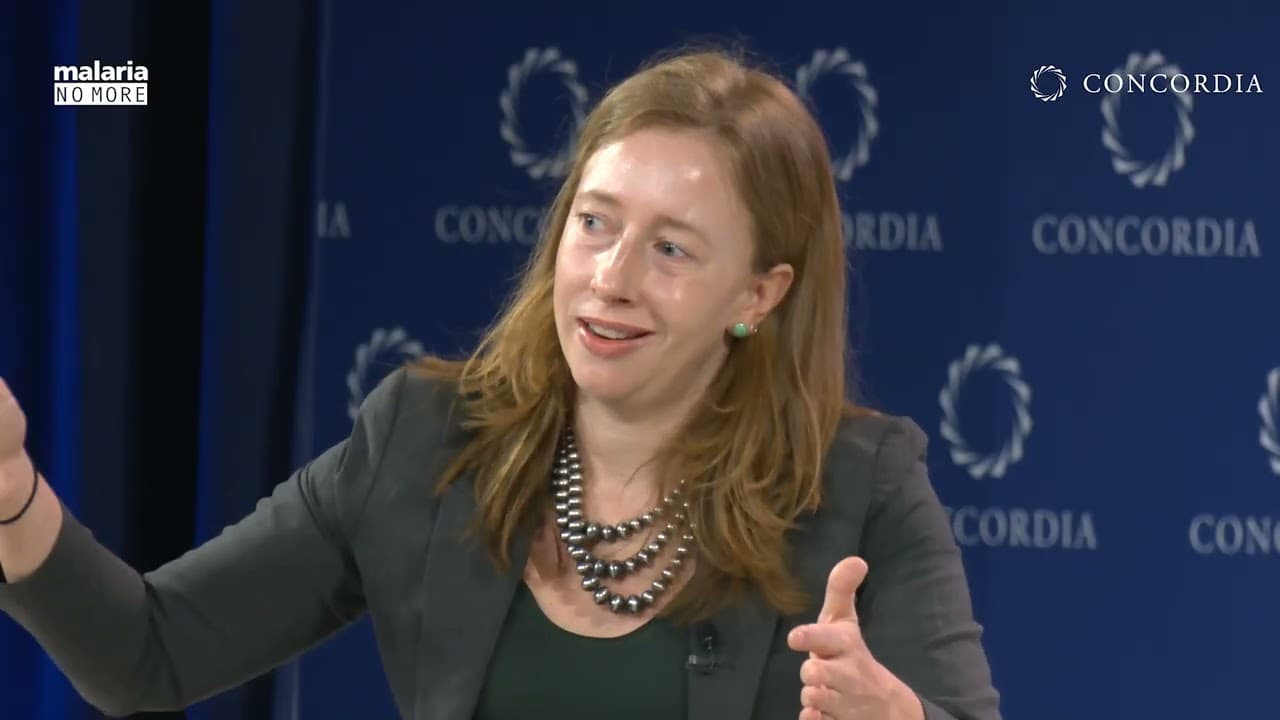
A high-stakes panel at the Concordia Annual Summit brought together leaders from Novartis, Maisha Meds, and Malaria No More to confront a crisis decades in the making: the antimalarial drugs that have saved millions of lives are losing their edge, and the global health system may not be moving fast enough to get replacements to the patients who need them most.
- Novartis's next-generation antimalarial, Ganaplacide Lumefantrine, enters regulatory review as resistance to current first-line drugs spreads across at least five African countries
- Maisha Meds reveals a stark drug quality gap: 90% of public-sector antimalarials are WHO-prequalified vs. just 10% in the private sector, where half of all malaria patients seek care
- Two baggage handlers died of malaria at Frankfurt Airport — panelists warn the disease is no longer confined to traditional endemic zones
- U.S. government begins transitioning malaria programs to African national ownership, raising questions about funding continuity during handoff
- Panelists call on WHO Director-General candidates to treat health as an investment, listen to grassroots data, and accelerate approval timelines
The Clock Is Ticking on Antimalarial Resistance
The basics: Malaria kills approximately 600,000 people per year, predominantly children under 5 in sub-Saharan Africa. The current generation of antimalarial drugs — artemisinin-based combination therapies, or ACTs — has been the global standard for roughly 25 years. But the malaria parasite is adapting, as it has done with every previous class of drugs.
Why it matters: If resistance outpaces the pipeline, the world faces a scenario in which the primary weapon against one of humanity's deadliest diseases stops working — with no backup on the shelf.
Where things stand: Dr. Lutz Hegemann, President of Global Health at Novartis, laid out the scale of the threat in blunt terms. "It is one of the oldest, but also one of the deadliest diseases that is known to mankind, and it still kills about 600,000 people every year," he said. Resistance to current ACTs is now documented in at least four or five African countries, with suspected resistance in more, and has long been observed in the Greater Mekong area.
The consequences are no longer theoretical or distant. "Two people died of malaria at the Frankfurt Airport, baggage handlers in Germany, which you wouldn't expect," Dr. Hegemann warned. "So we shouldn't be thinking of malaria as a disease that's far away, but it is in fact on our doorsteps."
He also placed malaria's toll in a striking context: during the current Ebola outbreak in the Democratic Republic of the Congo, "it is estimated that more people die from malaria than from Ebola."
Novartis has been conducting targeted drug discovery to develop the next-generation treatment — Ganaplacide Lumefantrine, internally called "Ganloom" — which is currently in the regulatory approval process. The drug offers two critical features: it saves the lives of individual patients and blocks transmission of the disease, potentially slowing resistance spread.
Dr. Hegemann argued that the traditional sequential deployment pipeline — "first completing clinical trials, then waiting for regulatory approval, then talking to WHO, then changing guidelines, then establishing supply chain" — is simply too slow for the current crisis. He called on all stakeholders to mobilize and work these steps in parallel.
Bill Steiger, CEO of Malaria No More, who moderated the panel, reinforced the urgency: "If we can't provide access to patients, to providers, that innovation is a false promise."
What's next: Ganaplacide Lumefantrine remains in regulatory review. Whether global institutions can compress the timeline from approval to bedside delivery — rather than following the traditional multiyear sequential path — may determine whether the next-generation drug arrives before resistance to current treatments becomes catastrophic.
Inside the Private-Sector Quality Gap
Why it matters: Roughly half of all malaria patients in sub-Saharan Africa get their care not from government clinics but from private pharmacies, clinics, and drug shops — and the quality of what they receive is dramatically lower.
Where things stand: Dr. Jessica Vernon of Maisha Meds described her organization's work with approximately 6,000 pharmacies, clinics, and drug shops across four African countries. Patients turn to the private sector because it is more convenient, closer, has shorter wait times, and often stocks drugs the public sector lacks. Patients typically pay about $1 out of pocket.
But the quality gap is severe. In the public sector, 90% of drugs are WHO-prequalified. "In the private sector, it's only about 10%," Dr. Vernon said. "So, 90% of the drugs are not necessarily going through that process to make sure that they're really good before they reach patients."
Maisha Meds has built a model to address this: clinical decision support tools — care checklists and mandatory testing before treatment — paired with quality-assured medications and a copayment structure. "We believe that this will build the building blocks of health insurance long-term," Dr. Vernon said.
The organization's data footprint is substantial: "We're seeing about 35 million patient encounters every year. About 12% of those are malaria." That volume generates real-time intelligence on prescribing trends — and some of what they see is alarming. Injectable artesunate use has increased roughly tenfold over the past decade in regions like South Sudan, a pattern that could accelerate drug resistance.
Decisions: No formal vote — this was a panel discussion — but the data Maisha Meds presented underscored a structural problem in global malaria care: the channel where half the patients go is the one with the least quality assurance.
The Funding Landscape Shifts
Why it matters: The global malaria funding model is changing. Many external donors have reduced malaria funding, and the U.S. government has begun transitioning programs to African national ownership through memoranda of understanding. The transition creates both a sustainability opportunity and a real risk of funding gaps during handoff.
Where things stand: Steiger framed the challenge directly, asking how innovation can help do more with less as funding models shift.
Dr. Hegemann described a transition from a largely donor-funded global health order to one with diversified funding and greater local engagement — which he sees as essential for long-term sustainability. He noted that malaria is no longer a uniform challenge: countries range from near-elimination to high-burden crisis, requiring a data-driven, locally led approach with a full toolbox of interventions.
Dr. Vernon echoed the importance of local government empowerment, noting that pharmacists continued providing care even through funding disruptions and that patients remain willing to pay for quality care.
Steiger noted that "there's more innovation in malaria in the last 18 months than in the previous 25 or 30 years" — but that tools alone are insufficient without the systems to deploy them.
Messages for the Next WHO Leader
In closing, each panelist delivered a message to candidates for the next WHO Director-General. Dr. Hegemann urged them to see "health is not a cost item but an investment opportunity to drive greater prosperity, and they should champion that." Dr. Vernon kept it simple: "I would say, first of all, just listen to the grassroots and the data." Steiger added his own ask: "Urgency. Move faster."