
City Council - Mar 24, 2026 - Meeting

City Council - Mar 24, 2026 - Meeting

City CouncilConcordMarch 25, 2026

Sources:

Locunity is a independent informational service and is not an official government page for this commission.We use AI-assisted analysis and human editorial review to publish information.

Guaranteed Income Data Reveals Sharp Cliff as Concord Families Crash After Program Ends

The Concord City Council on March 24 received the most detailed look yet at its $1.5 million guaranteed income experiment — and the results tell a story in two acts: dramatic relief during the program, then a harsh snapback the moment the checks stopped. The same meeting saw immigrant advocates demand the council move beyond a symbolic welcoming resolution and pass an enforceable ICE-free zone ordinance, as the closure of the San Francisco immigration court threatens to bring heightened federal enforcement to Concord's doorstep.

  • $1.5M guaranteed income pilot cut anxiety to near zero, but 90% of families couldn't pay rent after it ended — council members debated what the data means for future policy

  • Immigrant advocates from three organizations demand enforceable ICE-free zone ordinance, warning Concord's welcoming resolution "has no teeth" as immigration caseloads shift locally

  • Council approves $1.7M fleet replacement for 23 aging city vehicles, nearly half electric or hybrid

  • Saturday goal-setting workshop yields directive for new library roadmap and targets a $25M annual infrastructure funding gap

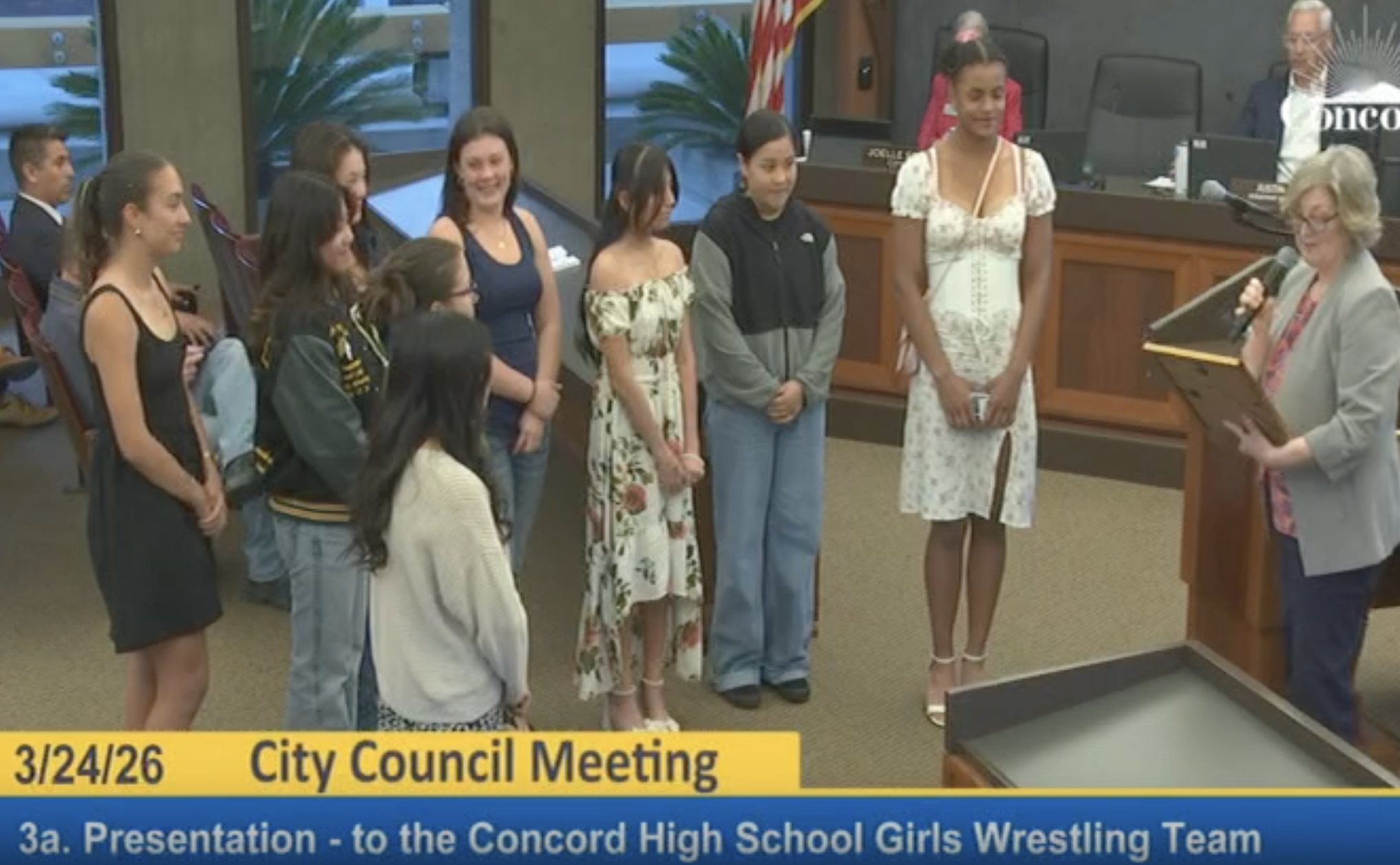
  • Concord High girls wrestling team honored for first-ever NCS Girls Dual Team Championship in California history


The Elevate Concord Verdict: $500 a Month Changed Lives — Then It Stopped

The longest and most substantive item of the evening was an informational presentation on the ELEVATE Concord guaranteed income pilot, which consumed roughly 40 minutes of council discussion and drew pointed questions about what comes next.

The basics: The city used $1.5 million in American Rescue Plan Act funds — $1.2 million of which went directly to cash payments — to provide 120 randomly selected single parents earning under $55,000 with $500 per month for 12 months, plus a one-time $2,500 stabilization gift. Additional private funding from the Latino Community Foundation, Y & H Soda, and Community Financial Resources extended payments to 15 months with tapering amounts.

Why it matters: The data, presented by Monument Impact staff member Julia Quintero and evaluator Dr. Rosa Maria Sternberg, showed the program produced measurable, significant gains in housing stability and mental health — gains that evaporated almost immediately when payments ended. That pattern is now shaping how Contra Costa County designs its next, larger program.

Where things stand: During the program, 82% of participants said Elevate helped them pay rent on time. Severe anxiety plummeted — at one measurement point, it reached zero. But post-program surveys painted a starkly different picture: 55% could not pay rent on time, nearly 90% found rent "very difficult," and almost half could not buy needed food. Stress and anxiety rebounded sharply.

"Anxiety was even more significant because as you can see in the baseline, it was large amounts of severe anxiety. The red slice, then the first quarter that we measured, it actually went to zero while they were receiving the initial payments and the $500 a month," said Sternberg.

She added that the data shows a documented return of $5 to $10 for every dollar invested over time in programs like Elevate.

Sternberg noted,"Maybe we didn't lift them out of poverty, but also this program gave them dignity during the duration of the program."

Quintero said newer guaranteed income research points to 18 months as the minimum duration for lasting economic mobility — a threshold Concord's 12-month pilot did not reach.

"A lot of the newer stuff is saying actually their GI programs are most effective around the 18 month mark. And that becomes kind of like the takeoff for a lot of people," she said.

She also announced that the evidence from Concord helped spark a countywide effort, noting that 179 families acorss the county will receive $1,000 a month for 18 months.

The other side: Council members were broadly supportive of the data but differed on implications. Vice Mayor Dominic Aliano praised the original application from Monument Impact and called ELEVATE fundamentally a mental health program. He acknowledged the city cannot continue funding it.

Councilmember Laura Hoffmeister offered a more cautious assessment, noting the payments eased daily life but did not create a pathway to higher earnings:

"The money was helpful, but it didn't solve anybody's problem to where rent was no longer a burden to them or child care costs were no longer a burden. It just helped a little bit."

Councilmember Carlyn Obringer suggested combining guaranteed income with rapid rehousing strategies. Councilmember Pablo Benavente proposed merging Concord's dataset with the upcoming county program data to support broader expansion.

Mayor Laura Nakamura offered the evening's strongest endorsement of the model:

"I look forward to a day when guaranteed income programs are no longer pilot programs because they've been done so often everywhere around the world. They've been proven to work to make a difference in people's lives."

Vanessa Chena of Monument Impact spoke during public comment to highlight a less-quantifiable outcome: civic engagement. She said five Elevate participants joined Monument Impact's tenant advisory program, and 25 attended a fair housing listening session.

What's next: No formal action was taken — this was an informational presentation. But the data will inform the countywide $1,000-per-month, 18-month pilot for 170 families across Contra Costa County, a significant scaling of the model Concord helped pioneer.


"No Teeth": Immigrant Advocates Push Council Toward ICE-Free Zone Ordinance

Three public commenters representing Monument Impact, United Latino Voices, and the Concord Immigrant Protections Network used general public comment to deliver a coordinated message: Concord's existing welcoming resolution is symbolic and unenforceable, and the city needs to act before federal immigration enforcement intensifies locally.

Why it matters: The San Francisco immigration court is closing, and cases are expected to transfer to Concord — bringing what advocates described as increased ICE activity and potential militarization to a city that already hosts a federal courthouse.

Where things stand: Tony Bravo, executive director of United Latino Voices, was blunt about the gap between the city's stated values and its legal posture:

"The welcoming resolution is great in word and theory, but we know that it has no teeth. And so we need something that people can turn to that lawyers can go to if any city agency violates this policy."

He cited the recent incident at San Francisco International Airport where SFPD appeared to assist ICE agents as evidence that even Bay Area cities with strong reputations on immigration can fail without enforceable policy.

Vanessa Chena of Monument Impact noted that multiple Bay Area jurisdictions — including Alameda, San Francisco, and Santa Clara counties, Pinole, and Richmond, plus Davis — have adopted ICE-free zone ordinances.

Raul Arana, a community engagement coordinator with United Latino Voices, brought the human cost into focus, describing students forced to choose between pursuing higher education and staying close to families facing deportation risk:

"It's difficult to look a student in the eyes and tell them that everything's going to be okay knowing that there's not ordinances like ICE-free ordinances that could offer them a level of security and protection."

Decisions: The council took no action — public comment does not require a response — but the advocates have placed the ICE-free zone squarely on the agenda pipeline. With the SF immigration court closure looming, this issue is likely to return with escalating urgency.


Council Approves $1.7M Fleet Overhaul, First Comprehensive Plan in Years

Mayor Laura Nakamura pulled consent item 4H for discussion because of its $1.74 million price tag, prompting a useful public explanation of how the city buys vehicles.

The basics: The plan replaces 23 city vehicles aged 12 to 25 years — including a 1999 Ford F-350 — with four full EVs and seven hybrids among the new fleet. All electric charging will take place at the city's corporation yard on Gasoline Alley.

Councilmember Carlyn Obringer asked why the city was purchasing from out-of-town dealerships rather than Future Ford of Concord. Staff member Jeff Rayos of Public Works explained the city uses state Department of General Services cooperative procurement contracts for competitive pricing, and that local dealer participation in government contracting has declined.

Councilmember Laura Hoffmeister clarified for the public that the large dollar figure reflects bundling multiple years of deferred purchases into a single plan — not a budget increase.

Decisions: Approved 5-0. (For: Nakamura, Hoffmeister, Obringer, Aliano, Benavente; Against: none.)


Championship Makers: Concord High Girls Wrestling Team Honored

The council proclaimed March 2026 as Women's History Month and recognized the Concord High School girls wrestling team as the inaugural NCS Girls Dual Team Champions and NCS Divisional Champions — the first such titles in California history — capped by an undefeated league season.

Team captain Elysia Youngblood traced the team's arc from near-obscurity to history:

"My freshman year, it was not a lot of girls on the team. There were, like, a handful, like five maybe, and only, like, three of us actually stayed throughout the whole four years on the girls side."

This year, the program finally had a full lineup.

Coach John O'Shea described the difficulty of recruiting and retaining girls in a physical combat sport and praised the team's toughness. Councilmember Laura Hoffmeister, a Concord High alumna, offered personal congratulations. Councilmember Pablo Benavente shared his own wrestling background. The moment was a genuine bright spot — a program that grew from five girls to a state first in four years.


Minor Items

  • Hidden Willow street name (Item 4E): Council modified the resolution to rename the street in a new Lenox Homes infill subdivision off Clayton Way from Hidden Willow Way to Hidden Willow Place, since the street is a dead-end cul-de-sac. Approved 5-0, with a fallback to "Way" if the fire marshal objects.

  • Caltrans Community Cleanup and Employment Pathway Grant (Item 4G): Accepted 5-0. Obringer highlighted the workforce development component and plugged the 242/Clayton Road off-ramp for cleanup; Hoffmeister flagged the Solano off-ramp near Fair Market. Funds are usable citywide.

  • Landscape & Lighting Maintenance District No. 3 (Item 4C): Resolution ordering preparation of an engineer's report approved 4-0. Nakamura recused herself due to an economic interest — her residence is in District 3. Aliano presided.

  • Prescription Drug Awareness Month proclaimed for March 2026, recognizing the Monument Youth Drug and Alcohol Coalition (MyDAC) for prevention work including the Lock It Up campaign and the upcoming National Prescription Drug Take Back Day in April. Tracy Hearn, treatment center director for BAART, described firsthand experience treating opiate use disorders in Contra Costa County, where 332 opioid-related ER visits were recorded in 2024.


Looking Ahead

Council members reported on a productive Saturday goal-setting workshop. Councilmember Pablo Benavente said the council directed staff through a Tier 2 goal to "bring back a roadmap as to what it will take to build a new library, look at our current infrastructure in our current library." Mayor Laura Nakamura outlined the broader workshop priorities: keeping the economic development strategic plan in motion, advancing housing element programs, tackling the Naval Weapons Station specific plan, and confronting what she described as a $25 million annual infrastructure funding gap. The city manager search also remains active.