
Concord Council Approves 10-Year Axon Deal, Drops Flock Cameras
City Council • ConcordNovember 11, 2026
Locunity is an independent informational service and is not an official government page for this commission. All information is sourced from public footage and an analysis of official agendas with the aid of responsible, fact-checked AI. to report an error or omission.
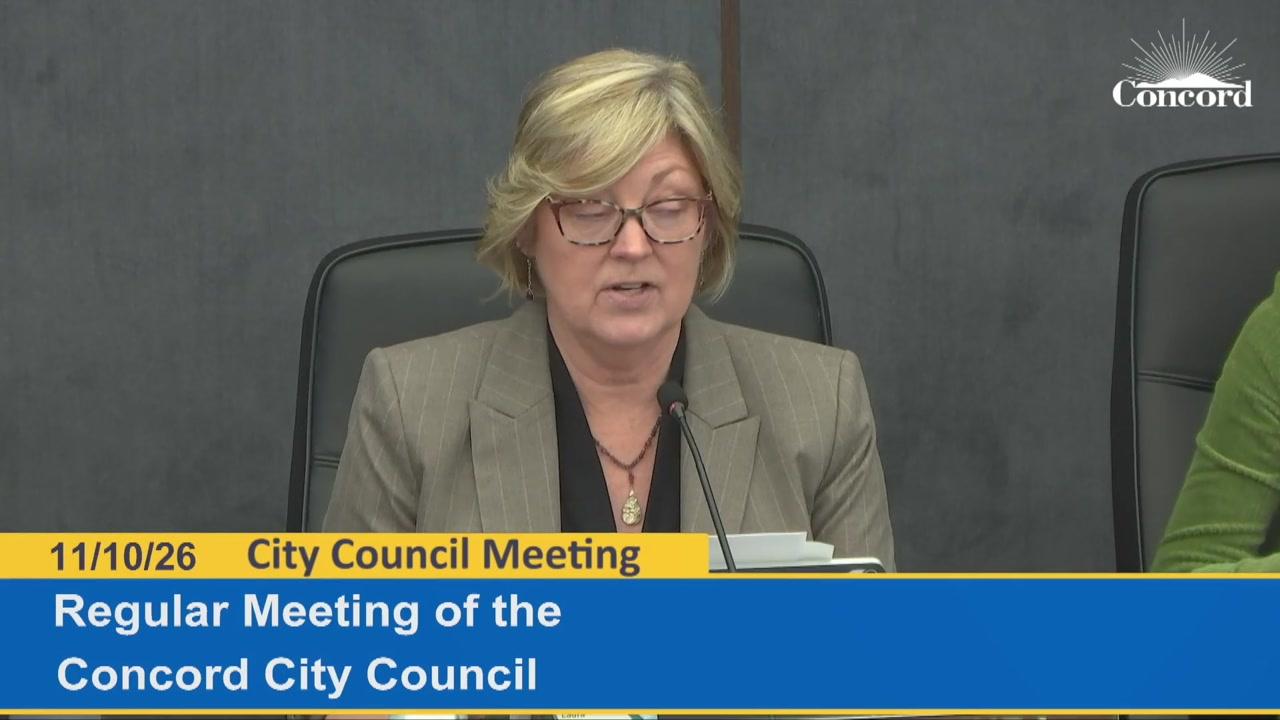
Concord's police technology is now set for the next decade. In a meeting that began Nov. 10, 2026, and ended about 1:53 a.m. Nov. 11, the City Council approved a 10-year Axon contract worth about $10.35 million on a 3-0-1 vote, after hours of surveillance objections and a failed bid to delay. The same night, the council approved a new armored rescue vehicle and moved to end the city's only operating cannabis business. Residents could not comment by Zoom on any of it because of an internet outage.
- 10-year, $10.35M Axon contract approved 3-0-1, replacing Flock license plate readers; Mayor Laura Nakamura abstained
- Coco Farms found out of compliance 4-0; staff will return with a termination ordinance
- Bearcat armored rescue vehicle approved 4-0 over militarization objections; police will report deployments
- Internet outage forced a one-hour recess; council proceeded without remote public comment
Axon Deal Locks In Police Tech Through 2036
Why it matters: The contract consolidates 13 separate police technology agreements into one 10-year deal. The only way out is the budget.
Where things stand: Administrative Lieutenant Matt Cain of the Concord Police Department put the negotiated value at about $10.35 million, with a not-to-exceed cap of about $12.42 million including contingencies. The deal covers body-worn cameras, in-car cameras, Tasers, evidence management and drones. It adds six virtual reality training kits, emergency live view, Prepared 911 call triage, Axon Assistant real-time translation and Fusus integration, which links camera feeds into the department's Real-Time Intelligence Center.
The largest policy shift moves the city's fixed automated license plate readers (ALPRs) from Flock to Axon's Outpost system. Staff said Flock costs about $212,000 a year, compared with an average of about $81,000 under Axon, and projected about $1.54M in savings over 10 years.
On privacy, staff said data sharing is off by default, retention stays at 30 days, audits run every 30 days, and only three or four administrators can change settings. "There are no federal agencies that have access to ALPR at all with Axon products," said Lt. Cain. Sharing logs are available through a public records request.
Under council questioning, staff said the only exit is the non-appropriation clause, which lets the city stop paying if it does not fund the contract. Staff defended the sole-source award and fixed price escalators. They said the timing mattered because pricing would rise in January with a new software-as-a-service tax and a 4% increase.
The other side: About a dozen speakers weighed in. Opponents asked the council to postpone. They cited the lack of Zoom comment, the absence of Vice Mayor Dominic Aliano and the item's 11 p.m. start.
- Sandy Fogg, a resident, pointed to cities canceling license plate reader services over misuse and asked the council to strip ALPRs from the contract.
- Fred Fogg, a District 5 resident, cited El Cerrito's cancellation of Flock.
- Maria Bagley, a District 1 resident and finance professional, questioned a sole-source commitment of up to $12.4M.
- Lindsay, a public commenter, said 10 years is too long without a chance to revisit the deal.
- Natalie, a public commenter, called the 10-year price lock predatory and asked what exit options exist.
Supporters included Justin Wilson of the Concord Police Association, Dr. Popal, president of the Noor Islamic and Cultural Community Center, and Park and Shop security lead Pete Zipkin. Dr. Popal said real-time translation could prevent misunderstandings in emergencies in his multilingual community.
Councilmember Pablo Benavente described a personal case. "Thanks to the ALPRs, they were able to find this person who was hit and run," he said. Councilmember Laura Hoffmeister said the commenters in the room had conveyed the concerns adequately, and that delay would not change her position.
Decisions and stakeholder impacts: Mayor Nakamura moved to continue the item and reopen public comment. The motion died for lack of a second. She backed the switch away from Flock but abstained on the final vote. "I am glad we are moving away from Flock cameras," she said. Hoffmeister moved approval and Councilmember Carlyn Obringer seconded. The vote was For: 3 (Benavente, Hoffmeister, Obringer); Against: 0; Abstain: 1 (Nakamura); Absent: 1 (Aliano).
Police gain a unified platform and translation tools. Privacy advocates lose their chance to revisit ALPRs short of a budget fight.
What's next: The council asked staff to improve public reporting on how the technology is used.
Coco Farms Pushed Toward Termination
Why it matters: Coco Farms is Concord's only operating cannabis business. It has 31 jobs and was projected to pay the city about $900,000 a year.
Where things stand: Principal Planner Frank Abejo said the 2022 development agreement requires payments equal to the greater of 5% of gross revenue or $50,000 a month. It also requires the employer to pay 90% of health premiums for employees and their families, and a "Coco Cares" program providing interim housing. "Staff's compliance review has determined that Coco Farms has not met all of the obligations of the agreement," said Abejo.
Two outside audits by HDL found that gross revenue was underreported because of intercompany transfers to affiliated stores. Staff said it found no evidence of the health plan for 2024-25 or of the interim housing program. Finance staff called about $555,899 owed non-negotiable. Other figures cited during the hearing included about $588,000 and roughly $1.5M including sales tax.
The other side: Chuck Wesley, managing member of Collaboration Concord, argued the company over-delivered, remitting $4.2M and adding volunteer hours. He said the intercompany terms were added after the selection competition. "Under duress, we agreed to it and crossed our fingers," he said. He proposed curing the documentation gaps, making a good-faith deposit and setting up a payment plan. Elliot Rasters, head of security at Rio Vista Security, said employees had not reported being unhoused and urged the council to keep the business.
Decisions and stakeholder impacts: "It is weighing on me that we would wipe out 31 jobs," said Councilmember Obringer. She offered a substitute motion to continue the hearing. Mayor Nakamura seconded it, but Obringer later withdrew it. "I don't think dragging this out for another hearing is going to get us anywhere," said Councilmember Hoffmeister, who moved the staff recommendation.
The vote was For: 4 (Benavente, Hoffmeister, Obringer, Nakamura); Against: 0; Absent: 1 (Aliano). Workers and the city's cannabis revenue stream face the biggest risk.
What's next: Staff will return with an ordinance terminating the agreement, documents revoking land use approvals, and environmental review (CEQA) determinations. The city still intends to collect the money owed.
Bearcat Replaces Aging Mamba After Emotional Debate
Why it matters: The purchase replaces an armored rescue vehicle acquired in 2011. It drew the night's sharpest debate over police militarization.
Where things stand: Police staff said the current Mamba has been deployed about 30 times since 2024. They said it is stored indoors and never used for patrol. The Lenco Bearcat is built for civilian law enforcement, will sit on a Ford F-550 chassis serviced in-house, and came in at least $20,000 below a competitor. It has an expected 20-year life and an 18- to 24-month build time.
Council members confirmed the purchase is funded with asset forfeiture, fleet and supplemental law enforcement funds, not the general fund. The vehicle falls under the city's annual AB 481 review process. No purchase price was stated, though speakers cited more than half a million dollars.
The other side: Kay, a public commenter, cited the city's $25M deficit and asked who the vehicle is meant to rescue. Addie, a public commenter, called it militarization that deepens distrust in BIPOC communities. Chappie, a Navy veteran, urged spending on mental health and prevention instead. Natalie said armored vehicles are needed. She noted that Berkeley rejected the Bearcat over optics and asked for a different model.
Supporters included the Concord Police Association, Dr. Popal and SWAT team leader Sgt. James Cartwright, who said the vehicle is about protecting human life, not militarization.
"I don't want to see anyone else die on the porch, and I don't want my staff to have to witness that," said Police Chief Mark Bustillos, who agreed to log deployments manually.
Decisions and stakeholder impacts: "I see this as a rescue vehicle, not an armored vehicle," said Councilmember Hoffmeister. She moved approval with direction for annual usage reporting, and Benavente seconded. The vote was For: 4; Against: 0; Absent: 1 (Aliano).
Outage Silences Zoom Comment on Major Items
Why it matters: State law now requires remote public comment, so the outage forced a recess and a formal legal finding before the meeting could continue.
Where things stand: The city's internet provider, Astound, went down around 10 a.m., and backup provider Lumen also failed. Mayor Nakamura called a one-hour recess. When the council reconvened about 7:41 p.m., it adopted a finding that staff had made good-faith efforts to restore service and that the public interest in continuing outweighed remote access. She noted this was the council's only November meeting. The vote was 4-0, with Aliano absent. IT Director Greg Taylor and the city attorney later walked through the timeline and the legal basis.
The other side: Commenters said major police purchases were buried on the consent calendar and heard late without Zoom access. Staff said the vehicle item was placed on consent because it was a replacement. The council also voted 4-0 to run past 11 p.m. and to hear the Coco Farms public hearing that night.
- Senior rides: Council voted 4-0 to accept a $242,950 Contra Costa Transportation Authority grant for Concord GO, including an electric Ford E-Transit van.
- Cleanup grant: Public Works detailed its $354,908 Caltrans cleanup grant, which ends April 2027, plus new Adopt-a-Spot and Adopt-a-Block volunteer programs.
- Consent calendar: Approved 4-0, including introduction of an ordinance repealing the stand-alone accessory dwelling unit (ADU) code section.
- Board vacancies: The city seeks applicants for five boards, including the Planning Commission and Design Review Board; applications are due Dec. 11.
- Public comment: Rising Sun Center for Opportunity sought council support for its youth home energy assessment program.
Looking ahead: Watch for the Coco Farms termination ordinance, the Dec. 11 board application deadline and new police reporting on Axon and Bearcat use.