
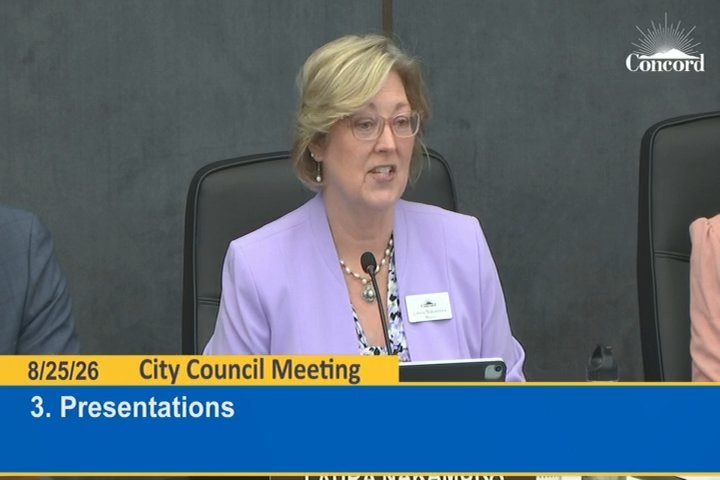
City Council - Aug 25, 2026 - Meeting
City Council • ConcordAugust 26, 2026
Locunity is a independent informational service and is not an official government page for this commission.We use AI-assisted analysis and human editorial review to publish information.
Council Approves I-680 Ramp Metering, $1.3M Police Data Platform Amid Immigration Pressure
Concord's City Council moved forward on infrastructure and public safety technology Tuesday night, but it was the sustained, emotional pleas from residents demanding immigration protections that set the tone — a preview of a policy fight the council will have to confront before year's end.
- I-680 ramp metering deal approved, putting Concord at the center of a regional pilot that could cut commute times by 10 minutes by 2029
- $1.3M Peregrine police data platform renewed after a resident forced it off the consent calendar, sparking a pointed debate over surveillance, audits, and data sharing
- Residents pack public comment demanding SB 580 compliance before the Jan. 1 state deadline, with a DACA recipient sharing his fear of deportation
- Flock camera oversight gaps flagged by a commenter citing Mountain View's independent audit that found 600,000 unauthorized searches
- Six new utility box murals approved, all privately funded, expanding Concord's public art program to 40 installations citywide
Residents Push Hard for Immigration Protections Before State Deadline
At least eight speakers used both the opening and closing public comment periods to demand the council take immediate action on SB 580, the state law requiring cities to adopt immigration enforcement policies by Jan. 1, 2027. The comments were organized, specific, and emotional — a clear signal that community groups are mobilizing ahead of what could be a defining policy vote.
Why it matters: The clock is ticking. With only four months and a limited number of council meetings remaining, the window for meaningful public input on SB 580 compliance is shrinking fast.
Where things stand: Speakers called for a non-cooperation ordinance with ICE, a ban on ICE staging on city property, a public communication protocol developed with community input, and reinstatement of the city's dormant Human Relations Commission. Mariana Moore, a public commenter, delivered a forceful call for action: "It is time now to take action. Not to pontificate or to put it off or to ask for more data. It is time to have a non cooperation ordinance that is strong in this city. It is time to prohibit ICE from staging on city property. Period. Clear."
Hernan Soto, a public commenter and DACA recipient, made the stakes personal: "I am an undocumented immigrant that currently benefits from DACA. I do feel uneasy because I'm also the main source of income for my family after my dad passed away. I'm deportable."
Robin Kuslitz, a public commenter and District 3 resident who teaches in the community, cited a third grader expressing fear of deportation. Natalia, a District 2 resident, linked the immigration discussion to policing priorities, criticizing the share of the city budget going to police and connecting Flock cameras to potential immigration enforcement. Christy Laughlin of the East Bay Alliance for Sustainable Economy echoed the urgency during the Peregrine item, tying data-sharing concerns directly to SB 580 compliance. Additional speakers Anna, Adi Olvera, and Monica Williams returned during the final public comment period to repeat the call for a town hall, police non-cooperation with ICE, and accountability mechanisms.
Decisions: Because SB 580 was not on the agenda, the council could not deliberate. But Mayor Laura Nakamura acknowledged the pressure directly: "I am in conversation with our city manager and we do know that there is a deadline of January 1st that needs to be met. So I just want to let you know that those conversations are happening, but we can't speak about the context of it all."
What's next: Expect SB 580 to appear on a future council agenda. The volume and coordination of public comment suggests advocacy groups — including the Concord Immigrant Protections Network and Stand Together Contra Costa — will keep the pressure on at every meeting until a policy is adopted.
I-680 Ramp Metering: A Regional Pilot Comes to Concord
The council's longest discussion of the night — nearly two hours — centered on a multi-agency agreement to bring adaptive ramp metering to the I-680 corridor, one of the Bay Area's most congested freeway segments.
The basics: The MOU involves two complementary systems. ARM (Adaptive Ramp Metering), funded by Caltrans' SHOPP dollars, will cover the full I-680 corridor. CARM (Coordinated Adaptive Ramp Metering) is a three-year CCTA-funded pilot on 16 northbound ramps between Acosta Boulevard and Willow Pass Road. In Concord specifically, five ramps will run on ARM and one — the Willow Pass northbound on-ramp — will operate on CARM, with that ramp widened from two to three lanes plus a retaining wall.
Why it matters: Northbound I-680 ranks among the Bay Area's top 10 most congested freeway segments. The new systems could save up to 10 minutes of travel time and reduce cut-through traffic on Concord's local streets — a chronic complaint from residents near freeway on-ramps.
Where things stand: The key difference between ARM and CARM is coordination. ARM meters individual ramps based on local conditions. CARM recalculates metering rates every 20 seconds using multiple detection points and coordinates all ramps corridor-wide to prevent spillback onto local streets. Darren Henderson, a consultant to CCTA, explained the approach: "The coordinated part, all of the ramps basically in the CARM system are working together and that allows them to more effectively manage the queues on the ramps themselves." A similar CARM project on I-15 in Temecula recently launched. Construction is already underway on ARM components; both systems target early 2029 activation. If CARM fails after the three-year pilot, ramps revert to ARM at state expense.
Stormwater, Data, and Emergency Access
Council members pushed hard on technical details. Councilmember Laura Hoffmeister zeroed in on stormwater drainage for the Willow Pass ramp widening, citing a past drainage incident at Chilpancingo: "I don't need Caltrans drainage. So I would want to see that covered in the MOU — how that's being handled, how that's being maintained, that Caltrans is responsible."
Hoffmeister also demanded transparency on the algorithms driving metering decisions: "Without knowing the formula, you can't really see and show where the problem lies. And so that's what I'm trying to get at. You keep telling us it's working fine. Here's the number. It's like, no. How did you come to that number?"
Councilmember Carlyn Obringer raised concerns about ramp metering backing up traffic onto city streets and asked how the system would interact with Concord's recently installed adaptive signal system: "So everything's streamlined. So is that system that the city of Concord has invested in — how does that interplay with ARM? Are they talking to each other?"
Staff and presenters confirmed that an Operations and Maintenance Procedures document will address detailed technical concerns — including emergency vehicle access and power outage protocols — before the system goes live.
Decisions: The MOU passed 4-0 (For: Nakamura, Aliano, Hoffmeister, Obringer; Absent: Benavente), authorizing the city manager to execute.
What's next: ARM construction continues; both systems target early 2029 activation. The council will likely revisit the Operations and Maintenance document before the systems go live.
$1.3M Police Data Platform Survives Consent Pull and Privacy Grilling
A routine consent calendar renewal for Peregrine Technologies — a four-year, $1.3M contract for a police records integration platform — turned into the meeting's sharpest policy exchange after public commenter Molly Debris forced the item off the consent calendar.
Why it matters: The debate exposed a gap in Concord's oversight of surveillance-adjacent technology and previewed a broader fight over data-sharing policies as SB 580 compliance looms.
Where things stand: Debris asked three pointed questions: Does Peregrine combine Flock camera data with other location data? Can federal or out-of-state agencies search the system? Who independently verifies any of it? She cited Mountain View's independent audit of its own Flock system: "Mountain View had its Flock data independently audited, and that outside review found roughly 600,000 unauthorized searches by more than 250 agencies which the city's own internal checks had missed."
The other side: Staff drew a firm line between Peregrine and Flock. IT Director Greg Taylor clarified that Peregrine does not integrate with Flock and does not share data with out-of-state agencies, complying with California law including SB 5434.
Police Chief Mark Castillo provided a detailed explanation of how Peregrine functions — not as surveillance, but as a data aggregation tool that pulls from the city's records management system, evidence system, and code enforcement database. He described it as a staff multiplier: "When officers are in the field being dispatched, when they go to an address, they get the immediate history now. Have we been there before? Have we made arrests there before? These are all critical to the safety of an officer responding to a house." He added that every system access requires a case number and badge number, creating a digital audit trail, and noted that Contra Costa County's District Attorney only accepts electronic court filings through Peregrine.
Councilmember Obringer asked about independent audits. After Chief Castillo clarified the distinction between Peregrine and Flock, Obringer praised the platform as a "workforce multiplier" and moved for approval.
Decisions: Approved 4-0 (For: Nakamura, Aliano, Hoffmeister, Obringer; Absent: Benavente).
What's next: The debate over independent audits of the city's surveillance technology — particularly Flock cameras — is unresolved and will likely resurface as part of SB 580 discussions.
Community Art, No City Cost
Six Utility Box Murals Bring Citywide Total to 40
The council unanimously approved Phase 4 of Concord's utility box artwork program, adding six new murals by local Contra Costa County artists at locations across the city. The theme: "The Beauty of Concord."
Why it matters: Unlike cities with dedicated art commissions and funds, Concord's program is entirely privately funded by community sponsors including the Concord Art Association, Councilmember Obringer, MCE, the Turtle Creek HOA, and individual donor Kathryn Hensick.
Councilmember Obringer, who initiated Phase 4, summed up the model: "Other cities, they've got their art commission, they've got their big art fund. We ain't got none of that, but we have each other, and we work well together."
Urban Forester Alex Diosdado and Thea Ju of the Concord Art Association presented designs for six locations, from Concord Boulevard near Concord High to Diamond Boulevard at Willow Pass. Artists will paint on-site with plans to finish before the rainy season.
Decisions: Approved 4-0 (For: Nakamura, Aliano, Hoffmeister, Obringer; Absent: Benavente).
Minor Items
- Consent calendar items A, B, D, and E approved 4-0; item C (Peregrine) was the only pull.
- Mayor's Cup checks presented to four youth organizations: the Concord Junior Giants (512 kids served this year, including 72 with special needs), First Tee Contra Costa (18,000+ youth, 100% financial aid available), Mount Diablo Education Foundation (enrichment for 29,000 students), and Concord Recreation youth swim and camp scholarships.
- Anthony Mitchell, president of Echo Green Solutions, offered to coordinate a meeting with the city about energy services projects using Public Utility Commission funds at no city cost, citing completed work in Walnut Creek.
- A public commenter called for a moratorium on data centers in Concord, arguing that as other cities ban them, companies will target jurisdictions without restrictions.
- Councilmember Benavente was absent for the entire meeting.