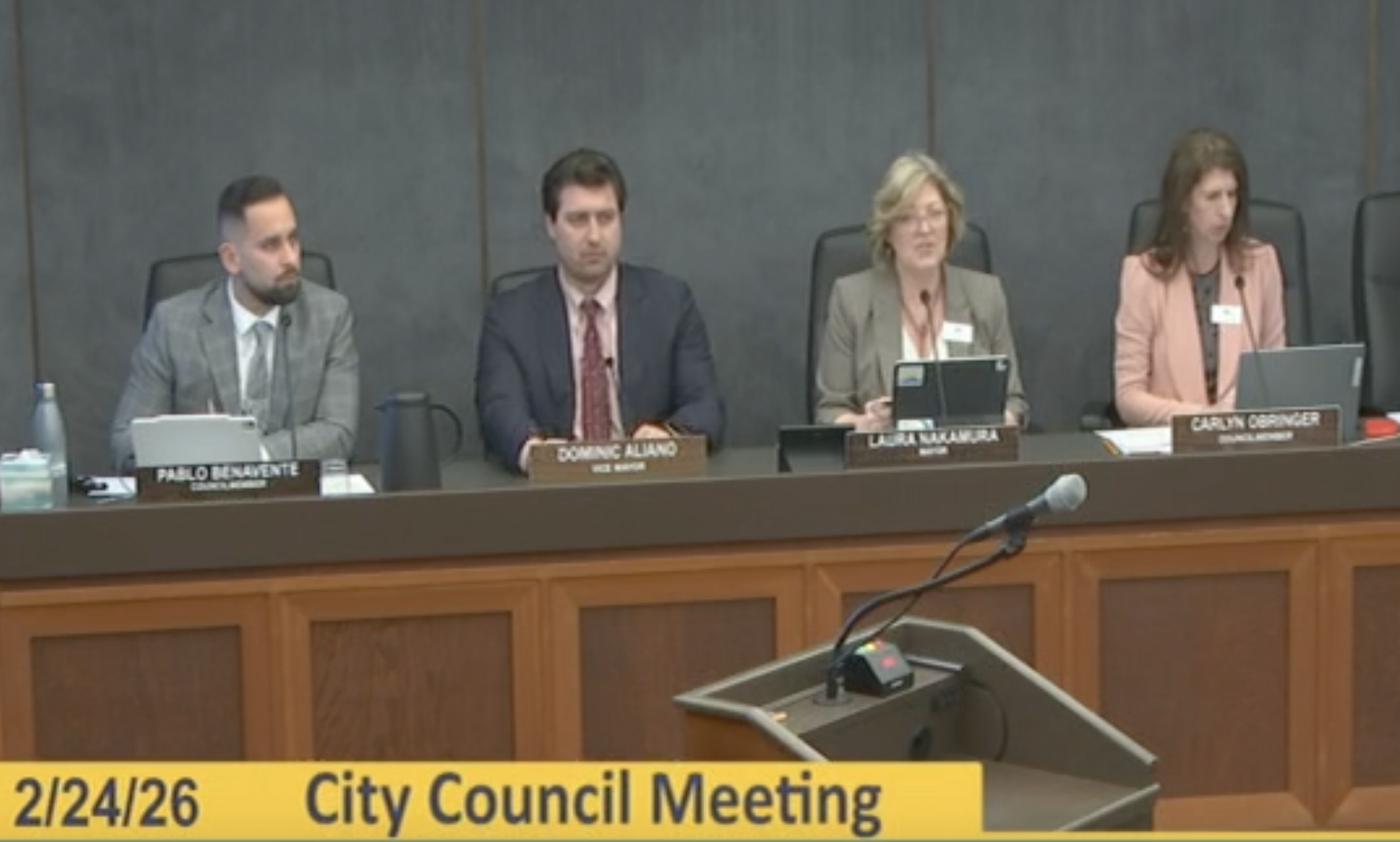
City Council - Feb 24, 2026 - Meeting

City Council - Feb 24, 2026 - Meeting

City CouncilConcordFebruary 25, 2026

Sources:

Locunity is a independent informational service and is not an official government page for this commission.We use AI-assisted analysis and human editorial review to publish information.

Council Greenlights 900-Unit Coast Guard Redevelopment, Rezones Five Sites for Housing

Concord's City Council gave its clearest signal yet that housing is the city's top priority, backing a massive 800-900-unit redevelopment of the former Coast Guard site and voting to rezone five neighborhoods for up to 1,000 additional homes — together potentially adding nearly 2,000 units to the city's pipeline. The Feb. 24 session also surfaced a labor dispute that could complicate the Coast Guard project's path forward.

  • Council unanimously supports 900-home concept for 59-acre former Coast Guard site, launching a roughly two-year entitlement process and forming an ad hoc committee to shape community benefits

  • AFFH rezoning passes 4-0, opening five high-resource sites totaling 28 acres to at least 60 units per acre — clearing a long-overdue state fair housing mandate

  • Carpenters union disputes exclusion from Coast Guard project labor agreement, saying they've been reaching out to the developer since 2024 without a deal

  • Downtown business improvement district exploration begins as ARPA cleanup funds run dry, with a feasibility study launching in April

  • Economic development plan gets first progress report: advisory group, international dining promotion and zoning reform all in early stages


A New Neighborhood Takes Shape on the Former Coast Guard Site

The longest and most intensely debated item of the night centered on "Concord Town Square," a proposed redevelopment of 366 vacant military housing units at 3295 Haleakala Street into a mixed community of roughly 403 townhomes, 409 single-family homes (56 with accessory dwelling units), and 72 deed-restricted affordable rental apartments across 59 acres.

Why it matters: This is Concord's largest pending housing project outside the Naval Weapons Station. The conceptual plan tests a novel approach to affordable housing — substituting deed-restricted multifamily rentals and non-deed-restricted ADUs for the 122 ownership inclusionary units the city's ordinance would otherwise require. How the council navigates that trade-off will set a precedent.

Where things stand: Principal Planner Frank Abejo presented the site plan and zoning framework. Applicant representative David Bowlby told the council the project would deliver affordable units first.

Bowlby also announced a project labor agreement with mechanical, electrical and plumbing trades:

"We have signed a project labor agreement with the hard working men and women of this community and of this region because it's very important."

But carpenters say they've been left out. Ramon Amaral of the North Coast States Carpenters Union (formerly Nor Cal Carpenters Union) told the council he has personally been in talks with the applicant since 2024 and found the claim that carpenters had not reached out "really confusing," as he personally had reached out. Jonathan Drescher, a carpenters union member and District 2 resident, noted that carpenter trades — concrete, framing, insulation, drywall, siding, scaffolding, windows, cabinets — represent roughly 70% of labor on a typical residential project.

Mayor Laura Nakamura directly asked the developer to reach out to the carpenters.

Neighbors raised serious infrastructure concerns. Cindy, a Hamilton Avenue resident, opposed the project, citing a lack of infrastructure for 800-900 additional cars on two-lane Olivera Road, school overcrowding and the risk that Hamilton Avenue's emergency gate could become a through-street. David, a longtime Concord resident, questioned whether trees instead of sound walls would adequately buffer existing homes.

On the other side, MEP union members rallied behind the proposal. Eric Haynes of Sheet Metal Workers Local 104 called it "a unique opportunity for missing middle housing with apartments, single family, townhomes, and ADUs." Matthew Brown of IBEW 302 supported the mix of family housing and local construction workforce commitments.

Joey Flagel Mishlove of East Bay Housing Organizations pressed the council harder on affordability, arguing the city has leverage because the developer needs a general plan amendment: deed restriction, not just unit type, is what guarantees affordability.

The other side: Vice Mayor Dominic Aliano urged caution about overloading the developer with demands.

"I kind of feel like we're getting a little out of bounds here when we're asking for performers. When it comes to community benefit, we don't own the property," he said, adding: "I don't want to box them in into anything."

Mayor Nakamura was expressed concerns about the total count of affordable housing:

"I've got concerns about that because I don't think that the 56 non deed restricted ADUs are necessarily something we can count on for affordable housing."

Councilmember Carlyn Obringer supported the concept and the alternative inclusionary approach, noting:

"I have heard many times could we please mix the affordable housing throughout the product rather than isolating people and concentrating people. And I do think that this is a unique approach."

She also flagged that the transit-oriented communities density policy the project falls short of does not yet formally exist, and the North Concord BART station's future remains uncertain.

Decisions: All four council members present endorsed the overall concept, density and housing mix. Obringer proposed — and all supported — an ad hoc committee (Obringer and Hoffmeister) to guide community benefits negotiations, pro forma review and final unit counts.

City Manager Valerie Barone estimated a roughly two-year process from the study session to final council decision, including an environmental impact report, design review and planning commission review.

What's next: The developer can now proceed to a formal application and tentative map. The ad hoc committee will begin meeting to shape the development agreement framework.


Fair Housing Rezoning Clears Final Hurdle

After nearly two years and more than 30 public meetings, the council voted 4-0 to adopt a general plan resolution and introduce an ordinance creating a new Affirmatively Furthering Fair Housing (AFFH) overlay district across five sites totaling approximately 28 acres — allowing at least 60 dwelling units per acre with a total capacity of 1,000 housing units.

The basics: Assembly Bill 686 and the city's own Housing Element (Objective 8.6) require Concord to rezone land in high-resource neighborhoods to facilitate affordable housing. The overlay applies to sites including Palm Lake (reduced from 300 to 165 units since January), two newly added Kirker Pass parcels (Sites 16 and 18, combined 116 units), and three previously identified locations.

Why it matters: This vote clears a long-overdue state compliance obligation and opens affluent Concord neighborhoods to higher-density development for the first time — a prerequisite before any affordable housing can actually be built on these sites.

Where things stand: Planning Manager Aaron Sage presented the revised proposal. Competing public concerns dominated the hearing. Rick Ferreira, a Concord resident, challenged the feasibility of Site 16 at Kirker Pass and Myrtle, where high-voltage transmission lines substantially constrain the buildable area. He noted staff confirmed the 60-unit estimate was based on rough calculation without detailed analysis. Stephen reinforced those concerns, citing a January 2025 article quoting a city official about excluding sites with low amenity access or problematic barriers.

The other side: Reverend Millie Phillips of the Faith Alliance for Moral Economy framed the rezoning as a moral imperative, telling the council she herself cannot afford to retire and pay market rent in the Bay Area despite being a working professional at age 70. Joey Flegel-Mishlove of East Bay Housing Organizations offered cautious congratulations but urged the council to ensure actual affordability follows the rezoning.

Eric Haynes of Sheet Metal Workers Local 104 urged labor standards on future projects built on these sites, noting apprentices start at $27 per hour and need affordable places to live. Obringer agreed and suggested the Policy Development and Internal Operations Committee explore a broader affordable housing labor standards policy.

City Manager Barone tempered expectations about what the city can demand on these sites, warning:

"You will be constrained under state law in California. And what you can look at and you cannot demand a community benefit that is not tied with a nexus to the project."

Staff also noted that 100% affordable projects may be exempt from certain traffic impact fees under state law.

Sherry Chaplin raised concerns about cumulative traffic impacts at the specifically the Treat/Oak Grove intersection when combined with projects on the Walnut Creek border. Jackie Buckland asked to exclude the thrift store at 5350 Clayton Road from the Clayton Fair site because the owner has twice stated in writing they are not interested in rezoning.

Decisions: Mayor Nakamura affirmed that while they are meeting a state mandate, there is still local control:

"The amount of community engagement that we've had does speak volumes about the local control that we've had. The community really has shaped the direction that we have gone on this project."

Councilmember Pablo Benavente made the motion, framing the council's position clearly:

"We don't get to opt out of this requirement from the state. What we do control is how we comply with the state law." (For: Benavente, Nakamura, Obringer, Aliano; Absent: Hoffmeister.)

What's next: The ordinance returns for second reading and adoption on March 10.


Downtown Improvement District on the Horizon as ARPA Funds Run Dry

Director of Economic Development and Base Reuse Guy Bjerke delivered the first implementation update on the economic development strategic plan adopted in December 2025 — and he was characteristically candid about expectations.

"If I had a home run, I would have led with it. So there is no home runs, but there's a number of people up at bat," Bjerke said.

Why it matters: One-time American Rescue Plan Act (ARPA) dollars that funded downtown cleanliness and safety programs around Todos Santos Plaza have been spent. A property-based business improvement district — where commercial property owners self-assess to fund shared services — may be the only sustainable replacement. Consultant proposals are under review, and work is expected to begin in April.

Where things stand: Near-term priorities include forming an economic advisory group of major employers targeting an April launch, creating an internal planning-economic development working group to tackle zoning barriers — particularly restrictive industrial zoning in North Concord and medical use restrictions outside the hospital area. Bjerke explained the historical policy whiplash:

"About 25 years ago, we thought industrial was on its way out and we were trying to turn North Concord into an office park rather than an industrial area. And so now we need to do some jujitsu and flip it."

Target industries include healthcare, construction and trades, finance and insurance, and innovation sectors including autonomous vehicle and drone testing. The first marketing push will promote Concord's international dining scene in partnership with Visit Concord and the Chamber of Commerce.

Councilmember Obringer pressed staff on whether outreach to farmers market businesses had begun in time for the June season. Staff is deferring broader city marketing until gateway entrances — including the Route 242 corridor — are consistently presentable.

A public commenter advocated for a San Francisco-style vacancy tax and pop-up retail program for empty storefronts to drive foot traffic and lower rents downtown.


Minor Items

  • Councilmember Hoffmeister was absent the entire meeting due to a family emergency.

  • Craig Sheeman reported ongoing illegal dumping, graffiti, and trespassing at Galindo Creek near San Miguel Road, describing repeated jurisdictional confusion between police and public works when reporting issues.

  • A public commenter urged the city to investigate mold problems and alleged misconduct at the Premier Inn, where city-funded residents are housed, and warned that Lattice Industries and the Data Initiative — reportedly seeking city investment — appear to have no verifiable products or clients.

  • Seth Bartolucci announced the launch of Small World, a new local media resource for Concord at yoursmallworld.com.

  • The meeting was adjourned in honor of Reverend Jesse L. Jackson Sr. for Black History Month.