City Council - May 26, 2026 - Meeting

City Council - May 26, 2026 - Meeting

City CouncilConcordMay 27, 2026

Sources:

Locunity is a independent informational service and is not an official government page for this commission.We use AI-assisted analysis and human editorial review to publish information.

Council Greenlights Historic $628M Navy Deal for 12,000-Home Weapons Station

Concord City Council unanimously approved the city's first-ever financial agreement with the U.S. Navy for the 2,400-acre former Naval Weapons Station, ending decades of negotiation and unlocking what will be the largest single development in Bay Area history. The vote capped a marathon session that also delivered a stark warning from BART directors about a $370 million annual deficit that could shutter stations across East County — the very transit backbone the weapons station project depends on.

  • Council votes 5-0 to approve $628M Navy term sheet, revised Brookfield deal, and ENA extension for 12,272-home, 30-year Naval Weapons Station redevelopment

  • BART directors warn of $370M annual deficit starting July 1; half-cent sales tax measure on track for November 2026 ballot after gathering 300,000+ signatures

  • Labor, environmental and business groups unite behind weapons station project in rare show of cross-sector support

  • Concord's unsheltered population drops 24% as CORE outreach team places 220 individuals into housing with 94% retention

  • Family Justice Center served nearly 1,900 clients at its busiest location; domestic violence calls to Concord PD declining since 2015 opening

  • City vacancy rate falls to 6.9%, down from nearly 10% a year ago, with police vacancies at just 2.3%


A Deal Decades in the Making

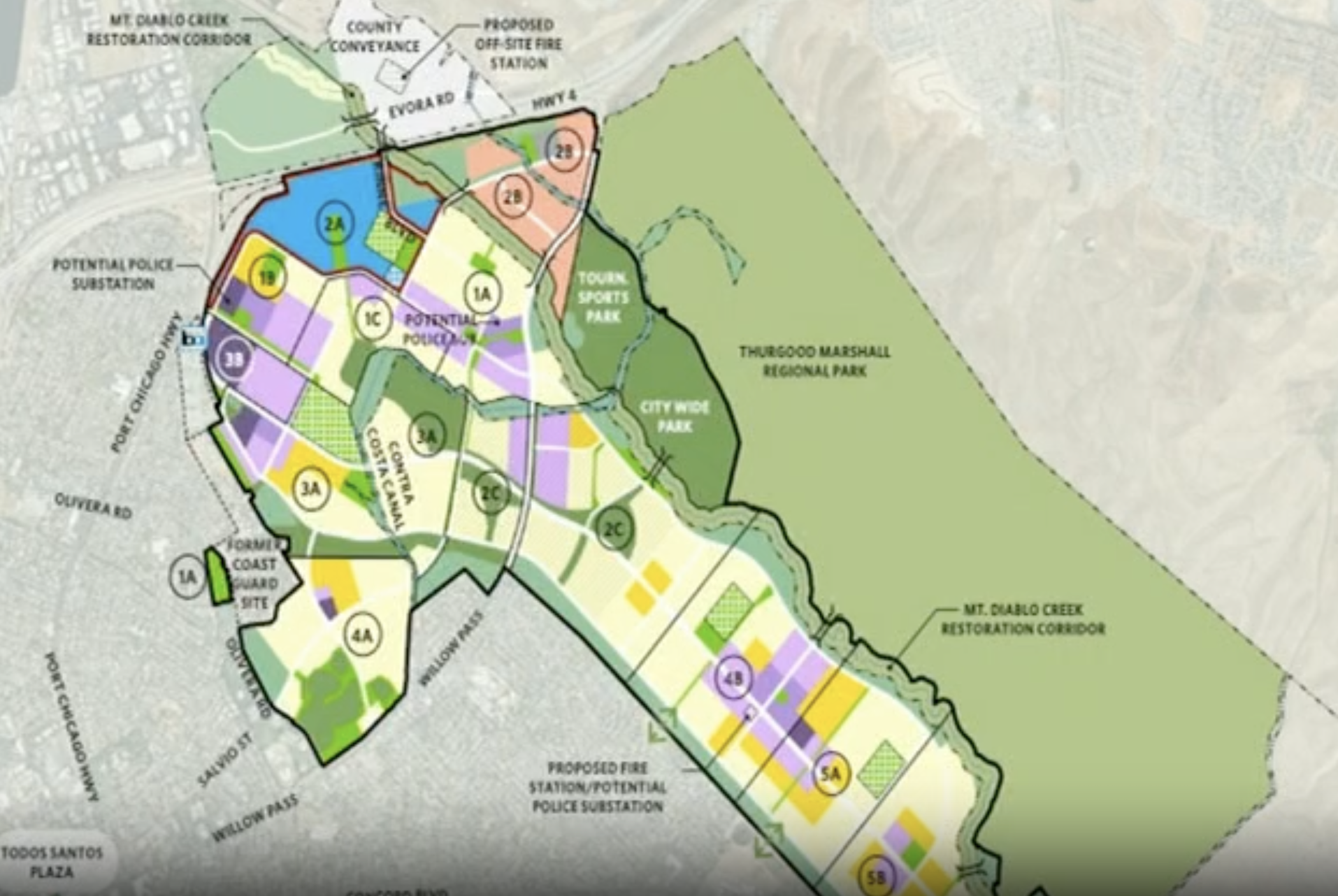
Why it matters: The 5-0 vote on the Naval Weapons Station term sheet ends a negotiation that began when the military base closed in 2005 and sets in motion a 30-year buildout of 12,272 homes (25% affordable), 6 million square feet of commercial space, and 868 acres of parks and open space — a project that will reshape Concord and eastern Contra Costa County for a generation.

Where things stand: Director of Economic Development and Base Reuse Guy Bjerke presented three interconnected documents:

  • the Navy term sheet establishing the price for the economic development conveyance

  • revisions to the Brookfield developer term sheet

  • an extension of Brookfield's exclusive negotiating agreement from March 2028 to December 2029

"I am happy to report that we have for the first time reached financial agreement with the United States Navy over the price and terms of payment for the economic development conveyance property at the former Concord Naval Weapons Station," said Bjerke.

The deal math: approximately $628 million in total payments to the Navy over 30 years, all generated from project value — not the city's general fund. The payment structure includes a $4.6 million deposit at initial land transfer around 2030, four annual guaranteed payments of $10 million each from 2033 to 2036 for the first three phases, 10–12% gross land proceeds from sales in later phases covering the Bunker City area (20-plus years out), and 50% of the city's share of profit participation above an 18% internal rate of return.

Bjerke was blunt about financial expectations, warning the councilt o not overestimate the amount the city would receive as part of the project. He noted that heavy infrastructure costs in early phases will consume most revenue. The 30-year pro forma shows an estimated $7.5 billion in total sources, $5.4 billion in uses, and $2.1 billion in project-wide net cash flow.

Several community commitments remain locked in: the 25% affordable housing target, 6 million square feet of commercial space, 868 acres of parks and open space, labor agreements with the Building Trades and Carpenters Union, a campus district, tournament sports park, community center and library, 16 acres of permanently supportive housing, and 10 acres for a food bank expansion.

To keep the project financially viable, some elements were deferred. A veterans land set-aside moves from phase 1 to phase 3. A $5 million tournament sports park contribution merges into phase 2's $15 million allocation. The city's $15 million loan repayment is deferred to phase 3. Certain backbone infrastructure — Evora Road, a bridge, and the Kinney culvert — shifts to phase 2, and one water reservoir is halved in the first phase.

Bjerke warned that rejecting the deal would have severe consequences.

"I think the Navy would not hesitate to begin to take actions, to figure out a new way to convey the property, to divide it or sell it," he said.

Brookfield plans to officially launch the specific plan process in early August 2026, and the Navy expects to sign within weeks.

A Coalition Rarely Seen

Public comment was overwhelmingly supportive, drawing an unusually broad coalition of labor unions, environmental groups, business organizations, and housing advocates.

"There are students who are going to graduate from high schools in the city of Concord in the next couple weeks that are going to join many of our apprentice programs and are going to work their entire career and retire on this project," said Contra Costa Building and Construction Trades Council representative Tim Sbranti, who compared the project's potential to the transformation Dougherty Valley brought to San Ramon.

Carpenters Local 152 representative Rick Solis urged approval, citing thousands of family-sustaining jobs with benefits and pensions. Save Mount Diablo representative Juan Pablo Galvan Martinez called the project a textbook example of balancing jobs, housing, and environmental protection. Bay Area Council representative Matt Regan, speaking for the region's 400 largest employers, and East Bay Leadership Council representative Meg Stern both emphasized the site's enormous potential. Sheet Metal Workers Local 104 member Eric Haynes, a Concord resident, noted that apprentices could build entire 30-year careers on a single project of this scale.

Resources for Community Development representative Courtney Powell, speaking for the Homeless Base Conversion Collaborative, highlighted the legally binding agreement for up to 260 homes for people exiting homelessness. East Bay Housing Organizations (EBHO) representative Joey Flegel-Mishlove expressed excitement that the 25% affordable housing commitment remained firm.

An Affordable Housing Caution

Not every voice was unqualified praise. Nonprofit Housing Association of Northern California (NPH) representative J.T. Herchmack raised concerns about SB 1145, a state bill that would weaken Surplus Land Act accountability for affordable housing on military base redevelopments statewide, potentially affecting up to 40,000 homes. While supportive of the Concord project, NPH urged the council to monitor the legislation closely.

Decisions

"I don't think it's an exaggeration to say this will be one of the most important votes the Concord City Council has made in over 30 years," said Councilmember Pablo Benavente.

Councilmember Laura Hoffmeister, who motioned to approve, reflected on the long arc of the project.

"In 2005, we got the BRAC closure. Here we are 21 years later," she said.

The motion, seconded by Councilmember Carlyn Obringer, passed 5-0 (For: Benavente, Hoffmeister, Obringer, Aliano, Nakamura; Against: none; Absent: none).

What's next: Brookfield plans to launch the specific plan process in early August 2026. The Navy is expected to sign the term sheet within weeks, with initial land transfer projected around 2030.


BART's $370M Cliff: Stations Could Close Without Sales Tax

Why it matters: Concord residents depend on BART for commuting and East County connectivity. The agency's looming fiscal crisis threatens station closures that would devastate transit-dependent communities, worsen freeway congestion, and undermine the transit-oriented vision of the Naval Weapons Station project just approved by council.

Where things stand: BART Director Mark Foley and BART Director Matt Rinn presented an operational update alongside a dire financial warning. On the bright side: all 700-plus fare gates have been replaced across 50 stations — under budget and ahead of schedule — generating roughly $10 million in additional annual revenue. Crime is down 41% year over year. Tap-and-ride launched as a Bay Area first. Customer satisfaction sits near 90%.

But the agency faces a $370 million annual operating deficit beginning July 1, 2026. Remote work has cut daily ridership from a pre-pandemic 410,000 to roughly 200,000 — a 50% recovery rate that has exposed BART's historical reliance on farebox revenue.

"71% of our operating budget came directly from the farebox. That is unheard of in this industry. We are one of the highest farebox recoveries in all of the world of transit," said Foley.

That model, once a point of pride, is now BART's central vulnerability.

The Ballot Measure Lifeline

A proposed half-cent sales tax under SB 63, branded Connect Bay Area, is on track for the November 2026 ballot after the Transbay Coalition gathered more than 300,000 signatures — double the 186,000 needed. If passed, BART's share would be approximately $310 million annually. The measure would also fund County Connection, Tri-Delta Transit, LAVTA, WestCAT, AC Transit, Muni, and Caltrain. A state loan of approximately $560 million could bridge the gap between passage and the start of revenue collection in 2028.

East County on the Chopping Block

Without the ballot measure, BART explored doomsday scenarios including closing up to 15 stations, reducing service hours, lengthening headways, raising fares, and laying off approximately 1,200 staff. Foley described the internal fight over which stations would close.

"The presentation that staff brought to us in February had all four of my stations closing. So essentially anyone beyond the Concord station would no longer be served by BART," he said, confirming that he and Rinn pushed back against staff recommendations.

Council members reacted forcefully. Councilmember Laura Hoffmeister offered a dramatic sacrifice to protect East County service:

"I'm even willing to sacrifice the North Concord BART station for an East County station right now. We know the ridership is low on that."

Mayor Laura Nakamura pushed back, noting the Naval Weapons Station redevelopment is being planned around that station.

The exchange highlighted a tension that will intensify as both the ballot measure campaign and the weapons station buildout advance simultaneously: BART's fiscal future and Concord's largest-ever development are now inseparable.

What's next: The Connect Bay Area measure heads to voters in November 2026. BART is also adjusting parking fees at market rates; Walnut Creek's rate will increase from $3 to $3.60.


Homelessness Drops 24% as City Eyes Freeway Encampment Grant

Why it matters: Concord's sustained investment in housing-focused street outreach since 2018 is producing measurable results, but state funding is sunsetting and encampments on Caltrans rights-of-way remain the city's biggest unresolved challenge.

The basics: The Coordinated Outreach, Referral, and Engagement (CORE) program, operated by Contra Costa Health, deploys teams to engage unsheltered residents and connect them to housing, services, and benefits.

Where things stand: The 2025 point-in-time count showed Concord's unsheltered population dropped from 173 to 131 — a 24% reduction. CORE Program Director Shelby Ferguson reported the team served 656 unique individuals in Concord in the first half of fiscal year 2025–26, with 83% reporting roots in the city. Of those served, 44% were homeless for the first time, 56% had no income, and 72% reported disabling conditions. The Concord-dedicated CORE team served 230 participants through 650 contacts, providing more than 1,000 emergency supplies, 2,500 housing coordination services, and 1,700 warming center placements.

Of 220 individuals who exited to positive destinations — rental units, shelters, family reunification, or treatment — 94% maintained that placement.

Director of Community Response Division Jenny Robbins grounded the data in affordability.

"To afford the average cost of rent in Contra Costa, it's around $45.50 an hour," she said, underscoring why housing-first outreach remains essential.

What's next: The city is partnering with Contra Costa County to apply for the state's fifth and final Encampment Resolution Grant, due June 30, targeting legacy encampments along Highways 242, 680, and 4. The grant would fund a dedicated CORE team for state rights-of-way, contracted shelter beds, and rapid rehousing. Councilmember Laura Hoffmeister pressed on whether state advocacy could unlock more resources for Caltrans right-of-way challenges. Staff noted the governor's May Revise decreased homelessness funding statewide — making this final grant round particularly high-stakes.


Family Justice Center: DV Calls Declining Since 2015 Opening

Why it matters: Since opening its Concord location — the busiest of four offices in Contra Costa County — the Family Justice Center has helped drive down domestic violence calls to Concord PD, offering free, comprehensive crisis support and long-term healing under one roof.

Where things stand: Executive Director Bisa French and Central Center Director Natalie Oleas reported the Concord office served approximately 1,900 clients in the past year, roughly half of whom are Concord residents. The center handles domestic violence (the majority of cases), sexual assault (7%), child abuse (8%), elder abuse (4–5%), and human trafficking, with more than 80 partners including nine law enforcement agencies and 69 community organizations.

About 50% of clients identify as Latinx, with 30% being non-English speakers. Client numbers dipped slightly from 2024 to 2025, attributed in part to immigration enforcement fears reducing service-seeking in the Latino community.

"During my time when we were creating the Family Justice Center, I realized the importance and the connection between interpersonal violence, community violence," said French, who founded the first FJC in Richmond as a police sergeant.

DOJ data shows DV calls to Concord PD have decreased since the center opened in 2015, with a spike during the COVID shelter-in-place period. Vice Mayor Dominic Aliano and Councilmember Pablo Benavente both expressed interest in helping the center find a permanent home in Concord; the center recently signed a lease through 2030 at Todos Santos Plaza. The center also recently opened a Danville location and operates offices in Richmond, Antioch, and Fairfield.


Minor Items

  • Consent calendar items 4A through 4K approved unanimously, 5-0.

  • Assessment district levies (4L) and healthcare district grants (4M) approved 4-0; Mayor Nakamura recused from both due to economic interests — a property within one landscape and lighting maintenance district and board membership on Growing Healthy Kids.

  • Annual base reuse consulting contracts (4N) renewed alongside the Naval Weapons Station vote at city attorney direction.

  • City vacancy rate drops to 6.9% from 9.8% a year ago, Senior HR Analyst Sarah Castro reported. Police vacancies fell to 2.3% (1 of 130 positions). Nine of 11 new Teamsters positions already filled. No policy changes recommended.

  • Holbrook resident Jeanette Green thanked the city and Councilmember Obringer during general public comment for a successful street repaving project after five years of advocacy.