City Council - Jul 28, 2026 - Meeting
City Council • ConcordJuly 29, 2026
Locunity is a independent informational service and is not an official government page for this commission.We use AI-assisted analysis and human editorial review to publish information.
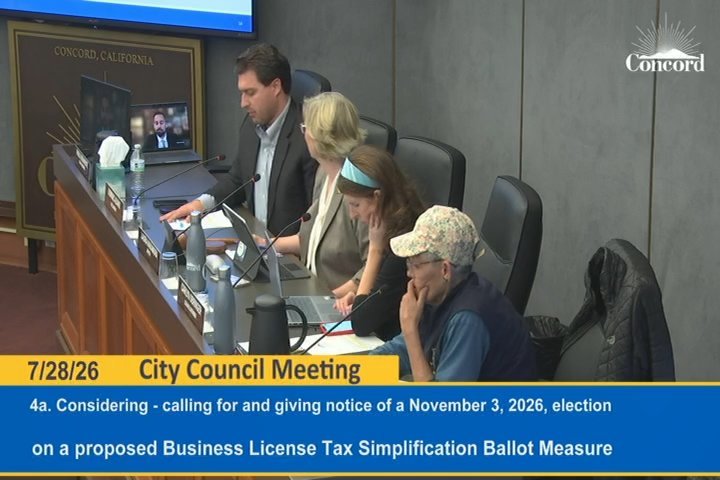
Council Sends Business Tax Overhaul to November Ballot
Concord's City Council unanimously voted to put a business license tax restructuring measure before voters in November 2026, aiming to close a $2.9 million annual deficit and begin chipping away at a $25 million infrastructure backlog. Separately, a wave of community speakers demanded the council act on state immigration enforcement protections before a January 2027 deadline — a request the council did not address.
- Business license tax simplification measure heads to the November 2026 ballot after a unanimous 5-0 vote, generating an estimated $2.9 million annually by leveling the rate large and small businesses pay
- Seven speakers from immigrant advocacy groups urge the council to agendize SB 580 compliance before the January 2027 deadline, citing increased ICE activity and 100,000+ cases transferring to Concord's immigration court
- CEQA contract approved for former Coast Guard site redevelopment, with staff confirming scope includes asbestos mitigation plans for neighboring residents
- Green Empowerment Zone advances federal Opportunity Zone 2.0 applications and identifies barriers to family-sustaining clean energy jobs
- MCE's founding CEO departs, with an acting chief named and a grand jury report pending board response
Closing a 1978 Tax Loophole: Business License Measure Goes to Voters
The basics: Concord's business license gross receipts tax has not been meaningfully updated since 1978, creating a structure where the smallest businesses pay the highest effective rate. Businesses earning up to $25,000 currently pay $1 per $1,000 in gross receipts (0.1%), while those earning over $7.5 million pay just $0.45 per $1,000 — roughly half the rate. The ballot measure would establish a uniform flat rate of 0.1% for all businesses regardless of size, while exempting 674 businesses that earn $5,000 or less — about 15% of all gross-receipts-paying businesses in the city.
Why it matters: The city has been deficit spending from a fiscal stability fund that staff say will be depleted by next fiscal year. Concord operates with 19% fewer staff than before the Great Recession and faces an estimated $25 million in annual unfunded infrastructure needs — $18 million of that for roads alone.
"We are currently estimating that annual need at $25 million. That's $25 million per year that we need to invest into our roadways, our parks, and our facilities," said Assistant City Manager Justin Ezell. "Of that 25 million, 18 million is needed just to keep our roadways at the current condition that they're in today."
Ezell framed the current structure as regressive: "The large businesses making over $7.5 million per year pay less than half of an effective tax rate than those small businesses. So instead of $1 for every thousand dollars made, it's 45 cents for every thousand dollars that's made."
Where things stand: The Infrastructure and Franchise Committee — Vice Mayor Dominic Aliano and Councilmember Laura Hoffmeister — held eight public meetings and conducted extensive outreach, including two independent surveys that both showed 66% resident support, small business roundtables, a Chamber of Commerce meeting, and an economic advisory group session. A community priority survey with more than 480 responses identified street repair as the top concern.
Councilmember Hoffmeister said businesses responded favorably to the simplicity of the proposed structure. "Some of the business people that I spoke to liked the idea that didn't matter how much more revenue they made, the percent formula would be the same," she said.
She also provided historical context for how the regressive structure emerged, noting that cities across the region had used redevelopment-era incentives to compete for businesses — a dynamic that locked in lower rates for larger firms decades ago.
The other side: Councilmember Pablo Benavente pressed on the reliability of the revenue projection, asking whether the $2.9 million to $3 million estimate was net of administrative costs and how it would hold up in a downturn. Ezell confirmed the figure accounts for implementation costs.
Benavente also asked about independent oversight. Ezell said the additional revenue would be placed under the existing Measure V oversight committee: "Putting it under the oversight of the Measure V committee provides confidence to voters that these funds that we are expected to generate will be used for the priorities that we discussed."
Public commenter Robin Kuslitz, a District 3 resident, supported the measure but questioned why oversight would apply only to the additional revenue rather than the entire fee structure.
Vice Mayor Aliano cautioned the public against viewing the measure as a silver bullet. "I just want to be very clear with the public that this isn't going to be the answer to our issues or our problems. This is one of multiple things that we have to do," he said, adding: "This is not good budgeting for us to rely on our reserves for operations and continued deficit spending."
Mayor Laura Nakamura questioned the origins of the regressive structure itself. "I question why the structure that was done originally in 1978 was to tax the larger, the more successful businesses less than maybe the beginner businesses, the smaller businesses," she said. "It seems like right now that what the community and what a lot of people are feeling is that business hasn't been paying its fair share."
Decisions: The council voted 5-0 to adopt the resolution placing the measure on the Nov. 3, 2026 ballot (For: Benavente, Hoffmeister, Obringer, Aliano, Nakamura). The vote required a four-fifths supermajority. The measure itself requires 50%+1 voter approval.
What's next: The deadline to submit the measure to the county clerk is Aug. 7.
Immigration Advocates Demand SB 580 Action
Seven speakers during open public comment pressed the council to agendize a discussion on compliance with Senate Bill 580, the state law that requires local governments to implement policies limiting cooperation with federal immigration enforcement by Jan. 1, 2027.
Why it matters: The San Francisco Immigration Court has closed, and more than 100,000 cases are transferring to Concord's federal immigration court — making the city a new focal point for immigration enforcement activity.
Vanessa Chena, representing Monument Impact and the Concord Immigrant Protections Network, described on-the-ground support the network is already providing, including a weekly food pantry serving more than 100 families and business outreach on immigration rights. She reported that volunteers have observed ICE vehicles patrolling the Home Depot parking lot.
"The Concord Immigrant Protections Network is already doing work on the ground to support our community," she said. "We've supported our neighbors through the loss of SNAP benefits by holding a food pantry every Monday evening, which typically serves more than 100 families a week."
Raul Arua spoke alongside a group of first-generation college students who have been accepted into the UC system. He described the fear students carry that their parents may not be home when they return, and urged the council to make Concord an "ICE-free city."
Amy Estella cited the case transfers from San Francisco and called for the council to establish a framework for responding to ICE activity.
Gwen Gilson and Katherine Durham Hammer, both of Indivisible Resisters Contra Costa — a group they described as having more than 7,000 members — asked the council to immediately agendize SB 580 evaluation with robust community input. Durham Hammer, a 15-year District 4 resident and small business owner, noted that even U.S. citizens fear racial profiling by ICE.
The council did not respond to the comments or take action during the meeting.
Former Coast Guard Site Moves Forward
Councilmember Carlyn Obringer pulled consent item 3A — a professional services agreement for environmental review (CEQA) work on the Concord Town Square project at the former Coast Guard property — to confirm on the record that the scope addresses community concerns.
"I want to confirm the scope of work that we're talking about in this agreement. Does this include a mitigation plan for when the soils disturbed, to prevent asbestos blowing into Holbrook East Sun Terrace?" she asked.
Staff confirmed the contract covers both asbestos mitigation and wildlife displacement plans. Councilmember Hoffmeister clarified that the city controls the CEQA contractor directly and the developer reimburses costs through a deposit account — meaning no general fund taxpayer money is used.
Decisions: Approved 5-0 (For: Benavente, Hoffmeister, Obringer, Aliano, Nakamura).
Minor Items
- Consent item 3B approved 5-0; specific subject was not stated during the meeting.
- Councilmember Obringer reported on the Green Empowerment Zone Board: the board supported Phillips 66's request for state tax incentives for sustainable aviation fuel; staff nominated census tracts for the federal Opportunity Zone 2.0 program; UC Berkeley Labor Center research found clean energy transition jobs are not yet family-sustaining compared to refinery work; and a chart identifying zoning and permitting barriers to clean manufacturing was provided to city staff.
- Councilmember Obringer reported the Bay Area Council toured the Naval Weapons Station and GoMentum Station, noting conversations about "potential campuses that are interested in locating near a BART station."
- Mayor Nakamura reported that MCE Community Energy's founding CEO Don Weiss departed June 17; Chief Operations Officer Vicken Kasarjian is serving as acting CEO. An ad hoc search committee has been formed. A Marin Civil Grand Jury report issued June 16 requires a board response; Concord was invited but not required to respond.
- Infrastructure concern: Glenda Navarro of Los Santos Tenants United raised safety concerns about potholes and inadequate lighting on Eureka Lane in District 3, noting injuries to elderly and disabled residents. She also flagged accessibility barriers with the ConcordConnect app for residents who struggle with account creation.
- The meeting was adjourned in memory of Will Tarbo, who served as Concord's public works director from December 2021 to January 2026 before becoming city manager of Redding, California. He passed away unexpectedly at age 56 on July 19, 2026. During his tenure, he helped bring the city's residential patch paving crew in-house, a cost-saving measure. He is survived by his wife Carrie and three children.