
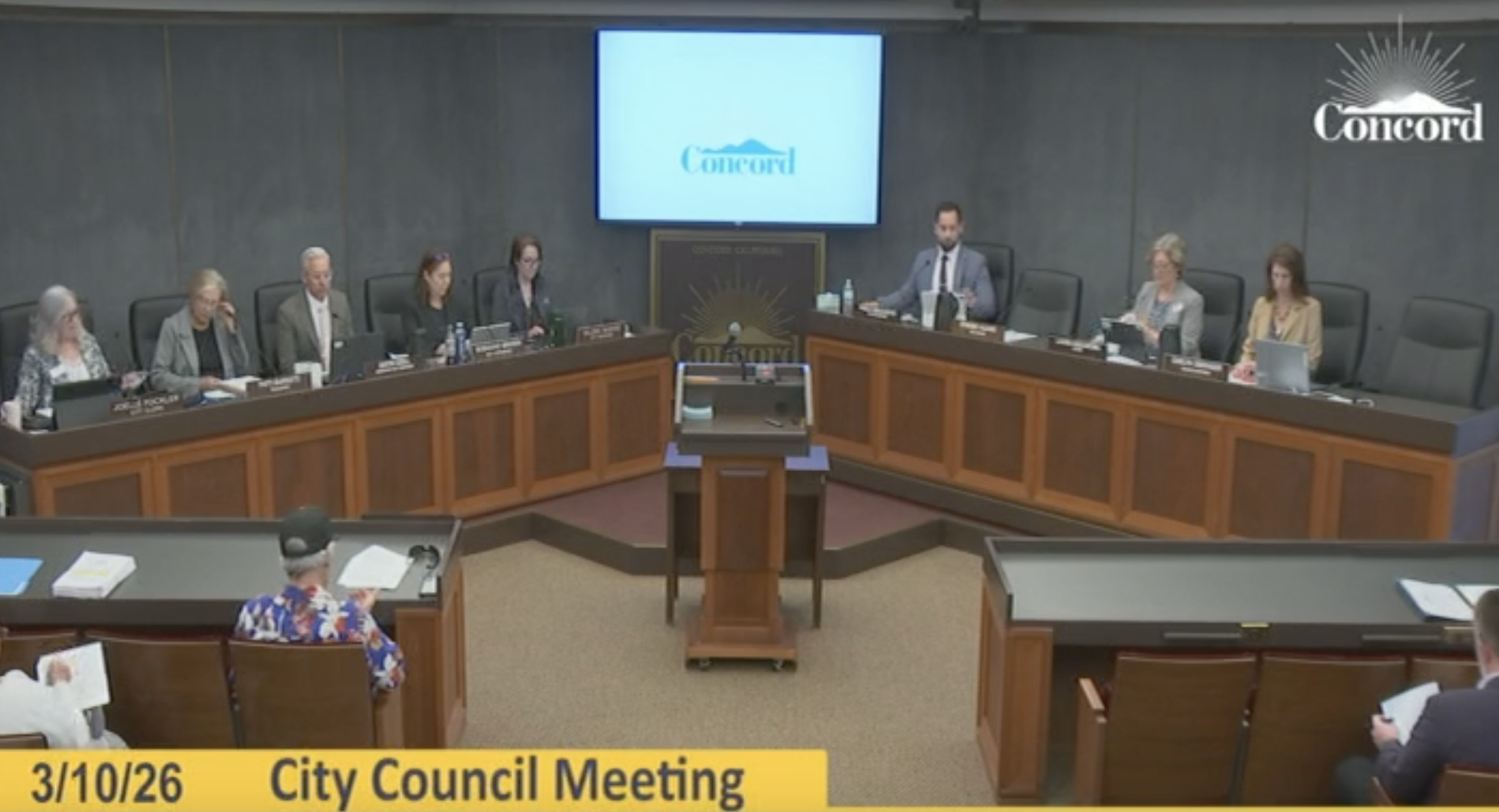
City Council - Mar 10, 2026 - Meeting

City Council - Mar 10, 2026 - Meeting

City CouncilConcordMarch 11, 2026

Sources:

Locunity is a independent informational service and is not an official government page for this commission.We use AI-assisted analysis and human editorial review to publish information.

John Muir Sounds Alarm on Federal Cuts as Council Adopts Fair Housing Rezoning

The Concord City Council's March 10 meeting was dominated by a stark warning from the city's largest hospital system about looming federal funding cuts, bookended by votes advancing fair housing goals and a candid look at the city's progress — and shortfalls — on state-mandated housing production.

  • John Muir Health warns HR1 could slash $100M–$150M in reimbursements and strip Medi-Cal coverage from up to a third of county enrollees

  • Fair housing overlay zone ordinance adopted 4-0 on second reading, rezoning five sites in higher-resource neighborhoods for denser housing over resident opposition

  • Concord hits just 15% of its state housing target at the 38% mark of the eight-year cycle, with SB 9 and ADU ordinance deadlines looming in mid-2026

  • Infrastructure committee advances business license overhaul to begin closing a $25M funding gap, with a formal recommendation expected in July

  • Climate Action Plan earns Platinum Beacon Award with 130 of 150 programs in progress or complete


A $2 Billion Rebuild and a Federal Threat

Paul Deeringer, Chief Strategy Officer of John Muir Health, delivered the most consequential presentation of the evening: a detailed look at a nonprofit hospital system caught between a massive seismic compliance mandate, rising costs, and a congressional bill that could gut its revenue.

The basics: John Muir Health served approximately 340,000 patients across Contra Costa County last year, including more than 43,000 in Concord — its single largest patient population. About 75% of those patients are on Medicare or Medi-Cal, making John Muir the county's largest Medi-Cal hospital services provider. The system already absorbs roughly $200 million annually in Medi-Cal shortfalls — the gap between what the program pays and the cost of care.

Why it matters: HR1 — the federal budget reconciliation bill dubbed the "Big Beautiful Bill" — could compound those losses dramatically. Deeringer told the council the bill threatens $100 million to $150 million in additional reimbursement cuts to the system and could cause up to a third of county Medi-Cal enrollees to lose coverage entirely.

"It's not a health care bill. It is a tax bill. But the way it's paid for is by gutting two of the largest line items in the budget, which are health care for Medi-Cal and food stamps," said Deeringer.

The consequences, Deeringer warned, would cascade. Patients who lose Medi-Cal coverage don't stop needing care — they show up in emergency rooms, where hospitals are legally obligated to treat them regardless of ability to pay.

A Campus That Must Be Rebuilt, Not Retrofitted

Layered on top of the federal threat is a state seismic compliance deadline that Deeringer called the industry's most daunting challenge. The total costs for John Muir to reach compliance is over $2 billion, with 80% of the cost concentrated at the Concord campus. The hospital cannot simply retrofit — it must rebuild entirely. Planned investments include a new central utility plant opening in 2029, a new patient care tower targeted for 2034, fuel cells, expanded cardiovascular services and catheterization labs, a sterile processing facility in north Concord, and a new two-story building for imaging and surgery.

Deeringer stressed that John Muir is not at risk of closure, but that the combined weight of federal cuts and the seismic mandate will significantly constrain the system's ability to expand services. He described new conversations with Contra Costa County about shared solutions:

"I think one of the most constructive things we can do, though, is really continuing that dialogue with the county and also with some of our counterpart community systems to figure out, like, this is not a John Muir problem, this is an everybody problem. So how do we figure out ways that we can either refer patients differently or transfer patients differently, or think about local funding solutions that are shared funding?

Behavioral Health: 10% of California's Child Psychiatric Beds

Jesse Tamplen, Vice President of Behavioral Health at John Muir Health, offered a striking data point when asked about children's mental health services. John Muir operates 71 psychiatric beds, including approximately 10 of the roughly 100 child (under 12) acute psychiatric beds in all of California.

Councilmember Carlyn Obringer asked whether the hospital had seen increased emergency room visits from patients losing Medi-Cal eligibility due to immigration status changes that took effect Jan. 1. Deeringer replied that it was too soon to tell. Obringer also raised the proximity of a federal immigration court to John Muir facilities:

"Do you provide training for your staff so that the staff can stay safe, the patients can stay safe?"

Deeringer confirmed that John Muir follows federal privacy protections and that staff are trained accordingly.

Mayor Laura Nakamura asked whether anyone is tracking the long-term cost savings from GLP-1 weight-loss drugs that may reduce comorbidities and future hospital costs. Deeringer responded that insurance companies likely were.

What's next: No formal council action was required. But the presentation served as an early warning to the city that its largest healthcare provider — and one of its largest private employers — faces historic financial pressure. The trajectory of HR1 in Congress will determine the severity.


Fair Housing Rezoning Clears Final Vote, 4-0

The council unanimously adopted the second reading of the Affirmatively Furthering Fair Housing overlay zone ordinance, rezoning five sites in higher-resource neighborhoods to enable denser housing development. The vote was 4-0, with Councilmember Laura Hoffmeister absent.

The basics: The ordinance fulfills Program 8.6 of Concord's state-certified housing element, a requirement under AB 686 that cities identify and rezone sites in well-resourced areas — those near good schools, transit, and services — to counteract historical patterns of housing segregation. The selected sites include land near BART shuttle service and a vacant Kmart site.

Why it matters: The ordinance removes the last formal zoning barrier to denser housing in some of Concord's most affluent neighborhoods. But it drew pointed opposition from District 1 residents who argued they are bearing a disproportionate share of the city's density goals.

Mayor Laura Nakamura delivered an extended statement framing the vote in historical context and pushing back on critics:

"Housing density is often discussed in ways that unintentionally suggest that people who live in apartments or multi-family housing somehow bring problems with them. That narrative is not only inaccurate, it is unfair."

She added:

"I firmly believe that housing policy isn't just about buildings. It's about whether the next generation has the same opportunity to live, work, and belong in our community."

The Other Side

Two public commenters spoke in opposition. Kristin, a 19-year-homeowner in District 1, argued the overlay was not required by AB 686, called it discriminatory to District 1 residents, and said the city had not adequately studied environmental impacts including air pollution, school overcrowding, and street congestion.

Mike Hall, citing a union background, opposed the Kmart location specifically, arguing that one-bedroom units at $2,000 per month are unaffordable for low-income residents. He urged the council to slow down, seek more community input, and consider alternative sites closer to BART and freeways.

Councilmember Carlyn Obringer responded by explaining the state-mandated methodology:

"This whole process has been take a look at the parts of town that have more resources, that have better performing schools, that have higher home values and rezone so that denser development can be developed and potentially it would be affordable."

She noted that lower-resource area sites are ineligible under the state's framework. Obringer also drew a direct comparison to affordability, citing the nearby Blue Oak Square project where rents start at $850 per month for households at 30% of area median income.

Vice Mayor Dominic Aliano acknowledged frustration with state mandates but said the council had little choice after a two-year process that included seven public meetings and an ad hoc committee:

"These are things that are being demanded of us by the state of California. I have personal beliefs on how the state has proceeded in taking away local control. But at the same time, we need to move forward, because if we don't, we could put the city in greater jeopardy."

Staff confirmed the housing element also includes a commitment to dedicate 50% of capital improvement program spending to low-resource areas.

Decisions: Passed 4-0 (For: Nakamura, Benavente, Obringer, Aliano; Absent: Hoffmeister).


Housing Production Lags State Targets

Associate Planner Ben Olray and CivicSpark Climate and Housing Fellow Louisa Stevens presented the city's 2025 annual progress report covering the general plan, Climate Action Plan, and housing element — painting a picture of a city making steady policy progress but falling behind on actual housing production.

Why it matters: Concord has permitted just 15% of its Regional Housing Needs Allocation target at the 38% mark of its eight-year housing cycle. To stay on pace, the city would need to hit roughly 14% per year. Falling significantly behind on RHNA targets can trigger state penalties and "builder's remedy" provisions that strip cities of some land use authority.

Staff attributed the shortfall largely to market conditions — high interest rates and construction costs — rather than local policy barriers. The city completed several housing programs in 2025, including the AFFH overlay zone, height increases in three zoning districts, reduced parking requirements for group housing, and a homelessness strategic plan dashboard.

State Deadlines Ahead

The workload ahead is significant. Staff must complete ADU ordinance updates, an SB 9 lot-splitting ordinance due by July 2026, and amendments to the Affordable Housing Incentive Program. Planning Manager Aaron Sage noted that most housing element deadlines are front-loaded in the first four years, meaning the compliance burden should ease after 2026.

Climate Action Bright Spot

The Climate Action Plan offered better news: 130 of 150 programs are in progress, complete, or ongoing. The city earned a Platinum Beacon Spotlight Award — one of only 13 local agencies recognized statewide in 2025. Highlights include an MCE energy management partnership for city buildings, a $1 million federal urban forestry grant with a completed tree canopy assessment, and new EV charger installations.

The general plan update noted six new downtown businesses, the launch of an Economic Development Strategic Plan, and road improvement projects that raised the pavement condition index for arterials to 75.

Decisions: Council accepted the report and authorized its submission to the Governor's Office of Land Use and Climate Innovation and the Department of Housing and Community Development. Passed 4-0 (For: Nakamura, Benavente, Obringer, Aliano; Absent: Hoffmeister).


Closing the $25M Infrastructure Gap

Vice Mayor Dominic Aliano reported that the Infrastructure and Franchise Committee — which he co-chairs with Councilmember Laura Hoffmeister — has been meeting since August to tackle an approximately $25 million infrastructure funding deficit spanning neighborhood streets, thoroughfares, traffic congestion, maintenance, capital improvements, and city facilities.

After seven meetings reviewing nine potential strategies, the committee has narrowed the field to five and is advancing a business license simplification measure as its lead option:

"We have a 30-year-old business license program and they could generate up to $3 million annually. So we're looking forward to streamlining... that system, reducing costs," said Vice Mayor Aliano.

No single strategy will close the full gap. Councilmember Carlyn Obringer noted the additional challenge of competing with other Bay Area agencies that are putting sales tax measures on upcoming ballots. A formal committee recommendation is expected in July.


Minor Items

  • Jeanette Green appointed to the Central Contra Costa Transit Authority Advisory Committee. Approved 4-0.

  • Quarterly treasurer's report: City Treasurer Edith Barsotti reported the city's unrestricted investment portfolio totals approximately $294.8 million with an average yield of 3.72% and estimated quarterly earnings of $2.8 million. Investments are in U.S. Treasuries, federal agency securities, LAIF, CAMP, and municipal instruments. No violations found in Barsotti's seven to eight years in the role.

  • American Red Cross Month proclaimed for March 2026. Volunteer Carlos Hanse reported the Red Cross responded to 16 home fires in Concord in 2025, assisting 76 residents and installing 88 smoke alarms. Clayton Valley Charter High School Red Cross Club members described student service projects.

  • Business Recognition Awards: The city and Greater Concord Chamber of Commerce honored four businesses — Concord Aquarium (longevity, operating since 1988), The Flipper Room (community impact, a pinball community hub), Patty's Original Cheese Zombies (community impact and longevity), and Blue Oak Square (building design award, a 181-unit affordable housing development by Meta Housing and KTGY Architects). Obringer noted Blue Oak Square houses 40% formerly housing-insecure residents and 60% new Concord residents. Jessica Music of KTGY Architects noted the project was reimagined from market-rate to affordable housing.

John Muir Sounds Alarm on Federal Cuts as Council Adopts Fair Housing Rezoning | City Council | Locunity