
Convention at 20: UN Committee Says Legal Progress Has Not Changed Thousands of Families' Reality
Committee on Enforced Disappearances • United NationsSeptember 24, 2026
Locunity is an independent informational service and is not an official government page for this commission. All information is sourced from public footage and an analysis of official agendas with the aid of responsible, fact-checked AI. to report an error or omission.
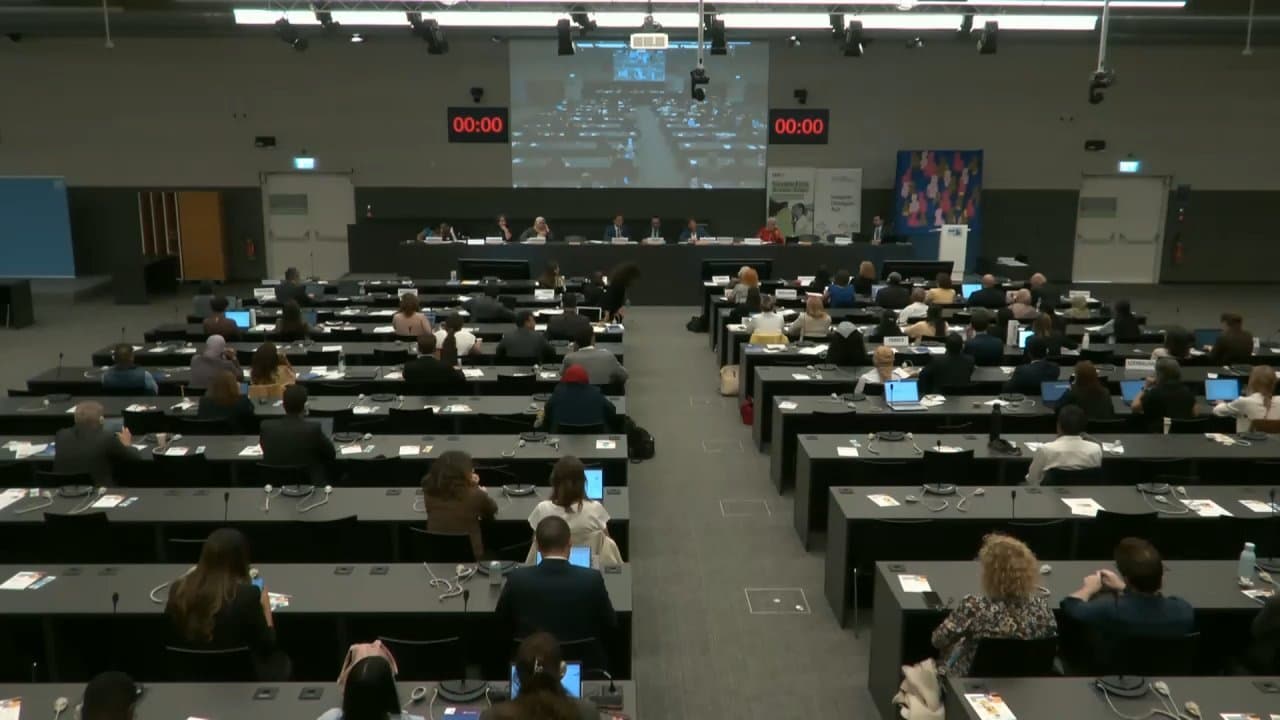
The United Nations Committee on Enforced Disappearances closed its 31st session with a striking admission from its own chair: two decades after the Convention's adoption, the gap between international norms and the lived experience of victims' families remains vast. Across three panels, drafters recalled the coalition that forged the treaty in record time, survivors from four continents testified that domestic mechanisms have failed them, and the Committee launched a new initiative targeting the banks, schools, and insurers whose forms have no box for a disappeared parent.
- Committee chair acknowledges Convention changed international law but has not delivered on its promise to thousands of families
- Families from Sri Lanka, Mexico, Sudan, and Pakistan testify that searches start late, investigations stall, and impunity persists
- New "We Are Still Here" initiative targets daily bureaucratic barriers — visas, bank accounts, inheritance — that compound victims' suffering
- Committee processed 181 new urgent action requests in six months, up from 161; 28 persons located, bringing the total to 574 since inception
- Convention drafters reveal how a coalition of NGOs, victims' families, and progressive states overcame US resistance to produce the treaty in three years
The Promise and the Gap: Chair Delivers Candid Stocktaking
Why it matters: The Convention on Enforced Disappearances, adopted in 2006, created the strongest legal architecture to date against a practice that persists across political contexts — from armed conflict to organized crime to transnational repression. Twenty years in, the Committee's own leadership is saying the architecture alone isn't enough.
Where things stand: Chair Juan Pablo Albán Castro opened the commemorative session with a warning that would echo through the afternoon: "This afternoon, we shouldn't confuse adopting a convention to truly implementing it and ensuring it changes people's lives."
He organized his stocktaking around four points. First, the legal architecture is genuinely stronger — the Convention prohibits incommunicado detention, develops state cooperation frameworks, and created a monitoring mechanism. The Committee's practice has further refined obligations, distinguishing search from investigation, requiring a presumption of life, and recognizing illegal adoption as a form of disappearance.
Second — and this was where the chair's tone shifted — legal progress must not be confused with real change. "20 years later, there is a real gap between the existence of the norms, the standards, the laws, and the reality of what thousands of families experience," he said. Impunity persists. Searches begin late. Investigations don't continue. Families face violence and reprisals for demanding answers.
Third, the chair pushed back against any suggestion that enforced disappearance is a historical artifact: "Enforced disappearance is not a phenomenon anchored in the past. It is a phenomenon of today." He identified four contemporary drivers — political repression, armed conflict, organized crime, and transnational persecution.
Fourth, and most consequentially for the Committee's next chapter, Chair Albán Castro identified the central challenge of the next 20 years: ensuring that legal standards produce results — immediate searches, institutional reform, fulfilled individual communications — rather than remaining dead letters.
Complementarity with the Working Group: Grażyna Baranowska, Chair of the UN Working Group on Enforced or Involuntary Disappearances, explained how the two bodies divide labor. The Working Group handles pre-ratification disappearances and cases involving non-ratifying states; the Committee covers post-ratification cases under ratifying states. She offered a concrete example: four Belarusian individuals disappeared; the perpetrator is now on trial in Switzerland — possible only because Switzerland ratified the Convention and aligned its criminal law with the treaty's universal jurisdiction clause. "This case is only going on because of the ratification," Chair Baranowska said.
What's next: The chair framed the Committee's future mission as operational, not normative — shifting from developing new standards to demanding measurable implementation from states parties.
Voices From Four Continents: Families Say the System Has Failed
Why it matters: Victim testimonials are a regular feature of UN treaty body sessions, but the breadth and intensity here — spanning Sri Lanka, Mexico, Sudan, and Pakistan — demonstrated that the implementation deficit cuts across every political context the Convention was designed to address.
The basics: Each speaker represented not just a personal story but a systemic failure: domestic search mechanisms that exist on paper but deliver nothing; governments that sign treaties but don't implement them; and countries that refuse to sign at all.
Where things stand:
An anonymous survivor's pre-recorded video testimony — delivered in French — described abduction, torture, and permanent physical and psychological scars, crediting the Committee's urgent action procedure as the mechanism that finally broke the silence.
Leela Devi Anand Naraja, General Secretary of the Association of Family Members of Enforced Disappeared Persons in Sri Lanka, detailed 16 years of searching for her son and thousands of others. She described the failure of Sri Lanka's Office on Missing Persons and called on the government to implement specific Committee concluding observations, including mass grave investigation, repeal of the Prevention of Terrorism Act, and a constitutional prohibition of enforced disappearance.
Alejandra Cartagena, Coordinator of the National Citizens Council of the National Search System in Mexico and an investigator at ITESO Jesuit University of Guadalajara, put a staggering number to Mexico's crisis: more than 130,000 disappeared persons. "We don't want paper. We want action and results, something that ensures that the more than 130,000 disappeared persons in Mexico return home," she said, demanding implementation roadmaps, family participation in follow-up, and measurable indicators tied to real outcomes. Mexico's delegate responded with 10 strategies for strengthening the national search mechanism.
Mossad Mohamed Ali, Executive Director of the African Center for Justice and Peace Studies, described Sudan's situation amid armed conflict: the collapse of state institutions, enforced disappearances at checkpoints and unofficial detention facilities, and the urgent need for awareness-raising in local languages to reach affected communities.
Amina Masood Janjua, Founder of Defense for Human Rights in Pakistan — a country that has neither signed nor ratified the Convention — described 21 years of activism and proposed regional ratification dialogues and a UN goodwill ambassador to engage non-signatory states. "5 political governments, 11 prime ministers, 14 chief justices, they come and go, but the families of the disappeared keep standing. Justice for them is still a farsighted dream," she said.
Additional interventions came from Saïd Ashmir, who raised the case of Mahmoud Bria, abducted in Algeria in 2009 by police officers and believed held in a military prison with no further information, and from a representative of Coordination for Human Rights covering Eritrea, who highlighted tens of thousands of disappearances including 16 journalists disappeared 25 years ago.
What's next: Chair Albán Castro closed the panel by affirming the Committee's commitment: "While families seek for a disappeared person, while some seek the truth and some seek justice, we are going to continue to be here just like you are here."
New Initiative Targets the Invisible Barriers: Banks, Schools, and Insurance Forms
Why it matters: International law has focused on criminal accountability and state obligations, but families of the disappeared face a parallel, largely invisible crisis: bureaucratic systems that do not account for their reality. You cannot inherit from someone who has not died. You cannot fill out a visa form when there is no box for a disappeared parent. You cannot access a bank account the missing person controlled. The new "We Are Still Here" initiative aims to change that.
Where things stand: Vice-Chair Barbara Lochbihler moderated the launch. The emotional center was the testimony of Talia Khan-Khattak, Associate Information Systems Officer at the Office of the UN High Commissioner for Human Rights, whose father — human rights researcher Idris Khattak — was disappeared in Pakistan in 2019 and sentenced to 14 years by a secret military trial.
She described daily bureaucratic impossibilities: "Because he had not died, there was nothing to inherit. Because he was not there, there was nothing he could sign."
School systems offered compassion but not policy: "I was lucky because my teachers were kind, but kindness is not a policy."
She credited Amina Masood Janjua with saving her life during a crisis: "I truly believe that that night she saved my life and that I was not alone. And no institution gave me that, but it was another family."
Her core demand was direct: "So when the forms are written, the policies are made, the decisions are taken, involve us."
Laura Dolci, Coordinator of the Global Alliance for Human Rights, explained that the Alliance — launched three months earlier by the High Commissioner — is a multi-sectoral mobilization timed to the 80th anniversary of the Universal Declaration of Human Rights in 2028. The initiative's name was inspired by the Brazilian Oscar-winning film "I'm Still Here" about the enforced disappearance of Rubens Paiva.
The first deliverable will be a practical guide for public and private institutions — healthcare systems, banks, insurers, schools, and administrative authorities — to better serve families of the disappeared. The Deputy High Commissioner for Human Rights framed the initiative in her opening remarks: "It responds to a frequently overlooked consequence of enforced disappearance, which are the recurring barriers faced by victims and survivors and families in their dealings with public and private institutions."
The other side: Nassira Duthour, President of the Euro-Mediterranean Federation Against Enforced Disappearances, pressed for more details on the Alliance's structure and follow-up to World Congress pledges. France reaffirmed its support and asked how states can best contribute. The representative of the International Committee of the Red Cross offered its expertise, tools, and policy proposals.
What's next: The practical guide is the Alliance's first concrete project; broader tracks will address human rights cities, environment, and education, building toward the 2028 milestone.
How the Convention Was Forged: Drafters Reveal Three-Year Sprint
Why it matters: The Convention's negotiation history is not merely academic — the coalition model and diplomatic techniques used to forge the treaty in a record three years offer a playbook for convincing the majority of UN member states that still haven't ratified.
Where things stand: Federico Andreu Guzmán, Coordinator of International Disputes at the Colombian Commission of Jurists, described his role as lead drafter beginning in 1995, working with Amnesty International, the International Commission of Jurists, FIDH, Human Rights Watch, and victim federations. The negotiation moved from the UN Sub-Commission to a formal working group and produced a finished text in roughly three years — a pace virtually unheard of in treaty-making.
Several key flashpoints nearly derailed the process. The United States, post-9/11, opposed inclusion of the right to truth. Andreu Guzmán recounted the breakthrough: "We met with the United States and we said to them, look, we don't understand why you're saying that this right doesn't exist when you agreed that it was an important right in the Geneva Convention Protocol I."
The impasse over military courts and amnesties was resolved through creative diplomacy. "Daniel Vigny from the delegation of Switzerland had a brilliant idea. He invented a passepartout clause, like keys in hotels that open every door," Andreu Guzmán explained — a drafting device that sidestepped explicit prohibitions while achieving the same legal effect.
He also insisted on including a monitoring mechanism over the objections of delegations that wanted a convention without enforcement teeth: "We've waited 20 years for a convention. We can wait another 20 years in order to have a convention with a mechanism, because in fact, if you're not given effective control oversight with a new convention, then you're not really being given something useful."
Catherine Calotti, Deputy Director of the Department of Strategic Security and Disarmament Affairs at the French Ministry of Foreign and European Affairs, described France's diplomatic leadership under Ambassador Bernard Kesidjan, including the challenge of convincing delegations this was not solely a Latin American issue. "They were saying that we have multiple treaties and instruments; we do not need another one. It'll be expensive. It would be better for us to implement existing instruments. And furthermore, they said this is a Latin American issue," she recalled.
Angkhana Neelapaijit, Senator in the Senate of Thailand and former member of the UN Working Group on Enforced or Involuntary Disappearances, conveyed FEDEFAM's message about the crucial role of victims in the negotiation chamber — a presence that gave moral authority to the legal text.
Delegates from France, Germany, and the Chair of the Association of Family Members of Disappeared Sahrawi Persons asked panelists how to convince non-ratifiers. Angela Orzo of the Border Violence Monitoring Network urged the Committee to strengthen attention to migration-related disappearances along borders. Panelists recommended rebuilding the coalition spirit and informing citizens to mobilize pressure.
Committee by the Numbers: 181 Urgent Actions, 28 Persons Found
Why it matters: The Committee's caseload is growing. The rising volume of urgent action requests — 181 in six months, up from 161 — signals that enforced disappearances are not receding even as the legal framework matures.
Rapporteur Maria De Finis reported that the 31st session, held Sept. 14–24, 2026, reviewed initial reports from Lesotho and Belize, additional information reports from Armenia and Gabon, and adopted lists of priority themes for Colombia, Cuba, Italy, and Paraguay. "Between 1st of March 2026 and 31st of August 2026, the Committee received 181 new requests for urgent action, compared with 161 in the previous reporting period," she said. Since the last session, 28 cases were closed following location of disappeared persons, bringing the total to 574 located since the Committee's inception — 437 found alive.
The Committee adopted General Comment 2 on the impact of enforced disappearance on women and girls and discussed a draft joint statement on transnational repressions with the Working Group. New Committee Member Marina Uts was welcomed, replacing Olivier de Frouville.
Minor Items
- Commemorative wall displaying more than 70 victim messages was presented during the opening segment, giving visual weight to the anniversary.
- Ecuador's delegate asked whether a future general comment could address state responsibility for disappearances committed by non-state actors — a question the Committee did not resolve but flagged for future consideration.
- Delegate from Mexico responded to victim testimony with 10 strategies for strengthening the national search mechanism; details were not elaborated in the session.