
SF Task Force Sends Commission Streamlining Legislation to Board of Supervisors
Commission Streamlining Task Force • San FranciscoFebruary 25, 2026
Locunity is an independent informational service and is not an official government page for this commission. All information is sourced from public footage and an analysis of official agendas with the aid of responsible, fact-checked AI. to report an error or omission.
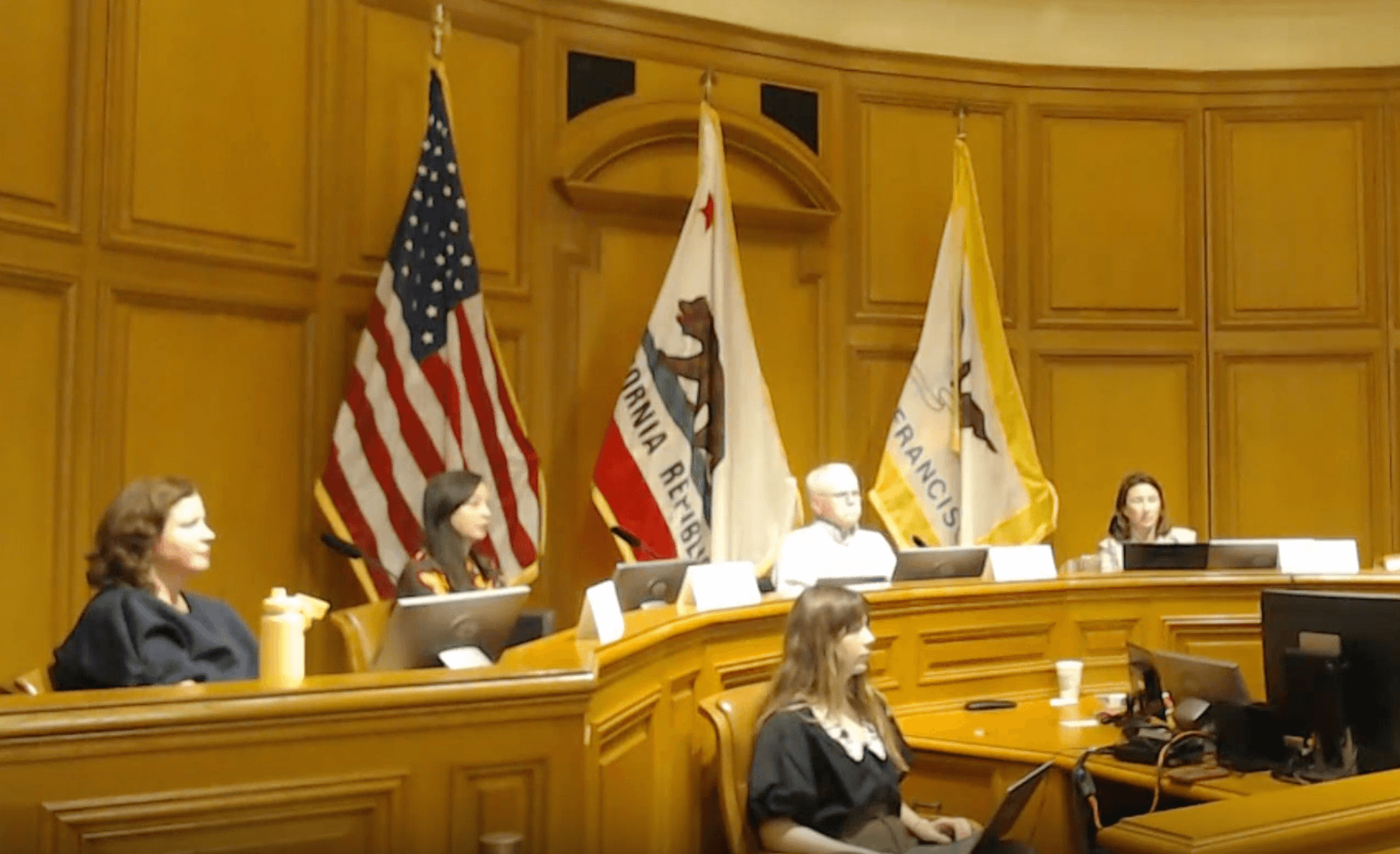
San Francisco's Commission Streamlining Task Force wrapped up a year of work Wednesday, unanimously approving the charter amendment and ordinance that would reshape the city's commission and advisory body governance structure. The legislation now heads to the Board of Supervisors, where it automatically becomes law in 90 days unless eight of 11 supervisors vote to block it.
Task force approves final charter amendment and ordinance 4-0, sending the most significant commission governance overhaul in years to the Board of Supervisors
Board faces high bar to change course: two-thirds supermajority required to reject or amend the ordinance within 90 days
New centralized tracking system will require city departments to report all commission appointments, removals and term expirations to the Clerk of the Board
Public commenters warn the reforms echo elements of Prop D, which voters rejected, and criticize the process for sidelining community groups
Supervisor Rafael Mandelman signals he may introduce his own version of the charter amendment with modifications
A Year of Work, One Final Vote
Why it matters: The ordinance carries unusual legislative weight. Under Prop E, the task force's legislation takes effect automatically unless the Board of Supervisors musters a two-thirds supermajority — eight of 11 votes — to reject it within 90 days. That high threshold gives the reforms strong default momentum and makes piecemeal changes politically difficult.
Where things stand: A member of the City Attorney’s Office walked the task force through the final draft, describing the changes since the last meeting as mostly cleanup. The biggest substantive additions included a new Section 5.110 requiring appointing authorities to report appointments, removals, resignations and seat requirements to the Clerk of the Board for centralized tracking — a basic governance function San Francisco currently lacks.
The ordinance also removed the PUC Revenue Bond Oversight Committee entirely because it was sunsetted several months ago and had not been removed from the code.
A late change adjusted the Family Violence Council's composition, substituting the Public Defender for the Chief of Adult Probation on one seat and designating the Office of Victims and Witness Rights to provide council support. Vice Chair Andrea Bruss pushed back gently on the tradeoff, noting the 15-member cap forced the swap:
"This is another example where we constrain to 15 and so we're deleting adult probation in lieu of a previously deleted public defender seat. What's the harm in having both?"
She ultimately deferred to staff's recommendation, noting the seat composition can be adjusted later by ordinance.
The task force voted 4-0 to approve the legislation, with Member Sophie Hayward absent. The motion authorized the City Attorney to make technical adjustments before transmitting the package to the Board by March 1.
Tracking Who Serves Where: Members Push for Flexibility
The basics: The new Section 5.110 creates, for the first time, a centralized system for tracking who sits on which city body and when their terms expire. The Clerk of the Board agreed to take on the role, contingent on departments actually providing the data.
Where things stand: The original draft language required appointing authorities to use an "electronic system" the Clerk might establish. Member Sophia Kittler raised concerns about tying a legal mandate to technology that hasn't been built yet. "The way I'm hearing this sounds like it's tied to the system that they are building. And that makes me very nervous," she said, questioning why the ordinance would use "shall" instead of softer language.
Member Natasha Mihal offered a practical fix: "I think it should be something that's a little more generic about whatever process the clerk determines. We don't know that it's a system."
Decisions: The City Attorney Office agreed to substitute "format" or "process" for "electronic system" as a technical adjustment before transmittal. Chair Ed Harrington characterized the tweak as non-substantive, meaning it did not require reconvening the task force for another vote.
The Path Forward: 90 Days, Eight Votes, and Mandelman's Signal
Why it matters: The legislative mechanics here are unusual and consequential. The task force — not a supervisor — introduces the ordinance at the Board. Under Prop E, the Board must hold a hearing on the report and charter amendment by April 1. After that, the ordinance automatically takes effect in 90 days unless eight supervisors vote to reject it.
A member of the City Attorney’s Office spelled out the stakes plainly:
"The only option for the Board is to reject with eight votes or else the ordinance goes into effect. So if they want to approve it with some changes, they're basically rejecting your original and approving [the amended one]. So they need eight votes to pass an amended version."
A simpler workaround exists: a supervisor could introduce a separate, competing version requiring only a simple majority of six votes. Chair Ed Harrington noted that Supervisor Rafael Mandelman appeared to be heading in that direction.
"When Supervisor Mandelman introduced the hearing last week, he mentioned that he thought he would be making amendments before he would introduce it, which makes sense to me.
For advocates and stakeholders focused on specific provisions, Harrington offered practical advice:
"My recommendation would be to just let it go through. And then if you want to bring that back, it's a much more straightforward thing to individually bring that back with the Board."
What's next: The Board must hold its hearing by April 1. The 90-day clock for the ordinance starts upon introduction. Staff noted the task force may reconvene around July depending on what the Board does with the charter amendment, since any charter changes could require a follow-up ordinance.
Voters Rejected This Once, Public Commenters Warn
Why it matters: Two public commenters used the task force's final regular meeting to register structural objections — not to specific provisions, but to the reform project's direction and process.
Erica argued the legislation mirrors elements of Prop D, which San Francisco voters rejected. She specifically criticized the Arts Commission restructuring for removing budgetary approval powers and the authority to hire and fire department heads, and for converting fixed terms to at-will service. She pointed to the struggling arts ecosystem — citing closures of the SF Art Institute and California College of the Arts, and SFUSD's consideration of cutting full-time arts education — as reasons to preserve the commission's independence.
Rachel Jones, who identified herself as the Youth Justice Director, challenged the task force's composition and outreach. She criticized the members as "like minded in ideology" and argued that grassroots advocates doing "micro and macro work" were being silenced. She warned that policies, oversight measures and community transparency safeguards fought for over many years were being overlooked.
Neither comment prompted discussion or changes to the legislation before the vote.
Minor Items
Minutes approved: Feb. 11, 2026, meeting minutes adopted 4-0 without discussion (Hayward absent).
Meeting schedule reduced: Task force adopted amended rules of order shifting from twice-monthly meetings to every four months beginning June 2026, with special meetings as needed. Adopted 4-0 (Hayward absent).
Possible July reconvening: Staff member Rachel noted the task force may need to meet again around July after learning the Board's disposition on the charter amendment, since code changes may depend on what the Board alters in the charter. "There are some things to change in code that are dependent on what changes in charter, and we don't know what will be changing in the charter," she said.
Chair's closing remarks: Chair Harrington thanked staff and members for the year-long effort, acknowledging the extensive outreach and discussions that shaped the final product.