
Board of Directors - Jul 14, 2026 - Meeting

Board of Directors - Jul 14, 2026 - Meeting

Board of DirectorsCoastside County Water DistrictJuly 14, 2026

Sources:

Locunity is a independent informational service and is not an official government page for this commission.We use AI-assisted analysis and human editorial review to publish information.

Coastside Water District Closes Landmark Capital Year, Honors Its Builders

The Coastside County Water District board moved through an ambitious agenda July 14, approving three infrastructure contracts, closing out the district's largest-ever capital project, and learning that capital spending blew past budget for the first time anyone can remember. The meeting opened with an unusually emotional tribute to two men — a 50-year engineer and a former board member — whose work built the very systems the district is now upgrading.

  • Record $15.8M in capital spending revises the board's longstanding metric for CIP underspending

  • $330K contract awarded to replace leaking Miramar water lines near eroding coastal bluffs

  • District pivots to horizontal directional drilling to rescue vulnerable raw water pipeline from storm-damaged creek

  • Carter Hill tank project closes out at 3.6 million gallons of storage with just 2.3% in field change orders

  • $181K emergency generator secures storm-season pumping for wells supplying 20% of district water

  • Nine candidates seek next general manager as application deadline arrives

  • Annual water quality report finds no PFAS in treated water


A Capital Year Unlike Any Other

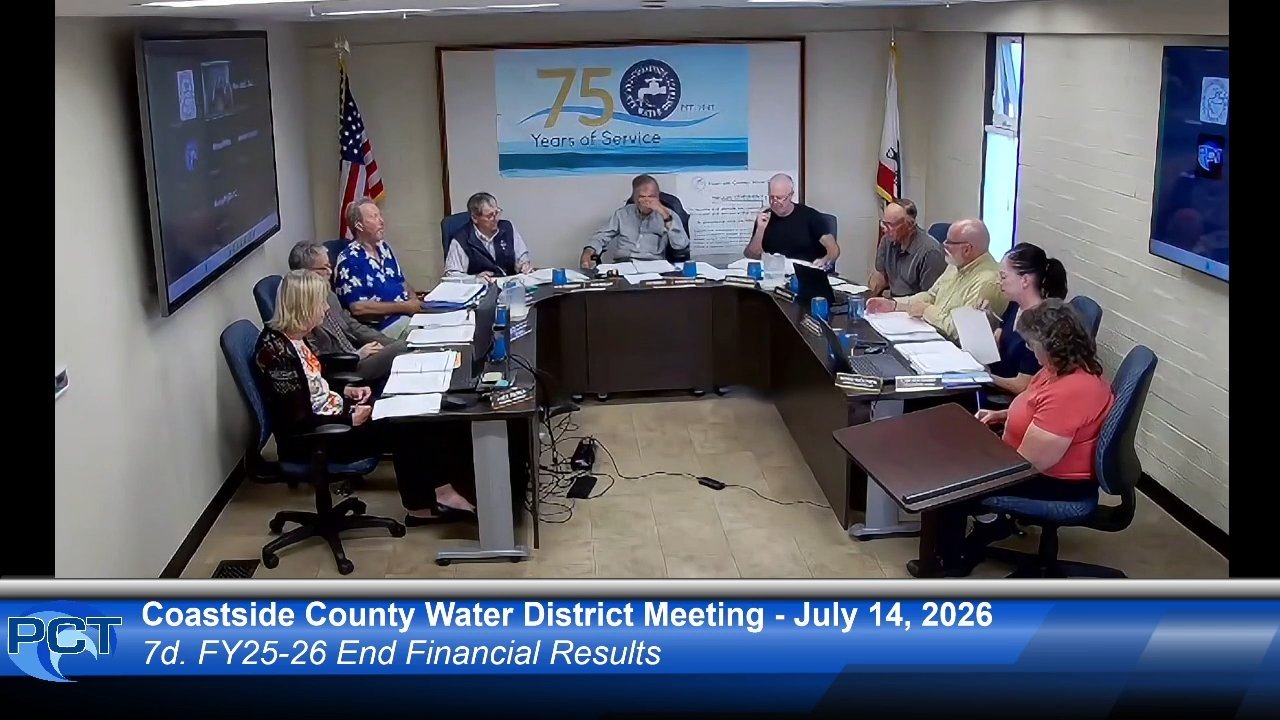
The board received preliminary year-end financials for FY 2025-26 that told a story of an agency in full infrastructure mode. Capital improvement spending reached $15.784 million — $734,000 above budget — a result so unusual it earned its own epitaph.

Why it matters: The district has historically underspent its capital budgets, a pattern tracked internally through what the board calls the "Feldman factor." This year's results retired that metric.

Where things stand: Revenue came in $671,000 below budget, driven by water sales of 496 million gallons versus a budgeted 542 million gallons. But $1.5 million in operating expense savings more than offset the gap. The single largest savings line: $835,000 on SFPUC wholesale water purchases, reflecting the district's strategy of maximizing local sources like Denison Reservoir and the Pillarcitos Canyon wells. Staff credited the operations team for reducing reliance on purchased San Francisco water to 252 million gallons — 32% below budget.

Additional savings came from salary vacancies, reduced overtime, and $243,000 in PG&E costs versus a $500,000 budget for Crystal Springs pump station operations. On the other side of the ledger, computer services ran $98,000 over budget due to cloud migration of GIS and asset management systems.

The district contributed $836,000 to capital reserves for the year, bringing the annual total to nearly $5 million. Cash balance ended at $8.64 million.

"This is a big year for us in terms of what we achieved and what we've brought to bear for the community," said Board President Bob Feldman.

No vote was required; the item was informational.


Carter Hill: Flagship Tank Project Closes Out

The board approved the ninth and final change order — $46,689.86 — for the Carter Hill prestressed concrete tank and seismic upgrade project with D&N Tanks LLC, formally closing the contract on the district's most significant capital project in recent memory.

The basics: The new 2.1-million-gallon tank now operates alongside the existing 1.5-million-gallon tank 3 at the Nunez Water Treatment Plant, providing 3.6 million gallons of total treated water storage. New features include electronic gate access, bollards to protect infrastructure, and full paving. A dedication ceremony is planned within weeks.

Why it matters: The project more than doubles treated water storage at the Nunez site, directly improving fire suppression capability and system resilience for the Coastside. The board paid particular attention to the change order rate: total field-modification change orders came in at just 2.27% of the project cost, with an additional 3% for district-added scope like expanded paving and bollard installation. Staff explained that most changes were minor field adjustments — pipe length changes, extra paving to match fence lines, and bollards at the treatment plant.

Decisions: Approved (For: 4, Against: 0, Absent: 1).

Separately, the board designated General Manager Mary Rogren as the district's real property negotiator for two items related to the Carter Hill site: a permanent easement for a fire turnout along the access road (required by the fire protection district so two large apparatus can pass) and a renegotiated cell tower lease with Verizon Wireless, whose equipment was displaced by the new tank construction. Both items passed (For: 4, Against: 0, Absent: 1; and For: 5, Against: 0, respectively).


Storm Damage Forces Pipeline Strategy Shift

The board approved a $146,000 professional services agreement with EKI Environment and Water Inc. to design the relocation of approximately 700 feet of critical raw water pipeline along Pillarcitos Creek Road — using horizontal directional drilling to bore the replacement pipe into the adjacent hillside rather than repairing it in the storm-battered creek bed.

The basics: The 12-inch pipeline conveys raw water from Pillarcitos Reservoir via Stone Dam to the transmission line along Highway 92. Severe winter storms in 2022-23 caused creek bank failures, damaging the road and threatening the pipeline.

Why it matters: After more than a year exploring creek bed stabilization, the district concluded that permitting in-creek work through multiple regulatory agencies could take years. "We started thinking about other alternatives. As we're looking at permitting, this is going to still maintain a lot of costs and it could be years dealing with the agencies that we're going to have to deal with," said General Manager Mary Rogren. A March 2025 field evaluation confirmed horizontal directional drilling is feasible.

The relocation avoids extensive environmental permitting while reducing long-term storm damage risk. The GM noted the pipeline move would not relieve the district of its obligation to maintain the road but would make road repairs simpler since the pipe would no longer need to be preserved in place. The work is timed to fall outside the marbled murrelet nesting season.

The other side: Director Chris Mickelsen endorsed the technology but flagged costs. "I'm just thankful that such technologies exist," he said, noting directional drilling previously enabled the El Granada pipeline project.

Decisions: Approved (For: 4, Against: 0, Absent: 1).


Miramar Gets New Water Mains as Bluffs Erode

The board awarded a $329,695 contract to Andrini Brothers — the low bidder among eight competitors — to replace approximately 600 feet of aging galvanized steel water lines on Alcatraz Avenue and Santa Rosa Avenue in the Miramar neighborhood, well below the engineer's estimate of $386,000.

Why it matters: The existing pipes run through utility easements across residential properties and have experienced multiple leaks in recent years, creating difficult repair conditions. Critically, several water service lines will be relocated away from coastal bluffs to reduce risk from coastal erosion.

Decisions: Approved unanimously (For: 5, Against: 0).


$181K Generator Plugs Storm-Season Power Gap

The board authorized the sole-source purchase of a 150kW portable emergency generator from Herc Rentals for $180,599.57 to power the district's six Pillarcitos Canyon wells during PG&E outages.

The basics: The wells — originally constructed in the 1960s and 1970s and recently replaced — are permitted to pump only between November and March, which is precisely when storms knock out power. The generator can power three of the six wells simultaneously, grouped by geography.

Why it matters: The canyon wells supply approximately 20% of the district's annual water demand. The recently completed well replacement project added manual transfer switches, and this generator purchase completes the emergency power capability. The trailer-mounted, 10,000-pound unit with a 300-gallon fuel tank is also sized to serve as a backup for permanent standby generators at other district facilities.

Director Ken Coverdell asked whether all six wells could run at once. Staff explained that cording distance limits the generator to three wells per grouping.

Decisions: Approved (For: 4, Against: 0, Absent: 1).


Board Remembers Its Builders

Before any business was conducted, the board spent more than 10 minutes honoring two figures who shaped the district across decades.

James Teeter served as district engineer for nearly 50 years, personally designing the district's tanks, treatment plants, and the connection to San Francisco's Crystal Springs system. "He took this district and really built some facilities, designed and built some facilities for us that are phenomenal, in my opinion, ahead of their time," said Director Coverdell. Multiple directors suggested naming a district facility after Teeter.

Major Frederick Gates served approximately 15 years on the board during what directors described as a contentious period when a board majority sought to curtail district operations. Director Mickelsen credited Gates and Coverdell for holding the district together, saying their perseverance "allowed me to come on board in 2001 and change the dynamic here to a board that actually cared about water."


Nine Candidates Vie for Next GM

General Manager Mary Rogren reported that the recruitment process for her successor has drawn nine qualified candidates, with the application period closing this week. A recruitment committee will review recommendations and schedule interviews for late August.

President Feldman praised the recruitment brochure, saying it authentically captured the district's identity: "The way that it was presented, the information, the way that it described us, the way they described the opportunity, the challenges, the work to be done. I just thought it looked cool."


No PFAS in Your Water

The 2025 annual water quality report, published June 15, found no PFAS in the district's treated water. All water met state and federal health standards. Staff also submitted the district's annual water supply and demand assessment to the state, reporting normal supplies with no expected shortage for FY 2027.

"We did put in information about PFAS. It seems to be topical and we were happy to report that we have not found any PFAS in our treated water," a staff member told the board.

The Urban Water Management Plan and Water Shortage Contingency Plan were also submitted to the Department of Water Resources and California State Library.


Minor Items

  • Consent calendar approved unanimously, including district financials.

  • Resolution 2026-07 adopted, setting the FY 2026-27 Gann Limit appropriations cap at $9,028,795. Staff noted the district's property tax budget of $1.3 million falls well below the cap, making it a routine compliance action. Approved (For: 4, Against: 0, Absent: 1).

  • Lisa Helsinger was recognized for 10 years of service upon her retirement from the district.

  • Operations report: SFPUC tunnel inspection underway; well project on schedule for July completion; tank sensor replacements in progress.

  • Closed session: The board entered closed session on three items — two real property negotiations (Nunez easement and Verizon lease) and one anticipated litigation matter.