
Board of Directors - Mar 10, 2026 - Meeting

Board of Directors - Mar 10, 2026 - Meeting

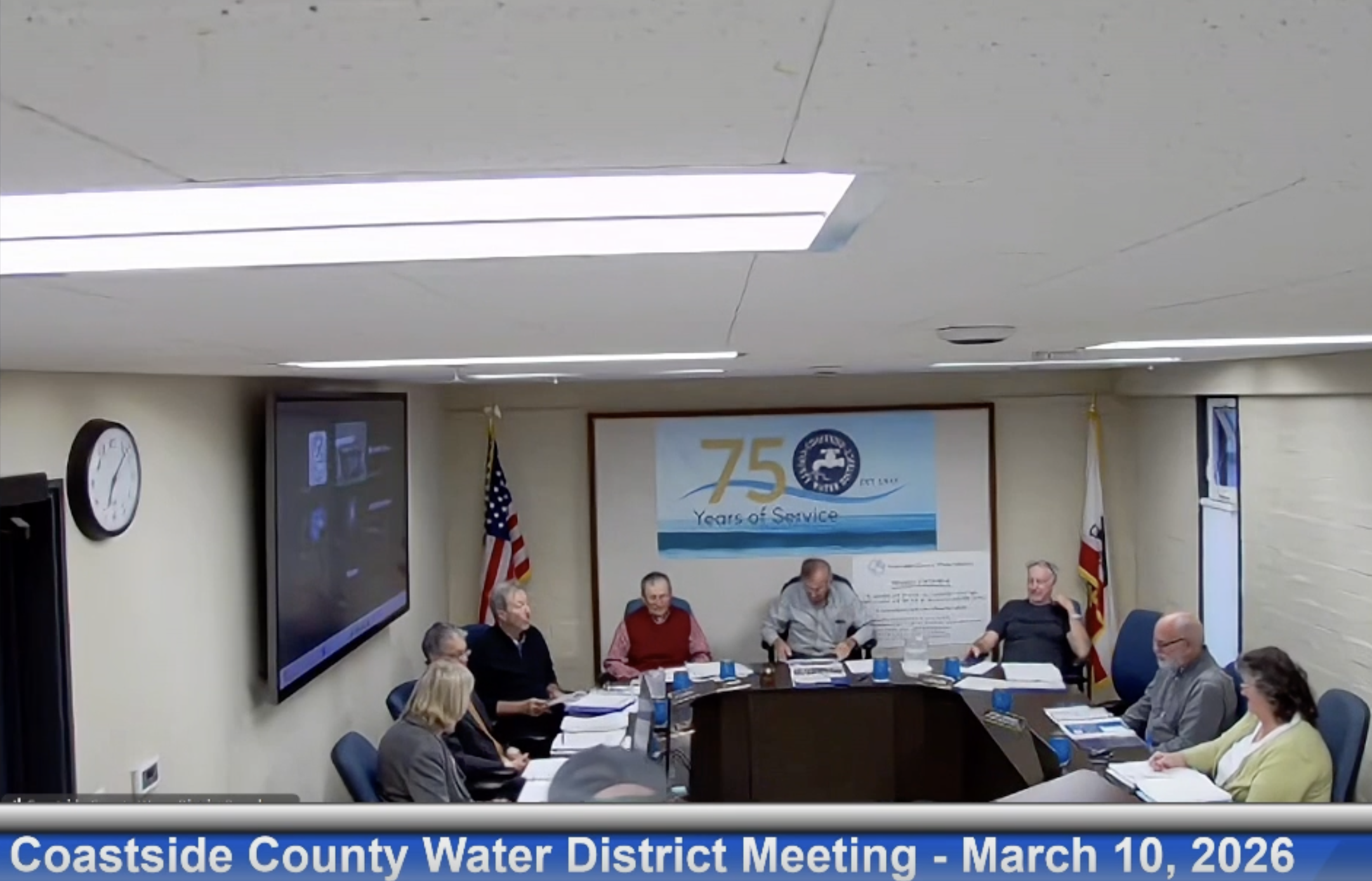
Board of DirectorsCoastside County Water DistrictMarch 10, 2026

Sources:

Locunity is a independent informational service and is not an official government page for this commission.We use AI-assisted analysis and human editorial review to publish information.

Coastside Water District Faces $34M–$350M Dam Fix as Board Says Farewell to Infrastructure Expert

The Coastside County Water District (CCWD) Board said farewell to its longest-tenured infrastructure expert and absorbed a stark briefing on the enormous price tag to repair the community's primary reservoir — all while managing a wholesale rate surprise that will add roughly $150,000 to the district's annual water bill.

  • SFPUC outlines $34M interim fix and up to $350M long-term overhaul for Pilarcitos Dam, rated "poor" by state regulators

  • Board honors Director Glenn Reynolds after 14 years; resignation leaves a vacancy and an expertise gap at a critical moment

  • Wholesale water rate increase jumps from projected 1% to 7.4%, driven by declining consumption across the Bay Area

  • New Carter Hill prestressed concrete tank goes live, with July dedication planned

  • Board approves $37,270 blower to keep drinking water compliant with tightening federal standards


A "Poor" Rating, a Century-Old Dam, and a Very Big Bill

The basics: Pilarcitos Dam, built in 1863 and expanded in 1913, is the Coastside's primary water source. The California Division of Safety of Dams (DSOD) has rated it "poor" — the lowest classification before failure — citing concerns about its emergency release structure, spillway, and the dam itself. A 20-foot water-level restriction is in effect, cutting usable reservoir capacity roughly in half.

Why it matters: For a small coastal community that depends on a single major reservoir, a halved water supply during drought years is an existential risk. The path to restoring full capacity will cost tens of millions of dollars at minimum, and those costs will eventually flow through to ratepayers across the SFPUC wholesale system.

Where things stand: Steve Ritchie, Assistant General Manager of the Water Enterprise for San Francisco Public Utilities Commission (SFPUC), walked the board through a restructured capital plan. After an October meeting, DSOD pushed back on SFPUC's longer timeline, demanding faster interim action rather than waiting for a comprehensive fix.

SFPUC responded with a phased approach. The first phase is an interim outlet works retrofit for Pilarcitos — along with parallel work on San Andreas and Turner dams — estimated at $34 million with a seven-year construction timeline. Ritchie. acknowledged DSOD will likely press to shorten that schedule.

The preferred engineering approach would build a new outlet structure around the dam through bedrock, avoiding any disturbance to the dam itself that could trigger additional DSOD concerns. The existing 1913 four-bay outlet structure is seismically unsafe and historically significant, requiring consultation with the state historic preservation officer.

The long game: Two long-term alternatives follow the interim work.

  • Alternative 1 — SFPUC's preferred option — accepts a permanent reservoir restriction with a lowered spillway and new discharge outlet for approximately $190 million. It requires the least construction on the dam. "

  • Alternative 2, which includes a full new dam embankment, spillway, and outlet works, would exceed $350 million.

Both alternatives stretch the project timeline to 2052.

Mary Rogren, General Manager of CCWD, underscored the gravity of the current restriction.

"It cuts our capacity significantly in half. And we really don't want to have to see any further lowering of the reservoir. And we have concerns in drought years," she said, though she noted new siphons have helped manage supply during the current wet year.

Board concerns: Director Chris Mickelsen, the district's Bay Area Water Supply and Conservation Agency (BAWSCA) representative, pressed on cost sharing:

"Looking at the expenditures and being the BAWSCA representative, what are other BAWSCA members saying about the expense?" Ritchie confirmed the system-wide cost-sharing approach, telling the board, "It's everybody's system."

One positive note: the National Marine Fisheries Service is reportedly satisfied with current creek operations, a signal that could smooth environmental review.

What's next: DSOD will conduct a significant site visit in April — a key milestone that will shape the pace and scope of the project for years to come. The board took no formal action but will continue to receive updates.


Farewell to Reynolds: The Board's Infrastructure Brain Departs

Why it matters: Director Glenn Reynolds resigned on Feb. 23 after 14 years on the board, removing the member widely regarded as the district's deepest technical mind — just as the district navigates dam safety decisions, a new tank completion, and rising costs.

CCWD General Manager Mary Rogren catalogued his contributions, sharing he served as president in 2014, 2017, 2021 and 2025. He spent all 14 years on the Facilities Committee and oversaw major projects including the Denniston and Nunes treatment plant improvements, the El Granada pipeline replacement, implementation of digital water meters and advanced metering infrastructure, and the Carter Hill prestressed concrete tank.

Director Ken Coverdell, the board's longest-serving member at roughly 30 years, offered in tribute:

"You've been the most knowledgeable board member in terms of what we do as a district, which is produce the best possible water we can at the price."

He specifically credited Reynolds' advocacy for the Nunes cement tank, expected to last 100 years.

Director Chris Mickelsen thanked Reynolds for "bringing big district expertise to our small district," noting that the Advanced Metering Infrastructure (AMI) implementation put Coastside ahead of many other BAWSCA agencies. Vice President John Miller presented forget-me-not seeds as a personal gift. President Bob Feldman closed the tribute, thanking Reynolds "on behalf of the board, the staff and the community of Half Moon Bay" for his service.

In farewell remarks, Reynolds praised the district's culture:

"I want to say that this district is really unique in that the respect that goes back and forth between the board members and the staff is exemplary in the industry."

What's next: The board now has a vacancy to fill at a moment when infrastructure expertise is at a premium.


Wholesale Rate Shock: 7.4% Where 1% Was Expected

Why it matters: A year ago, SFPUC projected a 1% wholesale rate increase. The actual number: 7.4% — driven not by rising costs, but by falling water demand across all wholesale customers.

CCWD General Manager Mary Rogren explained the math: wholesale customers were projected to use 136 million gallons per day in fiscal year 2027, but revised estimates show just 125 million gallons per day. Because SFPUC's costs — debt service, operations, maintenance — are largely fixed, fewer gallons sold means each unit of water shoulders a bigger share.

The board and staff ran the numbers: at roughly $26,000 per percentage point on the district's approximately $2.6–$2.7 million annual SFPUC bill, the additional six percentage points translate to about $150,000 in added costs. The SFPUC Commission is expected to vote on the rates in April.

Director Chris Mickelsen noted some BAWSCA members struggled to grasp why rates were going up when consumption was down — a conservation paradox familiar across California water agencies.

The board considered the increase manageable but acknowledged it will factor into upcoming budget planning and any future customer rate discussions.


Carter Hill Tank Now Online

The district's largest recent capital investment — the Carter Hill prestressed concrete tank — is now in operation.

The permanent supply line is not yet complete and operations remain partially manual; full automated operation is expected by early April. Construction crews are finishing backfill, installing drain and leak detection systems, and completing communication conduits. The design includes a monolithic impermeable membrane underneath the entire tank and two separate drain systems — one for leak detection and one for groundwater.

Director Ken Coverdell pressed staff on how the membrane termination will be sealed at grade level where paving occurs. Staff acknowledged they are consulting with the design engineer and committed to providing an answer at the next meeting.

A tank dedication event is planned for July 2026.


Minor Items

  • $37,270 Hurricane 200 blower approved 4-0 for trihalomethane control on the new tank. The unit, purchased from D&H Water Systems, features non-ferrous housing with stainless steel screens and was $15,000 cheaper than the alternative. Staff noted it helps the district avoid switching from free chlorine to chloramines as federal THM thresholds may tighten further.

  • Resolution 2026-02 adopted 4-0, endorsing John Weed of Alameda County Water District for the ACWA JPIA California Water Insurance Fund Board.

  • Staff certifications: Maintenance worker Jose Gonzalez passed his D2 exam and operator Carson Anderson passed D3.

  • Facilities Committee reported meeting with consulting engineer from EKI regarding system-wide tank and storage improvement plans.

Coastside Water District Faces $34M–$350M Dam Fix as Board Says Farewell to Infrastructure Expert | Board of Directors | Locunity