
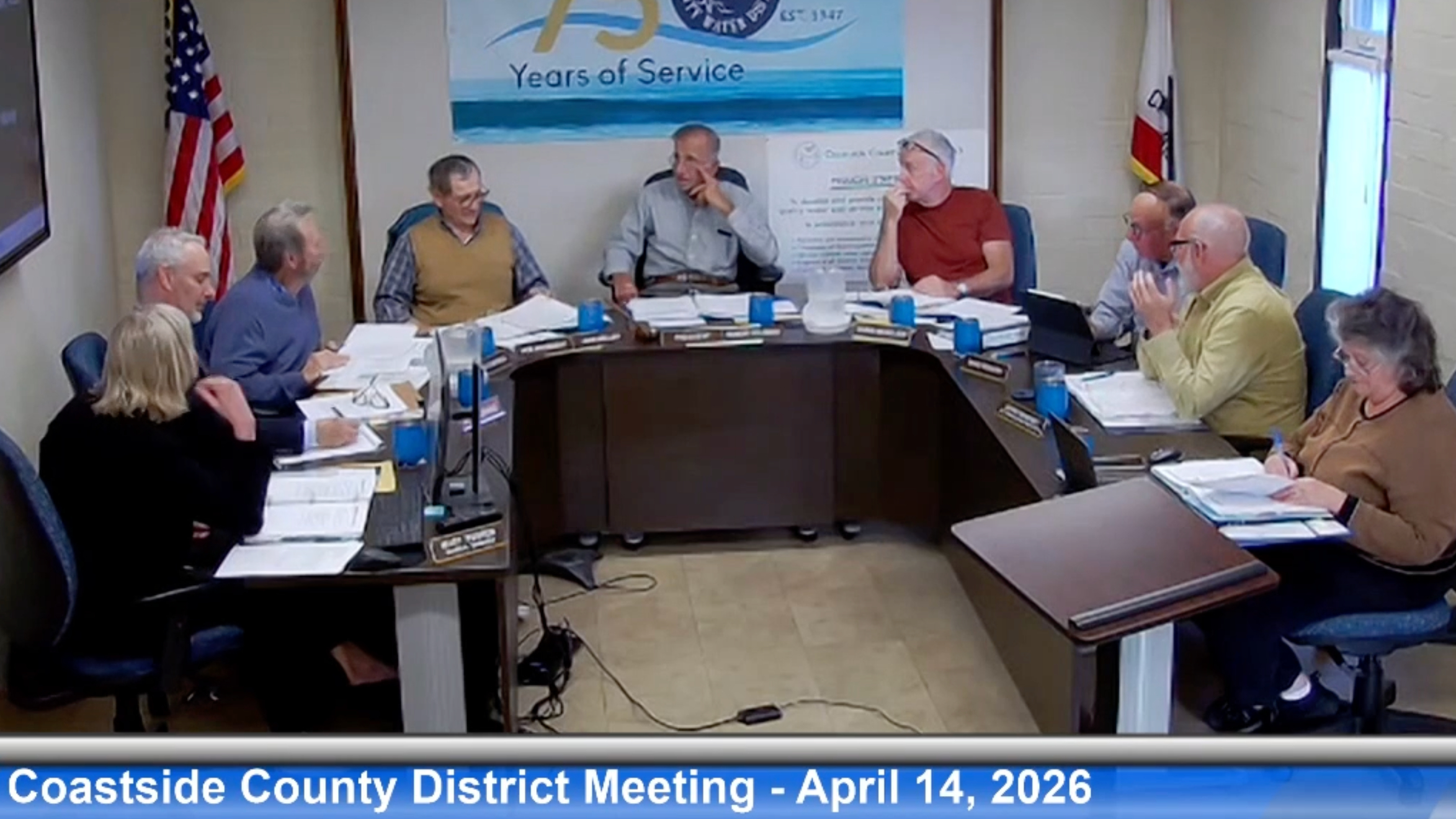
Board of Directors - Apr 14, 2026 - Meeting

Board of Directors - Apr 14, 2026 - Meeting

Board of DirectorsCoastside County Water DistrictApril 14, 2026

Sources:

Locunity is a independent informational service and is not an official government page for this commission.We use AI-assisted analysis and human editorial review to publish information.

Board Selects Alliance to Recruit Next General Manager

The Coastside County Water District board took its most consequential governance step in years on April 14, unanimously choosing an executive search firm to find its next general manager — a hire that will shape the small coastal district's infrastructure strategy, rate trajectory, and operations for the foreseeable future. The meeting also brought a national honor for the district's largest-ever capital project and a draft budget underscoring the revenue pressure of persistently flat water sales.

  • Alliance Resource Consulting selected at $32,000 to lead the general manager search, with an ad hoc advisory committee formed to guide the process

  • Carter Hill prestressed concrete tank named DN Tanks national Project of the Year out of 80 tanks built across the U.S. — and it's already online serving the community

  • Draft FY26-27 budget projects flat water volumes, a final 8% rate increase in January 2027, and a 2.8% rise in operating expenses

  • Nine-month financials beat budget by $913,000 as staff slashed costly imported water purchases by maximizing local sources

  • $144,000 in technology contracts approved for SCADA maintenance and cloud-based asset management software


The Big Hire: Alliance Gets the Nod for GM Search

Why it matters: General Manager Mary Rogren is departing, and whoever replaces her will oversee a district in the midst of record capital spending, a challenging revenue environment, and critical decisions about local water supply and rate-setting.

Where things stand: Rogren evaluated five executive recruitment firms — Alliance Resource Consulting, Wendy Brown Creative Partners, Bob Murray & Associates, Peckham & McKenney, and Koff & Associates— reaching out to seven, receiving five proposals, interviewing all, and checking references. Her top two were Alliance and Wendy Brown Creative Partners, with Alliance earning the edge for its personalized style and Bay Area proximity — the firm's recruiter is based in Los Altos.

Wendy Brown had strong social media reach and volume, but is based in Oregon. Bob Murray focuses on larger agencies. Peckham & McKenney lacked water district experience. Koff's recruiter is Tennessee-based.

Director Ken Coverdell was the most vocal advocate for Alliance, emphasizing the value of a local recruiter the board could meet face to face.

"I was most attracted to Alliance because of the proximity," he said. "I like the idea that that person's in Los Altos because it means that we've got access, pretty good access."

The other side: Director Chris Mickelsen raised a practical concern — whether the district's compensation package is competitive enough to attract strong candidates, noting one firm had flagged it as low.

"We want somebody really good. And is what we're offering competitive?" she said. "Because ultimately who they bring to us is going to have to accept whatever we're paying."

Newly sworn Director Dave Dixon was more direct, expressing comfort making the decision that evening.

"I think any of these firms would do a good job," he said. "They're all very competent and professional. And I would be comfortable making a selection tonight."

Decisions: The board voted 5-0 (For: 5, Against: 0, Absent: 1 — Reynolds absent) to authorize a professional services agreement with Alliance Resource Consulting at not-to-exceed $32,000.

What's next: Board President Bob Feldman appointed Coverdell and Dixon to an ad hoc GM Recruitment Advisory Committee that will work with Rogren on the recruitment document, compensation package, and candidate vetting. Legal counsel confirmed the ad hoc structure allows private conversations with candidates that would not be possible in open full-board sessions. The committee will report back to the full board.


National Honor: Carter Hill Tank Named Project of the Year

Why it matters: The Carter Hill prestressed concrete tank — the district's largest-ever capital investment — has now been recognized nationally and is already delivering water to the community.

DN Tanks designated the Carter Hill project as its Project of the Year out of 80 tanks built across the United States, citing strong leadership, excellent customer service, and stringent quality control by the construction management team.

Superintendent Darren confirmed the 24-inch outlet pipe is connected to the distribution system and the tank is operational.

"I might be a little premature on this, but for last month, we are online. It is serving the community," he said.

Backfill, waterproofing, drainage, electrical, and site work continue, with completion on schedule for June — ahead of the 120 remaining contract days.

General Manager Mary Rogren added that the state Division of Drinking Water has approved the tank for use:

"This month we did get approved by DDW. We've been approved to use the tank by the state and they've also been on site to see. And they're very, very impressed."

Director Ken Coverdell praised the team, singling out project manager Sean Donovan. Vice President John Miller asked about stormwater controls; staff confirmed no changes to stormwater drainage design and all controls are adequate.

What's next: A celebration event is planned for late June or July. The board discussed using the DN Tanks award for public outreach. Year-to-date capital spending on Carter Hill alone has reached $8.4 million, part of $11.4 million in total CIP spending this fiscal year.


Draft Budget: Flat Water Sales, Final Rate Hike, and a $500K PG&E Reserve

The basics: The draft FY26-27 operations and maintenance budget, presented for information only by Jeffrey Schneider, Assistant General Manager of Finance and Administration, assumes flat year-over-year water volumes — 7% below the current year's budget — and a final board-approved 8% rate increase taking effect in January 2027.

Why it matters: The district's water sales are running at roughly 50% of historical capacity, squeezing revenue and making cost discipline and the final rate increase critical to financial stability.

Key budget assumptions include: a confirmed 7.4% SFPUC rate increase; 60% of water purchases from SFPUC; a 1.75% cost-of-living adjustment for staff in July; step increases for all but three employees; three months of overlap budgeted for a new general manager; insurance cost increases of 10–13%; and a $500,000 conservative placeholder for PG&E/Crystal Springs Pump Station costs. Overall operating expenses are 2.8% above the current year budget. Interest income will decline as certificates of participation funds for Carter Hill are exhausted.

Director Ken Coverdell framed the revenue challenge bluntly:

"I think the biggest challenge that we have is selling water."

He urged strategies to generate new connections, particularly as affordable housing mandates loom.

"Half Moon Bay is going to get slapped by the governor for not building affordable housing. And they're the worst on that," he said, projecting future water demand from housing development.

Vice President John Muller widened the lens, questioning whether the region is planning for water access:

"Have they given any thought about access to water? Because all these communities in San Mateo County are all talking about building, building, building and you see all the high rises on El Camino going up San Mateo and Burlingame."

What's next: The 10-year capital improvement plan will be presented in May, with both the CIP and O&M budgets coming before the board for approval in June.


Local Water Strategy Pays Off in Nine-Month Financials

Why it matters: Staff's decision to maximize local water sources over expensive imported SFPUC water generated significant savings — even as overall water revenue lagged budget targets.

The nine-month financial review showed water revenue 0.5% below budget in dollars and 7.2% below in volume, with sales 3% down versus the prior year. But non-operating revenue came in $446,000 favorable, driven by $156,000 in excess ERAF property taxes, an $88,000 recycled water planning grant secured by General Manager Mary Rogren, $44,000 in claim recovery, $85,000 in favorable interest income, and early property tax receipts.

The operations team ran SFPUC purchases at just 48% of actual volume, well below the 65% budgeted — translating directly into savings.

"I want to just really commend the operating team — their response to our lower than budgeted demand. They've translated into lower than budgeted use of SFPUC to a greater extent," said Assistant General Manager Jeffrey Schneider.

PG&E costs were also below budget due to conservative Crystal Springs Pump Station operations.

Director Ken Coverdell specifically thanked Rogren for the recycled water planning grant:

"I just really wanted to emphasize and thank General Manager Rogren for her efforts on recycling program planning grant because that's been kicking around for a long time — recycled water."

Decisions: The review was informational; no vote was taken. The district's net nine-month position showed $913,000 favorable contribution to capital improvement and reserves. Year-to-date CIP spending reached $11.387 million, with $8.4 million on Carter Hill alone — the district is budgeted to spend $15 million in CIP this fiscal year.


Tech Upgrades: SCADA Contract and Cloud Migration Approved

The board approved two technology contracts aimed at keeping critical water systems running and improving field crew efficiency.

First, a one-year time-and-materials professional services agreement with Reliable Automation Control (RAC) for SCADA system maintenance and instrumentation support, not to exceed $80,000. Director Dave Dixon provided historical context, noting he brought in CalCon Systems — which now serves as backup — when he first arrived in 2008. He called the SCADA contract a critically important piece of the operation.

Second, the board authorized procurement of Trimble Unity asset lifecycle management software licenses for two years at $64,008. The move migrates the district's Cityworks asset management system from an on-premises server to the cloud, resolving VPN response-time challenges that have hampered field staff.

"When we move to the cloud, our new fees will be $32,004 a year. So the increment is $3,300," said Assistant General Manager Jeffrey Schneider.

AlterTech will assist with the migration for $15,000.

Decisions: Both items passed 5-0 (Reynolds absent). Combined, the contracts total $144,008.


Minor Items

  • Consent calendar approved 4-0 (Reynolds absent, Dixon not yet sworn in), including financial statements and petty cash/credit card statements reviewed by Director Coverdell.

  • Director Dave Dixon sworn in as the newest board member. President Feldman administered the oath of office and immediately appointed Dixon to the Facilities Committee alongside Director Mickelsen.

  • AB 2180 update: Vice President Miller reported that the Proposition 218 rate-setting clarification bill, sponsored by ACWA, passed the Assembly and heads to the Senate Local Government Committee, expected to be heard in June. President Feldman noted the district may have already supported the bill.

  • ACWA Region 5 invited to visit Oxnard desalination operations Sept. 3–4.

  • Well field replacement advances: GSW completed underground work on all wells, with electrical and piping mostly done and concrete pads now pouring.

  • Crystal Springs Pump Station earthquake joints — approved in August 2024, received in 2025 — were installed by district staff during the off season.

  • Three staff earned certifications: Carson Anderson (D3), Ivan Aguilera (D2), and Jack Whelan (Cross Connection Control Program Specialist).

  • Spare rapid mix gearbox for the Village Water Treatment Plant delivered; Miramar tank mixer replaced under warranty.