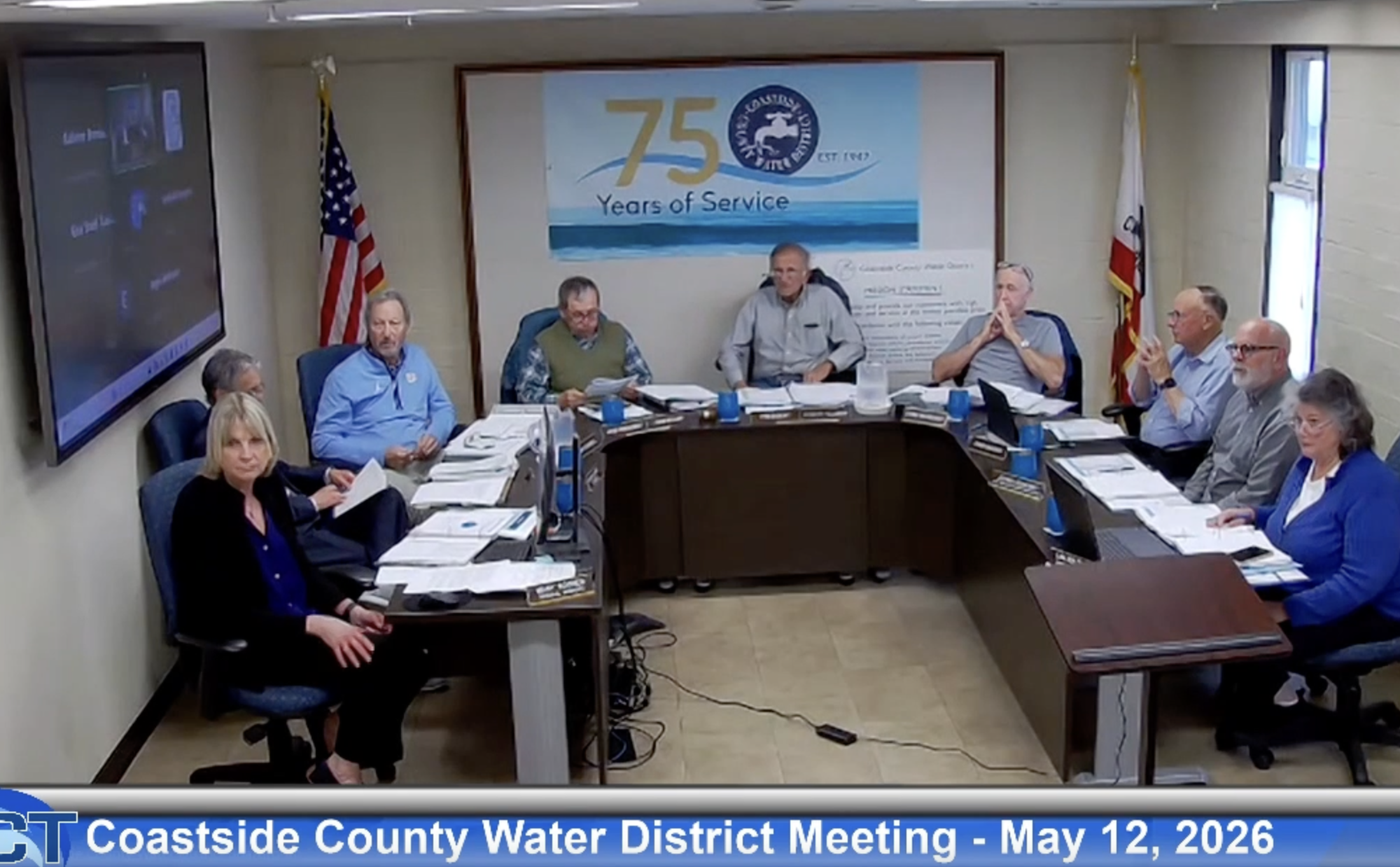
Board of Directors - May 12, 2026 - Meeting

Board of Directors - May 12, 2026 - Meeting

Board of DirectorsCoastside County Water DistrictMay 12, 2026

Sources:

Locunity is a independent informational service and is not an official government page for this commission.We use AI-assisted analysis and human editorial review to publish information.

$73M Capital Plan Looms Over Coastside Water District as Rate Hikes and Borrowing Debate Heats Up

The Coastside County Water District board adopted a state-mandated water shortage plan and approved a final change order on its flagship tank project Monday night, but the real signal came during a sobering preview of a $73 million, 10-year capital improvement program that board members acknowledged will require aggressive rate increases and significant borrowing. With a wholesale water rate hike from SFPUC already confirmed at 7.4% effective July 1, the fiscal pressure on this small coastal district is compounding fast.

  • $73M draft capital plan draws warnings that rate hikes and borrowing are "inevitable" — board members say annual revenue can't keep pace

  • 109-page Water Shortage Contingency Plan adopted unanimously, prepared entirely in-house to meet California Water Code mandate

  • Carter Hill tank project nears finish line — board calls it the best infrastructure project ever built on the coast side, plans July celebration

  • SFPUC wholesale rate increase of 7.4% officially approved, effective July 1, adding cost pressure ahead of June budget decisions

  • $57K change order approved on the $11M DN Tanks contract, holding total true change orders at just 1.84%


A $73 Million Question: How Does the District Pay for It?

Why it matters: The Coastside County Water District generates roughly $4–5 million annually in water revenue. The draft 10-year capital improvement program totals $73 million — up from $70 million last year — meaning the gap between what the district earns and what it needs to build is vast and growing.

Where things stand: General Manager Mary Rogren presented the draft CIP, which breaks down into six major categories. Tanks dominate at 47% of total spending, driven by the planned replacement of Half Moon Bay Tank 2 with a 3-million-gallon prestressed concrete tank. Pipelines account for 24% ($17 million), including Highway 92 Phase 2, neighborhood replacements, and a new pipeline assessment study for the Crystal Springs raw water line. Facilities and maintenance make up 13% ($9.5 million), including a new $5 million placeholder for a potential district shop relocation or renovation — a line item Board Member Chris Mickelsen had pushed to restore from plans dating back 10–15 years. Equipment rounds out the budget at 2% ($1.5 million), while water supply development and treatment plant improvements at Denniston cover the rest.

"As we look next year our spend is around $4 million — that's down from $15 million," said Rogren, referencing the wind-down of the current Carter Hill project cycle.

The other side: Board members didn't sugarcoat the math. Board Member Ken Coverdell was first to flag the structural deficit:

"The deficits start really soon, really quickly, and so it'll be interesting to see how comfortable people are with borrowing or what other type of financing, because we certainly won't be generating that kind of money."

Mickelsen, drawing on prior experience at the district, warned that construction inflation is outpacing general inflation.

President Bob Feldman acknowledged the current three-year rate increase plan remains intact but signaled that harder decisions are ahead.

"When we get to next year we'll be planning for the forward rate increases. That's when we will really have to take a hard look at how this all plays into cost of service, the rate structure, and what the rates will need to look like even if we include borrowing as one of the factors," he said.

Rogren noted one existing bond comes off the books in 2032, which could provide some borrowing capacity.

What's next: The finance committee meets June 2 at 9:30 a.m. to stress-test the long-range financial model against both the CIP and operating budgets. Budget approval is targeted for the June 9 board meeting — the session where rate trajectory and borrowing scenarios will take concrete shape.


Board Adopts Water Shortage Contingency Plan

The basics: California Water Code Section 10632 requires urban water suppliers serving more than 3,000 connections to update their Water Shortage Contingency Plan every five years. The plan must stand independently from the Urban Water Management Plan.

Why it matters: Without this plan, the district risks falling out of state compliance and losing eligibility for FEMA emergency funding during drought or disaster.

Where things stand: Cathleen Brennan, Water Resources Analyst, presented the 109-page plan, which she completed entirely in-house — saving the district consulting costs. The plan describes six standard water shortage levels, from 0–10% through 50%-plus, along with demand reduction actions, supply augmentation actions, and annual assessment procedures due each July 1. The district coordinated with Bay Area Water Supply and Conservation Agency (BAWSCA) and San Francisco Public Utilities Commission (SFPUC) on key requirements including Tier 1 and Tier 2 agreements, annual supply-and-demand assessments, and Bay Delta Plan impact analysis.

Board Member Ken Coverdell zeroed in on how realistic deep conservation mandates would be for residents already using relatively little water. The district's indoor use sits at just 47 gallons per capita per day.

"When most people are using 47 gallons, imagine them trying to use 23 gallons a day," he said.

Multiple board members praised Brennan's work. President Bob Feldman called it a comprehensive and professional effort done with integrity. Board Member Chris Mickelsen described her as an invaluable long-term resource on the staff.

Decisions: The board opened and closed a public hearing with no public comment, then unanimously adopted Resolution 2026-04 (For: 5, Against: 0, Absent: 0). The plan becomes an appendix to the Urban Water Management Plan.


Carter Hill Tank: The 'Ritz Carlton of the Water World'

Why it matters: The Carter Hill prestressed concrete tank and site upgrade is the largest infrastructure project the district has undertaken on the coast side — and it's weeks from the finish line.

Where things stand: Staff presented project update No. 19. The project is approximately 90 days from contract completion but staff expects to wrap up in roughly 60 days. Current work includes a new hydrant installation, subgrading for asphalt, connection to Tank 3, temporary bypass pipe removal, and cleanup. Paving should be done by mid-June with punch list items to follow, targeting full completion by end of June.

Board members were effusive. Vice President John Miller didn't hold back:

"I would go out on a limb, and I think that's probably one of the best projects ever built on the coast."

Board Member Ken Coverdell inquired about the stainless steel control cabinets (304 or 316 grade), and staff confirmed they hold up well in the coastal environment.

What's next: President Bob Feldman announced plans for a public celebration in July and suggested inviting EPA Region 9 and Bay Area Water Quality Control Board officials. Miller endorsed the idea as a chance to build political relationships and potential future funding connections.


SFPUC Wholesale Rate Hike Confirmed at 7.4%

General Manager Mary Rogren reported that the SFPUC commission officially approved a 7.4% wholesale water rate increase on April 28, effective July 1. The increase will directly raise the district's supply costs, compounding pressure as the board heads into June budget deliberations.

Rogren also updated the board on two emergency preparedness efforts. A county-wide local hazard mitigation plan involving 16 special districts and 21 cities and towns across San Mateo County is expected to be certified in fall 2026. Separately, the district must complete an EPA-required risk and resiliency assessment — including cybersecurity evaluations — by end of June, with an updated emergency response plan due to be EPA-certified by December. Board Member Ken Coverdell noted the district received a clean report from the grand jury on resiliency.


Minor Items

  • Consent calendar approved 5-0 after Vice President Miller reviewed financial reports, confirming a $6,000 encroachment fee to the City of Half Moon Bay, a $40,084 Pilarcitos well field investment, and Irvine Consulting's 30-year IT relationship with the district. Miller flagged that SFPUC water fees totaling $72,000 are increasing, with rates up 11.6% and 7.4%.

  • ACWA conference recap: President Feldman and Vice President Miller reported on the 1,400-attendee conference in Sacramento, highlighting the appointment of Carla Namath, a former state water official, as ACWA's new executive director. Sessions covered SB 218 changes, water resiliency, fire danger, and cybersecurity.

  • LAFCO nomination approved 5-0: The board authorized President Feldman to cast the district's vote for Katie Martin to serve as regular special district member on the San Mateo LAFCO through May 2030.

  • Change order No. 7 approved 5-0 for $56,906 on the DN Tanks LLC contract after crews discovered a 12kV electric line conflicting with the planned pipeline alignment. General Manager Rogren noted total true change orders on the roughly $11 million contract sit at $102,000, or 1.84% — well within industry norms. Staff anticipated approximately $46,000 in additional change orders in the coming month.

  • Budget timeline confirmed: Finance committee meets June 2; budget approval targeted for June 9.

  • Monthly operations report covered server room A/C replacement, tank inspections, well project progress, main breaks, and hydrant installations.