
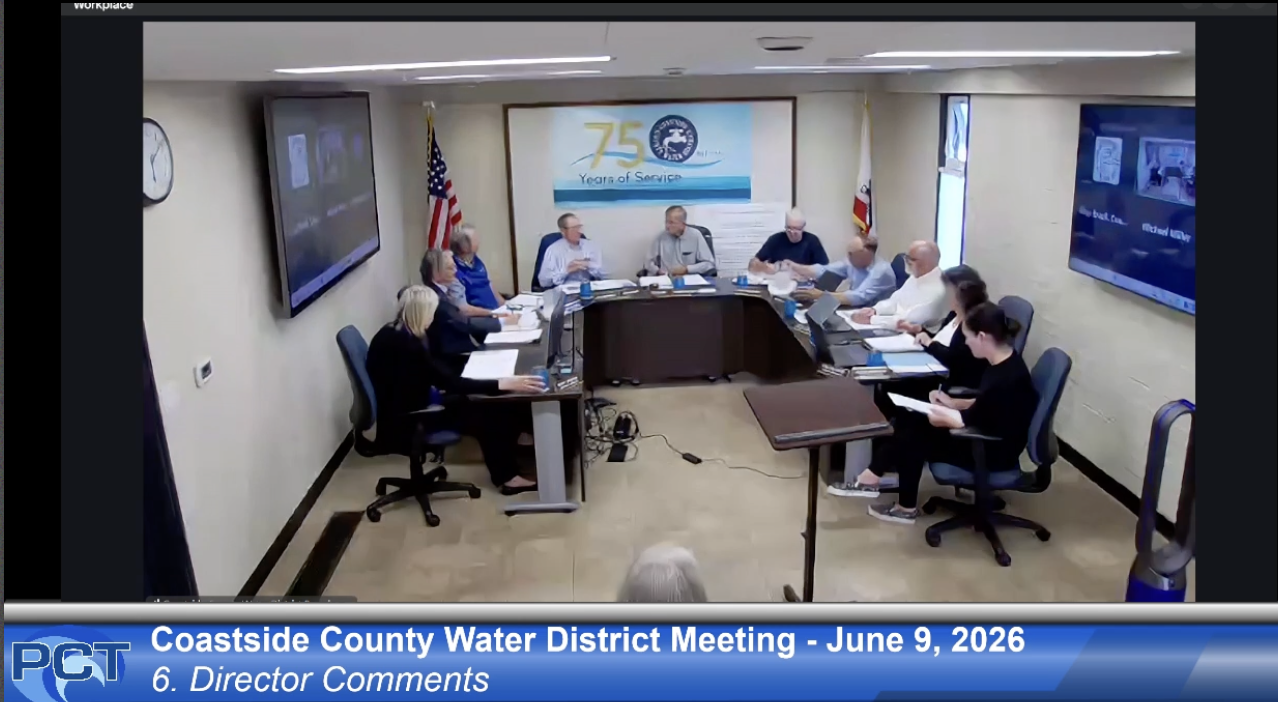
Board of Directors - Jun 09, 2026 - Meeting

Board of Directors - Jun 09, 2026 - Meeting

Board of DirectorsCoastside County Water DistrictJune 9, 2026

Sources:

Locunity is a independent informational service and is not an official government page for this commission.We use AI-assisted analysis and human editorial review to publish information.

Feldman Announces Retirement After 17 Years as Board Approves Budget, Water Plan

The Coastside County Water District board held a packed June 9 meeting that doubled as a milestone moment for the small coastal agency: Board President Bob Feldman announced he will retire from public service at the end of his term in December, capping nearly two decades of involvement with the district. The board also adopted a 2025 Urban Water Management Plan warning of severe dry-year shortfalls, approved a $73 million capital plan, and called a November election that will put three of five board seats on the ballot.

  • Board President Feldman to step down after 17 years, opening three of five seats in a single election cycle

  • Water plan projects flat demand through 2050 but warns of up to 52% supply shortfalls in consecutive dry years under worst-case Bay Delta scenarios

  • $73M ten-year capital plan and FY 2026-27 operating budget adopted, confirming third planned 8% rate increase in January 2027

  • District's local water production jumps from 30% to 40% of supply, validating years of infrastructure investment

  • GM recruitment on fast track, targeting September selection to allow overlap before March 2027 departure


Three Seats, One Election: Feldman's Exit Reshapes the Board

Why it matters: The district faces its most significant governance turnover in years — three of five board seats will appear on the Nov. 3, 2026 ballot — just as it navigates a general manager transition and tens of millions in infrastructure work.

Where things stand: General Manager Mary Rogren presented Resolution 2026-06 calling the November election for Zone 2 (Board Member Chris Mickelsen), Zone 5 (Board President Bob Feldman), and Zone 1 (Board Member Director Dixon, who is serving the remainder of former Board Member Glenn Reynolds' term as a two-year seat). Candidate filing runs July 13 through Aug. 7 with a 200-word statement limit.

Board President Feldman then addressed colleagues directly: "I have decided with much thought that I plan to retire from public service at the end of my term in December." He encouraged successors to step forward: "I am sure that someone in Zone 5 will want to take this opportunity to step up to public service."

The announcement drew emotional tributes from every director. Board Member Director Dixon recalled Feldman's earlier departure and return: "Both times your service has enhanced and improved the performance of the board. Your professionalism has been excellent." Board Member Ken Coverdell called it an honor to serve alongside Feldman for 25 years. Board Member Mickelsen referenced the "Feldman factor" in the district's capital improvement planning, while Vice President John Miller noted the opportunity for new leadership.

Decisions: The board adopted Resolution 2026-06 unanimously (For: 5, Against: 0, Absent: 0).

What's next: With three seats open, the filing period begins July 13. The incoming board members will oversee both the final phase of the Carter Hill tank project and the onboarding of a new general manager — making this election a pivotal moment for the district's direction.


Water Plan Adopted, but Dry-Year Shortfalls Loom Large

The basics: California requires water districts to update their Urban Water Management Plan every five years. The 431-page document, prepared with West Yost Associates, serves as the official blueprint for supply and demand through 2050 — and it's required for state grant and loan eligibility.

Why it matters: In a normal water year, Coastside's supply exceeds demand. But under the worst-case Bay Delta plan scenario — which the district chose to model because it reflects current regulatory conditions — five consecutive dry years could slash supply by 48–52%. That's a gap no amount of voluntary conservation can close.

Staff member Cathleen Brennan walked the board through the numbers. The district produced approximately 560 million gallons in the most recent fiscal year, with 66% supplied by the San Francisco Public Utilities Commission and 34% from local sources. A new econometric demand model from the Alliance for Water Efficiency projects essentially flat consumption through 2050 — 570 million gallons in 2030, declining slightly to 563 million gallons by 2050.

The concern lies in the dry-year scenarios. A single dry year shows a manageable 4% shortfall that voluntary cutbacks could address. But consecutive drought tells a different story. "It does go into that 48% shortfall in 2030, but then out to 2050 it gets even larger that fifth year and it's a 52% shortfall from what we expect to be normal water demands," Cathleen said.

The other side: Staff noted this is the worst-case analysis because the alternative agreement — Support Healthy Rivers and Landscapes — is pending and has not yet been modeled. Cathleen explained that the state's Bay Delta plan aims to manage the delta and its tributaries to improve water quality, with concern over salinity levels from the San Francisco Bay if water levels drop too low.

Board President Feldman stressed the public stakes: "I think it's important people understand this is overreaching, overarching, all of this water stuff and it's still a work in progress."

Two local supply projects are underway — Pilarcitos Creek well field improvements, which are nearly complete, and the San Vicente groundwater supply project — offering some buffer against San Francisco Public Utilities Commission (SFPUC) supply reductions.

Decisions: The board unanimously adopted Resolution 2026-05 (For: 4, Against: 0, Absent: 1 — Board Member Coverdell was not called during the roll call for this vote).

What's next: The Bay Area Water Supply and Conservation Agency (BAWSCA) water supply negotiations that would shape the district's long-term security remain uncertain. Board Member Coverdell reported during director comments that irrigation districts have requested extensions, pushing negotiations well into 2027 at the earliest — a timeline he called optimistic, suggesting it could take multiple election cycles to secure a reliable source.


$73 Million Capital Plan and Budget Hold to Rate Projections

Why it matters: The board's adoption of the FY 2026-27 operating budget and a $72.985 million ten-year capital improvement program confirms the third and final planned 8% rate increase in January 2027 — a commitment made three years ago that staff have held to despite inflation and construction cost pressures.

Where things stand: Assistant General Manager Jeffrey Schneider presented a budget built on six months of finance committee work, master tank plan reviews, and board presentations. Key assumptions include flat water sales at 504 million gallons, SFPUC water purchases budgeted at 60% of district supply (with a 7.4% SFPUC price increase partially offset by a raw water discount increase from $0.39 to $0.44 per unit), the 1.75% COLA, three staff step increases, three months of overlap for the GM succession, and $500,000 budgeted for Crystal Springs Pipeline usage.

"The total 10-year plan is $72,985,000 — $3,215,000 above the prior 10-year CIP plan," Schneider reported. The program covers Carter Hill tank completion, Half Moon Bay Tank #2 replacement, AL tank replacement, pipeline projects, and equipment.

The district projects contributing $4.094 million to capital and reserves, slightly down from the current year's $4.162 million. Interest income will decline as certificates of participation proceeds from the Carter Hill project are exhausted.

Board Member Mickelsen highlighted a notable shift in the district's supply portfolio: "We used to think we would be at 30% local sources in terms of dollars, and now we're at 40. So that vindicates the assumptions that we made about the benefits of investing in our sources."

Board Member Director Dixon praised collaboration under GM Rogren's leadership: "There's so much more collaboration in the district than has ever been. That's really thanks to Mary and the restructuring of the operations."

Vice President Miller offered a practical observation about the capital spending: "A lot of the expenses I've read here is meeting state standards, emissions and trucks and vehicles and everything. So we are following the law, but we have to invest in that. So it doesn't cost, it pays."

Board President Feldman summed up the fiscal discipline: "We've done a really remarkable job, in my view, to be able to still be able to count on that initial estimate as valid and correct for the situation going forward."

Board Member Coverdell noted the intensity of the process: "It's a six-month process. So 50% of our time we're in the budget process."

Decisions: Passed unanimously (For: 5, Against: 0, Absent: 0). Board Member Mickelsen moved the motion, seconded by Board President Feldman.


Staffing Report Shows a Healthy, Stable Workforce

Why it matters: With a GM retirement approaching and major capital projects in motion, workforce stability is critical. The district's AB 2561 public hearing — a state-mandated annual review of vacancies, recruitment, and retention — painted a picture of organizational health.

Where things stand: Assistant General Manager Jeff Schneider reported the district carries an 8% vacancy rate across 25 approved positions, with both vacancies tied to good news: one resulted from Ingrid Anderson's promotion to administrative analyst, and the other is a treatment distribution operator position that internal maintenance workers may fill after achieving D2 and T2 certifications. The Teamsters Local 856 union representative reviewed the report and saw no need to attend the hearing.

Retention is strong — 58% of staff have five or more years of service, with one employee leading at 30 years. The district recruits locally for operational availability and advertises via its website and the Daily Journal.

Board Member Coverdell highlighted the district's culture: "I'm just really proud of the fact that we really have a strong history of promoting from within. That's what we should be doing."

Board Member Director Dixon connected staffing to community: "Where else can you live close to the ocean with the wonderful situations that we have here? Small community, people still appreciate each other and respect each other. And it's just a wonderful place to be and live."


Salary Transparency: Board Approves 1.75% COLA, Reads Top Salaries Aloud

Under newly amended Government Code Section 54953, the district was required for the first time to verbally announce current and proposed salaries for senior positions at a public meeting. Assistant General Manager Schneider read each into the record:

  • General Manager: $283,425 → $288,386

  • Assistant GM of Finance/Administration: $222,123 → $231,661

  • Water Treatment Plant Operations Manager: $199,871 → $208,451

  • Water Distribution Operations Manager: $176,656 → $184,240

The 1.75% cost-of-living adjustment (COLA) is calculated from the February-over-February Bay Area Consumer Price Index, per the union memorandum of understanding, effective July 1, 2026.

Decisions: Passed unanimously (For: 5, Against: 0, Absent: 0). Vice President Miller moved the motion.


Minor Items

  • Consent calendar approved unanimously (For: 5, Against: 0, Absent: 0), including minutes and claims.

  • Carter Hill tank change order #8 ratified at $49,000 for paving of 39,900 additional square feet of the treatment plant access road, which deteriorated from heavy truck traffic during construction. The change order was pre-approved under the GM's $200,000 cumulative authority. Staff member Paul reported that PG&E responded in just two weeks to upgrade two 12kV electrical boxes on the treatment plant road — the first upgrade since 1992. A public celebration with state regulators and elected officials is planned for late July. Passed unanimously (For: 5, Against: 0, Absent: 0).

  • Board clerk Lisa Sulzinger will retire at the end of July after 11 years. Ingrid Anderson, who joined customer service in 2024, has been promoted to replace her and is already in training.

  • Moment of silence held for Al Edrovino, a former 16-year board member and coastside community figure. Vice President Miller shared a personal tribute, recalling Edrovino's philosophy: "If you're not giving, you're not living."


Looking Ahead: The GM recruitment brochure is expected by mid-June, with applications closing July 13, first-round interviews targeted for the week of Aug. 10, and a candidate selection hoped for September. Board President Feldman emphasized keeping the process on an ambitious fast-track schedule to allow a three-month overlap before GM Rogren's March 2027 departure.

Feldman Announces Retirement After 17 Years as Board Approves Budget, Water Plan | Board of Directors | Locunity