
CVWD Groundwater Plans Hold Up Through 2050 as Directors Question Growth Math
Board of Directors • Coachella Valley Water DistrictNovember 4, 2026
Locunity is an independent informational service and is not an official government page for this commission. All information is sourced from public footage and an analysis of official agendas with the aid of responsible, fact-checked AI. to report an error or omission.
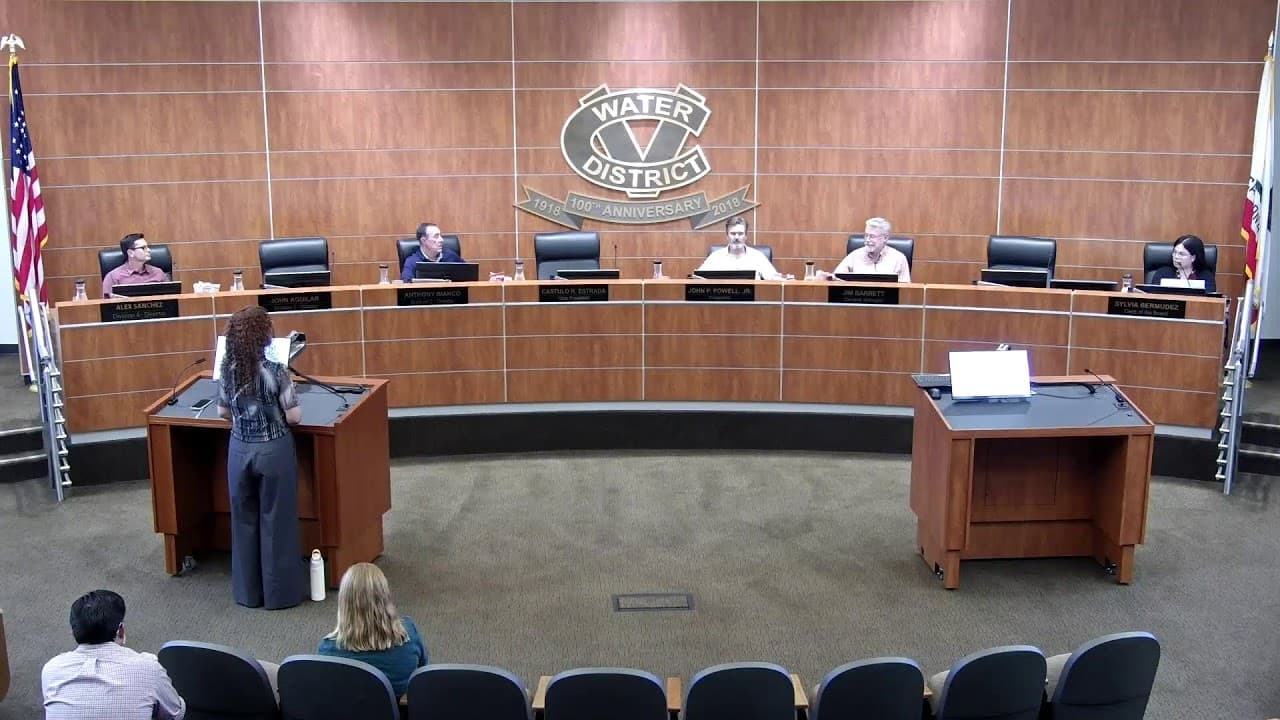
Coachella Valley Water District staff told the Board of Directors on Nov. 4, 2026, that both the Indio and Mission Creek groundwater subbasins stay sustainable through 2050, even under a severe climate scenario. The study session involved no vote, but it was the board's last formal look before a Dec. 8 public hearing and adoption, ahead of a Dec. 28 state deadline. The sharpest pushback was not about the water. It was about the population forecasts behind the plans.
- All 57 Indio and 9 Mission Creek key wells stay above minimum thresholds through 2050 in every modeled scenario
- Indio thresholds lowered 10 feet at 37 wells; 20 held at 2009 lows over subsidence and Salton Sea concerns
- Directors challenge SCAG growth forecasts, especially for the city of Coachella; staff defend them as the best available data
- Mission Creek faces negative storage trends under severe climate conditions without new supplies such as Sites Reservoir
- Adoption set for Dec. 8, with plans due to the state Department of Water Resources on Dec. 28
Two Basins, One Verdict: Sustainable
The basics: The Sustainable Groundwater Management Act, or SGMA, requires local agencies to manage groundwater basins so pumping does not cause lasting harm. Plans are updated every five years. "Minimum thresholds" (MTs) are the groundwater levels at monitored key wells that should not be crossed.
Why it matters: These five-year plans guide which supply projects CVWD pursues and, by extension, what ratepayers pay for. The findings give the district a clean bill of health heading into adoption.
Where things stand in Indio: The Indio team includes CVWD, the Coachella Water Authority, Desert Water Agency and the Indio Water Authority. Its population is projected to grow from 307,000 to about 419,000 by 2050, while demand rises only about 2.4% because of conservation. Most of the subbasin's supply comes from Colorado River imports.
Staff lowered thresholds at 37 of 57 key wells. "We reduced the MTs at 37 of these key wells by 10 feet for operational flexibility and for exercising the Agua Caliente Water Authority tribal water right," said Water Resources Planning Administrator Lupe Lara-Antonescu. The other 20 wells stayed at 2009 lows because of potential subsidence areas and seawater intrusion concerns near the Salton Sea.
Modeled projects raise groundwater storage. These include PDGRF Phase 2, OASIS, WARP 7 and WARP 10. All scenarios stay above thresholds. One director called it a result the district should be proud of: "We're giving you a doom and gloom scenario, and we're still good."
Where things stand in Mission Creek: The Mission Creek update covers the Mission Creek Subbasin plus the Desert Hot Springs Subbasin and Garnet Hills Subarea. CVWD developed it with Desert Water Agency, Mission Springs Water District and consultants. Thresholds at nine key wells were refined to within 1.5 feet of the originals.
Subsidence appeared only near the Edom Hill Landfill. Uranium and nitrate remain constituents of concern, and chromium-6 was added to the list. Demand is projected to rise 19.6% by 2050, offset by conservation.
"All 9 key wells' groundwater levels remain above their MTs through 2050, indicating that the basin is sustainable," Lara-Antonescu said.
The other side: Mission Creek's margin is thinner. Staff modeled six scenarios. Moderate climate conditions yield net neutral or positive balances. Severe climate conditions yield net negative balances in every project group, even though well levels stay above thresholds. Mission Creek relies on a less diverse supply portfolio than Indio, which makes new recharge water, such as Sites Reservoir supplies, central to its dry-year resilience. The Delta Conveyance Project also appeared among the supply options discussed.
Decisions and stakeholder impacts: No action was taken. Indio's lowered thresholds give pumpers more room and support the Agua Caliente tribal water right. The held thresholds protect areas near the Salton Sea and potential subsidence zones. Mission Creek ratepayers served by Desert Water Agency and Mission Springs Water District have the most at stake if imported supplies keep slipping.
Directors Doubt the Growth Forecasts
Why it matters: Population projections drive long-term supply planning and potential rate impacts. Inflated forecasts could steer investment toward capacity the valley may not need.
Where things stand: One director said growth over the past 20 to 30 years has run far slower than projected. "We're not even close to any of those numbers," the director said, and asked whether the district should push regional planners or hire someone to produce better numbers. Directors called the Coachella Water Authority figures in particular implausible.
Staff said the data come from city reporting through the Southern California Association of Governments (SCAG) and are the best available dataset. Staff added that 2020 projections generally matched actual figures and promised to discuss the concerns as a team.
The other side: Board President John Powell Jr. noted the plans update every five years and argued that conservative projections could help preserve water rights. "It doesn't really hurt us and it might help us," Powell said.
A second director defended the sourcing. That director said relying on an official database shields the district from criticism that a paid consultant told it what it wanted to hear. "It is important for us to cite a published official database rather than to just make up numbers ourselves," the director said.
The same director also flagged the limits of CVWD's role: "We're not a land use agency, so we don't really have any control over how quickly they may want to grow in Indio." Cities set the pace of growth. The water district still carries broad responsibility for replenishing the basin.
Decisions and stakeholder impacts: Nothing changed on Nov. 4. The debate pits accuracy against defensibility. Trimming forecasts could ease pressure for new capital projects. Keeping SCAG's numbers aligns CVWD with official regional data and may strengthen its position on water rights. Cities reporting to SCAG, including Coachella and Indio, effectively shape the assumptions behind the district's spending.
What's next: The open question is whether the projections will be revisited before the Dec. 8 adoption hearing.
Climate Models Trim Imported Water
Where things stand: One director asked whether a modeled drop in runoff matches expectations of fewer but larger desert storms. "There is anticipated to be fewer but larger, more extreme storms," said Rosalind Prickett, Managing Principal of Rincon Consultants. She acknowledged that the USGS Basin Characterization Model mutes extremes compared with historical storms.
Rincon downscaled Sacramento River watershed outputs to local State Water Project deliveries. "BCM forecasts 43% reliability in the moderate climate change conditions," Prickett said. Reliability falls to 39% under severe conditions. Both figures sit below the roughly 45% average allocation of the past 17 years.
Why it matters: Lower assumed imports increase how much new recharge water and capital investment the district says it needs. Directors remarked that no one knows precisely. They noted that California precipitation has been decent while the Colorado River Basin has suffered.
Minor Items
- Informal start: Staff presented the Mission Creek portion before the formal call to order while awaiting a quorum.
- Quorum: Board President John Powell Jr., Director Anthony Bianco and Director Alex Sanchez answered roll call.
- Institutional memory: Powell offered history on early Whitewater storm capture: "There's so many new faces here that I think that history is important."
- Staff priorities: Staff priorities for both subbasins include:
- Full use of Colorado River supplies
- Better State Water Project reliability
- Expanded recycled water
- Source substitution and replenishment
- Efficiency
- Salt and nutrient management planning
- Ongoing monitoring
Looking Ahead
"We will be bringing these alternative plans to the board on December 8th for public hearing and adoption, and the alternative plans are due to the Department of Water Resources by December 28th of this year," Lara-Antonescu said. Residents and partner agencies who want to weigh in on thresholds, growth forecasts or supply priorities should plan for the Dec. 8 hearing.