
Water Board Backs Lake Mead Conservation Pacts as Bid Costs Climb
Board of Directors • Coachella Valley Water DistrictSeptember 22, 2026
Locunity is an independent informational service and is not an official government page for this commission. All information is sourced from public footage and an analysis of official agendas with the aid of responsible, fact-checked AI. to report an error or omission.
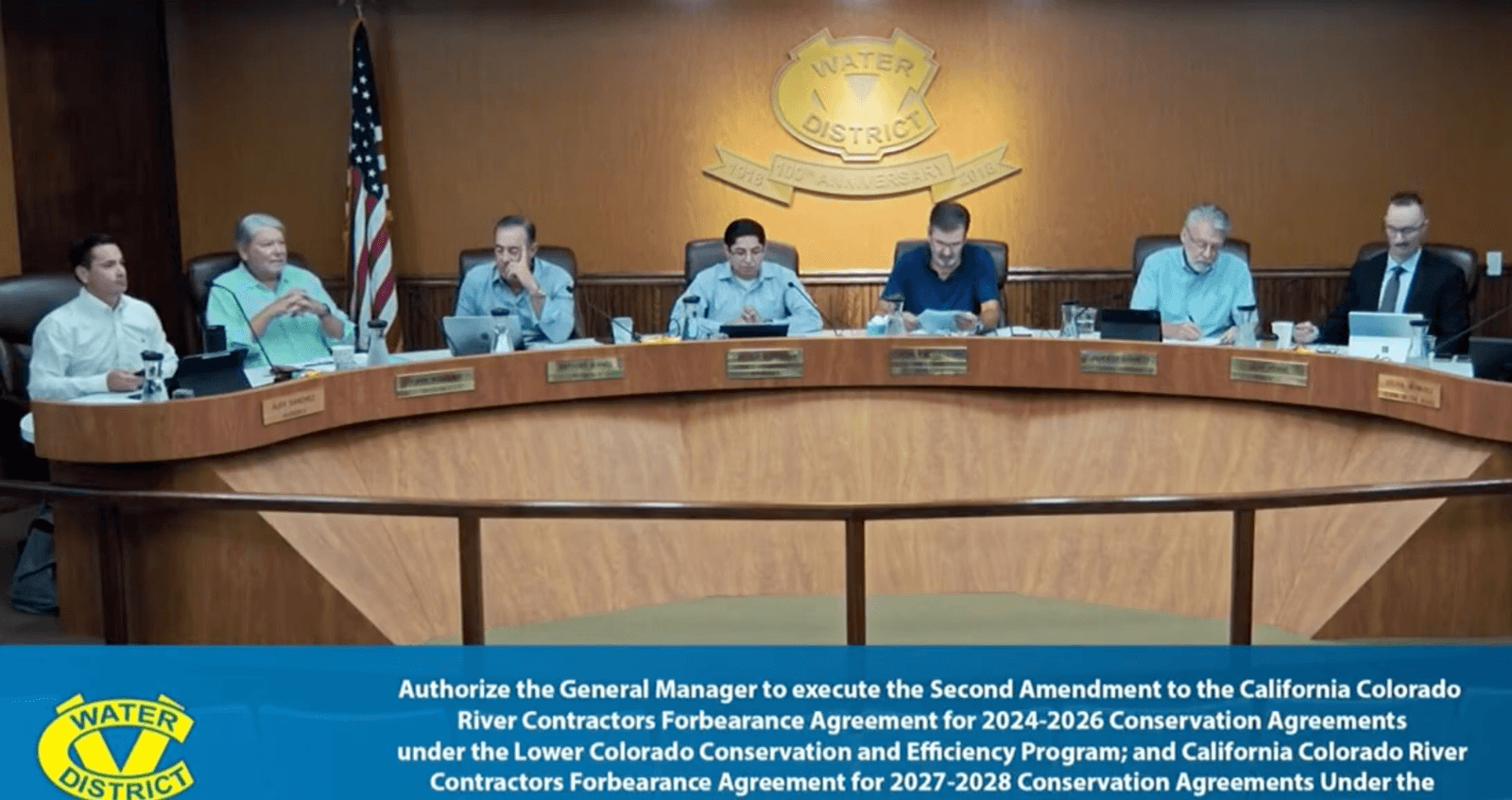
The Coachella Valley Water District board voted 5-0 on Sept. 22, 2026, to keep federally funded Colorado River conservation water parked in Lake Mead for up to two more years. Directors also approved roughly $6M in contracts for tanks, recycled water and billing. One director warned that bids are running well above estimates and the capital plan will need to change.
Colorado River forbearance agreements approved 5-0, covering up to 35,000 acre-feet a year through 2028
$2.67M recycled water upgrade awarded to Weka, Inc. after bids topped the engineer's estimate
Director Anthony Bianco warns a roughly $150M capital spend could really cost $200M–$250M
Low bidder withdraws from tank project; Cora Constructors awarded $429,800 contract
$2.61M InfoSend billing deal extended through Sept. 29, 2029, without competitive bidding
1 Big Thing: Keeping Conserved Water in Lake Mead
The basics: A forbearance agreement is a promise by the other California Colorado River contractors not to claim water that one party conserves. Without it, conserved water could be taken by others instead of staying in Lake Mead.
Why it matters: Board President John Powell Jr. said one missing signature could cost conservation funding and lower Lake Mead. Federal dollars depend on everyone agreeing to leave the water alone.
Where things stand: The board authorized the general manager to sign two documents. One is a second amendment to the 2024–2026 California Colorado River Contractors Forbearance Agreement. The other is a new forbearance agreement covering 2027–2028 conservation.
District staff member Robert Chang explained that CVWD had already signed separate conservation funding agreements with the federal government. This item is the companion pact among California parties. The amounts match: up to 35,000 acre-feet a year for two years. The district can conserve less, but it is not paid for water it does not conserve. Chang also said the federal rate has dropped from $400 to $325 per acre-foot.
Board Vice President Cástulo R. Estrada said he was confused about whether this was a new deal. Powell explained why these agreements keep coming back to the board:
"Pretty much any time there's a new conservation agreement, the other parties need to sign a forbearance saying they won't make a claim to that water that was conserved," said Powell.
Who pays: Director John Aguilar asked the question ratepayers would ask: "What does this mean for the average customer, residential, business, agriculture?"
"I don't think there's going to be any impacts to the customers," said Chang. He said customers would see no impact through 2028.
Director Anthony Bianco said the district made up for the conserved QSA water by switching golf course and agricultural customers to other surface water.
Decisions and stakeholder impacts: The motion passed. For: 5 (Powell, Bianco, Estrada, Aguilar, Sanchez), Against: 0, Absent: 0. Bianco moved the item and Aguilar seconded. Federal conservation payments keep flowing, and Lake Mead keeps the stored water. Golf and farm users depend on the replacement supply, which shifts some of the load to them.
What's next: Estrada stressed the time limit before the vote: "It's a 2-year deal." The pact runs through 2028. After that, the district will have to negotiate again.
Bids Run Hot on Recycled Water Fix
Why it matters: Five older non-potable water connections from the late 1980s have no flow or pressure control. As more customers connect, staff said, that puts the hydraulic capacity of the whole system at risk, along with overfilled ponds and pressure spikes.
Where things stand: The five connections are Portola Country Club, Marriott Desert Springs, First Tee, Palm Desert Greens and Desert Golf Resort. Staff member Armando said the project adds pressure-reducing and flow-control valves, plus telemetry and SCADA, the district's remote monitoring and control system.
The district received 12 bids. Weka, Inc. was lowest at $2,171,626, which was above the engineer's estimate. Staff blamed rising prices for SCADA equipment, valves and electrical work. Another $498,925 in soft costs brings the total to $2,670,551. Directors also flagged a mix-up in how the report described the high- and low-pressure zones, and staff corrected it.
The bigger warning: Bianco used the item to make a broader point. He said high bids are now the norm, and the capital improvement plan and budget should assume them. He said a capital spend expected to be about $150M could really cost $200M to $250M. He added that some items on that day's consent calendar were "like-to-have" projects and that the district must live within its means.
"We gotta buckle down," said Bianco.
Aguilar asked why engineers' estimates miss bids by so much. Staff said they push consultants to update their numbers, but "it's hard to predict what the market is," said Armando.
Decisions and stakeholder impacts: The contract passed. For: 5, Against: 0, Absent: 0. Bianco moved and Director Alex Sanchez seconded. Golf course and resort customers get more reliable service. The district's cost warning means future projects may compete harder for funding.
What's next: Watch whether staff build higher bid assumptions into the next capital plan and budget, as Bianco urged.
Low Bidder Exits Tank Project
Why it matters: Hydropneumatic tanks are pressurized steel vessels that help booster stations keep water pressure steady. Staff said contractors without experience on this kind of work risk defects and warranty problems.
Where things stand: The project replaces two corroded steel pressure vessels and rehabilitates a third at three booster sites. It was budgeted at $400,000. The board approved $726,500 in total spending, including a $429,800 construction contract.
The district opened six bids on July 16. Ironwave Builders, which does business under the name Mehta Civil Tech LLC, was the apparent low bidder. Cora Constructors filed a protest, pointing to how recently Ironwave was formed and its lack of relevant experience.
"None of the projects that they listed to fulfill that experience requirement involved anything even close to this work," said staff member Glenn.
After talking with legal counsel, staff gave Ironwave the option to withdraw. The company sent a withdrawal letter on Aug. 31.
The other side: Powell asked why the district would return Ironwave's bid bond, the deposit bidders put up to guarantee their bid. Counsel said returning it may not be legally required. It was part of a settlement that encouraged the withdrawal and made a fight less likely. Bianco said it sounded like Ironwave underbid. Staff said the main concern was experience.
Decisions and stakeholder impacts: Estrada moved and Powell seconded. The item passed on a voice vote, but no tally was announced. Directors noted that Cora is a local firm that has worked for the district before. The trade-off is a higher price in exchange for avoiding a likely dispute.
Billing Vendor Locked In Through 2029
Why it matters: InfoSend prints and mails the district's monthly bills and its delinquency and shutoff notices. It also connects with Paymentus, the payment processor, and SpryPoint, the district's upcoming new billing system.
Where things stand: The board approved a three-year sole-source contract, meaning no competitive bidding, with two one-year options. The total is $2.61M, and annual increases are capped at 5%. The district's Director of Public Affairs and Customer Experience said about $750,000 goes to InfoSend itself. About $1.86M is postage the district would pay no matter which vendor it used. The money is already in the department budget.
"Changing vendors at this point would create risk to the project and could delay the SpryPoint implementation," said the Director of Public Affairs and Customer Experience.
The other side: Powell asked when the district could stop mailing bills. Staff said about 40,000 customers use autopay, but many still prefer paper. Estrada asked about credit card fees the district absorbs. Staff said they could be about $1M a year, and noted that cash and checks also cost money to process. Bianco said the district should keep offering every payment option.
Decisions and stakeholder impacts: Aguilar moved the item and noted the term runs through Sept. 29, 2029, not 2028 as the staff report stated. Estrada seconded. For: 5, Against: 0, Absent: 0. Customers who pay by mail keep that option, and the new billing system stays on schedule.
Minor Items
Consent calendar: 17 items (6.A–6.Q), including SCADA and IT purchases, engineering agreements and a Clean Water SRF loan resolution, passed 5-0 without discussion.
Brown Act change: District counsel said an urgency bill signed by the governor repeals several SB 707 translation requirements, effective immediately. "So the board will still have to dual broadcast its meetings to the public so they can participate virtually," said counsel.
Regional reports: Bianco said the Coachella Valley Conservation Commission tabled a proposed increase in developer mitigation fees. Aguilar said the Salton Sea Conservancy extended its search for an executive director.
Employee recognition: Benito Reyes Jr. was honored for 20 years of service. He supervises a 15-person team that runs the Whitewater replenishment facility.
Closed session: The board met privately on labor negotiations. No reportable action was taken.
Looking Ahead
The Salton Sea Summit is scheduled for Oct. 16–17. Estrada said the district's disadvantaged communities group plans to change its format to draw more participation. Ratepayers and advocates should watch the next capital improvement plan to see which projects directors treat as "need-to-have."