
Coachella Planning Commission Backs Fast-Track EV Charger Permitting Rules
Planning Commission • CoachellaOctober 21, 2026
Locunity is an independent informational service and is not an official government page for this commission. All information is sourced from public footage and an analysis of official agendas with the aid of responsible, fact-checked AI. to report an error or omission.
Coachella is moving to make its state-mandated fast lane for electric vehicle chargers permanent. On Oct. 21, 2026, a three-member Planning Commission unanimously recommended that City Council adopt Ordinance No. 1240, which writes strict review deadlines and site standards into the city's municipal code.
- Ordinance 1240 advances to City Council after a 3-0 Planning Commission vote
- Fixed state deadlines of 5 and 20 business days for smaller charger projects
- Standalone charging sites would need 3 acres and 200 feet of street frontage
- Missed city deadlines could mean applications are deemed complete or approved
A Permanent Fast Lane for EV Chargers
Why it matters: The ordinance adds Chapter 17.120 to the Municipal Code. It codifies state requirements under AB 1236 and AB 970 and replaces Urgency Ordinance 1239, which City Council adopted Oct. 14. Businesses and property owners installing chargers would get a predictable, deadline-driven process.
The basics: An urgency ordinance takes effect right away but works as a stopgap. Ordinance 1240 is the permanent version. It must still win City Council adoption.
Where things stand: Community Development Director Kendra Reed presented the ordinance. She was direct about its origin: "The primary purpose of this ordinance is to comply with state requirements for expedited EV charging station permitting," she said.
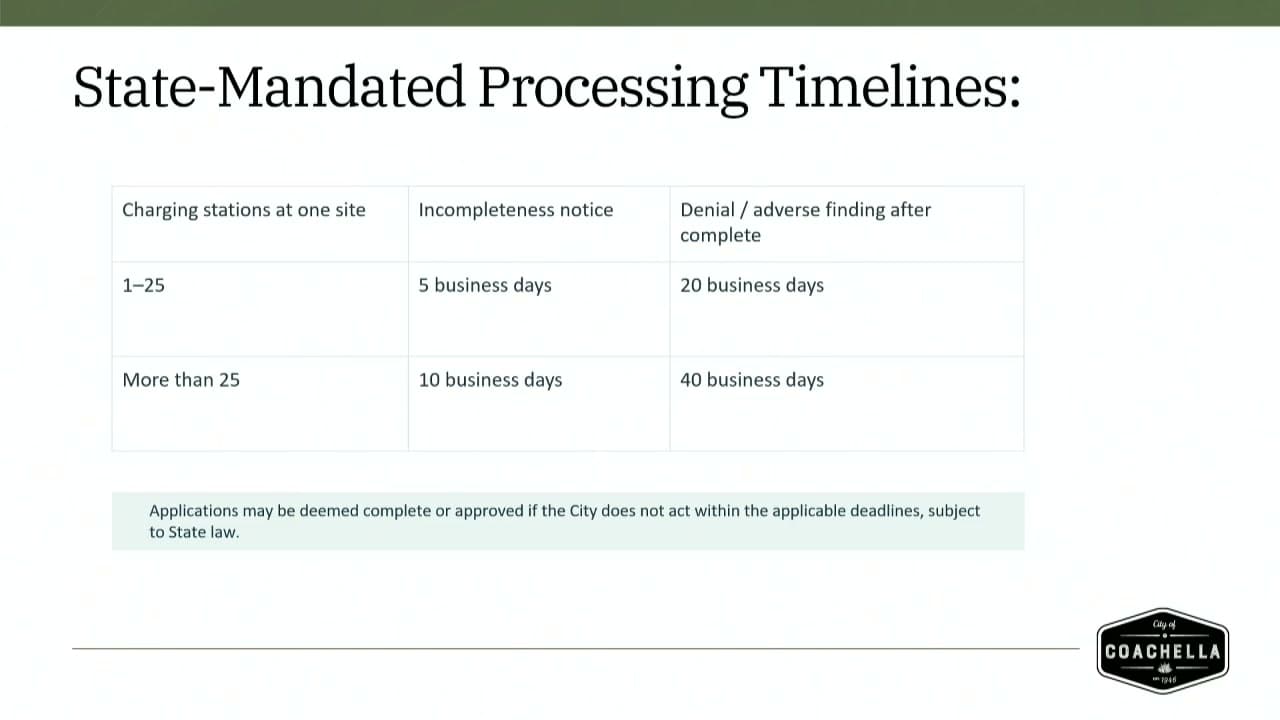
The framework creates a streamlined administrative review led by the city's building official. Applicants would use a public checklist and electronic submittal. The state sets the review clock:
- 1 to 25 stations: The city has 5 business days to flag an incomplete application and 20 business days after completion to deny it.
- More than 25 stations: The city has 10 and 40 business days.
The deadlines have teeth. If the city misses them, applications may be deemed complete or approved.
Health, building, electrical, fire, accessibility and utility safety standards still apply. The city can require a conditional use permit only if it substantiates a specific adverse health or safety impact. Homeowners association approval cannot be made a condition. Applicants can appeal building official decisions to the Planning Commission.
Standalone sites, higher bar: Reed distinguished two kinds of projects. Accessory chargers, such as a shopping center adding chargers to its parking lot, would generally get administrative approval. Facilities where charging is the primary use face added objective standards. "The ordinance establishes a minimum lot size of 3 acres and a minimum street frontage of 200 feet," Reed said.
Standalone sites must also meet underlying setback and height rules. Staff will review vehicle access, circulation, parking and queuing. Any non-charging amenities would trigger administrative, architectural and site plan review.
Where chargers could go: One commissioner asked, "Does the city already have any possible locations within the city limits?" Reed said "the Economic Development Department did receive a grant from the Department of Energy." That grant funded a site inventory study of possible charger locations, which has already been completed.
Staff found the ordinance is not a project under the California Environmental Quality Act (CEQA), or is otherwise exempt.
Decisions and stakeholder impacts: Vice Chairperson Torres moved to approve Resolution PC-2026-33, and the motion was seconded. It passed on a roll call: For: 3, Against: 0, Absent: 3 (Chairperson Lara, Commissioners Ordórica and Murillo).
Retailers and property owners adding chargers to existing lots gain the clearest benefit: firm timelines and administrative approval. Developers proposing standalone charging hubs face a tougher test because of the acreage and frontage minimums. City staff take on enforceable deadlines, and missing them carries real consequences. Residents in HOA-governed communities cannot have charger permits held up by an HOA approval condition.
What's next: The recommendation goes to City Council for adoption. If approved, Ordinance 1240 replaces the urgency ordinance and becomes permanent city code.
Minor Items
- Minutes approved: The commission approved its Oct. 7, 2026, minutes. For: 3, Against: 0, Absent: 3.
- State of the City: Staff invited commissioners to the State of the City on Oct. 22, 2026.
- Commission seats open: Applications are open for all city commissions, and members with expiring terms must reapply.
- Resident Engagement Academy: The academy starts early next year for residents 16 and older. Applications are on the city website in English and Spanish.
Looking Ahead
City Council will take up Ordinance 1240, its decision on making Coachella's expedited EV charger rules permanent.