
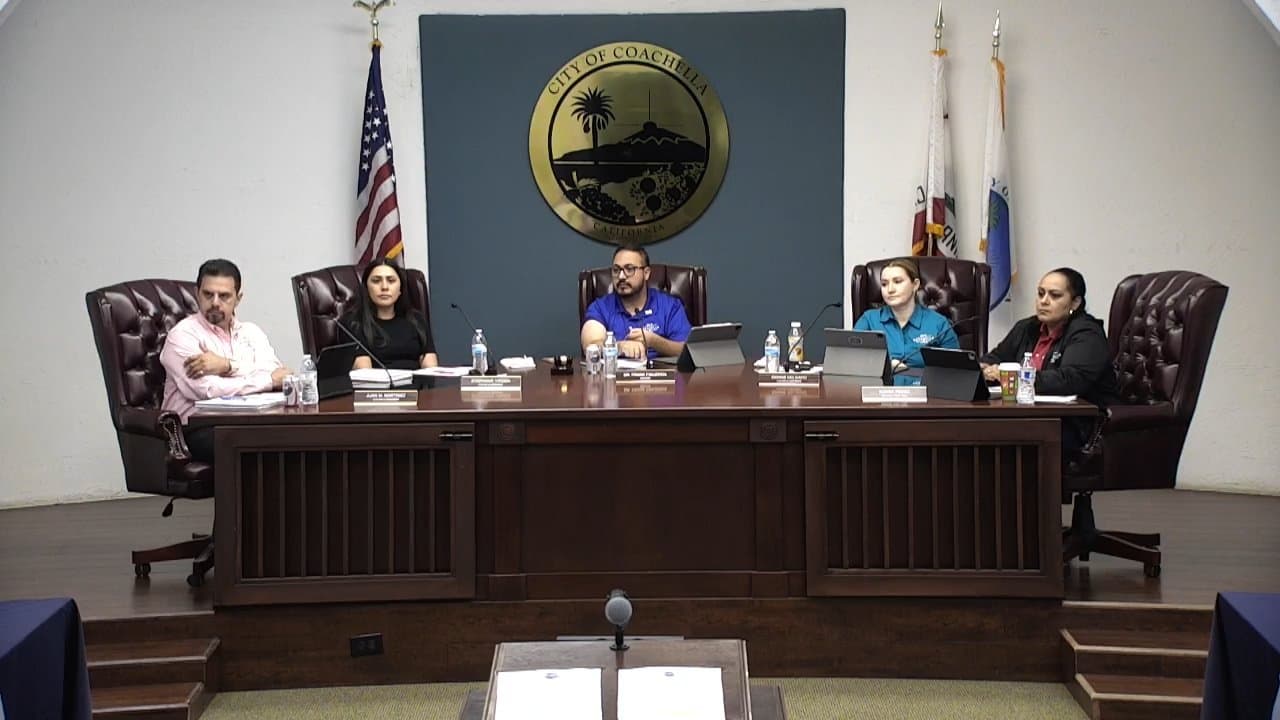
Coachella Awards $48.7M Avenue 50 Bridge Contract, Trims Park Plans
City Council • CoachellaSeptember 21, 2026
Locunity is an independent informational service and is not an official government page for this commission. All information is sourced from public footage and an analysis of official agendas with the aid of responsible, fact-checked AI. to report an error or omission.
Coachella's long-awaited Avenue 50 Bridge is ready for construction. The City Council voted 5-0 to award a $48.7 million contract to Riverside Construction Company, and staff said no general fund money will be needed. The same night, power-grid limits shaped two other decisions: the council cut EV chargers and a splash pad from Rancho Las Flores Park, and it heard a citywide EV study that flagged tight electrical capacity.
$48.7M Avenue 50 Bridge contract approved 5-0; the bid came in about $7 million under estimate
Rancho Las Flores Park heads to bid at about $12.5M; splash pad and 30 EV chargers cut
EV study projects 226 public charging ports by 2030 as IID grid capacity tightens
State loan forgiveness of up to $50M for chromium-6 cleanup remains available; no dedicated state funding won
1 Big Thing: The Bridge Finally Gets Built
Why it matters: The new bridge replaces a crossing over the Whitewater Channel that floods regularly. Staff said the city's share comes from saved road funds rather than reserves.
Where things stand: The project dates back years. Federal Highway Bridge Program (HBP) funds were secured in 2014, environmental clearance followed in 2019, and Caltrans authorized construction in May 2026. Seven companies bid when bids opened Sept. 3. Riverside Construction Company was the lowest responsive bidder, and no protests were filed.
Staff told the council that "our low bid at $48,709,000 was actually about $7 million under our estimate."
The deal:
The contract is $48,709,821.10, plus a $4,870,982 contingency (10%).
Adding the $7.97 million construction-management amendment brings the total to about $61.55 million.
The city's local share is about $2.78 million. It comes from SB 1 (state road repair funds) and Measure A (county transportation sales tax).
HBP grants and the Coachella Valley Association of Governments (CVAG) cover the rest.
Staff said "there are no general fund allocations up there because the project was $7 million under budget." Mayor Frank Figueroa clarified that the city's share is already budgeted, not drawn from unallocated general fund money.
The engineering amendment, with Angenious Engineering Services, passed earlier on the consent calendar. Staff said about 88.8% of that work is funded by HBP grants. The CVAG and the city split the remainder 75/25.
The other side: Public commenter James Rodriguez spoke on more agenda items than anyone else that night. He questioned the bridge design during the consent calendar: "Even though it is billed as a 4-lane highway, when you look at all of the design, it is going to be wide enough to be 6 lanes eventually." He warned that a wider road could worsen particulate pollution unless the city adds mitigation.
On the construction contract itself, Rodriguez supported the project. He asked the city to attach conditions so that development along the new corridor brings residents jobs and low-cost goods, rather than uses like rental-car storage. "We need to have some kind of a conditional use permit agreement," he said.
Decisions and stakeholder impacts: Councilmember Juan M. Martinez moved approval. He noted that "this was one of the first questions that I had in my first meeting to bring this project back with an update."
Vote: For: 5 (Martinez, Virgen, Delgado, Perez, Figueroa). Against: 0. Absent: 0.
Commuters and nearby residents gain a crossing that stays open during floods.
The contractor takes on the city's largest infrastructure project.
The council made no commitment on Rodriguez's request for land-use conditions.
What's next: A groundbreaking is set for Oct. 15 at Sierra Vista Park.
Rancho Las Flores Park Shrinks to Fit Its Budget
Why it matters: The city found no additional grants. To avoid tapping general fund reserves, staff cut features from a design the council had backed in November 2024 at $15 million to $17 million. The revised project fits roughly $12.5 million.
Where things stand: Staff used value engineering, a review that trims or swaps features to lower cost. The following were removed or scaled back:
A large shade structure
The splash pad, which is expensive to maintain; its space is preserved for later
Thirty EV charging stations
The large outdoor gym
Improvements on Mitchell Drive
Separate playgrounds and picnic areas, now consolidated
Retention-basin landscaping, now desert landscaping
Staff identified the splash pad as the single largest savings item. The EV chargers were dropped for a different reason. "IID actually cannot currently have enough capacity to give us the power for the 30 charging stations that were there," staff explained.
Several features stay unchanged: the futsal court, restrooms, dog park and Spiral Art Walk. Parking still roughly doubles.
Decisions and stakeholder impacts: Members voiced regret over the lost amenities but backed moving forward rather than delaying further. Mayor Figueroa seconded the motion.
Vote: For: 4. Against: 0. Absent: 1. Mayor Pro Tem Yadira Perez had left for another engagement.
Families lose a splash pad for now.
Dog owners and futsal players keep their planned amenities.
What's next: Staff is authorized to advertise the project (P-31) for construction bids.
EV Study Maps 668 Ports by 2040, but the Grid Is the Catch
Why it matters: The study gives Coachella a roadmap for future grant applications. It also shows that the Imperial Irrigation District's (IID) distribution system could limit how fast charging can expand. That is the same constraint that removed chargers from Rancho Las Flores Park.
Where things stand: A $76,350 grant from the U.S. Department of Energy's EECBG program paid for the study, prepared by Walker Consultants. Rebecca Shepherd, Management Analyst, Economic Development Department, framed its limits: "I would like to emphasize that this is just a planning study. It's not a commitment on the part of the city to fund or construct any of the infrastructure that will be discussed tonight."
Key findings:
Coachella has five existing charging sites and about 2,500 registered EVs.
The study drew 183 survey responses.
It projects 226 public ports by 2030 and up to 668 by 2040.
Total capital costs are around $30 million, shared among private and public parties.
IID substations are operating near 80% capacity.
"We understand distribution capacity is highly constrained within the city," said Nick Auerbach, Senior Data Scientist and Planning Lead, Walker Consultants.
The other side: Public commenter James Rodriguez urged caution. He cited electricity demand, supply chains, changing technology such as swappable batteries, and the cost to the city if the industry shifts. "The more that we dedicate ourselves to having these electric vehicles, the more infrastructure we need to support it all," he said.
What's next: The council received the report without a vote.
Sacramento Update: Chromium-6 Relief Depends on Who Applies
Why it matters: Chromium-6 is a contaminant the city must treat in its drinking water. State loan forgiveness could spare ratepayers major water rate increases. Meanwhile, state deficits threaten health and food programs.
Where things stand: The city's state legislative advocate reported that the State Water Board's plan for using its water funds, adopted in late August, kept loan forgiveness capped at up to $50 million. Legislators did not secure a dedicated chromium-6 appropriation, however. "In all, only 4 cities applied: the City of Coachella, the City of Indio, and 2 other cities that are in Central and Northern California," the advocate said. The Community Water Systems Alliance will push more cities to apply.
On the state budget:
Cuts affecting undocumented residents were delayed until next June.
The state projects deficits of $10 billion, $8 billion and $8 billion.
The budget includes about $175 million for immigration defense, with $10 million for the Inland Empire.
Counties receive $233 million for food-access staffing.
About 900 bills await the governor, who faces a Sept. 30 deadline. He has already signed seven data center bills, which require a separate electricity rate from the state's utility regulator and environmental review.
Minor Items
Consent calendar passed 5-0. It included a $1.3M voucher listing, $120,000 for Library Annex design, and the alcohol garden at the city's October festival, approved over Rodriguez's objection.
CVAG rules change approved 5-0. It lets Riverside County and tribal nations send non-elected alternates and allows penalties for repeated absences. Two-thirds of CVAG members must still approve it.
Martinez named League of California Cities voting delegate (5-0). Mayor Figueroa and Councilmember Denise Delgado will serve as alternates.
Resident Engagement Academy returns Jan. 19 to March 9, 2027. It serves 25 participants with $250 session stipends. Martinez's proposal to add a completion certificate passed with four recorded yes votes.
A Riverside County sheriff's captain explained the city's police contract. Coachella buys 90 hours of coverage per day, the equivalent of 17 deputies, and the county bills actual costs only.
Looking Ahead
Oct. 10–11: The HeadTrip Festival at the Empire Polo Club will run about 300 shuttle buses on Coachella streets, including Harrison Street, Airport Boulevard and Jackson Street. The resident hotline is 760-391-4112.
Oct. 14: The council meeting will take up the delayed Care Solace mental health item, which would use opioid settlement funds. Members also requested updates on the abandoned Glenroy Hotel site at Avenue 48 and Van Buren and on code enforcement. Staff will present water and sewer cost-of-service studies and ask for authorization to mail Proposition 218 rate notices.
Oct. 15: Avenue 50 Bridge groundbreaking.
Oct. 17: Tacos, Tequila and Chavela's Festival.
Dec. 9: Public hearing on water and sewer rates