World Bank Triples Private Capital; Lead Coalition Survives USAID's Fall; Young Leaders Demand a Seat at the Table
Clinton Global Initiative • United NationsSeptember 23, 2026
Locunity is an independent informational service and is not an official government page for this commission. All information is sourced from public footage and an analysis of official agendas with the aid of responsible, fact-checked AI. to report an error or omission.
The 2026 Clinton Global Initiative Annual Meeting put a single question at the center of every panel, keynote, and working session: How do you build economic hope in a world where a generation of young people — 1.2 billion of them in emerging markets alone — doesn't believe the economy works for them? The answer, offered through war photographer memoirs, World Bank spreadsheets, and a 15-year-old's cold-call log, was the same: show up, invest directly, and measure what matters.
- World Bank triples private capital mobilization from $30B to $112B in three years; Chobani announces billion-dollar rural factory investments in New York and Pennsylvania
- Lead poisoning coalition raises $550M despite the dismantling of USAID, with 25 countries now conducting blood lead surveys
- Direct Relief pledges $10M more for Ukraine as Action Network expands mental health and children's programs
- Refugee advocate Chantal Zuzi launches $12M campaign for refugee girls; teen researcher Heman Bekele debuts soap that treats skin cancer; Iowa mayor earns $400 a year fighting for an accessible playground
- Clinton defends press freedom and rebukes immigration restrictions in politically charged closing address, connecting below-replacement birth rates to economic stagnation
- 90+ working session tables yield new commitments on climate AI, maternal health data, democracy funding, and reproductive rights
The Capital Gap: World Bank and Chobani Make the Case for Showing Up
Why it matters: With 1.2 billion young people in developing nations approaching adulthood within 15 years, the world faces what World Bank President Ajay Banga called either a demographic dividend or a demographic disaster — and the margin between the two is private capital that reaches overlooked communities.
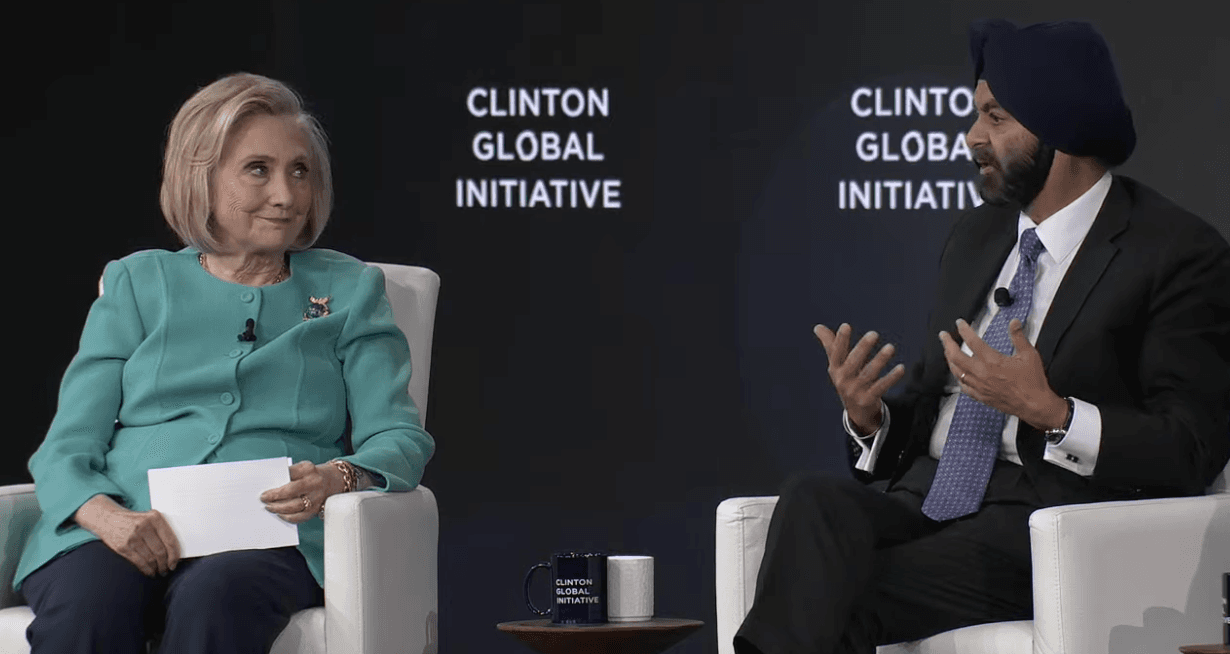
Where things stand: Hillary Rodham Clinton moderated a conversation with Banga and Chobani Founder and CEO Hamdi Ulukaya that moved between World Bank balance sheets and the story of painting a factory wall in upstate New York.
Banga reported a dramatic shift in how the World Bank deploys capital. "$112 billion of private capital is what we mobilized for co-investing with us in the developing world," said President Banga. "Three years ago when I joined, it was $30 billion of private capital, so we've trebled." The Bank's own balance sheet grew only $10 billion over the same period — meaning the institution is now leveraging outside money at roughly 10-to-1.
He outlined three categories of private capital the Bank must reach differently: corporate operators who invest alongside operations, institutional investors (pension funds, sovereign wealth) who need "asset-class wrappers" to deploy money in developing markets, and entrepreneurs who need venture-style structures. In Egypt, he described a model in which the World Bank and the Egyptian government each contributed $50 million, then handed the combined fund to a young Egyptian venture capitalist returning from London. Critically, 25% to 50% of each investment was structured as pure grant equity — money entrepreneurs never have to repay.
"Poverty is both a state of mind and a state of being," Banga said, quoting entrepreneur John Hope Bryant. A job, he argued, provides dignity beyond material survival.
Ulukaya brought the domestic counterpart. He told the Chobani origin story — buying an abandoned factory in South Edmeston, N.Y., with an SBA loan and four employees. "We're going to go to the hardware store. We're going to buy some paints and we're going to paint the wall outside," he recalled telling his first hires.
Now Chobani is building new factories in Rome, N.Y., and Allentown, Pa., representing billions in private investment. In Pennsylvania, Ulukaya highlighted a partnership with Gov. Josh Shapiro to support the state's declining small dairy farms: "There will be a massive amount of milk purchase, it will be supported over $100 million from the state of Pennsylvania to the farmers." Regulatory changes for milk transport were also part of the deal.
Ulukaya dismissed any suggestion that community investment comes at the expense of returns. "We are number one dollar and volume growth contributor to the whole country when it comes to food last year," he said. "So doing things is good for the business."
But he stressed that capital alone is insufficient. After a mass shooting in Twin Falls, Idaho — home to one of Chobani's plants and a large refugee population — he flew to the community to be present. "This small gesture was more powerful than everything else we've done before," he said.
Clinton pushed both speakers on measurement. "We are losing a whole generation of young people across the world who do not believe that the economy works for them," she said, pressing for new metrics beyond GDP.
What's next: Banga's Egypt venture model is being replicated across emerging markets. The World Bank's challenge is converting one-off pilot structures into repeatable asset classes that institutional investors can deploy at scale.
$550M and Counting: Lead Poisoning Coalition Adapts After USAID's Destruction
Why it matters: Lead poisoning affects more than 1 billion children worldwide, causes an estimated 3.5 million deaths annually, and drains roughly 7% of global GDP — yet before 2024, total investment in developing countries was just $15 million.
Where things stand: Former USAID Administrator Samantha Power returned to CGI two years after launching the Partnership for a Lead-Free Future to deliver a progress report shaped by a seismic disruption: the dismantling of USAID itself.
"The dismantling of USAID. The agency was taken down in a matter of weeks by people who could not name a single USAID program," Ambassador Power said, calling it one of the worst actions in American foreign policy history.
Despite losing its anchor U.S. government agency, the coalition adapted. Philanthropies, foreign governments, and multilateral organizations filled the vacuum. "The world has now committed more than $550 million to eradicate global lead poisoning," Power reported — a nearly 37-fold increase from the pre-2024 baseline.
The coalition now includes 40 governments and more than 50 organizations. Blood lead surveys are completed, underway, or planned in 25 countries, up from fewer than 10. Country-level results are concrete: Bangladesh adopted a cabinet-backed plan targeting 95% reduction by 2035; Ethiopia established a national roadmap for 60% reduction by 2030; Pakistan halved lead in paint in three years; Malawi reduced lead paint brands from 89% to 4%.
Key funders include GiveWell, Coefficient Giving (more than $200 million), and Bloomberg Philanthropies, which launched a five-year initiative across nine countries. Power also announced a new effort by the Clinton Health Access Initiative and Renaissance Philanthropy, anchored by Arnold Ventures, to develop lower-cost blood lead tests — a critical barrier to reaching hundreds of millions more children.
What's next: The coalition's $1.6 billion goal by 2040 now depends almost entirely on non-U.S. government sources. The lower-cost blood lead test initiative could determine whether surveys scale beyond the current 25 countries.
Ukraine Action Network Expands as Direct Relief Pledges $10M More
Why it matters: With Russia intensifying attacks on civilian power and heating infrastructure, the CGI Ukraine Action Network — launched three years ago with First Lady Olena Zelenska — is scaling mental health, children's welfare, and maternal health programs at a moment of acute need.
Where things stand: Three organization leaders reported from the front lines of the humanitarian response.
Irina Galina, head of the Razom With You Mental Health Program at Razom, reported that the organization has reached more than 22,000 people through psychological consultations and provided mental health education and resilience training to more than 550,000 people.
Dr. Irwin Redlener, co-founder of the Ukraine Children's Action Project, described supporting more than 40 local partners helping children who have been injured, traumatized, or displaced. He called Russian attacks on civilian infrastructure "stone-cold crimes against humanity."
Amy Weaver, CEO of Direct Relief, announced the organization has distributed more than $2.5 billion in humanitarian aid since the full-scale invasion, including more than $75 million in financial support. "We have now distributed more than $2.5 billion in humanitarian aid since the full-scale invasion. This includes both donated medicines and more than $75 million and financial support for programs ranging from mental health to prosthetics," said CEO Weaver. She announced an additional $10 million commitment supporting the Olena Zelenska Foundation, UCAP, and Razom, along with a new commitment to maternal and newborn health.
Hillary Rodham Clinton noted that Dr. Redlener and Weaver first met at CGI — an illustration of the network's partnership-building function.
What's next: The $10 million commitment will fund mental health, prosthetics, maternal health, and children's programs as winter approaches.
Three Young Leaders, Three Continents, One Message: Invest in Us Now
Why it matters: A mayor who earns $400 a year, a teenager who cold-called 500 professors, and a refugee who lost both parents each demonstrated that youth leadership isn't aspirational rhetoric — it's already producing results that established institutions have failed to deliver.
Where things stand: President Bill Clinton moderated a panel with three young leaders whose stories moved between small-town Iowa, a UVA chemistry lab, and a Ugandan refugee camp.
Mayor Eva Phipps of Henderson, Iowa — population 144 — described deciding to run for office on the last possible filing day. "I took that paper, walked to 10 of my neighbors, knocked on their door, asked him to sign my paper," she said. She earns $400 per year. Her signature initiative: a seven-year fight to build an accessible playground for children with disabilities. "One of the biggest heartbreaks was when I had to watch one of our kids that was not able-bodied sit on the sidelines while his friends played soccer, and he came up to me crying because all he wanted to do was play," said Mayor Phipps.
Heman Bekele, a high school senior born in Ethiopia and founder of the nonprofit Care for All, described developing a bar of soap to treat early-stage skin cancer after witnessing the gap in healthcare access between Ethiopia and the United States. "For the past couple of years, I've been working on a bar of soap with the ability to treat early stages of skin cancer," he said. How he got started: at age 13, he found the UVA faculty directory online. "You give a 13-year-old a list of 500 phone numbers. I went pretty crazy that night, and I called every single person on that list," said Bekele.
Chantal Zuzi, founder of Refugee Can Be and originally from the Democratic Republic of Congo, recounted losing both parents, joining 70,000 refugees in Uganda, being resettled in the United States in 2018, and earning a full scholarship to Wellesley College. "What separated my life and theirs is sustained investment," she said of the refugee girls she left behind. Zuzi announced a $12 million fundraising campaign to establish a home for refugee girls and support them for six years. "We are raising $12 million, and this will go toward establishing a home for these girls to create self-sufficiency, and also will allow to support them for 6 years," she said.
All three delivered the same message to the room: listen to young people, give them a seat at the table, invest in their ideas, and stop calling them "the future" without building it alongside them.
Clinton's Closing: Press Freedom, Immigration, and the Power of Example
Why it matters: President Clinton's closing address was the meeting's most politically direct segment, connecting USAID's dismantling, press freedom, and immigration restriction into a single argument about declining American expectations.
Where things stand: Clinton praised Ambassador Power for raising $550 million after USAID's destruction, saying "she has got a 4-room apartment in heaven for what she has done in the face of the callous dismantling of AID."
He defended press freedom with characteristic bluntness. "There were lots of times when I wanted to ban the White House press corps. And there's a reason we have a Constitution. Because none of us are immune from being pissed off," said President Clinton.
On the economy, he challenged current job creation numbers — contrasting 60,000 new jobs with his own 1990s average of 223,000 per month — and connected immigration restriction to stagnation. "If you don't take any immigrants, no matter how talented they are, and the birth rate is below replacement, you get a stagnant population, so you're building on very low expectations," he said.
Clinton wove together the day's speakers — war photographer Giles Duley, journalist Jason Rezaian, astronaut Oratia Bowe, and 86-year-old Grameen Bank founder Muhammad Yunus — as evidence of the "power of example." He urged the audience to hold themselves to a higher standard: "We have got to prove that hope can be justified and is worth fighting for."
Opening Keynote: Giles Duley on Rebuilding After Losing Three Limbs
Giles Duley, CEO and founder of the Legacy of War Foundation, delivered the meeting's emotional anchor. A former rock-and-roll photographer who fell into depression and addiction before finding purpose as a war photographer, Duley triggered an IED in Afghanistan in 2011, losing both legs and his left arm. He spent 46 days in intensive care able only to blink.
"I woke up the next day and I said to myself, from this moment on, Giles, you will never think about what you can't do, but you'll focus on what you can and be the very best at that," he said. After 37 operations and 18 months of rehabilitation, he returned to conflict zones. His foundation now operates in Syria, Rwanda, Ukraine, the DRC, and South Sudan.
"Everything begins with a story. Keep clarity of purpose. Focus on what you can control. Don't be overwhelmed by that which you can't. And finally, do whatever you do with love and with kindness."
Minor Items
- CGI working sessions produced more than 90 action tables with 1,200 participants. Vice Chair Chelsea Clinton reported that 66 tables were led by women and about half of participants were new to CGI. Highlighted commitments included Men for Choice organizing on reproductive rights, Stacey Abrams discussing the Democracy Index Fund, Nokia leading a table on AI-powered early warning systems and disaster response drones for climate resilience, and the National Medical Association committing to a maternal health data-sharing initiative.
- Too Small to Fail and UnidosUS launched a listening campaign to reach more than 100 Latino and immigrant families amid heightened immigration enforcement fears. Farmworker families reported needing childcare access starting at 5 a.m. The initiative aims to redesign early childhood programs as participation declines.
- Bob Harrison received the Clinton Global Citizen Award for two decades of foundation and CGI leadership. President Clinton credited Harrison with building CGI into a year-round community. "I'm absolutely certain that if it hadn't been for Bob, we never would have been able to improve the lives of more than half a billion people in 180 countries," Clinton said. Harrison led the Alliance for a Healthier Generation (reaching 31 million children in 56,000+ schools), served as CGI CEO for nine years, and stepped in as interim Clinton Foundation CEO.
- Postcode Lottery was recognized during the proceedings for its support of CGI programming.