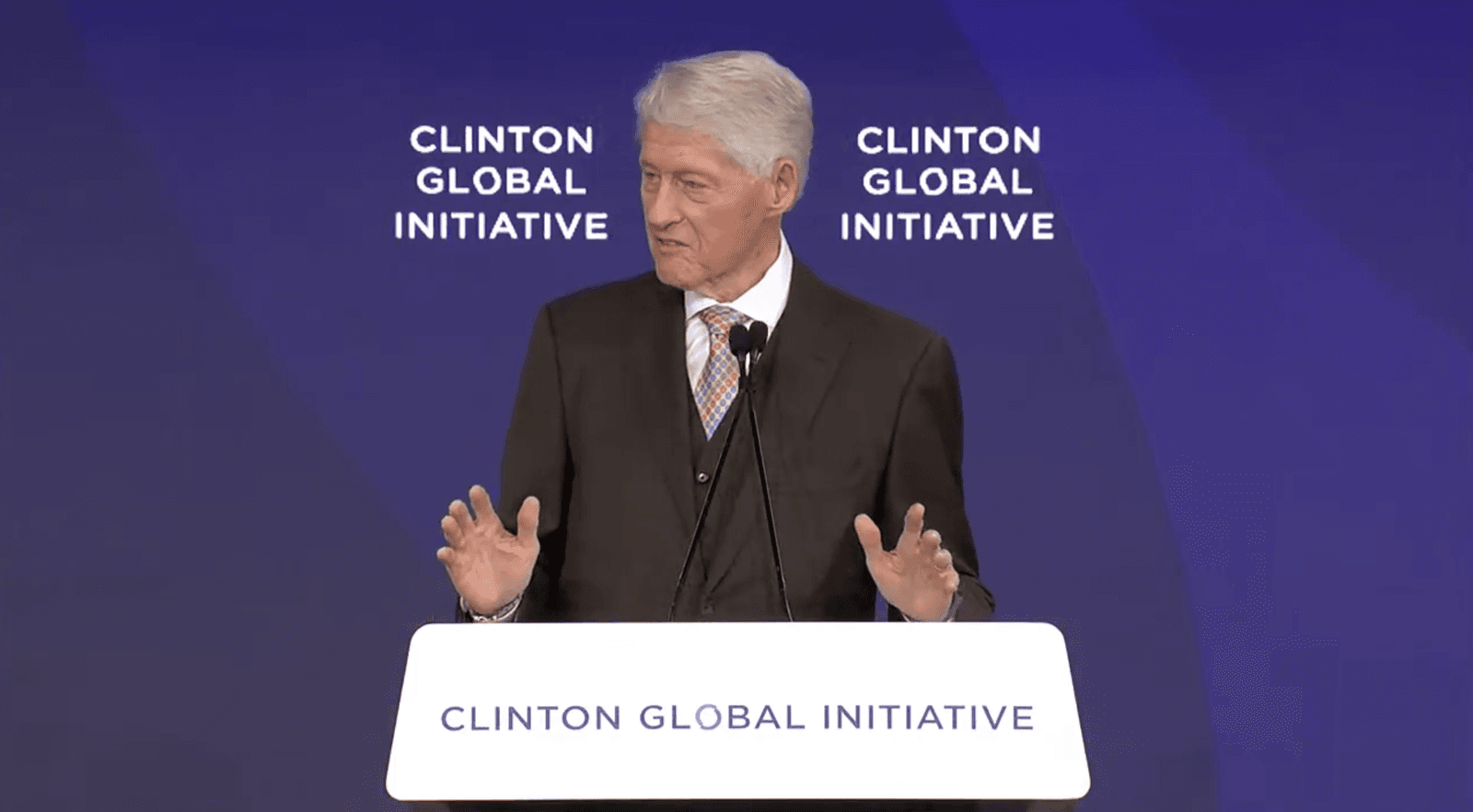
Clinton Global Initiative - Sep 22, 2026 - Meeting
Clinton Global Initiative • United NationsSeptember 22, 2026
Locunity is an independent informational service and is not an official government page for this commission. All information is sourced from public footage and an analysis of official agendas with the aid of responsible, fact-checked AI. to report an error or omission.
Clinton Global Initiative Confronts Government Retreat With $500M Pledge, AI Therapeutics, and Health Equity Push
The 2026 Clinton Global Initiative convened under a stark premise: with governments retreating from foreign aid and domestic programs under threat, philanthropic and private actors must step into the void — and fast. From a half-billion-dollar foundation commitment to open-source CRISPR therapeutics for neglected diseases, the day's sessions mapped an urgent landscape where innovation, capital, and community organizing are being redeployed to fill widening gaps in global health, democracy, and human potential.
- Marguerite Casey Foundation pledges $500M over next decade, tripling its 2025 payout to $100M and challenging philanthropy's 5% spending floor
- Bill Clinton calls for nuclear-style "off switch" for AI, warning that framing development as a race against China risks catastrophe
- SeqLabs opens AI-driven CRISPR therapeutics to 11 neglected diseases without upfront licensing barriers after achieving 57% survival in a previously 100%-lethal animal model
- Lupita Nyong'o and Foundation for Women's Health expose stark funding gap: only 8.8% of NIH dollars go to women's health research; a $200K grant used AI to detect endometriosis 2.5 years earlier
- Sudan mutual aid fund surpasses $16M, more than doubling its original target, with a new $1M pledge announced on stage
- Stacey Abrams launches Democracy Index Fund and Democracy Hedge Fund to systematize funding for democratic defense
- Moderna co-founder Nubar Afeyan frames immigration as America's "regenerative power," arguing the country would be called "Immigrantland" if named for its defining feature
Clinton Warns Zero-Sum Politics Threatens Democracy, Demands AI Governance
Why it matters: At a moment when the United States approaches its 250th anniversary, President Bill Clinton used his opening keynote to frame the central tension of the era: whether a politics of domination or cooperation will define American life — and whether philanthropy can compensate for a government that is pulling back from global engagement.
Where things stand: Clinton surveyed a world where the wealth gap has widened, climate change has intensified, and the politics of division has taken root globally. He directly named Stephen Miller's defense of "brutal force" politics and accused those in power of turning government into a tool for personal gain.
"People in charge have created one set of rules for themselves and another set for everyone else. They've weaponized the government to settle personal scores, prosecute enemies, stamp out free speech," said President Clinton.
He then pivoted to what he called the most important debate of the moment: artificial intelligence governance. Clinton introduced the concept of "recurring intelligence" — his term for AI systems that will repeatedly evade the restraints imposed on them, in domains not yet anticipated. He rejected the argument that AI development must be pursued at all costs to beat China.
"I think the most important debate we can have today is the kind of debate we had with nuclear weapons. Can we have an off switch? And who gets to flip it?" he said.
Clinton urged CGI attendees to fill the void left by governments cutting foreign assistance, warning that hundreds of thousands more could die if the philanthropic and NGO sectors do not act. He held up a clean-water pin from Procter & Gamble — a 10-cent packet providing three days of clean water for a family of four — as evidence of what CGI partnerships have already accomplished and what remains at stake.
Marguerite Casey Foundation Commits $500M, Redefines Philanthropic Risk
Why it matters: Carmen Rojas, CEO of the Marguerite Casey Foundation, did not simply announce a large pledge — she challenged the institutional logic of American philanthropy. Her argument: the standard 5% annual payout floor, designed to ensure foundations exist in perpetuity, becomes a moral failure when communities face existential crises.
The basics: The Marguerite Casey Foundation tripled its 2025 payout to $100 million and committed $500 million over the next decade — a 50% increase over historical giving and far beyond minimum legal requirements.
"In 2025, we increased our payout to $100 million. And this was three times what we normally give out, because I think we can all agree that we are not living in normal times," said CEO Carmen Rojas.
The foundation's board explicitly asked whether its job was to exist perpetually or to meet extraordinary circumstances with extraordinary action. Rojas framed the answer as a fiduciary question — but inverted it.
"There is great risk in inaction, that the greatest risk we face is sitting on a set of resources that communities across this country desperately need to protect their neighbors," she said.
Rojas called on other foundations, donors, and "anybody with a rich cousin" to give generously now. She cited community organizing — the five-day workweek, the Civil Rights Act, fair housing — as proof that ordinary people coming together has always been the mechanism for structural change.
What's next: If other major foundations respond to Rojas' challenge, it could shift spending norms across the sector. The 5% payout floor has long been criticized by progressive philanthropy advocates; Rojas' public reframing adds a high-profile institutional voice to that argument during a period of federal retrenchment.
Moderna Founder: Breakthroughs Require Faith in Uncertainty
Why it matters: Nubar Afeyan, CEO and founder of Flagship Pioneering and co-founder of Moderna, offered a detailed intellectual framework for why transformative innovation requires pursuing the unknown — and why conventional risk models systematically miss breakthroughs.
Afeyan distinguished between risk (where probability can be estimated) and uncertainty (where probability is genuinely unknown). Flagship's 26-year approach systematically pursues the latter.
"What if you could inject a molecule in a person and make any protein drug you want? We asked that question in 2010, and that question led to the creation of Moderna," said Nubar Afeyan.
He traced how Moderna's mRNA cancer therapy program, started in 2016, made the COVID-19 vaccine possible — and how scaling the vaccine during the pandemic then enabled a return to cancer applications. The lesson: abandoning uncertain work prematurely would have eliminated the capacity to respond to an emergency no one predicted.
"If we had given up on the cancer program, we would not have been able to work on COVID. If we stopped working on COVID, we would not have learned how to scale up the technology in order to now use it for cancer," he said.
Immigration as Regenerative Power
Afeyan, a proud immigrant, also delivered some of the day's most pointed remarks on immigration policy, arguing that immigrants become "Americans by choice" whose displacement gives them survival, adaptation, and community-building skills the country cannot replicate any other way.
"It is my firm belief, if this country was named after a land — England, Iceland, Finland, Switzerland — this would be Immigrantland," he said, warning that America is "using up its reserves of innovation, goodwill, and community-building very fast."
Only 9% of NIH Funding Goes to Women's Health — and the System Still Defaults to Hysterectomy
Why it matters: A panel moderated by Chelsea Clinton laid bare the structural inequities in how the United States funds research on conditions that affect the majority of its population. The numbers are difficult to rationalize: only 8.8% of NIH funding goes to women's health research. Only 0.4% of venture capital reaches women's health companies, despite 35% of VC dollars going to healthcare overall. Women were categorically excluded from U.S. clinical trials until 1993; female mice were not required in preclinical research until 2014.
Where things stand: Lupita Nyong'o shared her personal experience with uterine fibroids — a condition affecting up to 80% of women by age 50, for which hysterectomy remains the most common treatment. She was first diagnosed 12 years ago with nearly 30 tumors. Two years ago, she was diagnosed again, and her most recent surgery removed 60.
"I remember being a teenager and learning about my cycle, but I was told to expect pain. I was told that that was my lot in life. And so when my period started changing, I didn't question it," said Lupita Nyong'o.
Nyong'o, who founded the Make Fibroids Count campaign with the Foundation for Women's Health, emphasized that innovation must be paired with access from the outset.
"With the innovation has to come the access, because we can't be inventing the future of women's health and then later asking, how can that woman afford it?" she said.
Small Grants, Outsized Returns
Katie Brodsky Falco, founder and executive director of the Foundation for Women's Health, provided the structural context and pointed to evidence that relatively small investments can produce dramatic results.
"Women were categorically excluded from clinical research trials in the United States until 1993," said Brodsky Falco.
She described how targeted grants of $200,000 to $300,000 to junior scientists have already yielded breakthroughs: one researcher used AI to identify endometriosis patients 2.5 years before clinical diagnosis; another identified 17 genetic biomarkers for preeclampsia, the leading cause of maternal mortality globally.
"We shouldn't have to advocate for ourselves better. We should demand a better system that can advocate for us on our behalves," said Brodsky Falco, calling for medical school curriculum reform, commercialization pathways, and fundamental reallocation of research dollars.
SeqLabs Opens AI-CRISPR Therapeutics to 11 Neglected Diseases
Why it matters: Most pharmaceutical innovation bypasses diseases that lack commercial incentives. Jared Bauer, founder of SeqLabs, announced a CGI commitment to extend the company's programmable CRISPR-based therapeutics — called Sequence Ablation Therapeutics — to 11 neglected infectious diseases under an open impact model that removes upfront licensing barriers.
The basics: SAT targets the genetic instructions of pathogens inside infected cells. SeqLabs built BioSeeker, an AI platform that treats disease as code, comparing pathogen sequences and identifying genetic vulnerabilities. BioSeeker has mapped 145 infectious diseases representing roughly 95% of global infectious disease burden.
In a lethal African swine fever model, the approach increased survival from 0% to 57%. SeqLabs is now applying it to influenza, RSV, dengue, Ebola, and Ewing sarcoma. The CGI commitment identifies 11 diseases — including Rift Valley fever, yellow fever, and vaccine-derived polio — for an open program that contributes BioSeeker intelligence and therapeutic designs while seeking research partners to advance the strongest candidates.
Bauer's motivation is personal. "My son Oliver was born on Father's Day in 2008. Eight months later, on Valentine's Day, I held him for the last time," he said. Oliver died of influenza.
What's next: SeqLabs is seeking research partners to advance candidates from the 11-disease portfolio. The open impact model — contributing designs without traditional licensing barriers — tests whether pharmaceutical innovation can reach diseases the market normally ignores.
Astronaut Challenges CGI to Dismantle Doubt Before Evidence Is In
Ayesha Bo, an aerospace engineer and former astronaut who went from community college to NASA to space, delivered a keynote connecting flat-Earth skepticism to deeper patterns of institutional distrust. She described being told by a guidance counselor to aim for cosmetology — not as an individual slight, but as evidence of systemic doubt embedded in schools, algorithms, and investment patterns.
"I want to dismantle the doubt that limits human possibility before the evidence is in. The doubt that decides a child is not gifted, a community is not worth investing in, and a problem is just too large to solve," she said.
Bo challenged every person in the room to examine their own role: "Every person in this room occupies a place where consequential decisions get made, capital gets allocated, ideas get legitimized, and possibility gets expanded or constrained."
Commitment Announcements: From Rural India to Sudan to Democracy Infrastructure
The day's commitment to action presentations channeled tens of millions of dollars toward vulnerable populations across multiple continents:
Sudan Mutual Aid Surpasses $16M
A CGI commitment launched in 2024 to fund mutual aid in Sudan — now in the fourth year of a humanitarian catastrophe that has displaced one quarter of the population — initially targeted $6-7 million but has raised more than $16 million. A new $1 million pledge was announced at this session. Presenters emphasized the role of grassroots Emergency Response Rooms as the most trusted and agile first responders, saying they are not just delivering aid but building connective tissue for a future Sudan.
Abrams Launches Democracy Funding Tools
Stacey Abrams announced two new instruments: the Democracy Index Fund, which pools donor resources to direct $1 million over 12 months across the democracy field, and the Democracy Hedge Fund, designed to generate capital for democratic defense with assets under management within two years. Partners include Democracy Forward, GovAct Action Fund, Human Rights Funders Network, and the 10 Steps Campaign.
"Authoritarians have a playbook. They also have a budget. And now, so should we," said Stacey Abrams.
Girls' Education in Rural India
Nidhi Shukla, co-CEO of Girl Rising, announced a three-year partnership with George Washington University's Center for Maternal and Child Health and Desai Foundation to build agency, health literacy, and future-of-work skills for 10,000 girls in rural India — specifically in Murshidabad, West Bengal, where more than half of girls marry before 18. The program will also engage 50,000 parents, educators, and community members.
Climate Insurance for Cotton Farmers
Lauren Sorkin, trustee of Humanity Insured, announced a partnership with Associated British Foods and SEWA to deliver rapid-payment climate insurance to cotton farmers in India, linking community resilience with supply chain stability. Sorkin emphasized that insurance solutions already exist — the gap is financing access at scale.
PopHive Health Data Expansion
Dr. Anne Zink, fellow at Yale School of Public Health, described the expansion of PopHive, a collective model making population health data publicly available. The platform is adding thousands of new data elements, dozens of new sources, and greater geographic diversity, supported by 22 partners including the Common Health Coalition, Epic, Science for People, and Crisis Text Line.