
Sustainable Finance Leaders Push From Targets to Action at Climate Week NYC
Climate Week NYC • United NationsSeptember 24, 2026
Locunity is an independent informational service and is not an official government page for this commission. All information is sourced from public footage and an analysis of official agendas with the aid of responsible, fact-checked AI. to report an error or omission.
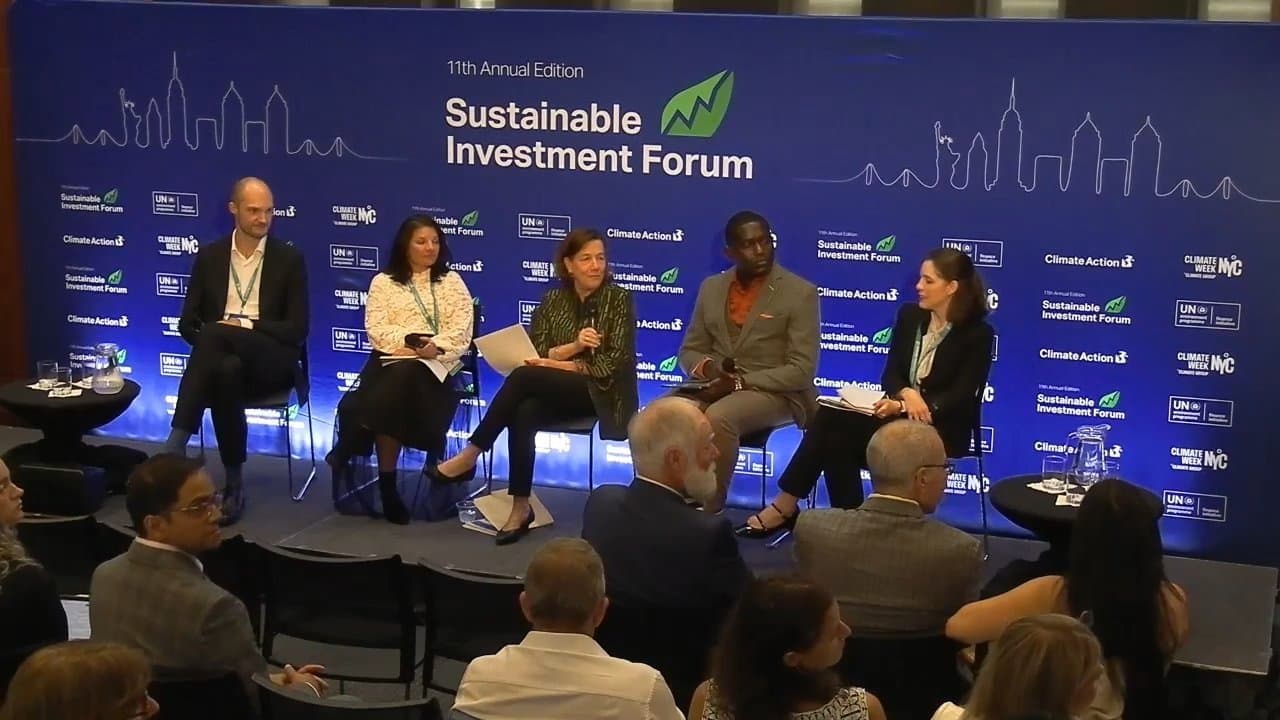
The 11th Annual Sustainable Investment Forum convened at Fordham University during Climate Week NYC on Sept. 24, 2026, with a clear message from the world's largest asset owners and development banks: the era of setting climate targets is over, and the era of deploying capital at scale has begun. UNEP FI Head Eric Usher set the tone, framing the current moment not as a retreat from sustainability but as a "repricing of reality" — one in which extreme heat, grid bottlenecks and nature loss are landing directly on institutional balance sheets.
- Ontario Teachers' doubles climate allocation to $70B after hitting 2025 decarbonization targets a year early; CalSTRS builds $10B climate solutions portfolio
- UK unveils Transition Finance Guidelines and 17 sector plans covering 83% of national emissions, with NatWest, HSBC and Santander testing the framework
- 2,500 GW of clean energy projects stuck in grid queues as $160B in data center investments delayed or cancelled over ESG concerns
- TNFD doubles adopters to 1,000 across 50 countries, representing $26 trillion in assets; IFRS ISSB to publish nature disclosure draft at COP17
- Natural asset companies win listing approval on UK and Euronext exchanges, potentially creating a new investable asset class backed by ecological performance
- Norges Bank slashes reliance on third-party ESG data, using AI to independently assess 7,200 companies and overhaul proxy voting
Climate Overshoot Is Here — and the Business Case Holds
Why it matters: The forum's opening argument — that sustainability integration is risk management, not ideology — was backed by fresh data on climate costs and energy transition wins.
Where things stand: Eric Usher, Head of UNEP FI, warned that this summer's extreme heat in Europe could lop 1% off EU GDP, or roughly €180 billion. He pointed to a "Godzilla El Niño" warming in the Pacific and catastrophic glacier collapse in Nepal costing 10% of that country's GDP. But his sharpest point was about momentum: Pakistan has replaced 20% of its gas power with solar in just three years.
"Imported gas accounting for 30% of their power sector down to 10%. And at the same time, solar has gone from almost nothing up to 25%," said Eric Usher, Head of UNEP FI.
He cited evidence that ESG-integrated portfolios continue to deliver lower cost of capital and better profitability, and referenced a UK Climate Change Committee finding that one more fossil fuel shock would cost more than the entire journey to net zero by 2050.
"Thank you for sticking to your convictions and seeing that the sustainability transition and carbon decoupling are the growth multipliers for decades to come," Usher told the audience.
Chair Mark Barton framed the day's central question bluntly: "The question for this room is not whether sustainable investing still matters, it's how institutional capital moves further and moves faster."
Pension Giants Pivot From Portfolio Targets to Real-World Impact
Why it matters: The world's largest pension funds are shifting from measuring portfolio emissions to funding actual climate solutions — a signal that institutional climate investing is maturing beyond headline targets.
Where things stand: Ontario Teachers' Pension Plan hit its 2025 decarbonization targets a year early, achieving 50% portfolio decarbonization, and has now doubled its climate allocation to a $70B target focused on climate solutions and private market decarbonization.
CalSTRS is building a $10B climate solutions portfolio spanning private equity, credit, infrastructure and real estate, partnering with Rhodium for real-world impact assessment. Brian Rice of CalSTRS described their net-zero pledge as built on three pillars — emissions, influence and investing — and emphasized that emissions are now treated as a metric, not a goal in themselves.
Anupam Bhargava of Kirkby Climate, a family office backed by LEGO, described a pivot to systems-level investing across energy transition, circular plastics and land sustainability, stressing the need for additionality and working across full value chains rather than isolated projects.
The other side: Ontario Teachers' challenged the proliferation of collaborative climate initiatives, calling for more focused, practical coordination rather than multiplying pledges and coalitions.
UK Launches the Most Ambitious Transition Finance Framework Yet
The basics: Transition finance directs capital to high-emitting sectors that need to decarbonize — steel, cement, aviation, shipping — as opposed to "green finance," which flows to already-clean projects like wind and solar.
Why it matters: Currently 90% of the $1.65 trillion invested annually in clean energy goes to green finance, leaving the hardest-to-abate sectors starved of capital. Only 10% of the UK's 4,000 net-zero project pipeline has been judged investable.
Where things stand: Chris Skidmore, Co-Chair of the UK Transition Finance Council and former UK Energy Minister, unveiled final Transition Finance Guidelines containing four principles — credible ambition, transparent accountability, action into progress, and addressing dependencies — with 15 core and 8 additional assessment criteria.
Banks including NatWest, Standard Chartered, Santander, Lloyds and HSBC, along with asset managers Ninety One and Carlyle Group, are already testing the guidelines. Skidmore announced the development of 17 sector transition plans from 2026 to 2029, covering 83% of UK emissions, with the Centre for Economic Transition Expertise (CETEX) at the London School of Economics appointed as knowledge partner.
"The energy transition can't continue to be about perpetuating a renewable energy versus fossil fuel tired narrative, but rather it needs to be about that trade-off between the economic forces of the future versus the economic risks of the past," said Chris Skidmore, Co-Chair, UK Transition Finance Council.
What's next: The IEA estimates $4-5 trillion in transition finance is needed globally. Skidmore's framework is designed to be the template — finance plans co-created with industry from the outset, not imposed after the fact.
Grid Bottleneck Threatens the Energy Transition
Why it matters: Even as clean energy investment soars, 2,500 GW of projects are stuck in grid interconnection queues worldwide — a physical bottleneck that is reshaping where and how institutional investors deploy capital.
Where things stand: Ida Mosgaard-Schildrup of Pension Danmark described investing in microgrids to bypass the bottleneck entirely, and noted that most of the fund's new green capacity is now financed in emerging markets — particularly India and South Africa — because European regulatory complexity has slowed investment.
Rhian-Marie Thomas of the Green Finance Institute framed clean electrification as the decade's biggest opportunity: 60% of abatable emissions could be addressed through electrification, but only 21% of global energy is currently electrified. She announced that JPMorgan is financing GFI's research on European grid investment needs.
Data Centers Under Scrutiny: The panel debated whether data centers can credibly be called sustainable. Ida Mosgaard-Schildrup highlighted $160B in data center projects delayed or cancelled in Q1 2026 due to ESG risks. Bertrand of La Casa warned against labeling all data centers as sustainable and emphasized the need for government policy stability and long-term cost calculations.
Rhian-Marie Thomas called for "coordination" over "collaboration" and emphasized the need for clear industrial strategy aligned with finance.
Nature Goes Mainstream: TNFD Hits 1,000 Adopters
Why it matters: Nature-related disclosure is approaching a tipping point. IFRS ISSB plans to publish a nature disclosure draft incorporating TNFD at COP17, which would embed nature into the global baseline of financial reporting standards.
Where things stand: David Craig of TNFD reported 1,000-plus adopters from 50 countries — doubled in a year — representing $26 trillion in assets. Fifty percent of the Nikkei now uses TNFD, as does 40% of the FTSE 100. The United States is the third-largest country of reporting, with 50-plus S&P 500 companies participating. Over 80% of asset owners and managers said nature is fundamental and they need consistent metrics.
Craig emphasized the LEAP methodology (Locate, Evaluate, Assess, Prepare) and the reduction from 3,500 potential nature metrics to just nine key indicators aligned with the five drivers of biodiversity harm.
Daniel Klier of PUR described three major shifts in corporate supply chains: from CSR to resilience-driven interventions, from generic global programs to supply-chain-specific ones, and from one-to-one programs to landscape-level transformations.
What's next: The IFRS ISSB nature disclosure draft at COP17 could redirect capital flows toward nature-positive investments on a global scale.
Natural Asset Companies Win Exchange Listings
Why it matters: If nature itself can be represented as tradeable equity, it creates an entirely new investable asset class — one that rewards ecological preservation rather than extraction.
Where things stand: Douglas of Intrinsic Exchange Group (IEG) explained the model: an operating company chartered to license the ecological attributes of a given area and convert that value through equity into financial capital. He noted that nature produces approximately $100 trillion in goods and services globally that are externalized from the economy, and that about 75% of natural capital has been lost since 1970.
IEG has received approval to list natural asset companies on UK and Euronext exchanges. Fordham University's Responsible Business Center is developing assurance standards for natural asset reporting, modeled after SASB, with governance and reporting boards established.
Emerging Markets: Capital Isn't Reaching Where It's Needed
Why it matters: Despite $500 trillion in global financial assets, developing economies remain dramatically underinvested — particularly in climate infrastructure where the need and the returns are both high.
Where things stand: Misha Lentz of the Asian Development Bank described Asia-Pacific as the global hub for renewable energy, with 60% of new capacity additions, but noted 150 million people remain without electricity and 80% of the region's electricity mix is still fossil fuel. He highlighted the ASEAN Power Grid — a $100 billion investment connecting 700 million people — as a signature project.
Cecile Goubet of the Institut de la Finance Durable identified three barriers: prudential frameworks, data accessibility and fragmented catalytic capital information. She announced a catalytic capital repository being developed with BCG, GFENS and the Capacity Building Coalition for launch at COP31.
Matthew Arnold of the Nature Conservancy described a stark imbalance: $7 trillion annually in nature-negative investments versus $220 billion nature-positive. He advocated for blended capital structures in which philanthropists provide sub-market-rate loans rather than one-off grants.
Physical Climate Risk: From 'Poor Cousin' to Core Strategy
Why it matters: Only 15% of executives can assess their financial exposure to physical climate risk, even though 68% say they prioritize adaptation — a critical execution gap.
Where things stand: The first panel explored how asset owners, insurers and development banks are translating physical risk data into investment decisions. Édouard Le Bonté of Capgemini described three data layers — hazard intelligence (strong), vulnerability data (gaps) and financial translation (major gaps).
Peter Cashin of CalPERS discussed their climate value-at-risk analysis and a new macroeconomic risk concept from MSCI, noting that macro impacts from events like European summer heat often exceed direct physical damage to assets. He revealed that only 5% of CalPERS' $60 billion-plus climate deployment is in resilience.
Jamie Ferguson of the World Bank framed adaptation as systemic and location-specific: 4.5 billion people are exposed to climate events, 1.5 billion are also economically vulnerable, and targeted adaptation could protect 150 million jobs.
Norges Bank Brings ESG Analysis In-House With AI
Why it matters: When the world's largest sovereign wealth fund ditches third-party ESG data providers in favor of proprietary AI-driven analysis, it signals a fundamental shift in how sustainability data is generated and consumed — with potential transparency risks.
Where things stand: Ashley of NBIM (Norges Bank Investment Management) described a transformative year in which AI was integrated across the fund's $2.2 trillion portfolio. The 700-person team now produces proprietary sustainability assessments for all 7,200 companies rather than relying on external data providers, and has overhauled proxy voting with AI assistance. He identified water as the single most important emerging investment issue.
Nikki of the World Benchmarking Alliance reported that 69% of 2,000 assessed companies claim climate transition plans, but credibility remains low. Only 2% of companies in nature-dependent sectors have nature plans, and only 5% of climate plans address impacts on workers and communities.
Chris Skidmore warned about the threat of misinformation eroding public support for climate action: "If you lose power, you lose the ability, as the Biden administration found, to actually change anything. So making sure you retain power is absolutely vital."
Pension Funds Overhaul Manager Selection Around ESG
Where things stand: Major pension funds are demanding firm-level sustainability alignment from asset managers, not just product-level commitments. Colin of PGGM described their shift from 3,500 stocks to 800 in what they call "conscious investing," emphasizing stewardship consistency and philosophical alignment across a manager's full business.
Andrew Siwo of the New York State Common Retirement Fund outlined a $40 billion sustainable investment commitment across seven asset classes, using a "7 Ps" assessment framework. The fund has achieved 12% annual returns versus a 5.9% assumed rate — powerful evidence that climate-integrated portfolios can significantly outperform assumptions.
Lena Drager of LA Capital highlighted factor-based evidence that climate signals are now priced in markets. The panel discussed the shift from backward-looking carbon intensity measures to forward-looking metrics like Paris alignment and Science Based Targets initiative targets.
Minor Items
- Carbon pricing gap: Peter Easton, Director of CARE and Editor-in-Chief of Accountability in a Sustainable World Quarterly, promoted an upcoming virtual conference featuring a speaker who will justify $1,800/tonne carbon pricing, calling the current market price of approximately $30/tonne "absolutely absurd."
- Vakıf Bank mobilizes MDB capital for Turkey: CEO Osman Arslan outlined a €1.5 billion IBRD-guaranteed facility for SMEs, a $3 billion AIIB climate and earthquake reconstruction facility, a $500 million ADB package expected at COP31, and European development agency programs totaling over €750 million. "Our ambition is not merely to finance the transition, but to make it investable, scalable, and measurable," Arslan said. Turkey hosts COP31 in November.
- Audience Q&A highlights: Diedrich of Natural Systems Capital asked about the need for more intermediaries in emerging markets. Mark Chasson of ARRIVAL raised ecosystem credits beyond carbon. Enes Sremawi of Catalyst MENA announced a new climate fund and challenged panelists on unlocking real investment in the Global South beyond mega-funds.
- GHG Protocol delays: Matthew of United Church Funds highlighted that ongoing standardization delays in the GHG Protocol are frustrating corporate engagement on emissions accounting.
- Daisy Stratfield of Ninety One pushed panelists on shifting more investment toward emerging markets, citing greater opportunity for returns, energy transition progress and positive impact.