
Insurance Crisis, Permitting Breakthrough, and Financial Contagion Dominate Climate Week NYC
Climate Week NYC • United NationsSeptember 26, 2026
Locunity is an independent informational service and is not an official government page for this commission. All information is sourced from public footage and an analysis of official agendas with the aid of responsible, fact-checked AI. to report an error or omission.
At Climate Week NYC, a roster of federal lawmakers, state officials, security experts, and housing scholars painted a picture of a country where climate risk has stopped being a future problem and started being an economic emergency — from collapsing insurance markets in Florida to $60 billion wildfire seasons in California. But the panels also surfaced pragmatic pathways forward: a bipartisan permitting deal that could unlock historic clean energy deployment, local governments quietly saving taxpayer money through resilience investments, and a housing strategy that doubles as a gigaton-scale climate solution.
- Bipartisan permitting reform bill "extremely close" to finalization, potentially unblocking 2.4 terawatts of clean power waiting to connect to the grid
- Climate-driven insurance failures cascading into mortgage defaults and municipal bond stress, with parallels to the 2008 financial crisis
- 92% of Texas voters concerned about homeowners insurance costs, with nearly half of Trump voters in Florida connecting their crisis to climate change
- California's single wildfire season cost $60 billion — six times the state's entire climate bond
- Housing experts argue strategically building 14 million needed homes could avoid 70 million metric tons of emissions annually, equivalent to shutting 18 coal plants
- National Guard disaster duty tripled since 2015, with 445,000 paid duty days in 2024 alone
- Local governments from Alabama to Utah advancing resilience without federal support or climate labels, saving $1,200 per vehicle through fleet electrification
Permitting Deal Could Unlock the Largest Clean Energy Deployment in US History
Why it matters: Some 2.4 terawatts of clean power are waiting to connect to the grid — enough to reshape America's energy landscape — but permitting bottlenecks are the primary barrier.
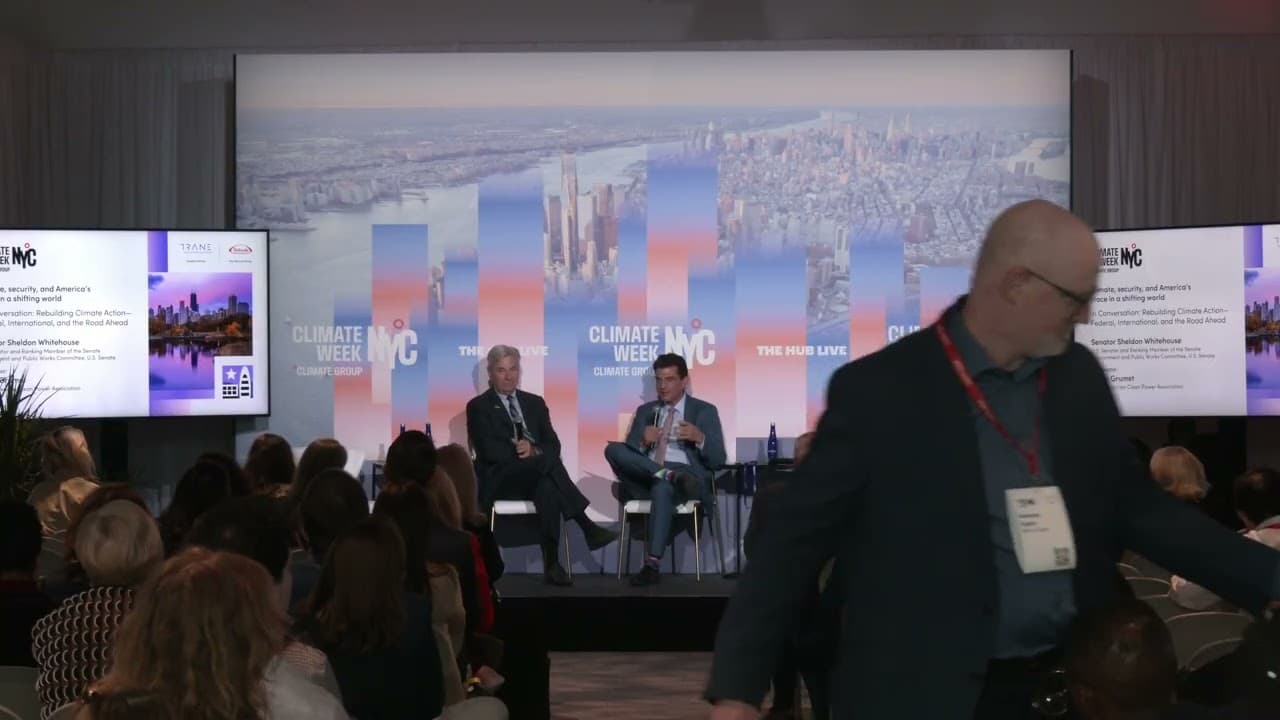
Where things stand: Senator Sheldon Whitehouse, Ranking Member of the Environment and Public Works Committee, told the opening fireside chat that a bipartisan permitting reform bill is on the verge of completion. "We are extremely close. I wouldn't rule out that today is the day when we put the pens down," he said.
Four elements need to converge: agreement on committee text, scheduling votes in both chambers with White House sign-off, ending administration interference with clean energy projects, and allowing time for the traditional manager's amendment process. Sen. Whitehouse described successfully pushing back against federal interference with five offshore wind farms, with backing from Republican leaders including Chairman Capito, Senator Barrasso, and Majority Leader Thune.
The marketplace is already leaning overwhelmingly toward clean energy. Jason Grammett, CEO of the American Clean Power Association, noted that "90% of all of the new electrons that got on the grid last year were coming from clean sources." Sen. Whitehouse argued that permitting reform disproportionately benefits clean energy — perhaps by ratios of 20-to-1 or even 100-to-1 — because fossil fuel leases "go begging with no one bidding."
What's next: If the bill advances, it could trigger the largest clean energy deployment in US history. The political dynamics are unusual: both parties have reasons to claim credit, and the economic case is overwhelming. But scheduling votes in both chambers amid election-year politics remains the final hurdle.
Climate Risk Is Already Breaking the Financial System
Why it matters: Climate-driven losses are no longer hypothetical. They are spreading from insurance to real estate to municipal bonds — a cascade that touches nearly every American household and institutional investor.
The basics: Global catastrophe losses hit $200 billion in 2025, with less than half insured. At the household level, rising insurance costs are forcing impossible choices. At the government level, growing "protection gaps" mean recovery costs fall to taxpayers, even as borrowing for resilience gets more expensive.
Where things stand: Dr. Mercy Berman-Dimeno, Distinguished Scholar at NYU and Executive in Residence at Duke University, laid out the financial contagion in stark terms. "Homeowners are making really hard choices between being able to pay for their insurance and being able to pay for their mortgages," she said. The cascade doesn't stop there: "We've seen risk spread from insurance to real estate to municipal bonds, which means it's spreading from insurers to banks to investors. Nearly every institutional investor in the US has some exposure to one of these markets."
Dr. Berman-Dimeno highlighted state-level innovation as a bright spot. Insurance commissioners in New York, Alabama, North Carolina, California, and Colorado are pioneering approaches including climate-integrated risk management, insurer resilience investments, and first-in-the-nation pricing of mitigations.
Phil Duffy, Chief Scientist at Spark Climate Solutions, delivered a sobering scientific update: Earth's energy imbalance has more than doubled in the last 25 years, meaning global warming is accelerating beyond model predictions. "The world I live in is where these risks, which have literally trillion-dollar potential consequences for humanity, these risks are treated like they're mildly interesting academic research projects," he said. He called for massive scaling of carbon dioxide removal and investigation of temporary climate stabilization tools.
The other side: The question is whether existing financial models and regulatory frameworks can adapt fast enough. DJ Gerken, President and Executive Director of the Southern Environmental Law Center, argued they cannot — noting that 100-year and 500-year storm designations are "statistically out of date and wildly optimistic." Drawing on personal experience, he told the audience: "Friends, I grew up in Asheville, North Carolina, and I can tell you that 1,000-year storms are now part of our life here."
Gerken expressed cautious optimism that lived climate experience is breaking through politicization, noting that Alabama has a resilience office and communities in Georgia and South Carolina are stepping in to protect their wetlands.
What's next: State insurance commissioners are becoming the de facto climate regulators. Whether their innovations can scale fast enough to prevent systemic financial contagion — before it reaches 2008-crisis proportions — is the central question for markets, governments, and homeowners alike.
Insurance Crisis Rewrites Climate Politics in Red States
Why it matters: When nearly half of Trump voters in a battleground state connect their personal financial pain to climate change, the political ground has fundamentally shifted.
Where things stand: Sen. Whitehouse presented polling data showing that climate has crossed from the "science department" to the "economics department" of American life. In Texas, 92% of voters are concerned about homeowners insurance costs — a figure that exceeds the state's homeownership rate, indicating the issue has saturated everyday conversation. In Florida, the insurance market is in what he described as "more or less full collapse."
The most striking finding: "Trump voters ascribe the home insurance crisis that they're experiencing there to climate change, the dreaded double C, causing worse storms and hurricanes," Sen. Whitehouse said — and that connection emerged without Democratic messaging pushing it.
He argued this creates a powerful opening for climate advocates to press the debate "with real oomph." The political implication is significant: climate is no longer a wedge issue that splits neatly along party lines when it hits people's wallets.
Whitehouse Warns Data Centers: Self-Regulate or Congress Will
Why it matters: Data centers' explosive energy demand is reshaping utility costs and depleting water supplies for communities across the country — and congressional intervention appears imminent if industry behavior doesn't change.
Sen. Whitehouse delivered a sharp critique, comparing the industry's approach to a "Wile E. Coyote moment." He outlined four specific harms: consuming community water without consultation, driving up electricity costs by pushing demand onto expensive grid units, shifting grid infrastructure costs to ratepayers, and demanding nondisclosure agreements from local governments.
"They came in not like good citizens, but like looters. And they decided that the way to proceed was to use up as much of the community's water as you wanted without dealing with that as a community issue, run up people's fuel costs by putting the demand on the grid," he said.
He offered a path forward: data centers could voluntarily offset generation cost impacts, pay for grid enhancements, respect water tables, and maintain transparency. But he warned that if self-regulation fails, bipartisan congressional action to mandate those requirements is likely.
Military Stretched Thin: 445,000 Guard Duty Days on Disasters
Erin Sikorsky, Director of the Center for Climate and Security, reported that national security planning remains built on the assumption of a stable climate that no longer exists. "In 2024, the National Guard spent 445,000 paid duty days responding to natural disasters, to extreme weather events. That's triple the amount from 2015," she said. Globally, militaries responded over 100 times to wildfires in the current year alone.
The compound risk picture is especially alarming. Sikorsky described how the Iran conflict and Strait of Hormuz closure have locked down fertilizer supply chains, layered on top of existing climate impacts on agriculture and an approaching super El Niño: "The compound risk question is one we're seeing right now in the wake of the Iran conflict and the closure of the Strait of Hormuz, which has locked down fertilizer. You've already got climate impacts on agriculture globally. You now have a super El Niño coming on top of that."
She cited California's year-round National Guard wildfire task forces as a promising model and highlighted bipartisan provisions in the National Defense Authorization Act, but argued the US needs post-9/11-scale institutional reform to treat climate as the security threat it has become.
California's $60 Billion Wake-Up Call
State Senator Henry Stern described California as confronting "multiple crises all at the same time" — wildfire, super El Niño, and supply chain disruptions — with resources that are vastly outmatched by the scale of damage.
"The Palisades Fire alone is a $40 billion catastrophe. It's $21 billion for just the Eaton Fire. That's a $60 billion hit just from one season of wildfires," he said. Against that, the state's $10 billion climate bond — its largest ever — has spent only about $2 billion. Sen. Stern proposed using the remaining $8 billion as leverage to marshal $50–60 billion from private markets.
He also highlighted Senate Bill 261, his climate risk disclosure law that recently survived a court challenge, requiring companies doing over $500 million in revenue in California to disclose material climate risks. Cap-and-trade revenue, while useful for clean vehicles and research, "can't deal with the insurance crisis," he said.
Building 14 Million Homes Right Could Equal Shutting 18 Coal Plants
The basics: The US needs roughly 14 million new homes. Where, what, and how those homes are built will lock in emissions trajectories for decades.
Why it matters: Amy Whitman, Chief Impact Officer at the Urban Land Institute, broke down the climate math: "70 million metric tons of emissions avoided every year for the next decade if we build these homes in places that are good for climate. That's 18 coal plants if you put it in the power sector," she said, citing RMI research.
Heather Clark, CEO of the Housing Multiplier Project and Senior Fellow at MIT, framed the housing shortage as both a democracy threat and a climate opportunity, arguing that strategically solving it yields "gigaton-scale emissions benefits" across buildings, transportation, and energy.
Where things stand: Whitman identified three dimensions: where (near jobs, transit, and grid capacity — not in floodplains or wildfire zones), what (multifamily and compact connected development), and how (electrified homes with heat pumps, induction stoves, rooftop solar, and battery storage functioning as grid assets). Lawrence Berkeley National Lab research showed grid-interactive building investments could save $100 billion per year on grid transition costs. Developers are increasingly looking at "power as the new location" due to grid capacity constraints.
Laurel Blatchford, Director of Delivery Associates, highlighted the bipartisan Road to Housing Act as a breakthrough: "You also have a once-in-a-generation housing bill that passed earlier this summer called the Road to Housing, which I think a lot of us in the housing community feel like, okay, finally." The law codified HUD pilot programs, reformed modular and manufactured housing regulations, and authorized CDBG-DR for three years. But Blatchford warned from experience leading the Hurricane Sandy Task Force and IRA implementation that the gap between policy design and implementation is where housing progress typically fails.
What's next: With the Road to Housing Act now law, the test shifts to implementation — getting agencies to work across silos, coordinate financing, and adopt climate-smart building standards at scale.
Local Governments Quietly Lead on Resilience
Red and blue communities alike are advancing climate action without federal support — and often without using the word "climate."
Commissioner Bridget Shea of Travis County detailed practical wins: Austin is piping treated wastewater to county buildings, saving 45 million gallons of drinking water annually. The county adopted NOAA's Atlas 14 rainfall data in 2019 to update floodplain designations. And Austin's municipally owned utility calculated that "for every electric vehicle, they're saving $1,200 a year just on maintenance and fuel."
On emergency preparedness, she revealed the region's notification system had been landline-based until recently: "We increased the reach from 7% — I'm amazed we were reaching 7% with landlines — to over 80%" after transitioning to mobile phones. The county also piloted a first-of-its-kind neighborhood wildfire evacuation drill, modeled partly on Japanese tsunami exercises, that doubled as a community-building exercise.
Saharnaz Mirzadrad, CEO of ICLEI USA, described the organization's work with 1,200 local governments and a new Municipal Investment Fund that awarded $250,000 to 47 communities across all 50 states. In Utah, a coalition around Salt Lake City negotiated new renewable energy tariffs with state legislators. In Douglas County, communities bundled projects too small to finance individually: "The county took on them and found a dormant fund that was not used to link it and reduce the rates on the projects, the borrowing rates on the project," she said.
- CBAM as "last lifeboat": Sen. Whitehouse argued the EU's Carbon Border Adjustment Mechanism is essential to every remaining viable climate pathway — only 11 of 1,200 scenarios modeled still lead to climate safety, and all require carbon pricing. He floated the idea of the EU granting a waiver to California, whose state-level policies might qualify it independently.
- Cheapest electricity now renewable: DJ Gerken noted that "the cheapest way to produce a watt of electricity in America is with renewable and storage" — but the electricity delivery model was designed for a different era.
- Philippines accelerated solar deployment one week after the Iran war began, after a mayor's delegation flagged the urgency — an example of how geopolitical shocks can catalyze clean energy action.