Climate Leaders Urge Shift From Cost Narrative to Growth Opportunity
Climate Week NYC • United NationsSeptember 23, 2026
Locunity is an independent informational service and is not an official government page for this commission. All information is sourced from public footage and an analysis of official agendas with the aid of responsible, fact-checked AI. to report an error or omission.
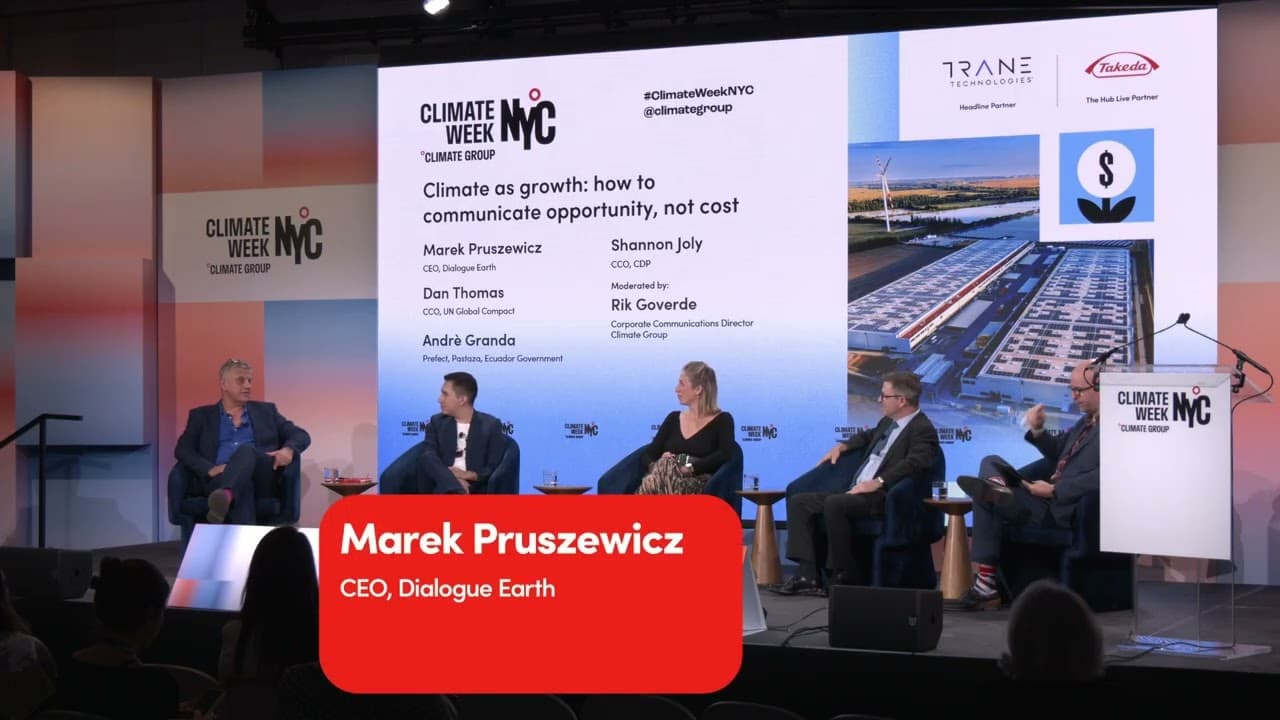
At Climate Week NYC, leaders from the UN Global Compact, CDP, Dialogue Earth, and Ecuador's Amazon region converged on a shared diagnosis: the business case for climate action is clear, but the communication strategy remains broken. Over a wide-ranging panel, the group laid out concrete frameworks — from reframed corporate data to indigenous consent-based finance — for making climate investment feel like opportunity rather than obligation.
- UN Global Compact, CDP, and Dialogue Earth leaders call for scrapping risk-and-compliance climate messaging in favor of opportunity framing
- Ecuador's Pastaza governor details trust fund model giving indigenous communities a vote — not just a voice — on territorial decisions
- Former BBC journalist warns that rebutting climate misinformation is "worse than useless" and only strengthens opponents' framing
- CDP links environmental performance to market cap outperformance in annual "Corporate Health Check" presented at World Economic Forum
- Dialogue Earth launches first communications campaign: "never more urgent, never more possible"
The Language Gap: Why Climate Communication Is Failing
The basics: The panel, moderated by Rick Goverde, Director, Climate Group, brought together four leaders with distinct vantage points on how the climate conversation reaches — or fails to reach — the audiences that matter most.
Why it matters: Despite growing scientific consensus and expanding corporate commitments, climate communicators have struggled to move beyond alarm and compliance language. Panelists argued this failure has real consequences, allowing misinformation to fill the vacuum and leaving potential allies — CFOs, mayors, indigenous leaders — without a narrative they can use.
Where things stand: Dan Thomas, Chief Communications Officer, UN Global Compact, framed the core problem bluntly: "The language around climate action and change has lagged behind the language around the risk of what happens if we don't change." His organization works with 25,000 companies globally and tries to help them frame sustainability as progress rather than obligation — "finding new ways of doing business, driving climate action as a business strategy."
Thomas argued that effective climate messaging must meet people where they are: "CEOs are thinking about the value to their business that they can drive. Investors are thinking about future markets and value creation. Employees are thinking about their jobs and whether they'll have a job. And families are thinking about their bills and the electricity bill and the community and flooding in their neighborhood."
Shannon Jolie, Chief Marketing Communications Officer, CDP, echoed the need for precision, arguing that "segmentation of our audiences is so important if we're looking to drive outcomes because we can narrow it down to a very tangible audience that speaks in their terms, in their languages."
Marek Przywicz, CEO, Dialogue Earth, was the most emphatic about the limits of data-driven persuasion. Drawing on 20 years at BBC News, he argued that "another report with a thousand scientists' name on it saying that planet's frying to a crisp is not going to change anybody's mind." Even corporate decision-makers, he said, are more susceptible to narrative than spreadsheets — challenging the room to name "the spreadsheet they filled out before they got married or chose a life partner or had children."
From Amazon to Boardroom: Pastaza's Consent-Based Climate Finance Model
Why it matters: While much of the climate conversation focuses on corporate commitments and national policy, Governor Andrés Granda of Pastaza Province, Ecuador, offered a ground-level case study in how subnational governments can structure climate investment around community consent — a model with potential replicability across the Global South.
Where things stand: Pastaza, Ecuador's largest province with 2.9 million hectares of Amazon rainforest and seven of the country's fourteen indigenous nationalities, has taken a distinctive approach. Granda described creating a local ordinance that gives indigenous communities not only voice but vote in territorial decisions. He reframed the familiar Amazon-versus-development debate: "The choice is not between Amazon and development, but it's a choice between one development that cuts down the forest and one development that pays the people that protect the forest."
The province is now building financial infrastructure to match. Granda described a trust fund — a "fideicomiso" — being created among three provinces (Pastaza, Morona, and Zamora), four indigenous nationalities, and the international organization NCI. The fund is designed to channel climate finance with community consent, ensuring that conservation generates revenue for the communities doing the conserving. Tourism was cited as a concrete economic alternative.
On the communication challenge, Granda noted that indigenous communities resist technical planetary language. When they hear about 1.5 or 2.5 degrees, he said, they disengage — they want to understand why keeping their forest protected matters to them directly.
What's next: Granda described a youth leadership school in Pastaza aimed at cultivating the next generation of climate champions and stressed urgency: "There is not so much time. We have a lot of opportunities but we don't have so much time."
The Disclosure Dividend: CDP's Data Reframe
Why it matters: One of the panel's most concrete takeaways was CDP's strategy for converting environmental disclosure data into a narrative that resonates in boardrooms and at investor conferences.
Where things stand: Jolie explained that CDP shifted its analytical lens after a corporate discloser asked for help making the business case to their CFO. Rather than leading with the quantification of risk across global disclosures — "quite a scary number" — CDP began tracking how much identified environmental opportunity was actually realized in a given year versus projected for the future. The result is an annual "Corporate Health Check" report, presented at the World Economic Forum, that correlates companies' environmental performance with market cap outperformance.
Jolie called this the "disclosure dividend" — the aggregate benefits that flow from the disclosure process itself. In a fragmented information environment, she argued, CDP's annual disclosure cycle provides stability: "The resources that we have, the energy that we put into a counterargument takes away from what you're trying to enable, which is, in our case, making sure that this data exists in the world so that we can have better informed decisions."
Don't Fight on Their Turf: The Case Against Rebutting Misinformation
Why it matters: With misinformation campaigns targeting EVs, renewables, and climate policy globally, the strategic choice between direct rebuttal and positive reframing has immediate implications for how advocacy organizations allocate resources.
Where things stand: The panel's sharpest exchange centered on whether climate communicators should spend energy countering misinformation. Przywicz was unequivocal: "You absolutely do not invest your limited resources fighting on somebody else's turf. It's actually worse than useless because all you do is reinforce the very frame you are trying to challenge. It's called frame negation."
He pointed to political slogans as examples of effective positive framing: "Make America Great Again is an absolutely classic example of that. So is Take Back Control. I don't like either of those, but they're brilliant at what they do." Drawing on his journalism background, Przywicz argued that winning the battle to label something — citing the UK "mansion tax" versus "home tax" debate — ultimately wins the policy argument.
The other side: Thomas agreed, warning against being "sucked into an argument that's being framed by somebody else," and advocated pivoting quickly to a positive counter-narrative. Jolie invoked Michelle Obama's principle of going high, arguing that counterarguments drain resources from enabling positive outcomes.
No panelist argued in favor of direct rebuttal as a primary strategy.
Closing Calls: Positive Honesty, Speed, and Possibility
Each panelist offered a final takeaway. Thomas advocated "positive honesty" — "Honesty about the challenge, but positivity about the opportunity that we have to get out of the situation we're in." Jolie urged the audience "to look at this challenge as the greatest opportunity of our lifetime." Granda called for faster action from the Global South. Przywicz announced that Dialogue Earth had just launched its first communications campaign with the slogan "never more urgent, never more possible."
Goverde summarized the panel's consensus: use data but change the narrative around it, "don't step in the framing of others. Stick to your own framing and start repeating that."
- Audience Q&A: Abhishek of the Swanithi Initiative, which works with elected parliamentarians across the Global South, asked how to create more political climate champions among legislators who face competing priorities. Granda responded by emphasizing urgency, personal motivation, and the youth leadership programs underway in Pastaza.