
Green Steel and Cement Fall Far Short of Climate Targets as Leaders Sound the Alarm
Climate Week NYC • United NationsSeptember 25, 2026
Locunity is an independent informational service and is not an official government page for this commission. All information is sourced from public footage and an analysis of official agendas with the aid of responsible, fact-checked AI. to report an error or omission.
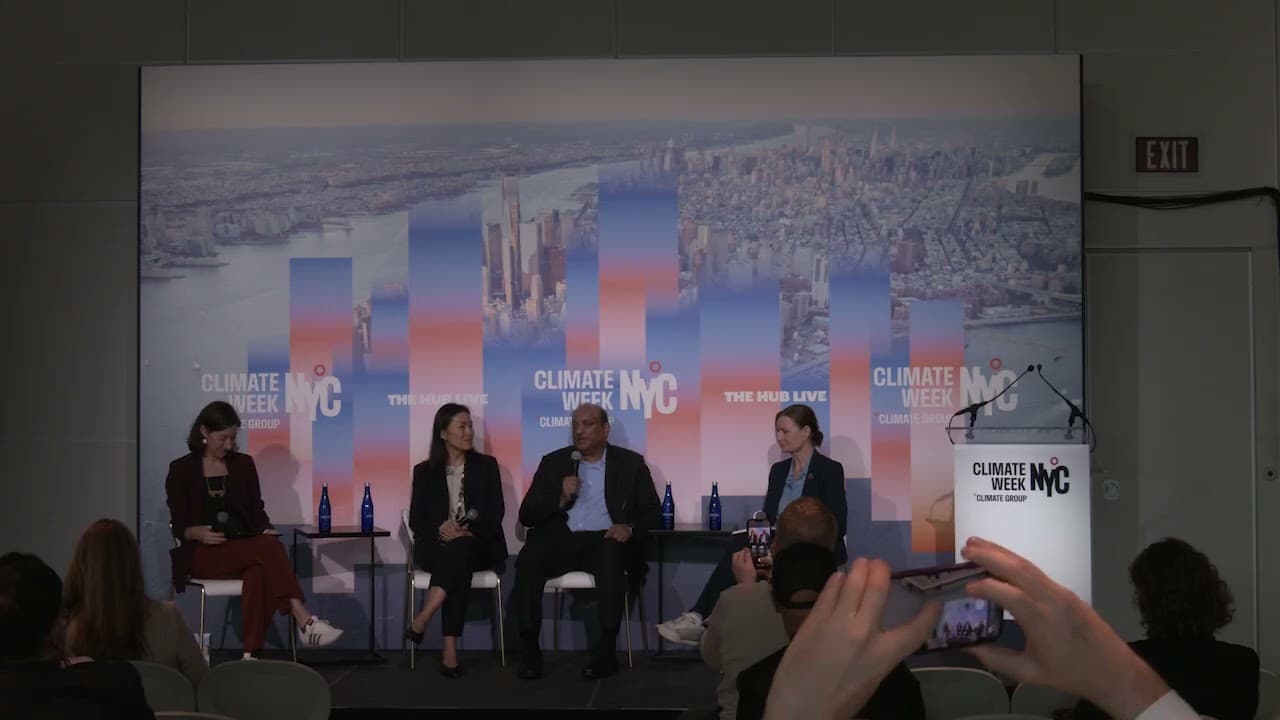
A Climate Week NYC panel laid bare the gulf between green steel and cement production and what the planet actually needs, with experts from four continents converging on one message: government procurement specifications — not new technology — are the fastest lever available to close the gap.
- Green steel pipeline delivers at most 50 million tonnes annually — climate targets demand 150 million
- Only $20 billion of the $200–$500 billion needed for steel decarbonization has been committed
- New York State sets emissions limits on concrete by compressive strength under Buy Clean law
- Kenya reaches 85% blended cement market share after replacing 1966 colonial building code
- Global coalition launches Blend Better Cement campaign to scale proven 50% emissions cuts
- Responsible Steel builds interoperability bridges between competing national green steel standards in China, Germany, India and Korea
The 'Wild West' of Green Steel Claims Meets a Global Standards Push
Why it matters: Steel and concrete together account for roughly 15% of global CO₂ emissions — and they are the physical backbone of the clean energy transition itself. Without a shared vocabulary for what "green" means, the trillions of dollars needed to decarbonize these industries cannot flow.
Where things stand: Shivakumar Kupaswamy, Policy and Transition Finance Lead at Responsible Steel, painted a stark picture of the current landscape. "It's kind of the Wild West now. There's a lot of claims being made about a product, about the greenness of a product. There's a desire to color-code materials, color-code gas, color-code everything else, but what's the definition when we say something is green?" he said.
Responsible Steel, whose membership represents about 250 million tonnes of annual steel production — roughly 15% of global output — is attempting to answer that question through a certification system and a broader interoperability effort. The Steel Standards Principle, launched at COP28 under World Trade Organization governance, is now building bridges between competing national frameworks. "We're now building a bridge between the Chinese standard, between the German standard — it's called LESS, Low Emission Steel Standard — and we are in discussions with India, and now Korea launched a standard last month," Kupaswamy said.
The standard goes beyond carbon. "Our standard has got 13 principles, and of which just one principle is about carbon. The rest is all about the social aspects," Kupaswamy noted, a reference to the roughly 250,000 workers across the organization's member facilities.
Moderator Betty Kremens, Advisor at UNIDO's Industrial Deep Decarbonization Initiative, underscored a related problem: environmental product declarations, or EPDs — the documents that quantify a material's environmental impact — are themselves not harmonized across borders. "I'm learning an EPD is not an EPD. There's a European EPD and an American EPD, and then there's other countries that don't have access to the underlying data to even be able to create EPDs," she said.
What's next: The interoperability work continues through WTO governance channels, with India and Korea as the newest participants. For manufacturers, the practical implication is that a single Responsible Steel certification could eventually satisfy multiple national procurement requirements — reducing compliance costs and enabling cross-border trade in verified low-carbon steel.
New York State Puts Procurement Muscle Behind Low-Carbon Concrete
The basics: "Buy clean" policies use the government's purchasing power — rather than new legislation — to set emissions standards for construction materials. In the U.S., governments collectively buy about 49% of concrete and about 25% of structural steel.
Why it matters: When a state as large as New York changes its procurement specifications, suppliers across the region must adapt or lose access to a major customer. The policy sends a market signal that ripples well beyond state-funded projects.
Where things stand: Maryann Jiang, Embodied Carbon Policy Lead at the New York State Office of General Services, described a two-track strategy. The first is Executive Order 22, "Leading by Example," issued in September 2022, which mandates state agencies to collect data and develop strategies to reduce embodied carbon across construction projects. The second is the Buy Clean Concrete initiative, grounded in state finance law.
"We came up with what is our definition of low-carbon concrete, and that included a table that essentially sets emissions limits for concrete by compressive strength that the state is able to procure," Jiang said. An interagency working group of about a dozen design and construction agencies has updated material specifications to incorporate the new limits.
The state hopes to extend the approach to steel. Jiang credited three stakeholder groups for making the work possible: industry partners who provide feedback during guideline development; nonprofits including Carbon Leadership Forum, RMI and NRDC; and peer states. "Those partners really help us in terms of pushing for more progress, ensuring that states are learning from each other," she said, citing California, Washington and Massachusetts as collaborators.
Asked what would most accelerate progress, Jiang pointed not to more demand but to awareness. "The one thing that would help us a lot in scaling this is just more general awareness about the topic," she said, noting the need for contractors and producers across the construction value chain to understand EPDs and lower-carbon sourcing.
The Numbers Don't Lie: Green Steel Is Falling Far Short
Why it matters: The gap between what the climate requires and what the steel industry is actually delivering threatens the entire clean energy transition — the wind turbines, transmission lines and seawalls that depend on steel cannot be built with conventional carbon-intensive product and still meet emissions targets.
Where things stand: Kupaswamy put hard numbers on the problem. "If you want to be aligned with climate targets, you need to be producing at least about 150 million tonnes of steel a year. But when you look at what's actually in production right now or in the pipeline right now, that number is falling short by a big number," he said, estimating current capacity at 20 to 50 million tonnes. Capital requirements range from $200 billion to $500 billion depending on the estimate, but only about $20 billion has been committed.
He identified insufficient demand as the central barrier and called on governments to act. "They need to make it a priority to buy low embodied carbon steel on their project, period. That's where the transformation can happen," he said.
The demand side: Sophie Runia Cederberg, Sustainability Lead at SKF, the Swedish bearing and industrial components manufacturer, reinforced the point from a corporate buyer's perspective. SKF faces an outsized exposure: "70% of our emissions in supply chain sits in steel. So we need to do something about it. And we need to make others move as well," she said.
The company collects supplier-specific emissions data quarterly from all steel suppliers. "We have supplier-specific data from all our steel suppliers and steel component suppliers. And we're expanding that more and more to other categories, but definitely for steel, because we really realize this is where we need to start," Runia Cederberg said.
SKF has proven the technology works. "We have done a pilot with a supplier a few years ago using hydrogen-based direct reduced iron. So we can do it, but it was a pilot. It was a small, you know, it was more of a symbol that, yes, we can do this," she said. The challenge is getting from pilot to mainstream. "I would like to see bearing steel at least become a mainstream product, not a niche premium low carbon, but mainstream should be easy to source low carbon bearing steel," Runia Cederberg said. She credited the automotive industry for previously driving demand but noted it has had setbacks.
Kremens framed the scale of the government opportunity: "Here in the US, governments, national and subnational governments, buy about 49% of the concrete and about 25% of the structural steel. So that's a pretty good percent of the market, but still not the whole thing."
Blend Better: A 100-Year-Old Technology Gets a Global Campaign
The basics: Blended cement replaces a portion of clinker — the calcium-rich powder made by burning limestone at 1,400°C — with alternative binders such as calcined clay, blast furnace slag, fly ash or volcanic ash. The substitution can cut emissions by roughly 50%, and the technology has been used commercially for more than a century.
Why it matters: Two-thirds of cement's emissions come not from energy use but from the chemical process of burning limestone itself. That means efficiency improvements alone cannot solve the problem — clinker reduction through blending is essential.
Where things stand: Walter Vink, Cement/Concrete Decarbonization Lead at Systemiq, explained the emissions challenge. "When we're burning the clinker or when we're burning the limestone, it goes at 1,400 degrees. So that's a lot of energy. But also at that point, CO₂ emissions are emitted from the process, which is actually two-thirds. So one-third is the energy, two-thirds is the CO₂," he said.
Vink announced the Blend Better Cement campaign, a partnership between UNEP, Global ABC, GCCA, the Breakthrough Cement and Concrete Agenda, the LC3 research institute, and Climate Group's Concrete Zero initiative. The campaign aims to raise awareness and drive adoption globally. He flagged procurement specifications as a critical barrier: "If you specify for the original Portland cement only in your products, then that obviously disqualifies certain blends."
His pitch was direct: "Why I'm excited is because we can scale it today. We have the experience today. We know that we can feel safe around its use, and it allows us to cut emissions with 50%. And we clearly need to cut emissions very fast."
He highlighted calcined clay-based blends as particularly promising for countries that lack limestone deposits but have abundant clay resources, enabling local supply chains and decentralized job creation.
Kenya: Proof That Blended Cement Can Reshape a National Market
Why it matters: Kenya's experience demonstrates that a developing nation can simultaneously cut construction emissions, reduce import dependence, create local green jobs and attract investment — all through blended cement adoption driven by government policy.
Where things stand: Ruth Ankari, Climate-responsive Construction Policy Advisor for the Government of Kenya, delivered perhaps the session's most concrete case study. "I'd like to refer to a recent market survey that placed around 85% of cement that is used in Kenya to be blended cement," she said.
Kenya's updated nationally determined contribution, submitted in April 2025, targets 35% overall emissions reduction by 2035, with the building sector contributing about 32%. The government's decarbonization roadmap aims for net-zero carbon in new construction and 67% operational emissions reduction by 2040.
A critical enabler was regulatory reform. "We used to have our colonial building code for over 60 — since 1966. And it was enacted recently in 2024, and it was a prescriptive building code where we were just specifying, for example, CEM 132.5 in the tender documents. But now we have a performance-based building code which allows us to adopt more building materials," Ankari said.
The shift has economic as well as environmental logic. "If we turn towards the SCMs that are available locally in Kenya and strengthen their supply chains, then it means we are able to cushion our local industry from global shocks in terms of forex fluctuations," she said, referring to supplementary cementitious materials like volcanic ash and calcined clay that can replace imported clinker.
Kenya is putting the approach to work in high-profile infrastructure. "We have this cement we call Duracem, which was used, I think, in Burj Khalifa. But then now in Kenya, we are using it in a stadium that we are building for the next African Games," Ankari said. The country's affordable housing project, targeting a 250,000-unit annual deficit, is certified under IFC EDGE and requires 20% lower embodied carbon.
Her call to action was clear: "We need to code this blended cement into our codes, and that will drive a lot of change and adoption in various markets and countries."
What's next: Kenya's experience is being positioned as a model for East Africa and other developing regions. The combination of performance-based codes, local material supply chains and government demand aggregation offers a replicable playbook — one that the Blend Better Cement campaign aims to spread globally.